


Don't know what to do ?
Get Free Counseling
Last Updated 14 August 2026
Singapore Job Market in 2026–30
- Strong demand for skilled professionals across IT, finance, healthcare, engineering, and biotech
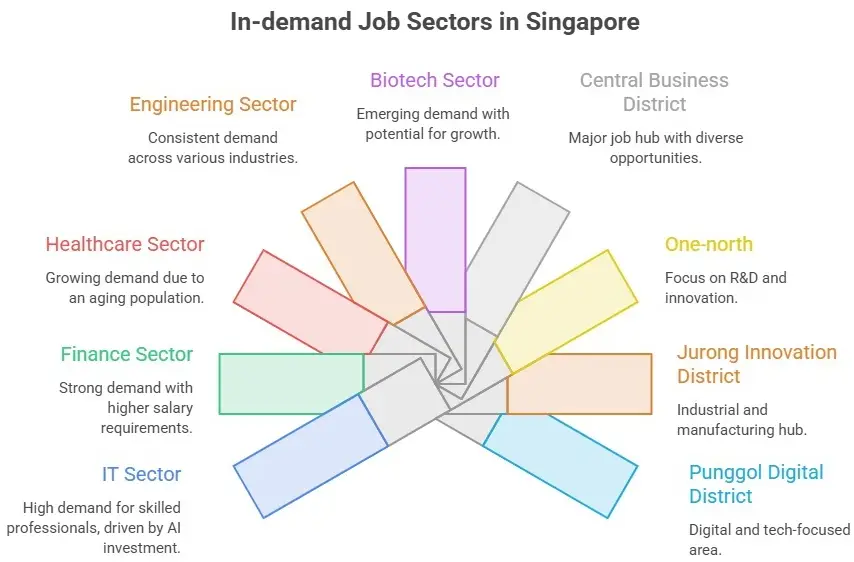
- Central Business District, one-north, Jurong Innovation District, and Punggol Digital District remain the top job hubs
- Singapore's GDP grew by 5.0% in 2025, and the 2026 growth forecast was upgraded to 4.5%–5.5% in August 2026, driven by an AI-led investment boom (Ministry of Trade and Industry)
- Unemployment stood at approximately 2.0% in early 2026, with around 78,800 job vacancies and 146 openings for every 100 jobseekers (Ministry of Manpower)
- Employment Pass holders need a minimum salary of SGD 5,600/month (SGD 6,200 in financial services) with no quota, while S Pass holders need at least SGD 3,300/month and are subject to sector-based quotas
Job Outlook in Singapore: Understanding the job market for job seekers and employers
Singapore continues to be one of Asia's strongest and most stable job markets, powered by its open economy, business-friendly policies, and world-class infrastructure. Key hubs such as the Central Business District, one-north, Jurong Innovation District, and Punggol Digital District serve as major employment centres, especially in finance, IT, biotech, engineering, and advanced manufacturing.
Singapore's economy expanded strongly in 2025, and the 2026 GDP growth forecast was raised sharply in August 2026 on the back of AI-related investment and strong electronics exports. This growth continues to support high demand for skilled international talent across multiple sectors.
*Want to work in Singapore? Let Y-Axis guide you with the process.
General Employment Trends for the Year 2026-30
Employment opportunities in Singapore closely track demand for specialised skills in finance, technology, healthcare, and engineering. Singapore's ageing population and growing focus on digitalisation, sustainability, and advanced manufacturing continue to create fresh opportunities for skilled international professionals.
Singapore's overall unemployment rate stood at approximately 2.0% in the first quarter of 2026 (Ministry of Manpower), one of the lowest rates globally. At the same time, around 78,800 job vacancies were recorded, with 146 vacancies for every 100 jobseekers — a labour market shaped by a shortage of specialised skills rather than a shortage of jobs.
Factors Influencing Job Demand in Singapore
Singapore's export-driven, AI-powered economy continues to generate strong demand for skilled professionals in technology, finance, and healthcare.
Following are the factors that influence job opportunities in Singapore:
- AI-driven growth and semiconductor and electronics exports
- Government initiatives under the Singapore Green Plan and Smart Nation strategy
- Investment in fintech, biotech, and advanced manufacturing clusters
- COMPASS points-based framework shaping Employment Pass approvals
- Global market conditions, trade policies, and automation
In-Demand Industries and Occupations in Singapore
Some of the most in-demand jobs in Singapore, along with their average annual salaries, are listed below. These sectors continue to hire skilled foreign professionals due to talent shortages and strong economic growth.
| Occupation | Average Salary per Year (SGD) |
|---|---|
| Information Technology (IT) & Software | SGD 96,000 |
| Banking & Finance | SGD 110,000 |
| Data Science & AI | SGD 120,000 |
| Healthcare & Life Sciences | SGD 100,000 |
| Engineering | SGD 85,000 |
| Marketing & Sales | SGD 75,000 |
| Education | SGD 70,000 |
| Hospitality | SGD 60,000 |
| Manufacturing & Skilled Trades | SGD 55,000 |
Read more…
Highest Paying Jobs in Singapore for Indians
Workforce Demands in Different Regions of Singapore
Understanding regional labour-market needs helps job seekers identify the best areas in Singapore for employment and career growth.
The Central Business District and Marina Bay lead in finance, banking, and professional services. One-north is Singapore's biotech and technology hub, home to major research institutes and tech firms including Grab. Jurong Innovation District drives advanced manufacturing, robotics, and clean energy. Punggol Digital District, expected to be fully operational in 2026, is projected to bring around 28,000 jobs in cybersecurity, AI, and smart-city technology, with anchor tenants including UOB, OCBC, and the Cyber Security Agency of Singapore.
Details of the workforce demands and job opportunities across Singapore's major regions and economic hubs are given below:
| Region | Key Sectors | Average Annual Salary (SGD) |
|---|---|---|
| Central Business District / Marina Bay | Banking, finance, professional services | SGD 110,000 |
| One-North | Biotech, IT, research, technology start-ups | SGD 105,000 |
| Jurong Innovation District | Advanced manufacturing, robotics, clean energy | SGD 90,000 |
| Punggol Digital District | Cybersecurity, AI, fintech, smart-city tech | SGD 95,000 |
| Woodlands / North Region | Healthcare, logistics, agri-tech | SGD 75,000 |
| Tuas / Jurong Island | Petrochemicals, process engineering | SGD 85,000 |
Note: Punggol Digital District is one of Singapore's most closely watched growth corridors — a 50-hectare smart district set to bring around 28,000 tech and cybersecurity jobs closer to residents in the North-East, integrated with the Singapore Institute of Technology.
Impact of Technology and Automation in Singapore
Singapore's job market is being reshaped by rapid advances in AI, automation, robotics, and fintech. According to the Ministry of Manpower, firms are three times more likely to redesign jobs around AI than to cut headcount — meaning most roles are evolving rather than disappearing.
Industries such as IT, finance, healthcare, and advanced manufacturing rely heavily on digital transformation, pushing employers to seek talent with strong technical and analytical capabilities. As automation expands, workers who continuously build digital skills remain best positioned for long-term employability.
Skills In-Demand in Singapore
Singapore's fintech and cybersecurity clusters, particularly around Punggol Digital District and one-north, continue to report a shortage of specialised professionals, keeping salaries in these fields well above the national median.
Employers in Singapore look for the following in-demand skills among foreign professionals:
- Artificial intelligence, machine learning, and data science
- Cybersecurity and cloud computing
- Software development and fintech engineering
- Digital marketing and e-commerce
- Project management and leadership
- Financial analysis and risk management
- Healthcare and biomedical sciences
- Sustainability and green-technology skills
- Communication and multilingual proficiency (English plus Mandarin, Malay, or Tamil)
- Adaptability, problem-solving, and critical thinking
Importance of Upskilling or Reskilling for Job Seekers Migrating to Singapore
Upskilling and reskilling are essential for staying competitive in Singapore's fast-evolving job market. As the economy embraces AI, automation, and digital transformation, professionals who continuously update their skills improve their job security and long-term career prospects.
*Want to apply for jobs in Singapore? Avail Y-Axis Resume Marketing services to find the right one.
Remote Work and Flexible Arrangements in Singapore
Remote and hybrid work continue to grow in Singapore as employers seek to attract and retain top talent, particularly in IT, finance, and consulting. While Singapore does not offer a standalone Digital Nomad Visa, foreign professionals working remotely for a Singapore-based employer must still hold an appropriate work pass, such as the Employment Pass or S Pass, since long-term remote work is not permitted on a tourist visa.
Many companies in Singapore now offer hybrid arrangements, giving employees more control over their schedules while helping employers access a wider, more diverse talent pool across the region.
Singapore Government Policies and Initiatives for Foreign Workers
Singapore's immigration and labour policies are designed to maintain a highly skilled workforce while addressing talent shortages in priority sectors such as IT, finance, healthcare, and advanced manufacturing. The Ministry of Manpower (MOM) oversees a structured work-pass framework, allowing employers to hire qualified foreign professionals when local talent is not readily available.
Non-EP roles are also supported through SkillsFuture initiatives, which fund training and reskilling for both citizens and eligible foreign professionals working in Singapore. The government continues to refine its Employment Pass framework through the COMPASS points system, which assesses candidates on salary, qualifications, workforce diversity, and support for local hiring.
Singapore Work Pass Types for Indian Professionals
Non-citizens, including Indian professionals, must generally have a job offer from a Singapore-registered employer before applying for a work pass. The employer submits the application to the Ministry of Manpower (MOM). Singapore offers several main pass types relevant to Indian job seekers:
| Pass | Description | Minimum Salary | Key Condition |
|---|---|---|---|
| Employment Pass (EP) | For professionals, managers, and executives | SGD 5,600/month (SGD 6,200 in financial services), rising with age | Must also clear the COMPASS points framework; no quota |
| S Pass | For mid-skilled professionals and technicians | SGD 3,300/month and above | Subject to sector-based quota (10% services, 15% manufacturing/construction); monthly levy applies |
| Overseas Networks & Expertise Pass (ONE Pass) | For top-tier global talent and business leaders | SGD 30,000/month or equivalent past earnings | 5-year validity; spouse can work; no employer sponsorship needed |
| EntrePass | For foreign entrepreneurs starting an innovative business | No fixed minimum; innovation and funding criteria apply | Must hold a significant equity stake in the business |
For Indian nationals, the Employment Pass is the most common route for professional roles. Employers are advised to plan applications early, since COMPASS scoring and salary benchmarks are reviewed periodically by MOM.
Challenges and Opportunities for Job Seekers in Singapore
Job seekers aiming to work in Singapore may encounter specific challenges, but with the right strategies, they can successfully navigate the market.
- Rising Employment Pass salary thresholds and the COMPASS points requirement
- High competition in top industries such as finance, IT, and consulting
- Sector-based quotas and levies applicable to S Pass holders
- Preference for candidates with regional or Singapore-specific experience
- Differences in workplace culture and communication style
Despite low unemployment, several job families in Singapore face persistent shortages, including healthcare and eldercare, cybersecurity, engineering, and sustainability-related roles. Skilled professionals in these areas generally face lower competition and a stronger case for employer sponsorship of a work pass.
Tips and Strategies for Navigating the Singapore Job Market Successfully
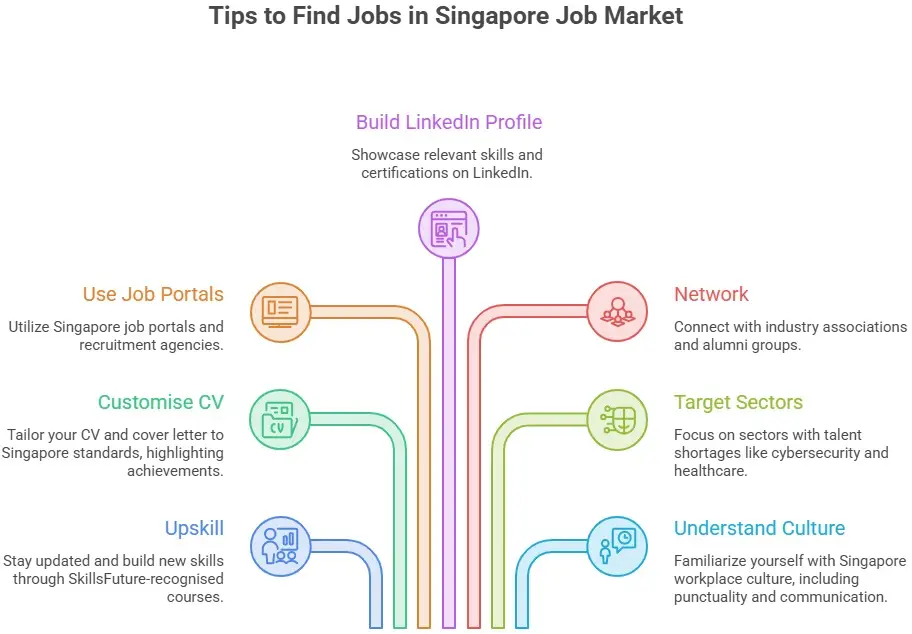
- Stay updated and build new skills through SkillsFuture-recognised courses and certifications
- Customise your CV and cover letter to Singapore standards, highlighting measurable achievements
- Use Singapore job portals such as MyCareersFuture, recruitment agencies, and company career pages
- Build a strong LinkedIn profile showcasing relevant skills and certifications
- Network through industry associations, alumni groups, and professional events
- Target sectors facing genuine talent shortages, such as cybersecurity, healthcare, and sustainability
- Understand Singapore workplace culture, including punctuality, hierarchy, and clear communication
Summary of Singapore Job Outlook
Singapore's job outlook remains strong, driven by an AI-powered economy, advanced industries, and continuous demand for skilled professionals. Key areas of growth include technology, finance, healthcare, biotech, and advanced manufacturing.
The technology and fintech sectors continue to expand rapidly, increasing demand for AI engineers, cybersecurity specialists, and data scientists. Healthcare and life sciences remain major employers, supported by Singapore's ageing population and strong biomedical research ecosystem.
Overall, Singapore remains one of Asia's most attractive destinations for skilled job seekers, offering competitive salaries, safety, and long-term career growth.
*Planning to work in Singapore? Contact Y-Axis, the world's No. 1 overseas immigration consultancy, for end-to-end support.
Y-Axis snapshot
1M
Successful applicants
1500+
Experienced counselors
25Y+
Expertise
50+
Offices
Don't know what to do ?
Get Free Counseling
Looking for Inspiration
Explore what Global Indians have to say about Y-Axis in shaping their future