


Posted on September 25 2026
Australia Replaces Ministerial Direction 119: Is It Getting Easier for Skilled Professionals?

By , Editor & Director
Updated September 25 2026
Highlights: Australia Replaces MD 119 With New Skilled Visa Priorities: What Has Changed?
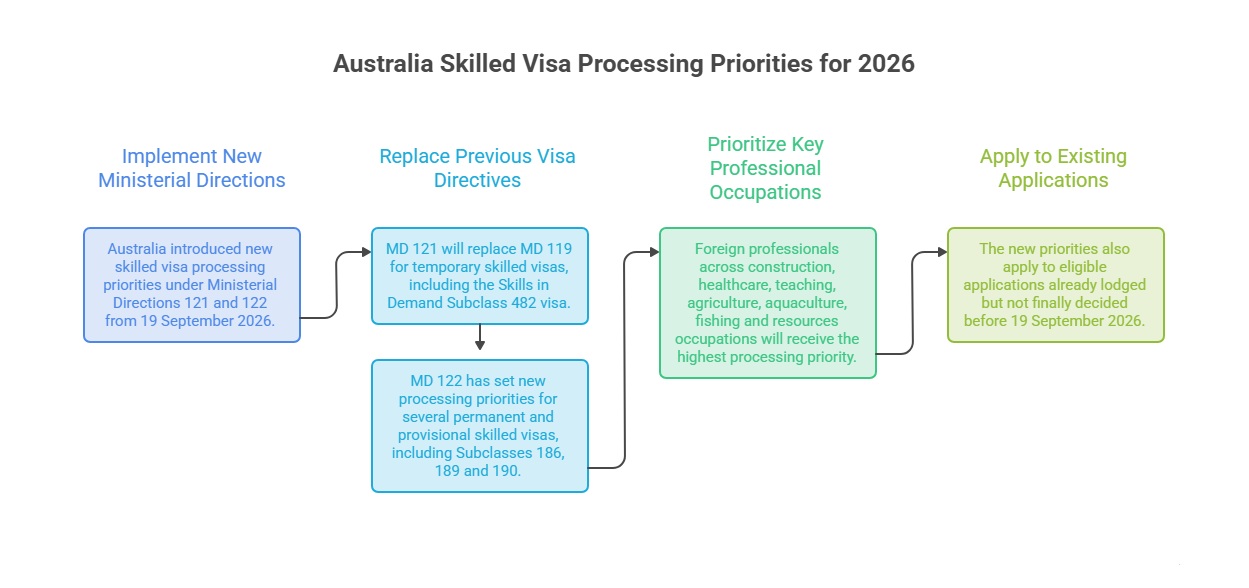
- Yes, Australia has introduced new skilled visa processing priorities under Ministerial Directions 121 and 122 from 19 September 2026.
- MD 121 will replace MD 119 for temporary skilled visas, including the Skills in Demand Subclass 482 visa.
- MD 122 has set new processing priorities for several permanent and provisional skilled visas, including Subclasses 186, 189 and 190.
- Foreign professionals across construction, healthcare, teaching, agriculture, aquaculture, fishing and resources occupations will receive the highest processing priority.
- The new priorities also apply to eligible applications already lodged but not finally decided before 19 September 2026.
*Interested to work in Australia? Let Y-Axis guide you with the process.
Australia Replaces MD 119 With New Skilled Visa Processing Priorities Under MD 121 and MD 122
Australia has officially revised priority framework for certain skilled visa applications, with Ministerial Directions 121 and 122 coming into effect on 19 September 2026. The two new directions replace the processing priorities previously set under Ministerial Direction 119.
The priority-based system in Australia itself continues, but the order and categories have been rearranged. MD 121 covers temporary skilled visas, while MD 122 covers specified permanent and provisional skilled visas. The new directions determine how applications are prioritised for processing and do not change the underlying visa eligibility requirements.
MD 121 Sets Priorities for Temporary Skilled Visas
Ministerial Direction 121 applies to Subclass 482 Skills in Demand visa applications, including relevant remaining Temporary Skill Shortage applications. Applications connected with priority occupations and sectors are placed first, followed by Specialist Skills stream applications, onshore applicants and specified offshore applicants.
MD 122 Covers Permanent and Provisional Skilled Visas
Ministerial Direction 122 applies to Subclasses 186, Subclass 187, Subclass 189, Subclass 190, Subclass 191, Subclass 489, Subclass 491, Subclass 494, Subclass 887 and Subclass 888. Priority is first given to applications relating to specified priority sectors, followed by applicants who were in Australia when they lodged their applications and certain offshore applicants.
The table highlights the new skilled visa processing priority order:
|
Priority |
MD 121 – Temporary Skilled Visas |
MD 122 – Permanent & Provisional Skilled Visas |
|
1 |
Construction, healthcare, teaching, agriculture, aquaculture, fishing, resources, law enforcement and defence interests |
Construction, healthcare, teaching, agriculture, aquaculture, fishing, resources, law enforcement and defence interests |
|
2 |
Specialist Skills stream |
Applicants in Australia at lodgement |
|
3 |
Applicants in Australia at lodgement |
Certain offshore applicants who lodged independently |
|
4 |
Certain offshore applicants who lodged independently |
Other applications |
|
5 |
Other applications |
— |
Note: The priority order determines the sequence in which applications are considered; it does not guarantee faster processing or visa approval.
Read more...
Australia Updates Skilled Visa Processing Priorities for 2026. Check Your Eligibility!
Priority Occupations Under the New Framework in Australia
The first priority category includes foreign professionals from specified occupations connected with construction, healthcare, resources and teaching, among other sectors applying for Australia permanent residence (PR). The Department's framework uses defined occupation groups and codes rather than automatically covering every job within an industry.
Key occupation groups include:
- Construction: Construction Trades Workers, Construction and Mining Labourers, Construction Managers, Engineering Managers, Architects, Civil Engineering Professionals, Electricians and other specified construction-related occupations.
- Healthcare: Health Professionals, Health and Welfare Support Workers, Medical Scientists, Counsellors, Psychologists, Social Workers, Medical Technicians, Aged or Disabled Carers, Nursing Support Workers and Personal Care Assistants.
- Resources: Mining Engineers, Geologists, Geophysicists and Hydrogeologists, Drillers, Miners and Shot Firers, Production Managers (Mining), Surveyors, Metallurgists and specified fitters and machinists.
- Teaching: School Teachers, Child Care Centre Managers, School Principals, Faculty Heads, University Lecturers, Vocational Education Teachers and Child Care Workers.
Note: The new directions apply not only to applications lodged from 19 September 2026, but also to eligible applications that were already lodged and had not been finally determined on that date. These applications are therefore re-ordered under the new processing priorities.
Also, read...
How Australia’s Revised Priority Framework Affect Foreign Professionals
The revised Australian skilled visa processing framework provides greater clarity on which occupations and applicant categories receive processing priority. Foreign skilled professionals working in the specified priority occupations may benefit from being placed in the highest processing category, while eligible applicants in other categories can understand how their location and visa stream affect processing order.
- Priority for key occupations: Professionals working in eligible construction, healthcare, teaching and resources occupations can fall within the highest priority category.
- Specialist Skills pathway: Eligible Subclass 482 applicants in the Specialist Skills stream receive a separate priority under MD 121.
- Greater clarity for applicants: The new framework clearly separates temporary skilled visa priorities from permanent and provisional skilled visa priorities.
- Onshore applicants: Eligible applicants who were in Australia when they lodged their applications receive priority over certain offshore applications under the relevant directions.
- Existing applications included: Foreign applicants with eligible applications already in the queue may also have their processing order reassessed under the new framework.
- Multiple skilled visa pathways covered: The changes apply across Subclass 482 and several permanent and provisional skilled visa categories, including 186, 189 and 190.
*Are you looking for a step-by-step with Australian Immigration? Contact Y-Axis, the world’s No. 1 abroad immigration consultancy, for end-to-end support! For more updates on Australia, check out Y-Axis Australia Immigration Updates!
FAQs
What are Australia’s new Ministerial Directions 121 and 122?
Ministerial Directions 121 and 122 are Australia’s updated skilled visa processing priority directions, which replaced the previous framework under Ministerial Direction 119 from 19 September 2026. MD 121 applies to certain temporary skilled visas, including Subclass 482, while MD 122 covers several permanent and provisional skilled visas. The directions change the order in which eligible applications are processed based on specified priority categories.
What happened to Australia’s Ministerial Direction 119?
Ministerial Direction 119 has been replaced by Ministerial Directions 121 and 122. Australia has retained its priority-based approach to processing skilled visa applications, but the order and categories have been rearranged. The new directions apply from 19 September 2026 and also affect eligible applications that were already lodged but had not received a final decision when the new directions took effect.
Which visas are covered by MD 121?
MD 121 applies to certain temporary skilled visa applications, including the Subclass 482 Skills in Demand visa. Under the revised priority framework, applications associated with specified priority sectors are processed first, followed by eligible Specialist Skills stream applications, applicants who were in Australia when they lodged their application, certain offshore applicants and other applications.
Which visas are covered by MD 122?
MD 122 applies to several permanent and provisional skilled visa subclasses. These include Subclasses 186, 187, 189, 190, 191, 489, 491, 494, 887 and 888. Under the new framework, applications linked to specified priority sectors receive the highest priority, followed by eligible applicants who were in Australia when they lodged their applications and certain offshore applicants.
Which occupations receive priority under Australia’s new skilled visa rules?
The highest priority category includes specified occupations across construction, healthcare, teaching, agriculture, aquaculture, fishing and resources, along with Australia’s law enforcement and defence interests. Examples include construction managers, civil engineering professionals, electricians, health professionals, medical scientists, psychologists, social workers, mining engineers, geologists, school teachers and childcare workers.
Do the new Australian skilled visa priorities apply to existing applications?
Yes. The new processing directions are not limited to applications lodged after 19 September 2026. Eligible applications that had already been lodged but had not been finally determined when MD 121 and MD 122 commenced are also subject to the revised priority arrangements. This means existing applications can be re-ordered according to the new processing priorities.
Do MD 121 and MD 122 make Australian skilled visas easier to obtain?
The new directions change the processing order rather than the underlying eligibility requirements for the relevant visas. Applicants still need to meet the requirements of their particular visa subclass. However, professionals working in occupations included in the highest priority categories may receive priority in processing compared with applications placed in lower priority categories under the revised framework.
What is the Specialist Skills stream priority under MD 121?
Under MD 121, eligible Specialist Skills stream applications receive the second processing priority after applications connected with specified priority sectors. Applicants must meet the applicable Specialist Skills income threshold, which is AUD 146,576 according to the information provided for the new framework. This priority applies to relevant temporary skilled visa applications covered by MD 121.
How do the new priorities affect Indian skilled professionals?
Indian skilled professionals may be affected according to their occupation, visa subclass and location when the application was lodged. Those working in specified construction, healthcare, teaching, agriculture, aquaculture, fishing or resources occupations can fall within the highest priority category. Eligible applicants already in Australia at lodgement may also receive a higher processing priority under the relevant direction.
When did Australia’s new skilled visa processing priorities take effect?
Ministerial Directions 121 and 122 took effect on 19 September 2026, replacing the previous priority arrangements under MD 119. The revised framework applies to relevant applications lodged from that date as well as eligible applications already lodged and awaiting a final decision. Applicants should check the specific direction applicable to their visa subclass to understand the relevant processing priority.
Tags:
Migrate to Australia
Australia immigration
Australia permanent residence
Australia PR
work in Australia Australia
Australia work visa
Australia immigration news
Subclass 482
Australia Skills in Demand Vis
Share
Options for you by Y-Axis

Get it on your mobile

Get News alerts

Contact Y-Axis
Latest Article
Related Post
Trending Article
Posted On September 25 2026
Australia Replaces Ministerial Direction 119: Is It Getting Easier for Skilled Professionals?