


Don't know what to do ?
Get Free Counseling
Last Updated 02 November 2026
Australia Subclass 191 Visa – Permanent Residence (Skilled Regional) for 491 and 494 Holders
The Subclass 191 Permanent Residence (Skilled Regional) visa lets eligible Subclass 491 and 494 holders become permanent residents after at least 3 years in regional Australia. There is no points test, no sponsor and no minimum income amount. You need ATO Notices of Assessment for 3 income years. The Regional Provisional stream fee is AUD 630 for the main applicant.
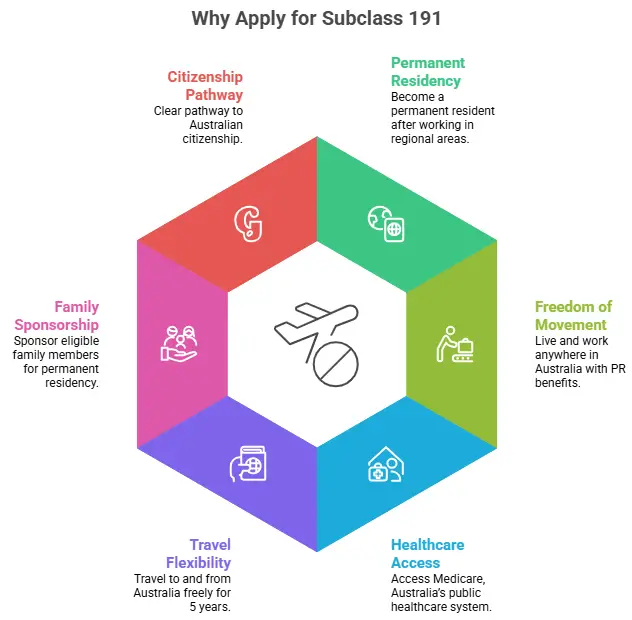
- Become a permanent resident of Australia after working in regional areas
- Live and work anywhere in Australia with PR benefits
- Access Medicare, Australia’s public healthcare system
- Travel to and from Australia freely for 5 years
- Sponsor eligible family members for permanent residency
- Pathway to Australian citizenship after 4 years of living in Australia, including at least 1 year as a permanent resident
What is the Subclass 191 Visa?
The Permanent Residence (Skilled Regional) Visa (Subclass 191) is a pathway for skilled workers who have already contributed to Australia’s regional workforce. It is designed for people who have lived, worked, and paid taxes in designated regional areas for at least three years while holding an eligible temporary regional visa.
This visa recognizes long-term employment and settlement in regional Australia and allows applicants to move from a temporary regional visa to permanent residence. Applicants must show that they have met all visa conditions, complied with Australian laws, and maintained consistent employment during their stay in regional areas.
The Subclass 191 visa does not require employer sponsorship or state nomination at the time of application. It focuses on an applicant’s work history, residence in regional areas, and income records rather than points testing.
This visa supports Australia’s goal of strengthening regional communities by encouraging skilled migrants to settle long-term after gaining regional work experience.
* Want to work in Australia? Contact Y-Axis for expert guidance
Subclass 191 Visa Streams
Regional Provisional Stream
This stream is for applicants who have lived and worked in regional Australia on an eligible provisional visa.
Key requirements:
- Must have held an eligible visa for at least 3 years
- Must have lived and worked in designated regional areas
- Must provide ATO Notices of Assessment for at least 3 income years while holding the eligible visa (no minimum income amount applies)
- No sponsor or nominator required at the time of application
- Must have followed all visa conditions while in Australia
Hong Kong Stream
This stream is for Hong Kong residents who have shown a long-term commitment to Australia.
Key requirements:
- Must hold a Hong Kong SAR passport or British National (Overseas) passport
- No sponsor or nominator required
- Must have held an eligible visa, such as a Subclass 482, 457 or 485, for at least 3 years and lived in a designated regional area during that time
- Must have Functional English or pay a second instalment of the visa application charge
- Must meet health, character, and other standard visa requirements
Eligibility for Permanent Residence (Skilled Regional) Visa Subclass 191
To be eligible for the Subclass 191 visa, applicants must:
- Hold an eligible visa such as Subclass 491 or Subclass 494
- Have lived and worked in regional Australia for at least 3 years
- Have taxable income for at least 3 income years out of the 5 years of your eligible visa, shown in ATO Notices of Assessment (there is no minimum income amount)
- Submit Notices of Assessment (NOA) from the Australian Taxation Office (ATO)
- Have complied with all conditions of their previous visa
- Meet health and character requirements
- Sign the Australian Values Statement
✅ No minimum income amount: The Regional Provisional stream has no minimum taxable income requirement. You must provide ATO Notices of Assessment for at least 3 income years out of the 5 years of your eligible visa, showing taxable income while you lived and worked in regional Australia.
Documents Required for Subclass 191 Visa Australia
- Valid passport
- Proof of holding an eligible regional visa (Subclass 491 or Subclass 494) for at least 3 years
- Australian Taxation Office (ATO) Notices of Assessment for at least 3 income years
- Evidence of living and working in designated regional areas of Australia
- Payslips or employer reference letters
- Employment contracts
- Proof of residential address in regional Australia
- Police clearance certificates from countries lived in for 12 months or more
- Health examination reports
- Relationship documents for dependents
Steps to Apply for Subclass 191 Visa
Step 1: Confirm that you have held an eligible regional visa (Subclass 491 or 494) for at least three years and have met all visa conditions.
Step 2: Ensure you have Australian Taxation Office (ATO) Notices of Assessment for at least three income years while holding your eligible visa. There is no minimum income amount, but each notice must show taxable income for that income year.
Step 3: Collect all documents such as your passport, visa details, employment records, proof of residence in regional Australia, and police clearance certificates.
Step 4: Access the Australian Government’s ImmiAccount portal to start your Subclass 191 visa application.
Step 5: Complete the Subclass 191 visa application form, upload the required documents, and submit the application online.
Step 6: If the Department of Home Affairs requests more information, health checks, or biometrics, provide them within the given timeframe.
Step 7: Once your visa is approved, you can live and work permanently anywhere in Australia as a permanent resident.
*Looking to settle in Australia permanently? Y-Axis can guide you through the entire Subclass 191 process.
Cost of Subclass 191 Visa
The cost of the Subclass 191 visa depends on the stream under which you apply. The visa application fee must be paid at the time of submitting the application. Additional charges may apply if you include family members in your application.
| Feature | Subclass 189 | Subclass 190 | Subclass 491 |
|---|---|---|---|
| Visa type | Permanent | Permanent | Provisional (5 years) |
| Nomination | Not required | State or territory nomination | State/territory nomination or eligible family sponsor |
| Nomination points | None | 5 points | 15 points |
| Location commitment | None | Live and work in the nominating state for at least 2 years | Live and work in a designated regional area |
| Pathway to PR | Already permanent | Already permanent | Subclass 191 after 3 years in a regional area |
| Competition | Usually needs higher points | Depends on state demand | Depends on state or regional demand |
Australian visa application charges are reviewed every year, and new charges usually take effect on 1 July. The charge that applies depends on the date Home Affairs receives your application. The fee is generally non-refundable. INR amounts are approximate and change with exchange rates. Check the official Home Affairs Visa Pricing Estimator before you pay.
Processing Time for Subclass 191 Visa
Home Affairs recently reported that 50% of Subclass 191 Regional Provisional stream applications were decided within 8 months and 90% within 10 months. Processing times change every month, so check the official Home Affairs Visa Processing Times guide before planning. Skilled visas are processed in a priority order set by a Ministerial Direction. However, the time taken to process the visa can vary depending on your individual case. Applications may take longer if additional documents are required, if further verification is needed, or if there is a high number of applications being processed at the time. To avoid delays, it is important to submit complete and accurate documents along with your application.
Subclass 191 vs Subclass 190 vs Subclass 189
| Feature | Subclass 191 | Subclass 190 | Subclass 189 |
|---|---|---|---|
| Who it is for | Current 491 or 494 holders after 3 years in regional Australia | New applicants with state nomination | New applicants without nomination |
| Points test | Not required | At least 65 points | At least 65 points |
| Sponsor or nomination | Not required at application | State or territory nomination | Not required |
| Location commitment | None after grant | Live and work in the nominating state for at least 2 years | None |
| Main applicant fee | AUD 630 (Regional Provisional) | AUD 6,140 | AUD 6,140 |
Note: Subclass 191 is only for people already holding an eligible 491 or 494 visa. If you are not yet in Australia, the Subclass 190 or 189 visa may suit your profile better.
Common Reasons for Subclass 191 Refusal
The reasons for Subclass 191 rejection are as follows:
- Holding the 491 or 494 visa for less than 3 years at the time of application
- Notices of Assessment that do not cover 3 income years within the eligible visa period
- Not living, working or studying in a designated regional area as required by the 491 or 494 visa conditions
- Breaching other visa conditions during the provisional period
- Not meeting health or character requirements
- Incomplete, inconsistent or unverified documents
How Can Y-Axis Help You?
Y-Axis has over 25 years of experience in Australian immigration services. We provide complete support to applicants applying for the Subclass 191 visa, including:
- Free eligibility check using the Australia Immigration Points Calculator
- Expert coaching support for PTE and IELTS exams
- Review of ATO Notices of Assessment and income eligibility
- Verification of documents proving regional work and residence
- Guidance on meeting Subclass 191 visa conditions and compliance
- Complete document checklist and document verification support
- End-to-end assistance with Subclass 191 visa application filing
- Support with health and police clearance requirements
- Regular application status updates and follow-ups
- Post-visa guidance for permanent settlement in Australia
Y-Axis snapshot
1M
Successful applicants
1500+
Experienced counselors
25Y+
Expertise
50+
Offices
Don't know what to do ?
Get Free Counseling
Looking for Inspiration
Explore what Global Indians have to say about Y-Axis in shaping their future