

Posted on June 26 2026
Top 10 Countries for Cybersecurity Analysts to Work Abroad

By , Editor & Director
Updated July 06 2026
Top 10 Countries for Cybersecurity Analysts to Work Abroad: Salary, Demand & PR Opportunities Compared
The global demand for cybersecurity analysts is rising with a projected market value of USD 562 billion by 2030. The world is facing a major cybersecurity workforce shortage of over 3.5 million across major countries likeUK, Australia and Germany among others. Every government, financial institution, healthcare network, and technology company across these developed countries is scaling its security operations centre (SOC), threat intelligence, and cloud security programmes. There is a significant demand for qualified cybersecurity analysts to protect critical infrastructure and digital assets worldwide. Indian cybersecurity professionals with expertise in SIEM platforms, penetration testing, cloud security, incident response, and compliance frameworks such as ISO 27001, SOC 2, and GDPR are in exceptionally high demand across the USA, Canada, UK, Australia, and beyond. Qualified professionals can access employer-sponsored visas, competitive salaries, and clear permanent residency pathways across major cities in North America, Europe, and Asia-Pacific.
This Blog Is for You If You are a:
- Cybersecurity Analyst, SOC Analyst, or Information Security Analyst with 2–10 years of hands-on experience in threat detection, incident response, or vulnerability management
- Penetration Tester, Ethical Hacker, or Red Team Analyst with experience in network, web application, or cloud penetration testing
- Cloud Security Engineer or DevSecOps professional with expertise in securing AWS, Azure, or GCP environments
- Cybersecurity lead or manager with team management experience targeting senior analyst, architect, or CISO-track roles abroad
- Indian IT professional with a B.E., B.Tech, MCA, or M.Tech background in computer science, IT, or electronics, holding certifications such as CISSP, CEH, CompTIA Security+, OSCP, or CISM
| Quick Fact | Details |
|---|---|
| Global Cybersecurity Market Size | USD 562 billion by 2030 (CAGR 12.3%) — Cybersecurity Ventures / Statista 2025 |
| Global Talent Shortage | 3.5 million+ unfilled cybersecurity roles worldwide — ISC2 Workforce Study 2025 |
| Fastest PR Country | Canada — Express Entry STEM draws; PR possible in 1–3 years for cybersecurity professionals (NOC 21220) |
| Highest Salary (Tax-Free) | UAE — USD 80,000–150,000/year for senior cybersecurity architects in Dubai and Abu Dhabi |
| Best PR + Salary Balance | Canada — USD 85,000–145,000/year through Express Entry (NOC 21220) |
| Top English-Medium Markets | USA, UK, Australia, Canada, Singapore, Ireland |
| Countries with an EU Base | Germany, Netherlands, Ireland |
| Asia-Pacific Cybersecurity Hub | Singapore — SGD 90,000–180,000/year in leading financial institutions and government security programmes |
| Most In-Demand Skills | SIEM (Splunk, QRadar, Microsoft Sentinel), Penetration Testing, Cloud Security (AWS, Azure, GCP), CISSP, OSCP, CEH, SOC Operations, Threat Intelligence, Zero Trust Architecture |
| Key Certifications | CISSP, CISM, CompTIA Security+, CEH, OSCP, AWS Security Specialty, Microsoft SC-200, ISO 27001 Lead Auditor |
*Want to find cybersecurity jobs abroad? Sign up with Y-Axis for end-to-end assistance.
Top 10 Countries for Cybersecurity Analysts: Quick Comparison
Cybersecurity analysts with expertise in SIEM platforms, penetration testing, incident response, cloud security, and compliance frameworks are in demand across every major economy globally. Financial institutions, healthcare networks, defence contractors, government agencies, and technology companies are all competing for qualified cybersecurity professionals. Countries including Canada, Australia, and the UK have placed cybersecurity roles on shortage occupation lists and fast-track visa routes to attract international talent.
The table below highlights average annual salary and immigration pathways across the top 10 countries for cybersecurity analysts.
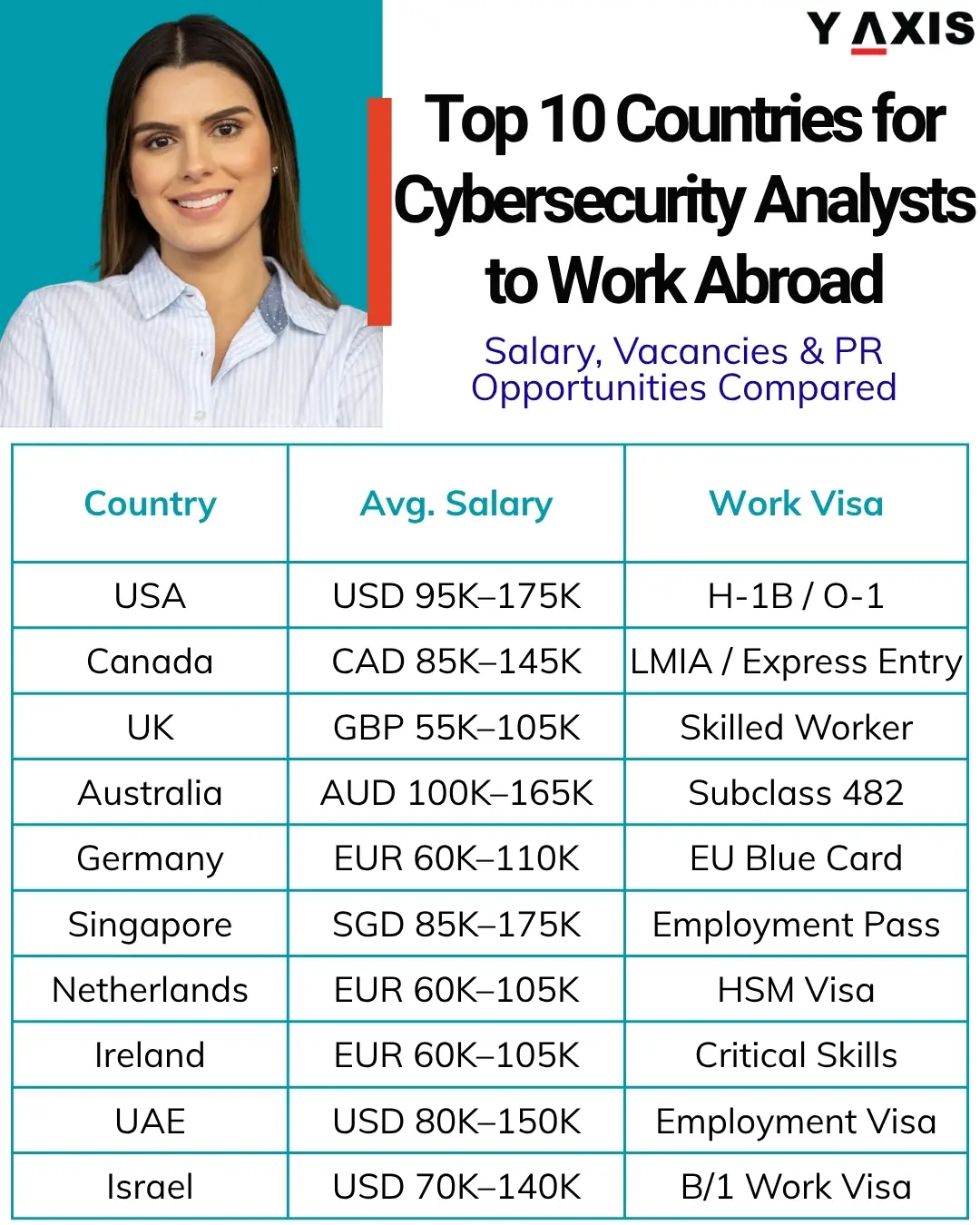
| Country | Avg Annual Salary | Work Visa | PR Pathway |
|---|---|---|---|
| USA | USD 95,000–175,000 | H-1B / O-1 Visa | EB-2 / EB-3 Green Card |
| Canada | CAD 85,000–145,000 | Express Entry / LMIA Work Permit | Express Entry (NOC 21220) — 1–3 years |
| UK | GBP 55,000–105,000 | Skilled Worker Visa | ILR after 5 years |
| Australia | AUD 100,000–165,000 | Skills in Demand Visa (SC 482) | SC 186 / Points Test (SC 189/190) |
| Germany | EUR 60,000–110,000 | EU Blue Card / Skilled Worker Visa | PR after 21 months (Blue Card + B1 German) |
| Singapore | SGD 85,000–175,000 | Employment Pass (EP) | PR after 2–3 years |
| Netherlands | EUR 60,000–105,000 | Highly Skilled Migrant (HSM) Visa | EU PR after 5 years |
| Ireland | EUR 60,000–105,000 | Critical Skills Employment Permit | Stamp 4 after 2 years |
| UAE | USD 80,000–150,000 (tax-free) | Employment Visa — employer-sponsored | Golden Visa (5/10 years) |
| Israel | USD 70,000–140,000 | Work Visa B/1 — employer-sponsored | PR after 5+ years |
Which Country Is Best for You: Cybersecurity Analysts' Decision Table
The ideal destination to migrate abroad as a cybersecurity analyst depends on individual priorities such as maximum salary, fastest permanent residency, strongest cybersecurity job market, or simplest visa process.
The table below helps you assess the best country to work abroad as an Indian cybersecurity analyst.
| Your Goal | Best Country | Why |
|---|---|---|
| Highest Salary (Tax-Free) | UAE | Zero income tax; senior cybersecurity architects earn USD 100,000–150,000/year in Dubai and Abu Dhabi; visa processed in 5–10 business days. |
| Fastest PR Globally | Canada | Express Entry STEM draws; cybersecurity NOC 21220 invited regularly; PR achievable in 1–3 years. |
| Fastest PR in Europe | Ireland | Critical Skills Employment Permit leads to Stamp 4 in 2 years; Dublin is a growing European cybersecurity and financial services hub. |
| Best PR + Cost of Living | Canada | Express Entry; universal healthcare; Toronto, Ottawa, and Vancouver are major cybersecurity employer hubs with strong government and financial sector demand. |
| EU Base + Highest Cyber Demand | Germany | Critical shortage of cybersecurity talent; EU Blue Card PR in 21 months with B1 German; SAP, Siemens, Deutsche Bank, and Bosch actively hire cybersecurity professionals. |
| Asia-Pacific Cyber Hub | Singapore | Regional hub for banking, government, and fintech cybersecurity; MAS regulations drive continuous demand; PR possible after 2–3 years on an Employment Pass. |
| English-First EU Workplace | Netherlands / Ireland | Highly Skilled Migrant (HSM) Visa in the Netherlands and Critical Skills Employment Permit in Ireland; both offer English-speaking workplaces with strong international tech and finance sectors. |
| Highest Gross Salary Globally | USA | USD 95,000–175,000 base salary; opportunities with NSA, FBI Cyber, CISA, FAANG security teams, and major financial institutions. |
*Want to work abroad as a cybersecurity analyst? Let Y-Axis guide you with the process.
1. USA — Highest Salaries and Deepest Cybersecurity Market in the World
The United States is the world's largest cybersecurity market and the highest-paying destination for cybersecurity analysts. Every federal agency, Fortune 500 company, defence contractor, and financial institution runs large-scale security operations in the USA. High-paying jobs in the USA for cybersecurity professionals are concentrated in Washington DC, New York, San Francisco, Dallas, and Boston. The USA job market for cybersecurity analysts is driven by mandatory NIST, CMMC, and SOX compliance requirements.
| Category | Details |
|---|---|
| Avg Annual Salary | USD 95,000–175,000/year (mid-level: USD 95,000–130,000; senior cybersecurity engineer/analyst: USD 135,000–175,000; CISO-track and FAANG security roles with equity: USD 200,000–400,000+) |
| Top Cities | Washington, DC; New York; San Francisco; Dallas; Boston; Chicago; Atlanta |
| In-Demand Skills | SIEM (Splunk, QRadar, Microsoft Sentinel), Penetration Testing, Cloud Security (AWS, Azure, GCP), CISSP, OSCP, Incident Response, Threat Intelligence, Zero Trust Architecture, SOC Operations |
| Work Visa | H-1B (employer-sponsored, annual lottery); O-1A Visa for extraordinary ability; L-1 Intra-Company Transfer; TN Visa for Canadian and Mexican nationals |
| PR Pathway | EB-2 or EB-3 Green Card through employer sponsorship; National Interest Waiver (NIW) for senior cybersecurity professionals contributing to US national security or critical infrastructure |
| Certification Note | CISSP (Certified Information Systems Security Professional), CISM, CompTIA Security+, CEH, OSCP, and AWS Security Specialty are standard requirements; US government roles require active security clearance. |
*Want to apply for a USA work visa? Let Y-Axis guide you with the steps.
2. Canada — Fastest PR Globally with Dedicated Cybersecurity STEM Draws
Canada is the top destination for Indian cybersecurity analysts seeking both a competitive salary and a fast, employer-independent permanent residency pathway. High-paying jobs in Canada for cybersecurity professionals are available across Toronto, Ottawa, Vancouver, Calgary, and Montreal. The Canada job outlook for cybersecurity analysts is particularly positive under NOC 21220 (Cybersecurity Specialists) which qualifies for Express Entry STEM-specific draws exempting a job offer.
| Category | Details |
|---|---|
| Avg Annual Salary | CAD 85,000–145,000/year (mid-level: CAD 85,000–110,000; senior cybersecurity analyst/engineer: CAD 115,000–145,000; CISO/Security Architect: CAD 150,000+) |
| Top Cities | Toronto, Ottawa, Vancouver, Calgary, Montreal, Waterloo |
| In-Demand Skills | SIEM, Penetration Testing, Cloud Security, Incident Response, CISSP, CEH, Threat Intelligence, Vulnerability Management, DevSecOps, Compliance (SOC 2, PCI DSS, PIPEDA) |
| Work Visa | LMIA-backed Work Permit; Express Entry – Federal Skilled Worker Program (FSWP); Global Talent Stream (2-week processing for qualifying cybersecurity roles) |
| Canada PR Pathway | Express Entry (Federal Skilled Worker Program / Canadian Experience Class) – NOC 21220; STEM-specific draws with no job offer required; Provincial Nominee Program (PNP) tech streams in Ontario (OINP), British Columbia (BC PNP), and Alberta PNP |
| Certification Note | WES credential evaluation is required for the PR pathway. CISSP, CEH, CompTIA Security+, and OSCP strengthen Express Entry competitiveness. CIPP/C privacy certifications are valuable for compliance and data protection roles. |
*Want to apply for a Canada work visa? Let Y-Axis guide you with the steps.
3. UK — Strong Cybersecurity Job Market Driven by NCSC and Financial Services
The United Kingdom has one of Europe's most active cybersecurity job markets, driven by the National Cyber Security Centre (NCSC), large financial services and insurtech firms. High-paying jobs in the UK for cybersecurity analysts are available in London, Manchester, Edinburgh, and Bristol. The UK job market for cybersecurity professionals is particularly strong in financial services, government security programmes, and defence contracting, where SIEM, penetration testing, and cloud security expertise is in constant demand. Cybersecurity is on the UK's Immigration Salary List, enabling priority Skilled Worker Visa processing.
| Category | Details |
|---|---|
| Avg Annual Salary | GBP 55,000–105,000/year (mid-level: GBP 55,000–75,000; senior cybersecurity analyst/engineer: GBP 75,000–105,000; Security Architect/CISO-track: GBP 100,000–140,000+) |
| Top Cities | London, Manchester, Edinburgh, Bristol, Leeds, Cheltenham (GCHQ corridor) |
| In-Demand Skills | SIEM (Splunk, QRadar, Microsoft Sentinel), Penetration Testing (CHECK/CREST certified), Cloud Security, CISSP, CISM, ISO 27001, Incident Response, Threat Intelligence, Zero Trust |
| Work Visa | Skilled Worker Visa – cybersecurity roles on the Immigration Salary List; salary threshold of GBP 38,700+ (standard) or lower for eligible shortage occupations; Global Talent Visa for exceptional cybersecurity professionals |
| PR Pathway | Indefinite Leave to Remain (ILR) after 5 years on a Skilled Worker Visa; Global Talent Visa holders may qualify for ILR after 3–5 years |
| Certification Note | CREST and CHECK certifications are highly valued for UK government and financial sector penetration testing roles. CISSP, CISM, and ISO 27001 Lead Auditor certifications are widely recognized, while no UK-specific general cybersecurity certification is mandatory. |
*Want to apply for a UK work visa? Let Y-Axis guide you with the steps.
4. Australia — Cybersecurity on Shortage List with Points-Based PR Access
Australia has a strong and growing demand for cybersecurity analysts, with ICT security roles listed on the Medium and Long-term Strategic Skills List (MLTSSL). High-paying jobs in Australia for cybersecurity professionals are available in Sydney, Melbourne, Canberra, Brisbane, and Perth, across government, defence, financial services, and enterprise cloud adoption. The Australia job market for cybersecurity analysts is particularly strong in critical infrastructure protection, government security clearance roles, and cloud security.
| Category | Details |
|---|---|
| Avg Annual Salary | AUD 100,000–165,000/year (mid-level: AUD 100,000–125,000; senior cybersecurity analyst/engineer: AUD 125,000–165,000; Security Architect/CISO-track: AUD 165,000–200,000+) |
| Top Cities | Sydney, Melbourne, Canberra (federal government security hub), Brisbane, Perth |
| In-Demand Skills | SIEM, Penetration Testing, Cloud Security, CISSP, CISM, ASD Essential Eight, Incident Response, Threat Intelligence, ISO 27001, DevSecOps, Security Clearance Readiness |
| Work Visa | Skills in Demand Visa (Subclass 482) – employer-sponsored; direct points-based pathways for ACS-assessed ICT Security Specialists |
| Australia PR Pathway | Subclass 186 Employer Nomination; points-based Subclass 189 and Subclass 190 visas (MLTSSL listing provides direct PR pathway); ACS skills assessment required for ANZSCO 262112 (ICT Security Specialist) |
| Certification Note | ACS (Australian Computer Society) skills assessment is mandatory for points-based PR pathways under ANZSCO 262112 (ICT Security Specialist). CISSP, CISM, CEH, and ISO 27001 certifications are widely recognized, while Australian government cybersecurity roles generally require an active Australian security clearance. |
*Want to apply for an Australia work visa? Let Y-Axis guide you with the steps.
5. Germany — Critical Shortage of Cybersecurity Talent with EU Blue Card Access
Germany faces one of the most acute cybersecurity talent shortages in Europe, driven by rapid digital transformation of its industrial, automotive, financial, and manufacturing sectors, alongside strict GDPR and NIS2 Directive compliance requirements. In-demand jobs in Germany for cybersecurity analysts are available in Berlin, Munich, Frankfurt, Hamburg, and Stuttgart. The Germany job market for cybersecurity professionals offers EU Blue Card access for qualified analysts meeting the salary threshold.
| Category | Details |
|---|---|
| Avg Annual Salary | EUR 60,000–110,000/year (mid-level: EUR 60,000–80,000; senior cybersecurity analyst/engineer: EUR 80,000–110,000; Security Architect/CISO-track: EUR 100,000–135,000+) |
| Top Cities | Berlin, Munich, Frankfurt, Hamburg, Stuttgart, Cologne |
| In-Demand Skills | SIEM (Splunk, QRadar, Microsoft Sentinel), Penetration Testing, GDPR & NIS2 Compliance, Cloud Security, CISSP, CISM, ISO 27001 Lead Auditor, Incident Response, OT/ICS Security |
| Work Visa | EU Blue Card (minimum salary threshold for eligible skilled professionals), Skilled Worker Visa, Germany Opportunity Card (Chancenkarte) for qualified job seekers |
| PR Pathway | Permanent Settlement (Niederlassungserlaubnis) after 21 months with an EU Blue Card and B1 German proficiency, or after 4 years under the standard EU Blue Card route; Skilled Worker Visa holders are generally eligible after 5 years of legal residence |
| Certification Note | International certifications such as CISSP, CISM, CEH, and ISO 27001 Lead Auditor are widely recognized without additional German certification. B1 German proficiency enables the accelerated 21-month EU Blue Card permanent residence pathway, while expertise in GDPR and NIS2 compliance is highly valued by German employers. |
*Want to apply for a Germany work visa? Let Y-Axis guide you with the steps.
6. Singapore — Asia's Top Cybersecurity Hub Driven by Finance and Smart Nation
Singapore is the most important cybersecurity market in Asia-Pacific, hosting the regional headquarters of virtually every global bank, financial regulator, and major technology firm. High-paying jobs in Singapore for cybersecurity analysts are available across financial services, government, fintech, and logistics. The Singapore job market for cybersecurity professionals is driven by the country's Smart Nation initiative and MAS (Monetary Authority of Singapore) cybersecurity requirements for financial institutions.
| Category | Details |
|---|---|
| Avg Annual Salary | SGD 85,000–175,000/year (mid-level: SGD 85,000–120,000; senior cybersecurity analyst/engineer: SGD 125,000–175,000; Security Architect: SGD 175,000–240,000+) |
| Top City | Singapore (city-state); Raffles Place, Marina Bay Financial Centre, and one-north (Biopolis/Fusionopolis) innovation corridors |
| In-Demand Skills | SIEM, Penetration Testing, Cloud Security (AWS, Azure, GCP), MAS TRM Compliance, Threat Intelligence, CISSP, CISM, OSCP, Zero Trust Architecture, OT Security, Data Loss Prevention (DLP) |
| Work Visa | Employment Pass (EP) – minimum qualifying salary for eligible tech professionals; Tech.Pass for highly accomplished cybersecurity leaders, founders, and technical experts |
| PR Pathway | Singapore Permanent Residence (PR) may be applied for after approximately 2–3 years on an Employment Pass, subject to assessment by the authorities. Cybersecurity professionals employed by multinational corporations and financial institutions often have strong long-term prospects. |
| Certification Note | CISSP, CISM, CEH, OSCP, and AWS Security Specialty are highly valued by employers. Expertise in MAS Technology Risk Management (TRM) Guidelines and PDPA compliance is a significant advantage. No Singapore-specific cybersecurity certification is mandatory. |
*Want to apply for a Singapore work visa? Let Y-Axis guide you with the steps.
7. Netherlands — International Cybersecurity Hub with English-Medium Workplaces
The Netherlands is a leading European destination for cybersecurity analysts, anchored by a large international technology and financial employer base in Amsterdam, Eindhoven, Rotterdam, and The Hague. High-paying jobs in the Netherlands for cybersecurity professionals are available at global companies such as ASML, Philips, ING, ABN AMRO, Booking.com, Adyen, and the European offices of major cloud providers. The Netherlands job outlook for cybersecurity analysts features an English-medium work environment at most international employers and one of Europe's most efficient work visa processes, with no labour market test required.
| Category | Details |
|---|---|
| Avg Annual Salary | EUR 60,000–105,000/year (mid-level: EUR 60,000–80,000; senior cybersecurity analyst/engineer: EUR 80,000–105,000; Security Architect: EUR 100,000–130,000+) |
| Top Cities | Amsterdam, Eindhoven, Rotterdam, Utrecht, The Hague (government cybersecurity hub) |
| In-Demand Skills | SIEM, Penetration Testing, GDPR & NIS2 Compliance, Cloud Security, CISSP, CISM, ISO 27001, Threat Intelligence, OT Security, Incident Response |
| Work Visa | Highly Skilled Migrant (HSM) Visa – no labour market test; employer must be an IND-recognised sponsor; typical processing time of 2–4 weeks |
| PR Pathway | EU Permanent Residence after 5 years of continuous legal residence; eligibility for Dutch citizenship after meeting residence, integration, and other statutory requirements |
| Certification Note | No Netherlands-specific cybersecurity certification is required. CISSP, CISM, CEH, ISO 27001 Lead Auditor, and OSCP are highly valued by employers. English is the primary working language at most international organizations, while expertise in GDPR and NIS2 compliance is a significant advantage. |
*Want to apply for a Netherlands work visa? Let Y-Axis guide you with the steps.
8. Ireland — Fastest PR in Europe with US Tech and Financial Cybersecurity Demand
Ireland offers cybersecurity analysts the fastest permanent residency route in Europe at just two years with access to a rapidly expanding financial services cybersecurity sector. High-paying jobs in Ireland for cybersecurity professionals are available in Dublin, Cork, and Limerick, at Amazon, Google, Microsoft, Meta, Salesforce, HubSpot, and major financial institutions including Citibank, Bank of America, and JP Morgan. The Ireland job market for cybersecurity analysts benefits from a critical shortage of experienced talent.
| Category | Details |
|---|---|
| Avg Annual Salary | EUR 60,000–105,000/year (mid-level: EUR 60,000–78,000; senior cybersecurity analyst/engineer: EUR 78,000–105,000; Security Architect/SOC Lead: EUR 100,000–130,000+) |
| Top Cities | Dublin (primary cybersecurity hub), Cork, Limerick, Galway (growing regional technology and financial services clusters) |
| In-Demand Skills | SIEM (Splunk, Microsoft Sentinel), Cloud Security (AWS, Azure), Penetration Testing, CISSP, CISM, ISO 27001, GDPR Compliance, Threat Intelligence, Incident Response, DevSecOps |
| Work Visa | Critical Skills Employment Permit (CSEP) – cybersecurity occupations are eligible under the Critical Skills Occupations List; General Employment Permit available for other qualifying cybersecurity roles |
| PR Pathway | Critical Skills Employment Permit holders can become eligible for Stamp 4 permission after 2 years of qualifying employment, providing a fast pathway to long-term residence without a points-based system |
| Certification Note | No Ireland-specific cybersecurity certification is required. CISSP, CISM, CEH, ISO 27001 Lead Auditor, and cloud security certifications are highly valued by employers. Cybersecurity professionals continue to be among the most actively sponsored skilled workers in Ireland. |
*Want to apply for an Ireland work visa? Let Y-Axis guide you with the steps.
9. UAE — Highest Tax-Free Packages and a Rapidly Growing Cybersecurity Ecosystem
The United Arab Emirates is the highest net-earnings destination for cybersecurity analysts, with zero income tax and a rapidly growing cybersecurity market. High-paying jobs in the UAE for cybersecurity professionals are available in Dubai Internet City, the Dubai International Financial Centre (DIFC), Abu Dhabi's Hub71, and government security agencies. The UAE's National Cybersecurity Strategy and mandatory data protection requirements across the DIFC and ADGM financial free zones are driving sustained demand for senior cybersecurity analysts.
| Category | Details |
|---|---|
| Avg Annual Salary | USD 80,000–150,000/year (tax-free) (mid-level: USD 80,000–105,000; senior cybersecurity analyst/engineer: USD 105,000–150,000; total compensation including housing and benefits: USD 115,000–170,000) |
| Top Cities | Dubai (Dubai Internet City, DIFC, Business Bay), Abu Dhabi (Hub71, ADGM, government agencies), Sharjah |
| In-Demand Skills | SIEM, Penetration Testing, Cloud Security, CISSP, CISM, OSCP, OT/ICS Security, Threat Intelligence, UAE NESA Compliance, ISO 27001, Incident Response |
| Work Visa | Employment Visa – employer-sponsored with typical processing in 5–10 business days; 2–3 year renewable contracts; no labour market test required |
| PR Pathway | UAE Golden Visa (5 or 10 years) for eligible cybersecurity professionals; senior specialists meeting qualification and salary criteria may qualify under the skilled professionals category |
| Certification Note | CISSP, CISM, CEH, and OSCP are among the most sought-after certifications for senior cybersecurity roles in the UAE. Expertise in UAE NESA cybersecurity standards and ISO 27001 is highly valued. No UAE-specific cybersecurity certification is mandatory. |
10. Israel — Global Cybersecurity Innovation Leader with Unique Career Opportunities
Israel is the world's most densely concentrated cybersecurity ecosystem outside the USA, renowned for its Unit 8200 military intelligence alumni culture, globally leading cybersecurity startups, and strong investment in national cybersecurity capabilities. High-paying jobs in Israel for cybersecurity analysts are available in Tel Aviv, Beersheba (the Cyber Spark innovation complex), and Haifa, across hundreds of cybersecurity-focused startups and multinational R&D centres. The Israel cybersecurity market is unique in offering exposure to cutting-edge offensive and defensive security research, advanced persistent threat (APT) analysis, and zero-day vulnerability research.
| Category | Details |
|---|---|
| Avg Annual Salary | USD 70,000–140,000/year (mid-level: USD 70,000–95,000; senior cybersecurity engineer/researcher: USD 95,000–140,000; Principal Security Architect and senior leadership roles: USD 140,000–200,000+) |
| Top Cities | Tel Aviv, Beersheba (CyberSpark), Haifa, Jerusalem, Herzliya |
| In-Demand Skills | Offensive Security, Penetration Testing, Threat Intelligence, Malware Analysis, Reverse Engineering, SIEM, Cloud Security, CISSP, OSCP, CEH, Vulnerability Research, Red Teaming |
| Work Visa | B/1 Work Visa – employer-sponsored; technology companies actively recruit experienced cybersecurity professionals through approved employer sponsorship programs |
| PR Pathway | Permanent residency for foreign professionals is limited and generally requires long-term legal residence, employer support where applicable, and government approval. Aliyah follows a separate immigration pathway for eligible individuals. |
| Certification Note | OSCP, CEH, and GIAC certifications (GPEN, GCIH, GREM) are highly regarded. Israeli cybersecurity employers place significant emphasis on hands-on technical expertise, offensive security experience, vulnerability research, Capture the Flag (CTF) achievements, and open-source security contributions alongside professional certifications. |
Key Skills Cybersecurity Analysts Need to Land Jobs Abroad
International employers and immigration authorities consistently look for the following qualifications, skills, and certifications when hiring cybersecurity analysts from overseas.
Here are the key skills to build before applying for overseas cybersecurity roles:
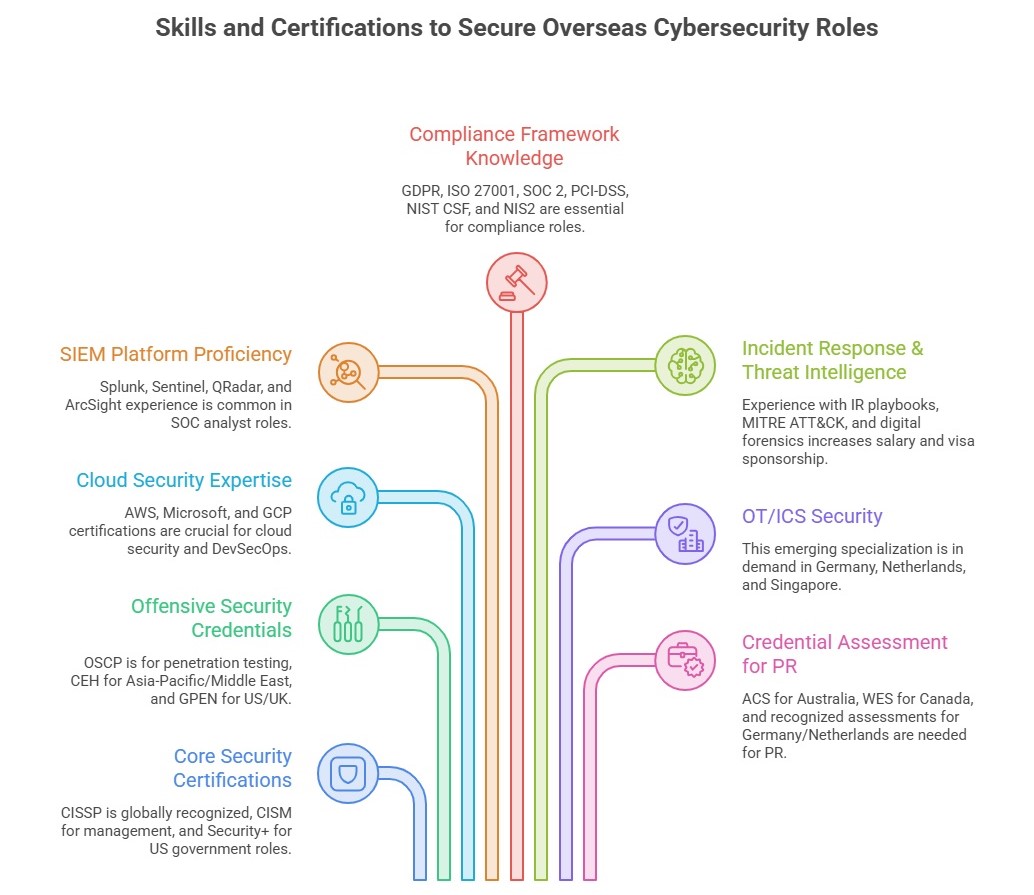
- Core security certification: CISSP (Certified Information Systems Security Professional) is the single most recognised credential across all 10 markets; CISM is the leading management-track certification; CompTIA Security+ is the baseline entry requirement for most USA government and enterprise roles
- Offensive security credentials: OSCP (Offensive Security Certified Professional) is the gold standard for penetration testing roles; CEH (Certified Ethical Hacker) is widely recognised across Asia-Pacific and the Middle East; GPEN (GIAC Penetration Tester) is valued for USA and UK roles
- Cloud security expertise: AWS Security Specialty, Microsoft SC-200 (Security Operations Analyst), and GCP Professional Cloud Security Engineer are increasingly required for cloud security and DevSecOps roles across all 10 countries
- SIEM platform proficiency: Splunk Core Certified Power User or Splunk Enterprise Security Certified Admin, Microsoft Sentinel, IBM QRadar, and ArcSight experience appears in over 75% of SOC analyst job descriptions globally
- Compliance framework knowledge: GDPR (essential for all EU markets), ISO 27001 Lead Auditor or Lead Implementer, SOC 2, PCI-DSS, NIST CSF, and NIS2 Directive knowledge are required for compliance-heavy roles in finance, healthcare, and government
- Incident response and threat intelligence: Practical experience with IR playbooks, MITRE ATT&CK framework, threat hunting, malware analysis, and digital forensics (EnCase, FTK, Volatility) significantly increases salary and visa sponsorship rates
- OT/ICS security (emerging): Operational technology and industrial control system security is a fast-growing specialisation in Germany, the Netherlands, and Singapore, driven by critical infrastructure protection requirements
- Credential assessment for PR pathways: ACS assessment (ANZSCO 262112) is mandatory for Australian PR; WES credential evaluation is required for Canadian Express Entry; recognised qualifications assessment is required for Germany and the Netherlands
Which Country Is Right for Your Cybersecurity Career?
The right country to migrate abroad as a cybersecurity analyst depends on your career stage, specialisation (SOC, penetration testing, cloud security, GRC), certifications, and PR goals. Cybersecurity specialisations and experience levels all affect which destination gives you the best career outcome.
The table below helps you identify the best country to pursue a cybersecurity career abroad:
| Your Priority | Best Country Option |
|---|---|
| Highest Gross Salary | USA – USD 95,000–175,000/year for senior cybersecurity analysts and security architects at leading technology companies, financial institutions, and government agencies. |
| Highest Take-Home Pay (Tax-Free) | UAE – Zero personal income tax with total compensation packages worth USD 115,000–170,000/year, often including housing, healthcare, and other benefits. |
| Fastest PR Globally | Canada – Express Entry STEM draws regularly invite Cybersecurity Specialists (NOC 21220), with permanent residence possible in approximately 1–3 years. |
| Fastest PR in Europe | Ireland – Critical Skills Employment Permit leads to Stamp 4 permission after two years, with strong demand from multinational technology and financial services companies. |
| EU Base with Strong Cybersecurity Demand | Germany – High demand for cybersecurity professionals; EU Blue Card holders can qualify for permanent residence in as little as 21 months with B1 German proficiency. |
| Best Asia-Pacific Cybersecurity Career | Singapore – Strong opportunities in banking, fintech, and Smart Nation initiatives, with Employment Pass eligibility and a potential PR pathway after several years. |
| Best PR Route through a Points-Based System | Australia – ICT Security Specialist (ANZSCO 262112) is on the MLTSSL, providing pathways through Subclass 189, 190, 482, and 186 visas after an ACS skills assessment. |
| English-First EU Workplace | Netherlands – Highly Skilled Migrant (HSM) Visa with no labour market test for recognised sponsors, extensive use of English in multinational companies, and permanent residence after five years. |
| Cutting-Edge Offensive Security Career | Israel – Home to the CyberSpark ecosystem in Beersheba and globally recognised cybersecurity innovation, offering exceptional opportunities in offensive security, threat research, and advanced cyber defence. |
| Fastest-Growing Government Cybersecurity Market | Australia – Canberra offers extensive government cybersecurity opportunities focused on ASD Essential Eight compliance, national security, and security-cleared roles. |
*Want to get your cybersecurity profile assessed? Try Y-Axis Free Eligibility Assessment to evaluate your profile. Call +91-7670800000.
Watch: Over 40? Here's How You Can Still Migrate Abroad Successfully!
Many professionals believe that crossing the age of 40 closes the door to international migration. However, that is one of the biggest misconceptions about immigration. Several countries continue to welcome experienced professionals who bring valuable industry expertise, financial stability, and strong professional backgrounds.
In the video below, you'll learn how a mid-career professional in his 40s, with two children, successfully secured a permanent residency pathway despite being told that it was too late. The story highlights how the right immigration strategy, relevant work experience, and occupations in demand can significantly improve your chances of migrating abroad.
The video also explains why countries such as Canada, Australia, and Germany continue to offer opportunities for skilled professionals over 40, especially in sectors experiencing labor shortages.
Watch to Know More: Over 40? Here’s How You Can Still Migrate Abroad Successfully!
Explore the best immigration pathways for professionals over 40, including visa options, eligibility requirements, and practical strategies to improve your chances of settling abroad.
How to Migrate Abroad as a Cybersecurity Analyst?
Migrating abroad as a cybersecurity analyst from India starts with validating your credentials — your B.E., B.Tech, MCA, or M.Tech degree — alongside security certifications and at least 2–5 years of practical SOC, penetration testing, cloud security, or GRC experience. Indian professionals can target countries via the Skilled Cybersecurity Worker route (employer-sponsored visa with PR pathway) or via the Independent Points-Based route (no job offer needed, for Canada Express Entry and Australia SC 189/190).
The steps to migrate abroad as a cybersecurity analyst from India are as follows:
Step 1: Identify your target country based on your cybersecurity specialisation, certifications, salary expectations, PR timeline, and readiness for local credential assessment using the comparison tables above.
Step 2: Get the right cybersecurity certification for your target country such as CISSP (all markets), OSCP (penetration testing roles), AWS Security Specialty (cloud security roles), or ISO 27001 Lead Auditor (EU compliance roles).
Step 3: Start credential assessment early such as ACS assessment (Australia, ANZSCO 262112) and WES credential evaluation (Canada) are required for PR pathways; start 2–3 months before your job search.
Step 4: Build a strong international cybersecurity profile by updating your resume and LinkedIn with specific tools, SIEM platforms, frameworks (MITRE ATT&CK, NIST, ISO 27001), and quantified security outcomes.
Step 5: Apply for cybersecurity roles through LinkedIn, Glassdoor, Indeed, specialist security recruiters (CyberSN, Hays Cybersecurity, Robert Half Technology), and direct company careers pages.
Step 6: Secure a job offer that meets the visa salary threshold in your target country.
Step 7: Submit your work visa or work permit application with required documents — passport, degree certificates, security certification transcripts, employment contract, and any country-specific credential assessments.
Step 8: Complete biometrics and verification as required by your target country's immigration authority.
Step 9: Await your visa approval and confirm your start date with your employer.
Step 10: Upon work permit approval, migrate to your preferred country to legally start working as a cybersecurity analyst.
Common Mistakes Cybersecurity Analysts Make When Applying for Jobs Abroad
Cybersecurity analysts are in high demand across Canada, Germany, Singapore, Ireland, and Australia. Understanding common mistakes around certifications, documentation, salary thresholds, and visa requirements can significantly improve your chances.
Here are some common mistakes to avoid when applying for overseas cybersecurity roles:
| Common Mistake | Practical Solution |
|---|---|
| Applying without a recognised cybersecurity certification | CISSP, CompTIA Security+, CEH, or OSCP are considered baseline qualifications across most international cybersecurity markets. Earning at least one globally recognised certification before applying significantly improves your chances of being shortlisted. |
| Listing security tools without demonstrating hands-on experience | Quantify your practical experience by highlighting the number of endpoints monitored, incidents investigated, SIEM rules or queries developed, vulnerabilities remediated, and security projects delivered. Measurable achievements carry more weight than tool names alone. |
| Delaying ACS or WES credential assessment for Australia and Canada | For permanent residence pathways, complete your ACS Skills Assessment (Australia) or WES Educational Credential Assessment (Canada) 2–3 months before beginning your international job search to avoid unnecessary delays. |
| Applying to Germany without basic German language skills | Many multinational employers recruit in English, but achieving B1 German significantly expands employment opportunities and enables the accelerated EU Blue Card permanent residence pathway. |
| Comparing UAE opportunities based only on base salary | Evaluate the complete compensation package, including tax-free income, housing allowance, annual air tickets, health insurance, bonuses, and other benefits. Total compensation is often substantially higher than the advertised salary. |
| Relying solely on the H-1B visa for US opportunities | Consider alternative immigration pathways such as the O-1A Visa for exceptional professionals, L-1 intra-company transfer, or the EB-2 National Interest Waiver (NIW), depending on your qualifications and experience. |
| Overlooking cybersecurity compliance specialisations in Europe | Develop expertise in GDPR, NIS2, ISO 27001, and the Digital Operational Resilience Act (DORA). Governance, Risk, and Compliance (GRC) professionals remain in high demand across Germany, the Netherlands, and Ireland, with strong employer sponsorship opportunities. |
Are you looking for step-by-step assistance with overseas immigration? Contact Y-Axis, the world's No. 1 overseas immigration consultancy, for end-to-end assistance! Call +91-7670800000.
FAQs
Which are the top 10 countries for cybersecurity analysts to work abroad?
The top 10 countries for cybersecurity analysts to work abroad are the USA, Canada, UK, Australia, Germany, Singapore, Netherlands, Ireland, UAE, and Israel. These countries offer the highest salaries, strongest demand for SIEM, penetration testing, cloud security, incident response, and compliance expertise, and clear work visa and PR pathways. The USA offers the highest gross salaries, the UAE offers the highest tax-free packages, Canada offers the fastest PR through Express Entry STEM draws under NOC 21220, and Ireland offers the fastest PR in Europe at two years on the Critical Skills Employment Permit.
What certifications do Indian cybersecurity analysts need to work abroad?
The most widely required certifications across all top 10 countries are CISSP (Certified Information Systems Security Professional), CISM (Certified Information Security Manager), CompTIA Security+, CEH (Certified Ethical Hacker), and OSCP (Offensive Security Certified Professional). For cloud security roles, AWS Security Specialty, Microsoft SC-200 Security Operations Analyst, and GCP Professional Cloud Security Engineer are increasingly required at mid-to-senior level. ISO 27001 Lead Auditor or Lead Implementer is essential for EU compliance-heavy roles in Germany, Netherlands, and Ireland. These certifications are globally recognised and directly influence visa sponsorship rates and salary offers.
Which country offers the fastest PR for cybersecurity analysts?
Canada offers the fastest and most accessible PR pathway for cybersecurity analysts globally. The Federal Skilled Worker Program under Express Entry allows cybersecurity specialists to receive an Invitation to Apply within 3–6 months of profile submission under NOC 21220 (Cybersecurity Specialists), with PR achievable in 1–3 years without requiring a job offer for STEM-eligible applicants. In Europe, Ireland offers the fastest PR — the Critical Skills Employment Permit leads to Stamp 4 (the equivalent of permanent residence) in just two years with no points test. Australia offers direct PR in 2–4 years via ACS-assessed points-based pathways under ANZSCO 262112.
What is the average salary for cybersecurity analysts in the USA?
In the USA, mid-level cybersecurity analysts and security engineers earn USD 95,000–130,000 per year at standard technology companies, financial institutions, and enterprise security teams. Senior cybersecurity analysts, SOC leads, and security engineers earn USD 135,000–175,000 at large enterprises and government contractors. CISO-track professionals and senior architects at FAANG companies and major financial sector security teams, including base salary, bonus, and equity, typically earn USD 200,000 to USD 400,000 or more in total compensation. The USA is the highest gross salary market for cybersecurity globally, though income tax rates of 30–40% at senior levels affect take-home compared to the UAE's zero-tax environment.
Is the UAE a good destination for cybersecurity analysts without a conventional PR pathway?
Yes, the UAE is an excellent destination for experienced cybersecurity analysts prioritising maximum take-home earnings and fast visa processing. Senior cybersecurity analysts and engineers earn USD 105,000–150,000 per year in tax-free base salary, with total packages including housing allowance, annual flights, and health insurance worth USD 115,000–170,000. The employer-sponsored Employment Visa is processed in 5–10 business days with no labour market test. The UAE Golden Visa (5 or 10 years) is available for qualifying cybersecurity professionals with sufficient salary, providing long-term residence stability. Dubai Internet City, Hub71 in Abu Dhabi, and the DIFC fintech hub are the primary cybersecurity employment corridors.
What is the Germany EU Blue Card and how does it work for cybersecurity analysts?
The Germany EU Blue Card is a fast-track residence permit for highly qualified non-EU professionals earning at least EUR 45,300 per year — a threshold that cybersecurity analyst roles in Germany comfortably exceed. The Blue Card is issued initially for four years and provides a streamlined path to permanent settlement: four years standard, or just 21 months with B1-level German language proficiency. Cybersecurity analysts are among the most actively recruited non-EU professionals in Germany due to critical shortages across SAP, Siemens, Deutsche Bank, Bosch, and Germany's fast-growing tech sector. International certifications (CISSP, CISM, ISO 27001, CEH) are accepted directly without local German qualification recognition.
Do cybersecurity analysts qualify for Australia's MLTSSL?
Yes, ICT Security Specialist (ANZSCO 262112) is listed on Australia's Medium and Long-term Strategic Skills List (MLTSSL), which provides access to the full range of permanent residency pathways. This listing allows cybersecurity professionals to apply for direct PR via Subclass 186 Employer Nomination, Subclass 189 Skilled Independent, or Subclass 190 State Nominated pathways. An ACS (Australian Computer Society) skills assessment under ANZSCO 262112 is required for points-based PR pathways and typically takes 6–8 weeks. CISSP, CISM, CEH, and cloud security certifications are standard requirements; government roles in Canberra additionally require Australian security clearance.
What is Singapore's Tech.Pass and who qualifies among cybersecurity professionals?
Singapore's Tech.Pass is a premium visa for established technology leaders, senior engineers, and founders with exceptional experience. Eligibility requires one of three criteria: a last drawn monthly salary of at least SGD 22,500 over the past year; five or more years of experience as a founder or C-suite leader in a tech company valued at USD 500 million or more; or five or more years as a technical leader in a cybersecurity, AI, or software development team. Tech.Pass holders can work for multiple companies simultaneously. For mid-level cybersecurity analysts, the standard Employment Pass (minimum SGD 5,600/month for tech roles from 2024) is the standard entry route, with PR available after 2–3 years.
Can cybersecurity analysts get PR in Canada without employer sponsorship?
Yes. Cybersecurity analysts can access Canadian PR without employer sponsorship through the Express Entry Federal Skilled Worker Program, provided their occupation is classified under NOC 21220 (Cybersecurity Specialists) or other STEM-eligible NOC codes. Canada has run STEM-specific Express Entry draws that invite candidates without requiring a job offer, with candidates selected based on their Comprehensive Ranking System (CRS) score built from age, education, English proficiency (IELTS), and work experience. WES credential evaluation of Indian university degrees is mandatory. CISSP, CEH, OSCP, and CompTIA Security+ certifications improve overall CRS profile competitiveness and employer attractiveness once in Canada.
What is the Ireland Critical Skills Employment Permit for cybersecurity analysts?
The Ireland Critical Skills Employment Permit (CSEP) is a fast-track work permit for occupations on the Critical Skills Occupations List, which includes cybersecurity and information security roles. It requires a minimum annual salary of EUR 32,000 for listed roles. The Critical Skills Permit leads to Ireland's Stamp 4 — the equivalent of permanent residence — after just two years of employment, making it the fastest PR route in Europe for cybersecurity professionals. CSEP holders' spouses and partners can work in Ireland without a separate work permit from day one. Dublin hosts the European headquarters of Amazon Web Services, Google, Microsoft, Meta, and Salesforce, creating strong demand for cybersecurity analysts to protect these hyperscaler and financial sector environments.
What makes Israel a unique destination for cybersecurity analysts?
Israel is the world's most densely concentrated cybersecurity ecosystem outside the USA, renowned for its Unit 8200 military intelligence alumni culture, globally leading cybersecurity startups such as Check Point, CyberArk, and Wiz, and strong government investment in national cyber defence. The Cyber Spark innovation complex in Beersheba co-locates dozens of cybersecurity companies, Israeli government units, and Ben-Gurion University's cybersecurity research programmes. For Indian cybersecurity analysts, Israel offers unique exposure to advanced offensive security, zero-day research, APT analysis, and OT/ICS security at a global frontier level. Practical skills and certifications (OSCP, GPEN, CEH) carry significant weight alongside formal qualifications.
📞 Call: +91-7670800000
📩 Email: info@y-axis.com
🌐 Visit: https://www.y-axis.com
Tags:
cybersecurity analyst jobs abroad
cybersecurity jobs overseas
information security salary abroad
cybersecurity PR pathway
cyber jobs for Indians
migrate as a cybersecurity analyst
work abroad in cybersecurity
overseas IT security careers
Share
Options for you by Y-Axis

Get it on your mobile

Get News alerts

Contact Y-Axis
Latest Article
Popular Post
Trending Article

Posted On September 29 2026
How Can I Get Permanent Residency in Portugal?