


Posted on November 19 2026
Canada Now Recognises Grant and Scholarship-Funded Academic Work for Express Entry. Check Your Eligibility!

By , Editor & Director
Updated November 19 2026
Highlights: Canada Eases Express Entry Work Experience Rules for University Academics
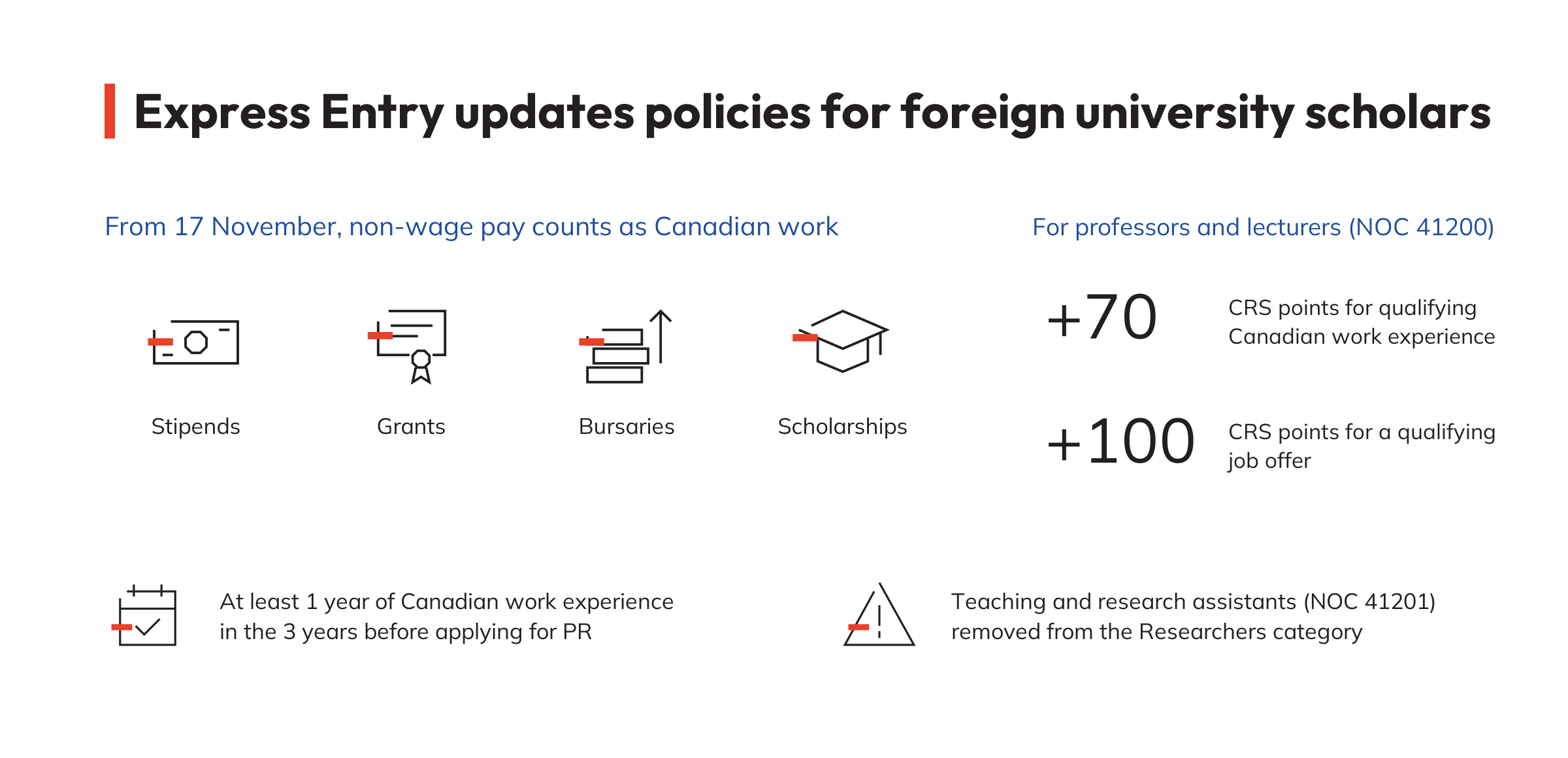
- Canada has expanded Express Entry eligibility for university professors and lecturers by recognising non-wage compensation from November 17, 2026.
- Eligible academics paid through stipends, grants, bursaries or scholarships may now count their Canadian work experience and job offers.
- University professors and lecturers in NOC 41200 may receive 70 additional CRS points for qualifying Canadian work experience or 100 points for a qualifying job offer.
- Candidates must have at least one year of qualifying Canadian work experience in the three years before applying for permanent residence.
- IRCC has removed post-secondary teaching and research assistants (NOC 41201) from the eligible occupations under the Researchers with Canadian Work Experience category.
*Want pursue research and academics in Canada? Avail Y-Axis Canada Eligibility Points Calculator to assess your profile.
Canada Expands Express Entry Eligibility for University Professors and Lecturers
Immigration, Refugees and Citizenship Canada (IRCC) has introduced a temporary public policy recognising non-wage compensation for university professors and lecturers under Express Entry, effective November 17, 2026. Academics employed by Canadian entities and paid through stipends, grants, bursaries or scholarships can now count this experience towards eligibility under the Canadian Experience Class (CEC) and Federal Skilled Worker Program (FSWP).
The change also allows eligible candidates to receive additional Comprehensive Ranking System (CRS) points. University professors and lecturers classified under NOC 41200 may receive 70 additional points for at least one year of qualifying Canadian work experience or 100 points for a qualifying job offer. IRCC has advised candidates with eligible Canadian experience to update their Express Entry profiles.
Also, read...
Canada Adds 100,000 More PR Opportunities. Apply Now!
Eligibility Requirements Under the New Temporary Public Policy
To qualify, candidates must receive an Express Entry invitation to apply (ITA) on or after November 17, 2026, and submit their permanent residence application under the CEC or FSWP. They must also demonstrate at least one year of full-time Canadian work experience, or equivalent part-time experience, in NOC 41200 within the three years before submitting their application.
Applicants must have performed the activities described in the occupation's lead statement and a substantial number of its main duties. Immigration officers may grant an exemption from the standard work experience requirements if the candidate meets the policy conditions. All other requirements, including language proficiency and admissibility, continue to apply.
The table below highlights the major details of Canada's updated Express Entry policy:
|
Category |
Details |
|
Effective date |
November 17, 2026 |
|
Eligible occupation |
University professors and lecturers (NOC 41200) |
|
Recognised compensation |
Stipends, grants, bursaries and scholarships paid by a Canadian entity |
|
Minimum work experience |
One year of full-time Canadian experience or equivalent part-time experience |
|
Experience period |
Within three years before the PR application is received |
|
Additional CRS points for Canadian work experience |
70 points |
|
Additional CRS points for a qualifying job offer |
100 points |
|
Eligible Express Entry programmes |
Canadian Experience Class (CEC) and Federal Skilled Worker Program (FSWP) |
|
ITA requirement |
Must receive an ITA on or after November 17, 2026 |
|
Policy duration |
No predetermined end date; may be revoked by the immigration minister |
IRCC has also removed post-secondary teaching and research assistants (NOC 41201) from the eligible occupations under the Researchers with Canadian Work Experience category. University professors and lecturers are now the only eligible occupation under this category.
Also, read...
Canada Doubles Low-Wage Foreign Work Permit Duration From 1 to 2 Years. Check Your Eligibility!
How will Canada Express Entry Updates benefit Indian scholars?
The policy may benefit Indian academics and university professionals who are currently working in Canada and receive non-wage compensation for their research or teaching roles. By recognising these payment arrangements, IRCC has made it easier for eligible professionals to have their Canadian experience considered under Express Entry.
Key benefits for eligible Indian applicants include:
- Recognition of academic compensation: Stipends, grants, bursaries and scholarships paid by Canadian entities may now count towards qualifying work experience.
- Additional CRS points: Eligible university professors and lecturers may receive 70 additional CRS points for qualifying Canadian work experience or 100 points for a qualifying job offer.
- Access to Express Entry programmes: Qualifying academics may benefit from exemptions to standard work experience requirements under the CEC and FSWP.
- More opportunities to pursue Canada PR: Indian academics already working in Canada may have a better opportunity to qualify for permanent residence through Express Entry.
- Clearer recognition of research careers: The policy acknowledges non-traditional academic payment arrangements that were previously excluded from the definition of work for Express Entry purposes.
*Are you looking for step-by-step assistance with Canada immigration? Contact Y-Axis, the world's No. 1 overseas immigration consultancy.
For recent Canadian immigration updates, check out the Y-Axis Canada Immigration News Page.
FAQs
What is Canada's new Express Entry policy for university professors and lecturers?
Canada has introduced a temporary public policy allowing eligible university professors and lecturers to count non-wage compensation towards their Canadian work experience and job offers under Express Entry. Effective November 17, 2026, the policy covers stipends, grants, bursaries and scholarships paid by Canadian entities. It aims to better reflect how academics and researchers are compensated for their work.
Which occupations are eligible under Canada's updated Express Entry policy?
The policy applies to university professors and lecturers classified under National Occupational Classification (NOC) 41200. These professionals may benefit if they receive qualifying non-wage compensation from a Canadian entity and meet the work experience requirements. Post-secondary teaching and research assistants classified under NOC 41201 are no longer included in the Researchers with Canadian Work Experience category following the November 17 update.
What types of non-wage compensation does IRCC recognise under the new policy?
IRCC now recognises stipends, grants, bursaries and scholarships as qualifying forms of compensation for eligible university professors and lecturers. These payments must come from a Canadian entity and relate to qualifying work under NOC 41200. The change allows eligible academics to have their experience considered under Express Entry, even when they are not paid through a conventional salary or hourly wage.
How many additional CRS points can eligible university professors receive?
Eligible university professors and lecturers may receive 70 additional Comprehensive Ranking System (CRS) points for at least one year of qualifying Canadian work experience. They may also receive 100 points for a qualifying job offer. These are separate grounds for additional points, and candidates must satisfy the relevant conditions. The points can improve an eligible candidate's overall Express Entry ranking.
What are the work experience requirements under the new policy?
Candidates must have at least one year of full-time Canadian work experience, or equivalent part-time experience, in NOC 41200. This experience must fall within the three years before IRCC receives their permanent residence application. Applicants must also demonstrate that they performed the activities described in the occupation's lead statement and a substantial number of its main duties.
Which Express Entry programmes are covered by the temporary public policy?
The policy covers the Canadian Experience Class (CEC) and Federal Skilled Worker Program (FSWP). Eligible candidates may receive an exemption from the standard work experience requirements under either programme. However, they must still meet all other applicable immigration conditions, including language proficiency and admissibility requirements. Immigration officers assess applications and determine whether the exemption can be granted.
Are candidates who received an Express Entry invitation before November 17, 2026, eligible?
No. The temporary public policy applies only to candidates who receive an Express Entry invitation to apply on or after November 17, 2026. Candidates invited before this date are not covered, even if they submit their permanent residence applications after November 17. Applicants should check their invitation date and eligibility conditions before relying on the new provisions.
Can Indian university professors benefit from Canada's new Express Entry policy?
Indian university professors and lecturers working in Canada may benefit if they meet the NOC 41200 classification and other policy requirements. Their qualifying Canadian experience may now count even when compensation comes through grants, stipends, bursaries or scholarships from a Canadian entity. The policy does not automatically cover academics working in India or those without the required Canadian work experience.
What has changed for post-secondary teaching and research assistants under Express Entry?
IRCC removed post-secondary teaching and research assistants under NOC 41201 from the eligible occupations in the Researchers with Canadian Work Experience category, effective November 17, 2026. University professors and lecturers under NOC 41200 are now the sole eligible occupation in this category. This change concerns eligibility under that specific category and does not mean NOC 41201 workers are excluded from all Express Entry programmes.
How long will Canada's temporary public policy for university professors remain in effect?
The temporary public policy took effect on November 17, 2026, and does not have a predetermined end date. However, Canada's immigration minister can revoke it at any time. Eligible academics should therefore review the latest IRCC guidance and ensure they meet the requirements when submitting their permanent residence applications. The policy does not guarantee approval or exemption for every applicant.
Tags:
Canada work visa
work in Canada
Canada Express Entry
foreign scholars in Canada
Canadian Experience Class
CEC
Federal Skilled Worker Program
migrate to Canada
Canada immigration
Canada immigration news
Share
Options for you by Y-Axis

Get it on your mobile

Get News alerts

Contact Y-Axis
Latest Article
Related Post
Trending Article
Posted On November 19 2026
Canada Now Recognises Grant and Scholarship-Funded Academic Work for Express Entry. Check Your Eligibility!