

Posted on November 10 2026
Canada Doubles Low-Wage Foreign Work Permit Duration From 1 to 2 Years. Check Your Eligibility!

By , Editor & Director
Updated November 10 2026
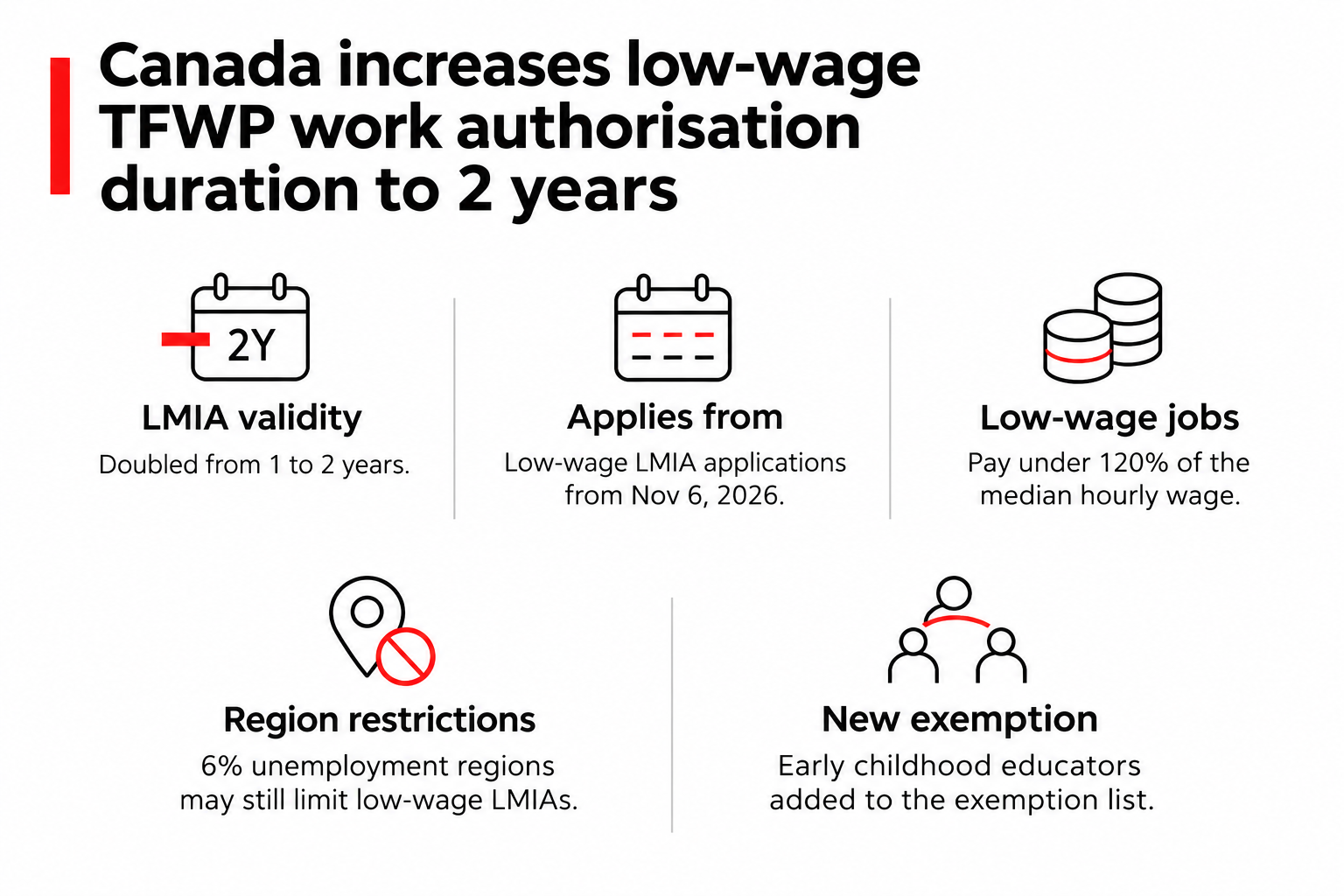
Highlights: Canada Increases Low-Wage TFWP Work Authorisation Duration to 2 Years
- Canada has officially doubled the maximum validity period of low-wage TFWP Labour Market Impact Assessments (LMIAs) from one year to 2 years.
- The revised duration applies to low-wage LMIA applications submitted on or after November 6, 2026.
- Low-wage positions for foreign workers are those paying less than 120% of the median hourly wage in the relevant province or territory in Canada
- Employers in regions covered by the 6% unemployment moratorium may still be unable to obtain low-wage LMIAs for non-exempt jobs.
- Early childhood educators have recently been added to the list of occupations exempt from the low-wage LMIA moratorium.
*Want to work in Canada? Let Y-Axis guide you with the process.
Canada Introduces Longer Work Permit Durations for Low-Wage Foreign Workers From November 2026
Canada has increased the maximum duration of Labour Market Impact Assessments (LMIAs) issued under the low-wage stream of the Temporary Foreign Worker Program (TFWP) from one year to two years. Employment and Social Development Canada (ESDC) announced the change on November 6, 2026, as part of targeted reforms to the temporary foreign worker system.
The revised duration applies to low-wage LMIA applications submitted on or after November 6, 2026. Since the validity period of an LMIA determines the maximum duration of a work permit issued by Immigration, Refugees and Citizenship Canada (IRCC), eligible foreign workers may now receive TFWP work permits for up to two years.
Who qualifies under the low-wage TFWP stream?
A job is classified under the low-wage stream when its hourly pay is below 120% of the median hourly wage in the province or territory where the position is located. As of the announcement, the applicable thresholds include:
|
Province |
Low-wage threshold |
|
$36.92 per hour |
|
|
$38.40 per hour |
To hire a foreign worker through the TFWP, an employer generally needs a positive or neutral LMIA from ESDC. This assessment confirms that no qualified Canadian citizen or permanent resident is available to fill the position. If a worker wants to extend an existing TFWP work permit, their employer must obtain a new LMIA.
Workers seeking to extend their permits must ensure their employers obtain a new LMIA. If an existing permit is due to expire within two weeks and the LMIA application is still pending, eligible workers may use IRCC's concurrent processing procedure. Workers who apply for an extension before their current permit expires can benefit from maintained status, allowing them to continue working under the conditions of their previous permit while awaiting a decision. IRCC removed the time limit for concurrent processing on October 28, 2026.
Also, read...
Canada Plans to Invite 2.3Million Immigrants by 2029. Apply for Canada Visa Now!
How Canada’s Extended LMIA Duration benefits Indian workers?
The extended LMIA duration could offer greater stability to Indian nationals working in Canada through the low-wage stream of the TFWP. It may also reduce the frequency of employer-led LMIA applications for eligible workers.
The benefits of LMIA duration extension for Indian workers in Canada are as follows:
- Longer work permit validity: Eligible Indian workers may receive TFWP work permits for up to two years, depending on the LMIA and IRCC's decision.
- Fewer renewal-related procedures: Employers may not need to apply for a new LMIA as frequently during the extended validity period.
- Better employment continuity: Longer LMIA validity could help workers plan their employment and stay in Canada with greater certainty.
- Support for eligible sector workers: Indian workers employed in exempt sectors such as construction, agriculture and healthcare may be less affected by the low-wage LMIA moratorium.
- Additional occupational exemption: Indian early childhood educators may benefit from the newly added exemption, subject to the applicable requirements.
- More flexibility during extensions: Eligible workers whose LMIA applications are pending may use concurrent processing and, if they apply before their permits expire, benefit from maintained status.
*Are you looking for step-by-step assistance with Canada immigration? Contact Y-Axis, the world's No. 1 overseas immigration consultancy.
For recent Canadian immigration updates, check out the Y-Axis Canada Immigration News Page.
FAQs
What is Canada's new rule for low-wage TFWP work permits?
Canada has increased the maximum duration of Labour Market Impact Assessments (LMIAs) under the low-wage stream of the Temporary Foreign Worker Program (TFWP) from one year to two years. Announced by Employment and Social Development Canada (ESDC) on November 6, 2026, the change applies to low-wage LMIA applications submitted on or after that date. It allows eligible foreign workers to receive work permits for up to two years.
When did Canada's new two-year low-wage LMIA rule take effect?
The revised LMIA duration took effect on November 6, 2026. It applies to applications submitted through the low-wage stream of the TFWP on or after this date. Applications submitted before November 6 remain subject to the previous rules. Employers must still meet the applicable LMIA requirements, and foreign workers must obtain approval from Immigration, Refugees and Citizenship Canada (IRCC) to receive their work permits.
Who qualifies for Canada's low-wage TFWP stream?
A position falls under the low-wage TFWP stream when its hourly wage is below 120% of the median hourly wage in the province or territory where the job is located. The applicable threshold varies by location. For example, the threshold was $36.92 per hour in Ontario and $38.40 in British Columbia at the time of the announcement. Employers must follow the relevant wage requirements when submitting LMIA applications.
What is an LMIA, and why is it required for TFWP work permits?
A Labour Market Impact Assessment (LMIA) is a document issued by Employment and Social Development Canada (ESDC) to assess the impact of hiring a foreign worker on Canada's labour market. Employers generally need a positive or neutral LMIA to hire foreign workers through the TFWP. It demonstrates that no qualified Canadian citizen or permanent resident is available to fill the position under the applicable requirements.
Will all low-wage TFWP workers receive two-year work permits?
No. The new rule increases the maximum LMIA duration to two years, but it does not guarantee every low-wage TFWP worker a two-year work permit. The actual duration depends on the LMIA issued by ESDC and the decision made by IRCC. Workers and employers must continue to meet the programme's eligibility requirements, and regional restrictions may prevent some employers from obtaining low-wage LMIAs.
Which Canadian regions are affected by the low-wage LMIA moratorium?
Canada maintains a moratorium on processing low-wage LMIAs for non-exempt jobs in Census Metropolitan Areas (CMAs) with unemployment rates of 6% or higher. At the time of the announcement, the restrictions covered 30 CMAs, including Toronto, Vancouver, Montreal, Calgary, Edmonton and Halifax. ESDC updates the list quarterly, with the next update scheduled for January 8, 2027.
Which occupations are exempt from Canada's low-wage LMIA moratorium?
Certain in-demand sectors, including construction, agriculture and healthcare, are exempt from Canada's low-wage LMIA moratorium. In its November 6, 2026 announcement, ESDC also added early childhood educators to the list of exempt occupations. These exemptions may allow eligible employers in affected regions to submit low-wage LMIA applications. However, employers must still meet the relevant programme requirements and other applicable conditions.
Can Indian workers extend their existing TFWP work permits under the new rule?
Yes, Indian workers may apply to extend their existing TFWP work permits, provided they meet the applicable requirements. However, their employers must obtain a new LMIA to support the extension. The two-year maximum duration does not automatically extend an existing permit. Workers should also consider regional LMIA restrictions, as employers in areas covered by the moratorium may be unable to obtain LMIAs for non-exempt positions.
What is concurrent processing for TFWP work permit extensions?
Concurrent processing allows eligible foreign workers to apply for a work permit extension while their employer's LMIA application is still pending. If the worker's existing permit is due to expire within two weeks and the employer has applied for the LMIA with sufficient lead time, they may submit an extension application. IRCC holds the decision until the LMIA is issued and attached to the application. The time limit for concurrent processing was removed on October 28, 2026.
What is maintained status for foreign workers in Canada?
Maintained status allows eligible foreign workers to continue working in Canada under the conditions of their previous work permit while IRCC processes a timely extension application. To benefit, workers must apply before their existing permit expires and remain in Canada while awaiting a decision. If their permit expires before they submit an extension application, they generally cannot continue working under maintained status. The applicable immigration conditions must be followed throughout the process.
Tags:
Work in Canada
Canada work visa
Canada immigration
migrate to Canada
Temporary Foreign Worker Program
Low-wage Labour Market Impact Assessments
BC PNP
Canada immigration news
Ontario PNP
Share
Options for you by Y-Axis

Get it on your mobile

Get News alerts

Contact Y-Axis
Latest Article
Related Post
Trending Article
Posted On November 10 2026
Canada Doubles Low-Wage Foreign Work Permit Duration From 1 to 2 Years. Check Your Eligibility!