

Posted on November 12 2026
Canada Adds 100,000 More PR Opportunities. Apply Now!

By , Editor & Director
Updated November 12 2026
Highlights: Canada Announces 100,000 Additional PR Admissions for Workers, Families and Humanitarian Applicants
- Canada has announced a breakdown of up to 100,000 additional permanent residence admissions spaces planned for 2027.
- The allocation includes 32,000 spaces for Hongkonger pathways and 18,800 for the Ukraine Family Reunification Pathway.
- A further 45,000 spaces will be allocated to spouses and dependent children of Canadian citizens and permanent residents.
- Another 12,600 admissions spaces are reserved for approved-in-principle humanitarian and compassionate applicants.
- The additional spaces are exclusively for people already in Canada who have submitted permanent residence applications.
*Want to check your eligibility for Canada permanent residence? Avail Y-Axis Canada Skilled Immigration Points Calculator to assess your profile.
Canada Opens 100,000 Additional PR Admissions Spaces for 2027
Immigration, Refugees and Citizenship Canada (IRCC) has released details of how it plans to allocate up to 100,000 additional Canada permanent residence (PR) admissions spaces for 2027. The breakdown was published in a government press release on November 10, 2026, outlining the immigration pathways that will benefit from the additional admissions.
The initiative aims to process remaining applications under the Hongkonger pathways and the Ukraine Family Reunification Pathway in 2027. The remaining spaces will be allocated to spouses, common-law partners and dependent children of Canadian citizens and permanent residents, along with approved-in-principle humanitarian and compassionate applicants.
IRCC has identified four categories for the additional admissions allocation. The spaces are intended for applicants who are already living in Canada and have submitted applications for permanent residence.
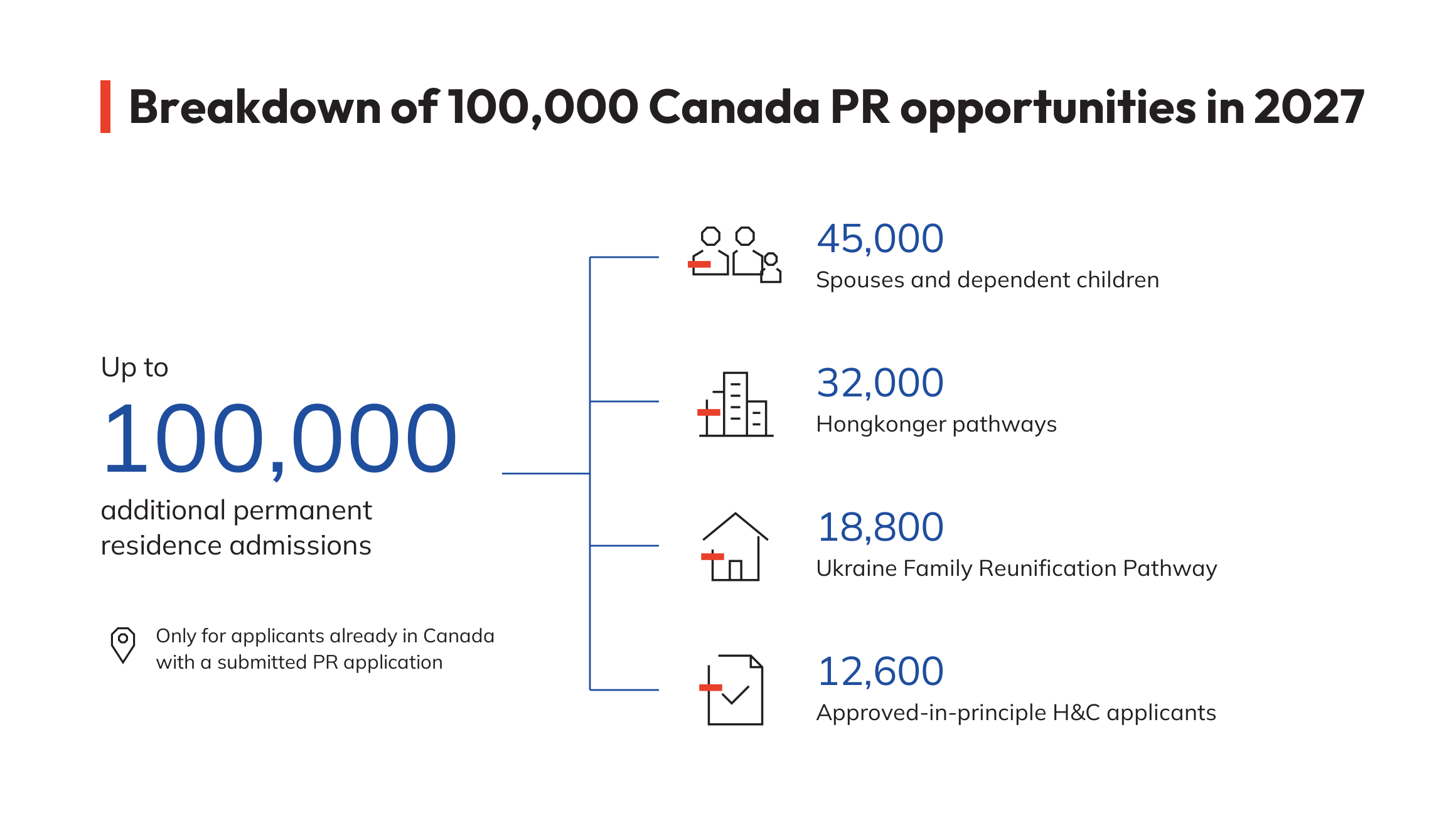
The table below provides a breakdown of Canada permanent residence allocation for 2027:
|
Permanent Residence Pathway |
Expected Admissions |
|
Hongkonger pathways |
32,000 |
|
Ukraine Family Reunification Pathway |
18,800 |
|
Spouses and dependent children of Canadian citizens and permanent residents |
45,000 |
|
Humanitarian and compassionate applicants |
12,600 |
|
Total |
1,08,400 |
Note: The figures add up to 108,400, although IRCC describes the initiative as providing up to 100,000 additional admissions spaces. The published figures should therefore be treated as expected pathway-level admissions, not as a confirmed 100,000-space total.
Also, read...
Who can benefit from the additional PR admissions?
IRCC confirmed that applicants do not need to submit a separate request or take any additional action to benefit from the accelerated processing initiative. The department intends to process the remaining applications under the two special pathways in 2027 and allocate the other spaces to eligible family and humanitarian applicants.
The 100,000 spaces form part of the government's 2027 Transition to Permanent Residence Measures (TPTMs), which include up to 200,000 additional PR admissions for people already in Canada. The other 100,000 spaces are intended for in-Canada workers and their family members through the Provincial Nominee Program (PNP), in collaboration with provincial and territorial governments.
The additional PR admissions could benefit eligible Indian nationals who are already living in Canada and have submitted permanent residence applications under the specified categories. However, the initiative does not create a new PR pathway or allow applicants outside Canada to apply directly.
- Faster application processing: Eligible Indian applicants with pending PR applications under the covered categories may benefit from accelerated processing.
- Family reunification opportunities: Indian nationals who are spouses, common-law partners or dependent children of Canadian citizens or permanent residents may benefit if their applications meet the initiative's conditions.
- Humanitarian consideration: Eligible Indian applicants with approved-in-principle humanitarian and compassionate applications may be included in the additional admissions.
- Potential PNP opportunities: Indian workers already in Canada may benefit from the separate allocation of up to 100,000 spaces for workers and their family members through the PNP.
- No additional application required: Eligible applicants do not need to submit a separate request to have their applications considered under the accelerated processing initiative.
*Are you looking for step-by-step assistance with Canada immigration? Contact Y-Axis, the world's No. 1 overseas immigration consultancy.
For recent Canadian immigration updates, check out the Y-Axis Canada Immigration News Page.
FAQs
How many additional permanent residence spaces has Canada announced for 2027?
Canada has announced plans to provide up to 100,000 additional permanent residence admissions spaces in 2027 under its transition-to-permanent-residence measures. These spaces will support applicants under the Hongkonger pathways, Ukraine Family Reunification Pathway, family reunification and humanitarian and compassionate categories. The initiative is specifically intended for people already living in Canada who have submitted permanent residence applications.
Which immigration pathways will benefit from Canada's additional PR admissions?
The additional admissions will cover four main categories: Hongkonger pathways, Ukraine Family Reunification Pathway, spouses and dependent children of Canadian citizens and permanent residents, and approved-in-principle humanitarian and compassionate applicants. IRCC plans to process the remaining applications under the Hongkonger and Ukraine pathways in 2027. The remaining admissions will support eligible family members and humanitarian applicants already in Canada.
How many PR admissions spaces are reserved for Hongkonger pathways?
Canada expects to provide 32,000 additional permanent residence admissions through the Hongkonger pathways in 2027. Immigration, Refugees and Citizenship Canada (IRCC) aims to process all remaining applications under these pathways during the year. The initiative is intended for eligible applicants already in Canada who have previously submitted their permanent residence applications. It does not reopen the Hongkonger pathways for new applications.
How many additional PR admissions will be available under the Ukraine Family Reunification Pathway?
Canada expects to process 18,800 permanent residence admissions under the Ukraine Family Reunification Pathway as part of its 2027 initiative. IRCC aims to complete all remaining applications under this pathway during the year. The additional admissions are intended for eligible Ukrainians already in Canada with pending permanent residence applications. They do not represent a new application window or an expansion of eligibility.
Will spouses and dependent children of Canadian citizens benefit from the additional PR spaces?
Yes. Canada expects to provide 45,000 additional permanent residence admissions for spouses, common-law partners and dependent children of Canadian citizens and permanent residents. Eligible applicants must already be in Canada and have submitted their permanent residence applications. This measure is intended to support family reunification by helping IRCC process existing applications. It does not automatically grant permanent residence to every family member.
How many additional PR spaces are reserved for humanitarian and compassionate applicants?
Canada expects to provide 12,600 additional permanent residence admissions for approved-in-principle humanitarian and compassionate applicants. These individuals have already received approval in principle for their applications and are included in the government's targeted processing initiative. The measure aims to help eligible applicants already in Canada transition to permanent residence. It does not mean that all pending humanitarian and compassionate applications will automatically receive approval.
Do applicants need to submit a new application to benefit from Canada's additional PR admissions?
No. According to IRCC, eligible applicants do not need to take any additional action or submit a separate application to benefit from the accelerated processing initiative. The department will identify and process existing applications under the specified pathways. Applicants should continue monitoring their application status and respond promptly if IRCC requests additional documents or information.
Are the additional 100,000 PR admissions available to people applying from outside Canada?
No. The additional admissions spaces covered by this initiative are intended exclusively for individuals already living in Canada who have submitted permanent residence applications. People applying from outside Canada cannot use this measure as a separate immigration route. The initiative focuses on processing existing applications under specific family, humanitarian and special immigration pathways rather than opening a new general PR programme.
Are the additional 100,000 PR spaces part of Canada's 2027 immigration target?
No. The additional admissions are over and above Canada's annual target of 380,000 permanent residents for 2027 under the 2027–2029 Immigration Levels Plan. They form part of the broader 2027 Transition to Permanent Residence Measures, which include up to 200,000 additional spaces for people already in Canada. A separate 100,000 spaces are intended for workers and their family members through the PNP.
How can Indian nationals benefit from Canada's additional PR admissions in 2027?
Indian nationals already living in Canada may benefit if they have pending applications under the eligible family or humanitarian and compassionate categories. Indian workers and their family members may also benefit from the separate 100,000 additional spaces planned through the Provincial Nominee Program. However, the initiative does not create a new PR pathway for Indians applying from outside Canada, and applicants must meet the relevant eligibility requirements.
Tags:
Canada PR
Canada permanent residence
Canada immigration
work in Canada
Canada work visa
Canada immigration news
migrate to Canada
settle in Canada
Share
Options for you by Y-Axis

Get it on your mobile

Get News alerts

Contact Y-Axis
Latest Article
Related Post
Trending Article
Posted On November 12 2026
Canada Adds 100,000 More PR Opportunities. Apply Now!