


Posted on October 29 2026
Canada Shares 3 Key Tips to Boost Your Permanent Residence Chances Before Applying for a Study Permit. Check Your Eligibility!

By , Editor & Director
Updated October 29 2026
Highlights: Canada Reveals 3 Effective Strategies for International Students Planning Their PR Journey
- Canada study-to-PR applicants can now improve their prospects by gaining skilled work experience, pursuing a master’s degree, or choosing a co-op program.
- Two to three years of eligible foreign skilled work experience can help foreign candidates maximise Express Entry CRS skill transferability points.
- A Canadian master’s degree can provide up to 30 additional CRS points for Canadian education, depending on the applicable criteria.
- Eligible graduates of one-year master’s programs in Canada can qualify for a three-year post-graduation work permit (PGWP).
- Co-op programs offer practical Canadian work experience and employer connections, potentially helping international graduates secure jobs after completing their studies.
*Want to study in Canada? Let Y-Axis guide you with the process.
Canada Study-to-PR Applicants Can Improve PR Prospects With 3 Key Strategies
Foreign students can transition to the status of Canada permanent residence (PR) by gaining skilled work experience before moving, pursuing a Canadian master’s degree, or enrolling in a co-op program.
The strategies focus on building a stronger Express Entry profile, reducing study costs where possible, and gaining relevant Canadian work experience to improve employment prospects after graduation.
Planning your study-to-immigration journey before applying for a Canadian study permit can help you make informed decisions about your education, finances and future PR eligibility.
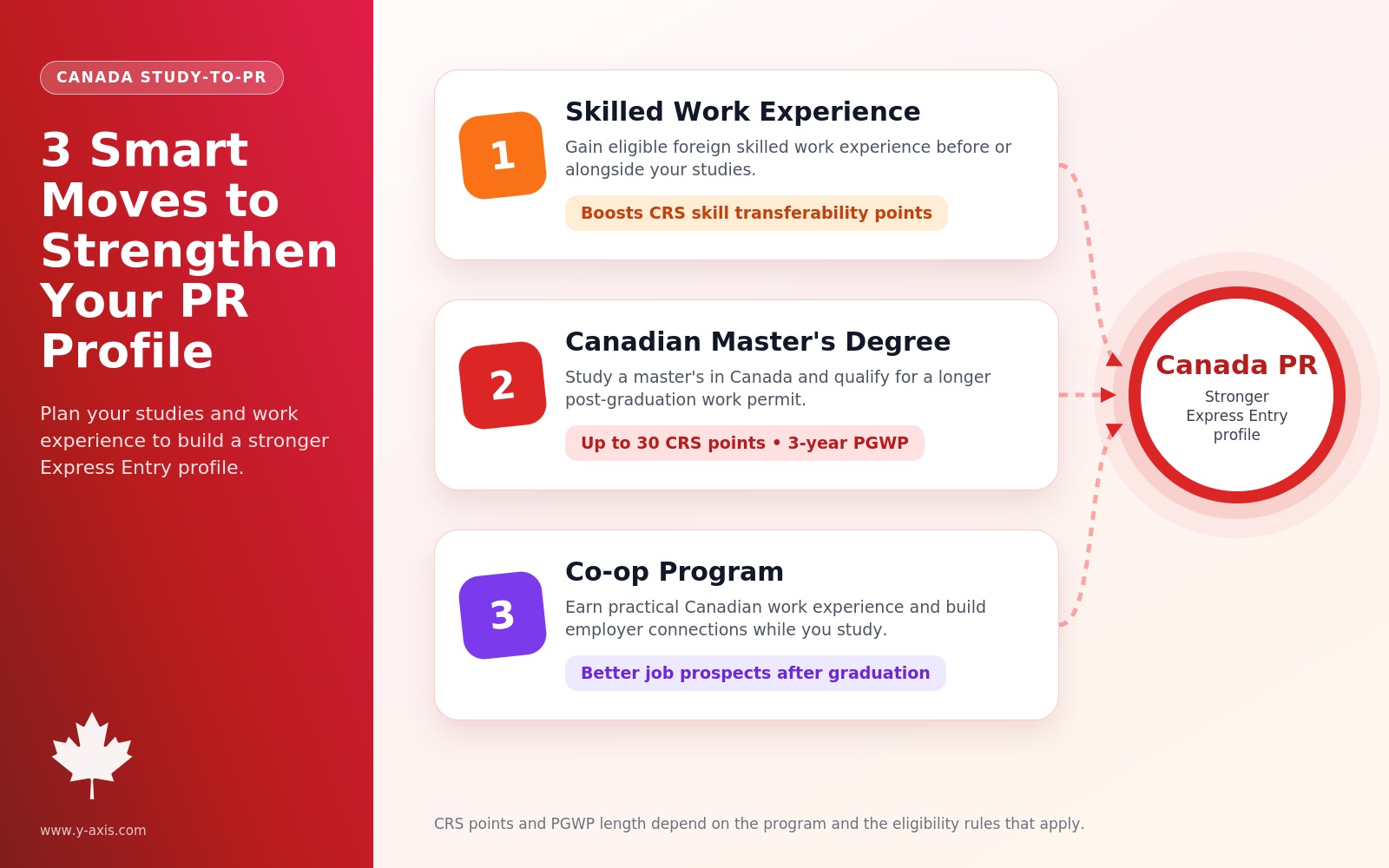
The table below highlights the 3 key strategies to boost student to PR transition in Canada:
|
Strategy |
How it can help |
|
Gain skilled work experience before moving |
Eligible foreign work experience can contribute to Express Entry skill transferability points. |
|
Pursue a master’s degree in Canada |
A qualifying Canadian master’s degree can provide up to 30 additional CRS points for Canadian education and may offer a three-year PGWP if eligibility requirements are met. |
|
Choose a co-op program |
Work placements can provide practical experience, professional contacts and potential employment opportunities after graduation. |
Also, read...
Canada invites 1.9 Lakh+ Candidates in 9 months in 2026. You Can Be The Next One. Apply Now!
How Can Indian Students Benefit From Canada’s Study-to-PR Strategies?
Indian students considering Canada for higher education can use these strategies to plan their study and immigration journey more effectively. Building relevant work experience, choosing a suitable postgraduate qualification and evaluating co-op opportunities before applying may help them make better-informed decisions about their long-term settlement plans.
The key benefits for Indian students include:
- Stronger Express Entry profiles: Eligible foreign skilled work experience can improve CRS skill transferability scores, depending on language proficiency, education and other qualifying factors.
- Potentially lower study costs: A master’s degree may take less time to complete than a typical four-year bachelor’s degree in Canada, reducing the duration of living expenses.
- Longer post-study work opportunities: Eligible master’s graduates may qualify for a three-year PGWP, including after certain programs lasting less than two years.
- Canadian workplace exposure: Co-op placements can help students develop industry-specific skills and build professional networks.
- Better long-term planning: Assessing PR pathways before applying for a study permit can help students compare courses, institutions, costs and future employment opportunities.
*Are you looking for step-by-step assistance with Canada immigration? Contact Y-Axis, the world's No. 1 overseas immigration consultancy.
For recent Canadian immigration updates, check out the Y-Axis Canada Immigration News Page.
FAQs
How can international students improve their chances of getting Canadian PR?
International students can strengthen their future Canadian permanent residence prospects by gaining eligible skilled work experience before moving to Canada, pursuing a master’s degree at an eligible Canadian institution, and considering co-op programs. These strategies can help improve Express Entry competitiveness, develop professional networks and support employment after graduation. However, studying in Canada does not guarantee PR, and applicants must meet the eligibility requirements of their chosen immigration pathway.
Does foreign work experience help with Canadian permanent residence?
Yes, eligible foreign skilled work experience can improve an Express Entry candidate’s Comprehensive Ranking System (CRS) score through skill transferability factors. Depending on the candidate’s education, language proficiency and other qualifications, two or three years of foreign work experience may help maximise these points. The work must meet the relevant requirements, and eligibility depends on the actual duties performed, not merely the job title.
Why should Indian students consider pursuing a master’s degree in Canada?
A Canadian master’s degree can offer several advantages for Indian students planning long-term settlement. Many programs take one or two years to complete, potentially reducing living expenses compared with a four-year bachelor’s degree. Eligible graduates may also receive additional CRS points for Canadian education and qualify for a post-graduation work permit. However, tuition costs, admission requirements, funding availability and future PR eligibility vary by institution and program.
Can a one-year master’s degree in Canada qualify for a three-year PGWP?
Yes, graduates of eligible Canadian master’s degree programs lasting at least eight months may qualify for a three-year post-graduation work permit, even if the program is shorter than two years. Applicants must meet the applicable PGWP eligibility requirements, including requirements related to their institution and program. A three-year permit is not automatic, so students should verify the latest Immigration, Refugees and Citizenship Canada (IRCC) rules before enrolling.
How many CRS points can a Canadian master’s degree provide?
A qualifying Canadian master’s degree can provide up to 30 additional CRS points under the Canadian education category of Express Entry. These points can improve a candidate’s overall ranking, but the degree does not guarantee an invitation to apply for permanent residence. Candidates should also consider language proficiency, eligible work experience, age and other CRS factors when assessing their competitiveness for Canadian immigration programs.
What is a co-op program in Canada?
A co-op program combines academic study with structured work placements, often with Canadian employers in a student’s field of study. Students complete coursework during study terms and gain practical experience during designated work terms. These placements can help students develop professional skills, build industry connections and explore future employment opportunities. Program structures vary by institution, and students should check work authorisation requirements before undertaking any placement.
Does work experience gained during a Canadian co-op count towards PR eligibility?
Work experience gained while studying full-time in Canada generally does not count towards the Canadian work experience requirement for many permanent residence pathways, including the Canadian Experience Class. However, co-op placements can provide valuable practical training and employer connections that may help graduates secure qualifying employment after graduation. Candidates should check the specific requirements of their intended PR program because eligibility rules differ across immigration pathways.
Is a Canadian master’s degree better than a bachelor’s degree for PR?
A Canadian master’s degree may offer advantages for some applicants because it can take less time to complete and provide additional CRS points for Canadian education. However, the best option depends on the student’s existing qualifications, budget, career goals and intended immigration pathway. A bachelor’s degree with a co-op component may be more suitable for some applicants. Neither qualification guarantees permanent residence in Canada.
Should Indian students gain work experience before applying for a Canadian study permit?
Gaining eligible skilled work experience before moving to Canada may strengthen an Indian student’s future Express Entry profile. Foreign work experience can contribute to CRS skill transferability points when combined with qualifying education and language proficiency. Applicants should assess whether their job duties meet the relevant occupational classification requirements. They should also consider their study plans, finances and career goals rather than delaying education solely to accumulate work experience.
Does studying in Canada guarantee permanent residence?
No, studying in Canada does not guarantee permanent residence. Graduates must qualify for an available immigration pathway and meet its requirements when they apply. Eligibility and selection can depend on factors such as language proficiency, skilled work experience, education, CRS scores and current immigration policies. Indian students should research PR options before choosing a course and avoid assuming that a Canadian qualification or post-graduation work permit will automatically lead to permanent residence.
Tags:
Study in Canada
Canada student visa
Canada PR
Canada permanent residence
Canada immigration
migrate to Canada
Canada work experience
CEC
Canada post-graduation work permit
Canada Express Entry
Share
Options for you by Y-Axis

Get it on your mobile

Get News alerts

Contact Y-Axis
Latest Article
Related Post
Trending Article
Posted On October 29 2026
Canada Shares 3 Key Tips to Boost Your Permanent Residence Chances Before Applying for a Study Permit. Check Your Eligibility!