

Posted on August 04 2026
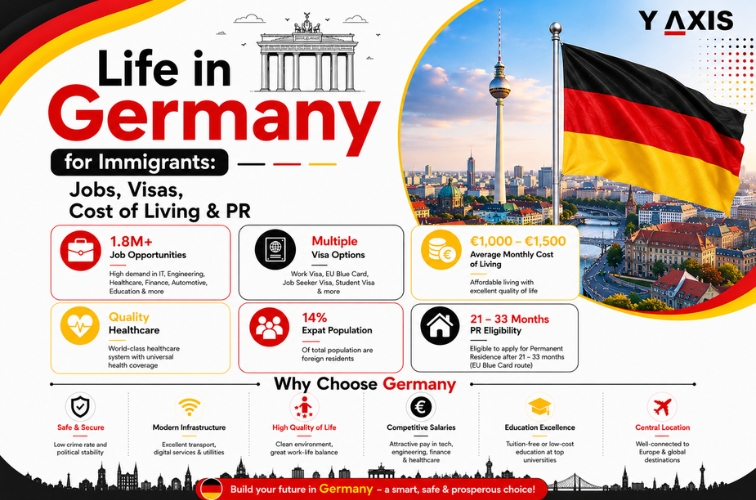
Life in Germany for Immigrants: Jobs, Visas, Cost of Living & PR

By , Editor & Director
Updated August 07 2026
Life for immigrants in Germany is shaped by Europe's largest economy, significant shortage of skilled workers, and one of the fastest permanent residency timelines in the EU. Germany raised its EU Blue Card salary thresholds from January 1, 2026, to EUR 50,700 per year for standard occupations and EUR 45,934.20 for shortage occupations, recent graduates, and qualifying IT specialists. Berlin, Munich, and Frankfurt offer the strongest job markets in IT, engineering, and finance, while the Opportunity Card (Chancenkarte) now lets skilled professionals search for work in Germany even without a job offer in hand. Germany suits immigrants who want strong worker protections, free or low-cost public education, and one of Europe's quickest EU Blue Card routes to permanent residence.
Some quick facts about Germany are as follows:
|
Population |
Approximately 84.5 million (2025-26) |
|
Capital |
Berlin |
|
Official Language |
German (English widely used in business, especially IT and finance) |
|
Currency |
Euro (EUR) |
|
Popular Immigrant Hubs |
Berlin, Munich, Frankfurt, Hamburg, Stuttgart, Cologne |
|
Economy |
Unemployment around 6%; over 770,000 job vacancies; strong shortage in IT, engineering, healthcare, and skilled trades |
|
Typical Route to Long Stay |
EU Blue Card or Skilled Worker Visa (Fachkräfteeinwanderungsgesetz); Germany Opportunity Card for job-seekers |
|
Permanent Residence |
EU Blue Card holders can apply in 21 months (German B1) or 27 months (A1); standard skilled worker route is 5 years |
*Want to settle in Germany? Sign up with Y-Axis for end-to-end assistance.
Why Choose Germany to Migrate Abroad?
Germany runs Europe's largest economy, facing a growing shortage of skilled workers across IT, engineering, healthcare, and skilled trades.
Here is why you should choose a life in Germany:
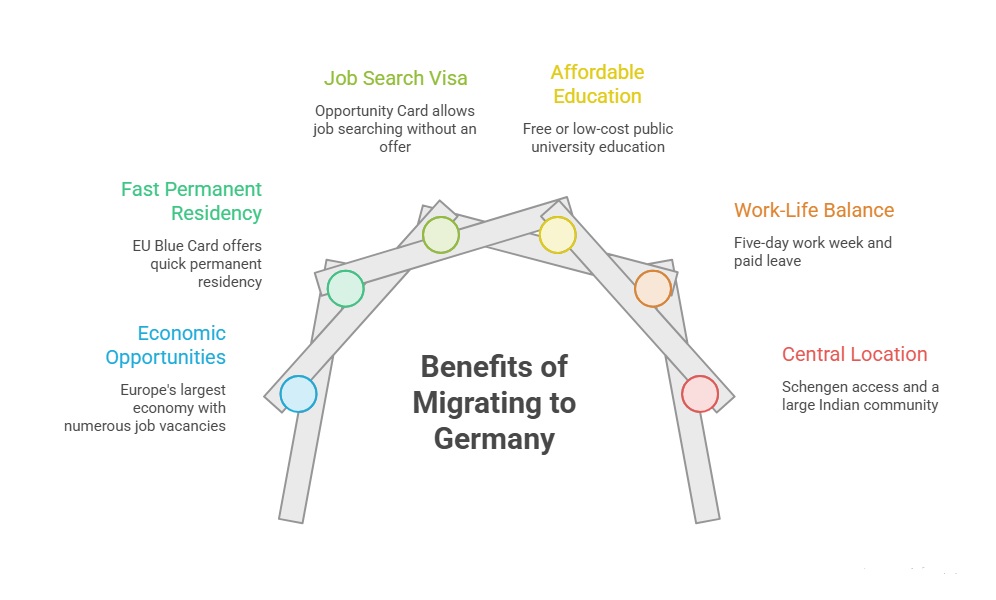
- Europe's largest economy, with over 770,000 job vacancies and around 90,000 skilled workers invited annually.
- The EU Blue Card offers one of Europe's fastest permanent residency timelines, as little as 21 months with German B1.
- The Opportunity Card (Chancenkarte) allows skilled professionals to search for work in Germany without a prior job offer.
- Free or low-cost public university education, along with strong social security and worker protections.
- A five-day working week, a minimum of 20 days of paid leave, and strong statutory health insurance coverage.
- Central European location with Schengen access, and a large, well-established Indian professional community.
*Want to work in Germany? Let Y-Axis assist you with the process.
Can I Move to Germany as an Indian Immigrant?
Most Indian nationals move to Germany through the EU Blue Card or the Skilled Worker Visa, both requiring a job offer from a German employer. Germany's Skilled Immigration Act, expanded further in 2024, also introduced the points-based Opportunity Card, letting skilled professionals enter Germany and search for work without a confirmed job offer.
Here is what you need to do to migrate to Germany:
Step 1: Get your education credentials recognised, if required, through Germany's ZAB/Anabin database
Step 2: Confirm your route such as EU Blue Card, Skilled Worker Visa, or the Opportunity Card if you don't yet have a job offer
Step 3: Secure a job offer, or apply for the Opportunity Card to search for qualified work in Germany
Step 4: Apply for your German national visa at the German consulate in India
Step 5: Undergo a medical checkup and arrange statutory or private health insurance
Step 6: Travel to Germany and register your address (Anmeldung) at the local Bürgeramt within 2 weeks of arrival
Step 7: Apply for your residence permit or EU Blue Card at the local Ausländerbehörde (immigration office)
Also, read...
What are the most in-demand jobs in Germany for Indian professionals?
Best Visa Options to Live in Germany
Germany offers several routes depending on your qualifications, job offer status, and career stage. The table below shows the main options for skilled workers and their route to long-term residence.
|
Visa Type |
Best For |
Duration |
Long-Term Pathway |
|
EU Blue Card |
Recognised degree + job offer; EUR 45,934.20-50,700/year (2026) |
Up to 4 years |
PR in 21 months (German B1) or 27 months (A1) |
|
Skilled Worker Visa (Fachkräfteeinwanderungsgesetz) |
Recognised vocational or academic qualification + job offer |
Up to 4 years |
PR after 5 years (4 years with B1 German and pension contributions) |
|
Opportunity Card (Chancenkarte) |
Job-seekers scoring 6+ points on education, language, and experience |
12 months (job search) |
Converts to Skilled Worker Visa or EU Blue Card once employed |
Also, read...
Best Areas to Live in Germany
Germany's job market and living costs vary significantly by city. Choosing the right area can influence your career opportunities, cost of living, housing expenses, and overall quality of life.
The table below highlights the major German cities and their best qualities for settlement abroad:
|
Area |
Best For |
Sightseeing |
Average Rent |
Job Market |
How Much You Can Save |
|
Berlin |
IT, startups & creative industries |
Brandenburg Gate, Museum Island |
EUR 900-1,200/mo (1BR) |
Strong, large startup and tech scene |
Moderate savings potential |
|
Munich |
Finance, automotive & engineering |
Marienplatz, English Garden |
EUR 1,200-1,800/mo (1BR) |
Strongest for engineering, highest salaries |
Lower, given highest cost of living |
|
Frankfurt |
Banking & finance |
Römer, city skyline |
EUR 1,100-1,400/mo (1BR) |
Strong, Germany's financial capital |
Good savings potential |
|
Hamburg |
Logistics, trade & media |
Port of Hamburg, Speicherstadt |
EUR 1,000-1,300/mo (1BR) |
Strong port and logistics job market |
Good savings potential |
|
Stuttgart |
Automotive & engineering |
Schlossplatz, Mercedes-Benz Museum |
EUR 1,100-1,400/mo (1BR) |
Strong, home to major automotive employers |
Good savings potential |
Also, read...
Cost of Living in Germany
Germany's cost of living changes significantly by city. Munich and Frankfurt cost the most, while Berlin remains comparatively more affordable for a capital city.
Below is a breakdown of average monthly expenses for a single adult in a mid-sized German city:
|
Rent (1BR apartment, city centre) |
EUR 800-1,200/month |
|
Utilities (electricity, heating, water) |
EUR 150-250/month |
|
Groceries |
EUR 200-300/month |
|
Public Transport |
EUR 60-100/month for a monthly pass |
|
Health Insurance |
Statutory contributions are shared between employer and employee, deducted from payroll |
|
Dining Out (per meal) |
EUR 12-20 |
|
Mobile & Internet |
EUR 30-50/month |
|
Entertainment & Leisure |
EUR 100-200/month |
Also, read...
Germany Opens Doors for Global Freelancers Through Its Flexible Freelance Visa. Apply Now!
Is Germany Expensive Compared to Switzerland or the UK?
No, Germany is considerably more affordable than Switzerland, and broadly comparable to or slightly cheaper than the UK, while still offering strong salaries in IT, engineering, and finance.
Salaries for skilled foreign professionals in Germany are proportionally strong against the local cost of living, so many immigrants build meaningful savings, particularly outside Munich and Frankfurt.
Cities like Berlin, Hamburg, and Stuttgart cost noticeably less than Munich or Frankfurt. This makes Germany a strong choice for immigrants who want a fast EU Blue Card PR timeline alongside a genuinely lower cost of living than Switzerland.
Also, read...
Germany Welcomes Skilled Researchers with Dedicated Long-Term Visa Route. Apply Now!
Work in Germany
Germany's job market runs on IT and software, engineering and automotive manufacturing, finance, and skilled trades, supported by a large base of multinational employers and a fast-growing Mittelstand (mid-sized company) sector.
The table below shows some of the most in-demand jobs in Germany for immigrants.
|
Occupation |
Average Annual Salary |
Demand Level |
Average Savings |
|
IT & Software Development |
EUR 55,000-90,000 |
Very High |
EUR 10,000-18,000/year |
|
Engineering (Mechanical, Automotive, Electrical) |
EUR 55,000-85,000 |
Very High |
EUR 10,000-16,000/year |
|
Healthcare (Nurses & Doctors) |
EUR 45,000-90,000 |
High |
EUR 8,000-16,000/year |
|
Finance & Banking |
EUR 60,000-100,000 |
High |
EUR 12,000-20,000/year |
|
Skilled Trades (Electricians, Plumbers) |
EUR 40,000-55,000 |
High |
EUR 6,000-10,000/year |
|
Academia & Research |
EUR 50,000-70,000 |
Moderate |
EUR 7,000-12,000/year |
Also, read...
What are the Eligibility Requirements for a Germany Work Visa?
Settling in Germany
Once you arrive in Germany, you need to register your address, arrange health insurance, enrol children in school, and set up banking.
Here is a quick overview of what to expect during your first weeks in the country:
|
Housing |
Healthcare |
Education for Children |
Banking & Financial Essentials |
|
Search via ImmoScout24 or WG-Gesucht; competitive rental market in Munich and Berlin |
Mandatory statutory health insurance (or private for high earners); register with a Krankenkasse soon after arrival |
Free public schools and universities; international schools available in major cities for expat children |
Open an account with Deutsche Bank, Sparkasse, Commerzbank, or N26 |
|
Landlords typically require a SCHUFA credit check and 2-3 months' deposit |
Statutory insurance covers most hospital visits and prescriptions once registered |
Public school enrolment is straightforward; international schools have limited seats and fill up early |
Address registration (Anmeldung) is usually required before opening an account |
|
Allow several weeks to secure a rental in Munich or Berlin, given demand |
Register with a Krankenkasse within the first few weeks of arrival |
Apply for school places as early as possible, especially for international schools |
Basic accounts can typically be opened within a few days once documents are ready |
Also, read...
Germany Simplifies Family Reunification Visa Rules for Spouses. Apply Now!
Permanent Residence in Germany
Permanent residence in Germany follows one of Europe's fastest timelines for EU Blue Card holders, while the standard Skilled Worker Visa route takes longer.
The table below shows the main routes and their approximate timelines:
|
Stage |
Requirement |
Approx. Timeline |
|
EU Blue Card Holder |
Recognised degree, job offer meeting the salary threshold |
PR in 21 months with German B1, or 27 months with A1 |
|
Skilled Worker Visa Holder |
Recognised qualification, ongoing employment and pension contributions |
PR after 5 years (4 years with German B1) |
|
Opportunity Card Holder |
6+ points; converts to Skilled Worker Visa or EU Blue Card once employed |
12 months job search, then standard PR timeline applies |
|
Permanent Settlement (Niederlassungserlaubnis) |
Sufficient pension contributions, German B1, secure income |
Final stage of the PR process |
|
German Citizenship |
5 years of legal residence (reduced from 8), B1 German, integration requirements |
Dual citizenship generally permitted since the 2024 reform |
*Want to apply for Germany PR dependent visa? Let Y-Axis guide you with the steps.
Dependent Benefits for Immigrants in Germany
Germany allows eligible visa holders to bring immediate family members, with strong work rights attached in many cases.
Here are the benefits of securing a Germany dependent visa:
- Spouses of EU Blue Card holders receive immediate, unrestricted work rights without needing to prove German language skills
- Family members of Skilled Worker Visa holders can also join through family reunification, often with simplified language requirements
- Children of visa holders can enrol in Germany's free public schools
- Family members can access statutory health insurance coverage once registered
- Spouses on family reunification visas can generally take up employment without a separate work permit
*Want to apply for a Germany work dependent visa? Let Y-Axis assist you with the steps.
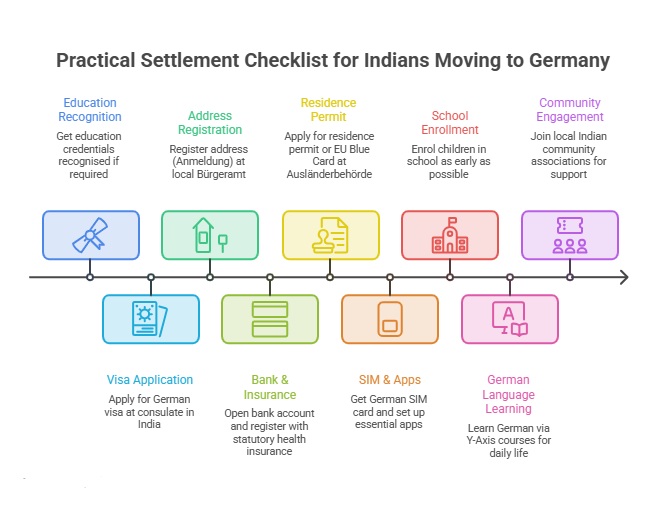
Practical Settlement Checklist for Indians Moving to Germany
Moving to Germany involves a few key steps. Complete them in order to avoid delays.
Follow the steps below for a smooth move to Germany:
Step 1: Get your education credentials recognised before applying, if required
Step 2: Apply for your German visa at the consulate in India
Step 3: Register your address (Anmeldung) at the local Bürgeramt within 2 weeks of arrival
Step 4: Open a bank account and register with a statutory health insurance provider (Krankenkasse)
Step 5: Apply for your residence permit or EU Blue Card at the local Ausländerbehörde
Step 6: Get a German SIM card and set up essential banking and transport apps
Step 7: Enrol children in school as early as possible
Step 8: Learn German via Y-Axis German Language Learning Courses and Classes for daily life, even if your workplace uses English
Step 9: Join local Indian community associations for support and networking
*Are you looking for step-by-step assistance with Germany immigration? Contact Y-Axis, the world's No. 1 overseas immigration consultancy!
FAQs
What is the easiest way for Indians to move to Germany?
Most Indians move through the EU Blue Card or the Skilled Worker Visa, both requiring a job offer from a German employer. If you do not have a job offer yet, the Opportunity Card (Chancenkarte) allows you to enter Germany and search for qualified work for up to 12 months, provided you score at least 6 points under Germany's points-based system.
What changed in Germany's EU Blue Card salary thresholds in 2026?
From January 1, 2026, Germany increased its EU Blue Card salary thresholds by approximately 5%. The minimum annual salary is EUR 50,700 for standard occupations and EUR 45,934.20 for shortage occupations, recent graduates, and qualifying IT specialists. Applications submitted after this date must meet the updated salary requirements.
Can I move to Germany without a job offer?
Yes. Germany's Opportunity Card (Chancenkarte) allows qualified non-EU professionals to enter Germany without a job offer and search for employment for up to 12 months. Applicants must score at least 6 points and demonstrate financial self-sufficiency of approximately EUR 1,091 per month.
Is healthcare free for immigrants in Germany?
Germany operates a mandatory public health insurance system, with private insurance available for eligible higher earners. Contributions are generally shared between employers and employees. Once registered with a statutory health insurance provider (Krankenkasse), most medical services, hospital treatment, and prescription medications are covered.
What is the average salary for skilled workers in Germany?
Salaries vary depending on the profession and city. Typical annual salary ranges include:
- IT & Engineering: EUR 55,000–90,000
- Finance (Frankfurt): EUR 60,000–100,000
- Skilled Trades: EUR 40,000–55,000
Munich and Frankfurt generally offer the highest salaries but also have higher living costs.
Can I bring my family to Germany on a work visa?
Yes. Family reunification is available for eligible work visa holders. Spouses of EU Blue Card holders can usually work in Germany without restrictions and are generally not required to demonstrate German language proficiency before arrival. Children may also accompany the primary applicant and attend Germany's public schools.
Which city in Germany is best for Indian immigrants?
The ideal city depends on your profession and lifestyle preferences.
- Berlin: Technology, startups, international community
- Munich: Engineering, automotive, high salaries
- Frankfurt: Banking and finance
- Stuttgart: Manufacturing and automotive industries
- Hamburg: Logistics, shipping, and international trade
Each city offers different employment opportunities and living costs.
How much does it cost to live in Germany?
The cost of living depends on the city. In Berlin, a single person can typically expect the following monthly expenses:
- One-bedroom apartment: EUR 900–1,200
- Groceries: EUR 200–300
- Utilities: EUR 150–250
Munich and Frankfurt generally have higher housing and overall living costs than most other German cities.
Do I need to speak German to live and work in Germany?
Not always. English is commonly used in Germany's IT sector, multinational companies, finance, and many international workplaces, particularly in cities such as Berlin, Munich, and Frankfurt. However, learning German significantly improves daily life, employment opportunities, and is generally required at the B1 level for permanent residence and citizenship eligibility.
How can I get German citizenship?
Eligible foreign nationals may apply for German citizenship after 5 years of continuous legal residence, provided they meet the applicable requirements, including:
- B1-level German language proficiency
- Financial self-sufficiency
- Successful integration into German society
- Meeting all legal residency requirements
Germany generally permits dual citizenship. However, India does not recognize dual citizenship, so Indian nationals should seek professional guidance before applying.
Tags:
Germany immigration
Germany work visa
Germany permanent residency
Living in Germany
Cost of living in Germany
Best areas in Germany
Jobs in Germany for Indians
Healthcare in Germany
Housing in Germany
Settle in Germany
Share
Options for you by Y-Axis

Get it on your mobile

Get News alerts

Contact Y-Axis
Latest Article
Popular Post
Trending Article
Posted On September 18 2026
What Are the Different Types of Canada Visas to Immigrate?