

Posted on June 24 2026
Germany Simplifies Family Reunification Visa Rules for Spouses. Apply Now!

By , Editor & Director
Updated June 27 2026
Highlights: Germany Strengthens Family Reunification Benefits for Spouses Seeking Relocation
- Germany continues to facilitate family reunification through its Spouse Visa, allowing eligible spouses of German citizens and legal residents to live together in the country.
- Eligible applicants can obtain a Type D national visa valid for 3–12 months, before converting it into a residence permit after arriving in Germany.
- Spouse visa holders can work without restrictions, pursue higher education, and access long-term settlement opportunities in Germany.
- Applicants must provide proof of marriage, their sponsor’s legal status in Germany, travel insurance, and basic German language proficiency at the A1 level.
- The visa can lead to permanent residence after three years and may provide a faster pathway to German citizenship for eligible spouses.
*Want to apply for a Germany dependent visa? Let Y-Axis assist you with the process.
Germany Spouse Visa Opens Pathways to Family Reunification and Long-Term Settlement
Germany’s Spouse Visa allows the husband, wife, or registered civil partner of a German citizen or a foreign national legally residing in Germany to join their partner and live in the country. Issued as a Type D national visa, it is generally valid for 3 to 12 months and can be converted into a residence permit after arrival. Applicants are typically required to demonstrate basic German language proficiency at the A1 level and submit proof of a genuine marital relationship.
The visa offers several long-term benefits, including unrestricted work rights, access to higher education, and pathways to permanent residence and citizenship. Eligible spouses may qualify for permanent residency after three years in Germany, while spouses of German citizens can apply for citizenship after three years of residence and at least two years of marriage, subject to language and other eligibility requirements.
| Category | Details |
|---|---|
| Visa Type | Germany Spouse Visa (Type D National Visa) |
| Who Can Apply | Spouses of German citizens or foreign nationals holding a valid residence permit, settlement permit, or EU Blue Card. |
| Visa Validity | Generally 3–12 months |
| Language Requirement | Basic German proficiency (A1 level) |
| Key Documents | Marriage certificate, visa application form, biometric photos, proof of spouse's status in Germany, employment and accommodation documents, and health insurance. |
| Work Rights | Unrestricted access to employment in Germany |
| Study Rights | Eligible to study at German universities without a separate student visa |
| Permanent Residence | Possible after 3 years of residence for eligible spouses |
| Citizenship Pathway | Available after meeting residence, marriage duration, and language requirements |
| Application Location | German embassy or consulate in the applicant's country of residence |
Also, read...
Germany Welcomes Skilled Researchers with Dedicated Long-Term Visa Route. Apply Now!
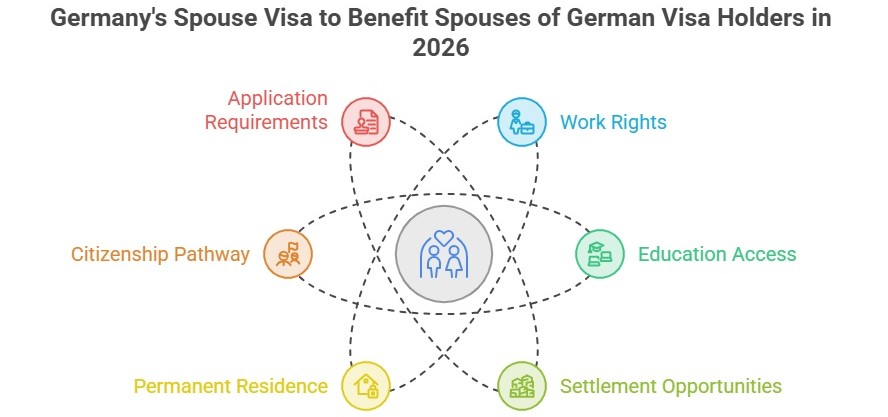
How Germany’s Family Reunification Policies Benefit Spouses of Visa Holders in 2026?
The Germany Spouse Visa offers more than just family reunification. In 2026, it continues to provide spouses of German citizens and legal residents with access to employment, education, and long-term settlement opportunities. The visa helps families build a stable future together in Germany while offering a clear pathway to permanent residence and, eventually, citizenship.
Key benefits of the Germany Spouse Visa are as follows:
- Live legally in Germany with your spouse under family reunification provisions.
- Work in Germany without requiring a separate work permit.
- Study at German universities and educational institutions without applying for a separate student visa.
- Access a pathway to permanent residence after meeting eligibility requirements.
- Become eligible for German citizenship through an accelerated route for qualifying spouses.
- Benefit from long-term family stability and integration opportunities in Germany.
- Access Germany’s healthcare, education, and social infrastructure as a legal resident.
- Travel within the Schengen Area in accordance with applicable residence permit rules.
*Are you looking for step-by-step assistance with Germany immigration? Contact Y-Axis, the world’s No. 1 overseas immigration consultancy!
For recent immigration updates, check out the Y-Axis Schengen News Page!
FAQ's
What is the Germany Spouse Visa?
The Germany Spouse Visa is a long-stay national visa that allows the spouse or registered civil partner of a German citizen or legal resident to join them in Germany. It is issued under Germany’s family reunification framework and is typically valid for three to twelve months. After arrival, visa holders can apply for a residence permit. The visa supports family unity and provides access to employment, education, and long-term settlement opportunities for eligible applicants.
Who is eligible to apply for a Germany Spouse Visa?
The visa is available to spouses of German citizens and foreign nationals who legally reside in Germany with a valid residence permit, settlement permit, or EU Blue Card. Applicants must demonstrate a genuine marital relationship and meet the required documentation standards. In most cases, proof of basic German language proficiency is also necessary. Eligibility may vary depending on the sponsor’s immigration status and the applicant’s country of citizenship.
What documents are required for a Germany Spouse Visa application?
Applicants generally need a completed visa application form, biometric photographs, a legalized marriage certificate, and proof of their spouse’s legal status in Germany. Additional documents may include employment records, salary slips, proof of accommodation, travel health insurance, and language certificates. German authorities may request translated and authenticated copies of documents depending on the country of issuance. Requirements can vary slightly among German embassies and consulates worldwide.
Is German language proficiency required for a spouse visa?
Yes, most applicants are required to demonstrate basic German language skills at the A1 level before obtaining a spouse visa. This requirement is intended to support integration into German society and daily life. Applicants typically submit a recognized language certificate issued by an approved testing provider. Certain exemptions may apply depending on the sponsor’s status, the applicant’s nationality, or specific personal circumstances recognized under German immigration regulations.
Can spouse visa holders work in Germany?
Yes, individuals who receive a spouse residence permit in Germany are generally allowed to work without restrictions. They do not need to obtain a separate work permit to take up employment. This provides flexibility to seek opportunities across different sectors and professions. Access to the labor market helps spouses integrate more easily into German society while contributing to the country’s economy and improving their long-term settlement prospects.
Can spouses study in Germany after receiving a residence permit?
Yes, spouse residence permit holders can enroll in German universities, colleges, and other educational institutions without obtaining a separate student visa. This allows spouses to pursue academic degrees, vocational training, or professional development programs while living in Germany. Access to education can improve career prospects and integration opportunities. Applicants must still meet the admission requirements of their chosen educational institution and comply with relevant academic regulations.
How long does it take to process a Germany Spouse Visa?
Processing times vary depending on the applicant’s country of residence, the German mission handling the application, and the completeness of submitted documents. In many cases, applications may take several weeks to a few months for approval. Delays can occur if additional verification is required. Applicants are advised to apply well in advance of their planned travel date and ensure that all supporting documents are accurate and complete.
Can a Germany Spouse Visa lead to permanent residence?
Yes, the spouse visa can serve as a pathway to permanent residence in Germany. Eligible spouses who have lived in Germany for a specified period and meet integration requirements may apply for a settlement permit. For many spouses of German citizens or settlement permit holders, permanent residence may be possible after three years. Permanent residency provides greater security and allows individuals to remain in Germany without renewing temporary permits frequently.
Can spouses of German citizens apply for German citizenship?
Yes, spouses of German citizens may qualify for a faster route to citizenship compared to standard naturalization pathways. In general, applicants can apply after three years of legal residence in Germany if they have been married for at least two years and meet language and integration requirements. Citizenship offers full participation in German civic life, including voting rights, unrestricted residence rights, and access to a German passport.
What are the main benefits of Germany’s family reunification policies?
Germany’s family reunification policies help families live together while providing access to important social and economic opportunities. Eligible spouses can work without restrictions, pursue education, obtain residence permits, and build a long-term future in Germany. The policies also create pathways to permanent residency and citizenship for qualifying individuals. By supporting family unity and integration, these measures help newcomers establish stable lives and contribute to German society.
📞 Call: +91-7670800000
📩 Email: info@y-axis.com
🌐 Visit: https://www.y-axis.com
Tags:
Germany spouse visa
Germany dependent visa
Germany work dependent visa
Germany family reunification policies
migrate to Germany
Germany immigration
work in Germany
Schengen visas
Germany work visas
Germany immigration news
Share
Options for you by Y-Axis

Get it on your mobile

Get News alerts

Contact Y-Axis
Latest Article
Related Post
Trending Article

Posted On September 16 2026
Belarus Makes Travel Easier for Indians With New E-Visa Facility. Apply Now!