


Don't know what to do?
Get free Counselling
Last Updated 21 May 2026
About the Germany PR Dependent Visa
The Germany PR Dependent Visa allows the spouse and dependent children of individuals who have earned permanent residence in Germany to join them and build a stable, long-term life together.
Germany's permanent residence is formally known as the Niederlassungserlaubnis (Settlement Permit). It is one of the most secure immigration statuses in Europe. The Settlement Permit is valid indefinitely and grants the right to work in any sector, in any job, for any employer — without restriction.
If your spouse or parent holds a valid Niederlassungserlaubnis in Germany — whether earned through the EU Blue Card route, the Skilled Worker Visa route (Section 18a / 18b AufenthG), or any other qualifying pathway — the Germany PR Dependent Visa is the official immigration route that allows your family to join them in Germany.
Unlike dependants of temporary work visa holders, PR dependants benefit from the exceptional stability of a sponsor who holds indefinite leave to remain in Germany. The family's own path to a German settlement permit is clearly defined and achievable within a fixed number of years of lawful residence.
India is one of the fastest-growing source countries for skilled workers earning German PR. Indian professionals in IT, engineering, healthcare, and finance are now achieving the Niederlassungserlaubnis in record numbers. As a result, demand for the Germany PR Dependent Visa from Indian families has risen sharply in recent years.
Germany PR Dependent Visa: Key Facts at a Glance
|
Category |
Details |
|
Visa Type |
Family Reunification Visa (Familiennachzug) — National Visa (Type D) |
|
Applicable For |
Spouse or registered partner and dependent children of German Settlement Permit (Niederlassungserlaubnis) holders |
|
Who Can Apply (Dependants) |
Legally married spouse, registered civil partner, unmarried dependent children under 18 years of age |
|
Sponsor Requirement |
Must hold a valid Niederlassungserlaubnis (Settlement Permit) — also applicable where sponsor holds an EC long-term resident status |
|
Work Rights (Spouse) |
Full and unrestricted — no separate work permit or employer sponsorship required |
|
Study Rights |
Full — spouse and children may study at any registered German educational institution |
|
Language Requirement (Spouse) |
A1 German generally required — exemptions apply depending on the type of Settlement Permit held by the sponsor; verify with the competent German mission |
|
Visa Fee (Adult) |
EUR 75 (approx. INR 7,000) |
|
Visa Fee (Child aged 6 to 17) |
EUR 37.50 (approx. INR 3,500) |
|
Visa Fee (Child under 6) |
Free |
|
Processing Time |
1 to 3 months from German embassy / consulate; 6 to 12 weeks for residence permit in Germany after arrival |
|
Validity |
Temporary residence permit initially — extendable; pathway to own Settlement Permit after qualifying years of lawful residence |
|
Health Insurance |
Statutory or private health insurance required for all dependants from arrival |
|
Accommodation Requirement |
Sponsor must prove adequate housing — approx. 12 sqm minimum per person |
|
Financial Requirement |
Approx. EUR 1,200 per month for couple + EUR 300 per additional dependent child (indicative — may vary by federal state) |
|
Application Method |
Online via German Consular Services Portal (digital.diplo.de) or at VFS Global centres in India |
* Interested to check your eligibility for the Germany PR Dependent Visa? Sign up with Y-Axis for a free profile evaluation.
Germany PR Dependent Visa: Overview
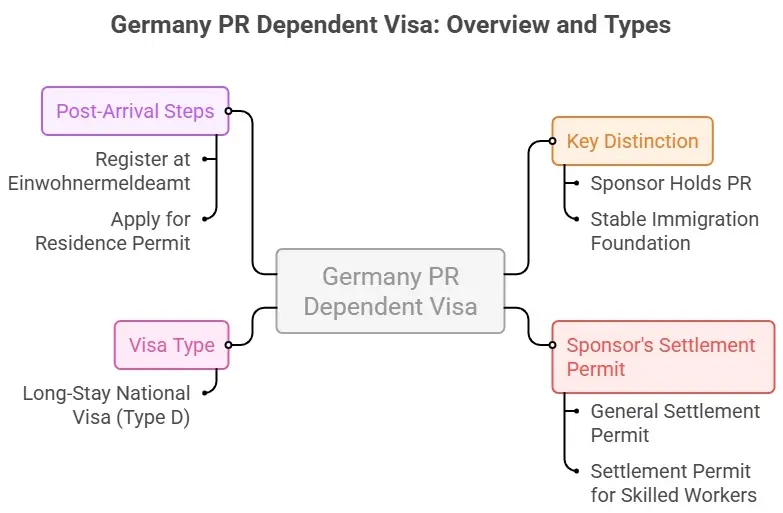
The Germany PR Dependent Visa is issued under Germany's Residence Act (Aufenthaltsgesetz — AufenthG). It allows close family members to join a sponsor who has already been granted permanent residence in Germany through the Niederlassungserlaubnis.
The key distinction of the Germany PR Dependent Visa compared to a regular family reunification visa for joining a work visa holder is that the sponsor already holds indefinite leave to remain. This gives the entire family a more stable immigration foundation. The sponsor does not need to renew a residence permit, and the family's long-term plans in Germany are not subject to the validity of a temporary work visa.
There are two main types of settlement permit that a sponsor may hold when a dependant applies for the Germany PR Dependent Visa:
- General Settlement Permit (Section 9 AufenthG): Granted after a specified number of years of lawful residence, meeting language, financial, and integration requirements.
- Settlement Permit for Skilled Workers (Section 18c AufenthG): Granted to skilled workers who have successfully worked in Germany for a qualifying period under the Skilled Immigration Act. Spouses joining holders of this permit may be exempt from the A1 German language requirement at the visa stage — subject to official confirmation.
The visa issued is a long-stay national visa (Type D). Once the dependant arrives in Germany, they must register at the local residents' registration office (Einwohnermeldeamt) and then apply for a residence permit (Aufenthaltserlaubnis) from the local immigration authority (Auslaenderbehoerde).
*Want to apply for Germany work visa? Let Y-axis guide you with the process.
Benefits of the Germany PR Dependent Visa for Indian Families
The Germany PR Dependent Visa gives Indian families one of the most comprehensive and stable dependent visa packages in Europe. Key benefits include:
- Spouses receive full, unrestricted work rights from the day the residence permit is issued in Germany. No separate work permit, no employer sponsorship, and no Labour Market Test is required.
- The sponsor holds indefinite leave to remain — the family's immigration status is not tied to a temporary work permit renewal cycle.
- Dependent children receive compulsory, free education at German state schools from the day they arrive. No school fees for primary and secondary education.
- Dependants accumulate lawful years of residence in Germany towards their own Settlement Permit (Niederlassungserlaubnis). After the qualifying period, they can apply for German PR independently.
- Spouses joining holders of a Skilled Worker Settlement Permit (Section 18c AufenthG) may be exempt from the A1 German language requirement at the visa stage — subject to confirmation with the German embassy.
- Dependants gain access to Germany's world-class statutory health insurance system once employed, and private health insurance from arrival.
- Berlin, Munich, Frankfurt, Hamburg, Stuttgart, and Cologne offer excellent infrastructure, safety, and growing Indian communities. Germany is one of the safest and most family-friendly destinations in Europe.
- Germany's reformed citizenship law (effective June 2024) reduced the minimum residence period for naturalization from eight to five years. This means the whole family has a faster route to German citizenship. Note: India does not currently recognise dual citizenship — Indian nationals wishing to acquire German citizenship must renounce their Indian passport; OCI status is available thereafter.
*Want to migrate to Germany? Let Y-Axis guide you with the steps.
Who is Eligible for the Germany PR Dependent Visa?
Eligible Dependants
The following family members of a German Settlement Permit holder may apply for the Germany PR Dependent Visa:
- Legally married spouse in a valid marriage recognised under German law.
- Registered civil partner (same-sex partnerships are recognised in Germany).
- Unmarried dependent children under 18 years of age — biological, adopted, or step-children.
- Children aged 16 to 17 years: Eligible if they can demonstrate sufficient knowledge of the German language OR if both parents or the sole-custody parent hold a valid German settlement permit. Otherwise, individual assessment applies.
Note: Parents, siblings, and adult independent children of the sponsor are generally not eligible under the Germany PR Dependent Visa route.
Primary Applicant (Sponsor) Requirements
|
Requirement |
Details |
|
Residence Status |
Must hold a valid Niederlassungserlaubnis (Settlement Permit) or EC long-term resident status in Germany at the time of the dependant's application |
|
Registration in Germany |
Must be legally registered at a German address — Meldebescheinigung (certificate of registration) required, not older than 6 months |
|
Financial Capacity |
Must demonstrate sufficient income to support the family — approx. EUR 1,200 per month (net, after deductions) for the couple + EUR 300 per additional dependent child |
|
Accommodation |
Must have adequate housing — approx. 12 sqm minimum living space per person, evidenced by rental contract (Mietvertrag) or property ownership documents |
|
Health Insurance for Dependants |
Must confirm health insurance is in place for all family members joining in Germany |
|
Good Character |
No criminal record that would prevent family reunification under German immigration law |
Can Germany PR Dependent Visa Holders Work in Germany?
Yes. Spouses of German Settlement Permit (PR) holders who are in Germany on a family reunification residence permit are fully entitled to work from the day their residence permit is issued. No separate work permit is required, and no employer sponsorship is needed.
|
Type of Work / Activity |
Permitted for Dependent Spouse? |
|
Full-time employment (any sector) |
Yes — unrestricted from day one of residence permit issuance |
|
Part-time employment |
Yes — unrestricted |
|
Self-employment / freelance work |
Yes — after completing the relevant business registration in Germany |
|
Work for any employer (not tied to sponsor's employer) |
Yes — no restriction |
|
Change employer freely |
Yes — no restriction on changing employers at any time |
|
Work in a different German city from the primary applicant |
Yes — no geographic restriction |
|
Remote work for an Indian employer (from within Germany) |
Permitted in most cases — tax and social security obligations apply; confirm with a qualified tax adviser |
|
Separate work permit required? |
No — work rights are included in the family reunification residence permit; no additional authorisation needed |
Note: Dependent children under 18 do not hold independent work rights but may undertake vocational training (Ausbildung) or internships in line with German labour law.
Also, read...
Study Rights for Germany PR Dependent Visa Holders
Dependent family members on a Germany PR family reunification residence permit can study at any registered German educational institution — schools, universities, vocational colleges, or language institutes — without restriction.
|
Study Aspect |
Details for Dependants |
|
Spouse / Partner |
Can study full-time or part-time at any German university, college, vocational school, or language institute — no restriction |
|
Children (school age) |
Compulsory school attendance (Schulpflicht) applies — state (public) primary and secondary school is free for all children residing in Germany |
|
German Integration Courses (BAMF) |
Dependants are entitled and strongly encouraged to attend BAMF integration courses — includes German language up to B1 level and civic orientation; free or subsidised for eligible participants |
|
Vocational Training (Ausbildung) |
Dependants can enrol in German apprenticeship programmes (dual system) — a highly regarded and well-paid pathway to employment in Germany |
|
University Education |
No restriction — dependants may apply to German public universities, most of which charge no tuition fees (only a small semester contribution per term) |
|
Student Financial Assistance |
BAfoG student support is generally not available while on a temporary residence permit — may become accessible after meeting long-term residence conditions |
Also, read...
Germany Opens New Study and Research Pathways for Indians. Apply Now!
Germany PR Dependent Visa Fees
|
Fee Type |
Amount (EUR) |
Amount (INR approx.) |
|
National Visa (Type D) — Adult applicant (18+) |
EUR 75 |
INR 7,000 approx. |
|
National Visa (Type D) — Child aged 6 to 17 |
EUR 37.50 |
INR 3,500 approx. |
|
National Visa (Type D) — Child under 6 years |
Free |
Free |
|
Residence Permit in Germany (Aufenthaltserlaubnis) — after arrival |
EUR 100 to EUR 110 per person (approx.) |
INR 9,300 to INR 10,200 approx. |
|
Health Insurance (statutory / private) — per person per year |
EUR 200 to EUR 900+ (varies by insurer and age) |
INR 18,600 to INR 83,700+ approx. |
|
German Language Course A1 (if required) — in India |
EUR 150 to EUR 500 approx. (varies by institute) |
INR 14,000 to INR 46,500 approx. |
|
Document Apostille (MEA India, per document) |
Varies |
INR 500 to INR 3,000 approx. |
|
Certified Translation (per document, German or English) |
Varies |
INR 800 to INR 2,500 approx. |
|
VFS Global Service Fee (India) |
Varies by city and service |
INR 1,400 to INR 2,500 approx. |
|
Y-Axis Professional Consultancy Fee |
As per service package |
As per service package |
Note: The visa application fee is paid at the German embassy or VFS Global centre at the time of application. The residence permit fee in Germany is paid at the local Auslaenderbehoerde after arrival. Exchange rate: approx. 1 EUR = INR 93. Fees are subject to revision — always confirm with the German mission before applying.
Germany PR Dependent Visa Processing Time
|
Stage |
Estimated Time |
|
German Language A1 Course and Exam (if required) |
4 to 8 weeks (varies by institute and availability in your city in India) |
|
Document Apostille — MEA India (e-Apostille) |
3 to 7 business days |
|
Document Apostille — MEA India (offline) |
2 to 4 weeks |
|
Certified Translation of Documents |
3 to 7 business days |
|
VFS Global / Consulate Appointment Booking (India) |
2 to 6 weeks (varies by city; Delhi and Mumbai can be longer — book early) |
|
Embassy / Consulate Processing Time (after submission) |
6 to 12 weeks (approx. 1 to 3 months) |
|
Residence Permit Application in Germany (after arrival) |
6 to 12 weeks at the local Auslaenderbehoerde |
|
Total Estimated Timeline — Language-exempt dependants |
2 to 4 months from preparation to visa grant |
|
Total Estimated Timeline — Dependants requiring A1 German |
3 to 6 months from preparation to visa grant |
Note: Processing times are indicative. Submitting a complete, correctly apostilled, and translated document set significantly reduces the risk of delays or requests for additional documents. Start preparation early — VFS appointment slots in major Indian cities can fill up weeks in advance.
Documents Required for the Germany PR Dependent Visa
Documents for Spouse / Registered Partner
- Marriage certificate — apostilled and with a certified translation into German or English (confirm language requirement with the competent consulate).
- Proof of sponsor's valid Niederlassungserlaubnis (Settlement Permit) in Germany — copy of the settlement permit card.
- Certificate of residence (Meldebescheinigung) of the sponsor in Germany — not older than 6 months.
- Proof of adequate accommodation in Germany — rental contract (Mietvertrag) or property ownership documents.
- Proof of sufficient funds — sponsor's last 3 months' payslips and German bank statements.
- Health insurance coverage confirmation for the dependant in Germany.
- Proof of German A1 language proficiency (if required) — Goethe-Institut or other recognised test certificate.
- Cover letter explaining the application and the family situation.
- Valid passport (minimum 6 months validity beyond planned stay).
- Completed visa application form (via digital.diplo.de).
- Two recent biometric passport-size photographs (per German biometric standards).
Documents for Dependent Children
- Valid passport (minimum 6 months validity beyond planned stay).
- Two recent biometric passport-size photographs per child.
- Birth certificate — apostilled and with certified translation.
- Proof of sponsor's valid Niederlassungserlaubnis (Settlement Permit) in Germany.
- Certificate of residence (Meldebescheinigung) of the sponsor.
- School records or current school enrolment certificate (if applicable).
- Custody documents or court-approved arrangements (where applicable).
- Written consent of the non-travelling parent (if the child travels with only one parent) — notarised and apostilled.
- German language certificate (for children aged 16 to 17 years, where required by the German mission).
Financial and Supporting Documents
- Sponsor's last 3 months' payslips from their German employer or proof of other income source.
- Sponsor's current employment contract or proof of self-employment / business income.
- Sponsor's last 3 months' German bank statements.
- Copy of sponsor's Niederlassungserlaubnis (Settlement Permit) card.
- Tax registration number (Steueridentifikationsnummer) of the sponsor in Germany.
Note: All documents not in German or English must be translated by a certified or sworn translator. Apostille is required on all Indian official documents — marriage certificates, birth certificates, and other relevant records. Always check the specific document checklist issued by the German Embassy India or VFS Global for the latest requirements before your appointment.
Also, read...
How to Apply for the Germany PR Dependent Visa from India
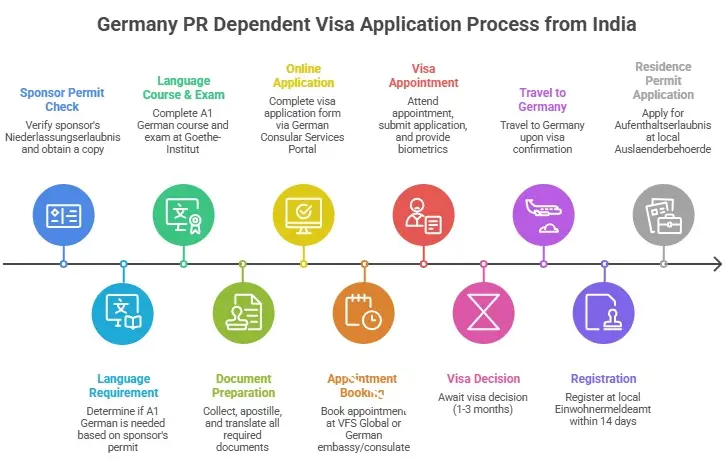
Follow these steps to apply for the Germany PR Dependent Visa from India:
Step 1: Confirm the sponsor holds a valid Niederlassungserlaubnis (Settlement Permit) in Germany — obtain a copy of the settlement permit card.
Step 2: Determine language requirements — check with the German embassy or Y-Axis whether A1 German is required for your specific application based on the sponsor's permit type.
Step 3: Complete the German A1 language course and exam at the Goethe-Institut or an authorised centre in India, if required.
Step 4: Collect, apostille, and translate all required documents — marriage certificate, birth certificates, accommodation proof, financial documents.
Step 5: Complete the visa application form online via the German Consular Services Portal (digital.diplo.de).
Step 6: Book an appointment at the nearest VFS Global centre in India or at the German embassy/consulate directly.
Step 7: Attend the appointment, submit the application, and provide biometrics on the scheduled date.
Step 8: Await the visa decision — processing takes approximately 1 to 3 months.
Step 9: Upon visa confirmation, travel to Germany.
Step 10: Register at the local Einwohnermeldeamt (residents' registration office) within 14 days of arrival.
Step 11: Apply for the residence permit (Aufenthaltserlaubnis) at the local Auslaenderbehoerde — bring all original documents.
Also, read...
Financial Requirements for the Germany PR Dependent Visa
The sponsor in Germany must prove that they can financially support all family members without relying on German public funds (Buergergeld or equivalent). This is a key requirement under German immigration law. The exact income threshold varies by German federal state (Bundesland) and is subject to periodic revision.
|
Financial Requirement |
Details |
|
Minimum income for sponsor + spouse |
Approx. EUR 1,200 per month (net, after tax and deductions) — indicative; confirm with the relevant Auslaenderbehoerde |
|
Additional income per dependent child |
Approx. EUR 300 per month per child (indicative — may vary by federal state) |
|
Documents required |
Last 3 months' payslips, current employment contract with salary details, last 3 months' German bank statements |
|
Public funds restriction |
Application may be refused if the family's income depends on public assistance (Buergergeld or equivalent social benefits) |
|
Self-employed sponsors |
Must provide tax assessments, business accounts, and proof of stable income — assessed on a case-by-case basis |
|
Important note |
The exact income threshold varies by German federal state. Confirm the latest figures with the local Auslaenderbehoerde or with Y-Axis immigration advisers before applying. |
Also, read...
Can I convert a Germany Opportunity Card to PR?
Accommodation Requirements for the Germany PR Dependent Visa
The sponsor must prove adequate housing in Germany to accommodate all family members. German immigration law specifies minimum living space standards.
|
Accommodation Requirement |
Details |
|
Minimum living space |
Approx. 12 square metres per person — minimum standard under German law (may vary by federal state and local authority) |
|
Documents required |
Rental contract (Mietvertrag) or property ownership documents confirming the address and size of the accommodation |
|
Landlord confirmation |
In some cases, written confirmation from the landlord that the accommodation is suitable for the number of family members may be requested |
|
Temporary accommodation |
If permanent accommodation is not yet secured, a confirmed hotel booking or temporary accommodation address may be accepted at the visa application stage |
|
Adequacy assessment |
The accommodation must be adequate for the whole family — overcrowded or substandard accommodation is a common reason for family reunification applications to be refused or delayed |
German Language Requirements for the Germany PR Dependent Visa
German language skills are generally required for spouses applying for the Germany PR Dependent Visa. However, important exemptions apply — and the specific requirement depends on the type of settlement permit held by the sponsor.
|
Scenario |
Language Requirement |
|
Spouse joining a Skilled Worker Settlement Permit holder (Section 18c AufenthG) |
Generally EXEMPT — no A1 German proof required at the visa application stage (subject to official confirmation with the German mission) |
|
Spouse joining a general Settlement Permit holder (Section 9 AufenthG) |
A1 German language skills generally required before applying for the visa |
|
Spouse who cannot reasonably be expected to acquire German (hardship exception) |
Exempt — evidence of the impossibility is required; assessed case by case |
|
Level required (where applicable) |
A1 level per the Common European Framework of Reference for Languages (CEFR) — basic everyday communication in German |
|
Recognised testing centres in India |
Goethe-Institut centres in Mumbai, New Delhi, Bengaluru, Chennai, Kolkata, Pune, Hyderabad — and other authorised test centres |
|
Language support after arrival in Germany |
BAMF integration courses — free or subsidised; covers German up to B1 level and civic orientation; strongly recommended for all family members |
|
Children (under 16) |
No German language test required at the visa stage for children under 16 years of age |
|
Children (aged 16 to 17) |
Must demonstrate sufficient German language knowledge OR prove that both parents / sole-custody parent hold a valid German settlement permit |
Note: Always confirm the language requirement with the specific German consulate you will apply through or with Y-Axis immigration advisers. Policy interpretation can vary by consulate and individual circumstance.
Germany PR Dependent Visa: Validity and Extension
The Germany PR Dependent Visa is a national Type D visa that permits entry into Germany. The formal residence permit is granted by the local Auslaenderbehoerde after arrival. Unlike the sponsor's indefinite Settlement Permit, the dependant's residence permit is initially granted as a temporary Aufenthaltserlaubnis, tied to the family relationship and building towards their own right of permanent residence.
|
Situation |
Validity Rule |
|
Initial Residence Permit in Germany |
Issued as a temporary Aufenthaltserlaubnis — typically 1 to 3 years; renewed at the local Auslaenderbehoerde before expiry |
|
Sponsor's Settlement Permit |
The sponsor's Niederlassungserlaubnis is indefinite — the dependant's permit is not affected by any renewal of the sponsor's status |
|
Relationship Remains Intact |
Dependant must continue to meet residence permit conditions — lawful residence, cohabitation with sponsor (for spouse), health insurance |
|
Relationship Breaks Down (Separation / Divorce) |
Spouse may retain an independent right of residence under Section 31 AufenthG if the marriage existed in Germany for at least 3 years — seek immediate immigration legal advice; domestic violence provisions apply |
|
Child Turns 18 |
Must apply for their own independent residence permit (Section 35 AufenthG); conditions depend on years of lawful residence, German language, and integration |
|
Dependant Qualifies for Own PR |
Dependant applies for own Settlement Permit (Niederlassungserlaubnis) at the Auslaenderbehoerde once qualifying conditions are met |
Pathway to German Permanent Residency for PR Dependent Visa Holders
Dependants on a Germany PR Dependent Visa accumulate years of lawful residence in Germany. After meeting the qualifying conditions, they can apply for their own Niederlassungserlaubnis (Settlement Permit) — German permanent residency — independently.
|
Route |
Details |
|
General pathway (Section 9 AufenthG) |
Settlement permit available after 5 years of lawful residence in Germany — subject to financial independence, B1 German, and integration requirements |
|
Spouse of skilled worker PR holder (Section 18c AufenthG) |
If the sponsor holds a settlement permit under Section 18c and the spouse works at least 20 hours per week, the spouse may qualify for their own settlement permit after 3 years of lawful residence — subject to conditions |
|
Independent right of residence for spouse (Section 31 AufenthG) |
After separation or divorce, a spouse who has lived with the sponsor in Germany for at least 3 years retains the right to remain independently — conditions apply |
|
Children (Section 35 AufenthG) |
Children who have held a residence permit for 5 years and meet language and financial conditions may apply for their own settlement permit — children who grew up in Germany may qualify under easier conditions |
|
German language requirement for PR |
B1 level of German (CEFR) — BAMF integration course completion supports this requirement |
|
German Citizenship Timeline |
After 5 years of lawful residence (following the June 2024 reform — reduced from 8 years). German language proficiency (B1+), financial independence, and civic integration are required. Note: India does not recognise dual citizenship — Indian nationals must renounce their Indian passport to acquire German citizenship; OCI status may be applied for thereafter. |
|
Practical pathway for Indian families |
Germany PR Dependent Visa → Lawful residence accumulation → Own Settlement Permit (PR) → German Citizenship |
Market Trends: Germany PR Dependent Visa
- India is among the fastest-growing source countries for skilled workers earning German PR (Niederlassungserlaubnis). Indian IT professionals, engineers, healthcare workers, and finance specialists are achieving the Settlement Permit in increasing numbers each year.
- The demand for Germany PR Dependent Visas from Indian families has grown in parallel with the growth in Indian skilled workers earning German PR. Indian families now constitute one of the most significant groups applying for family reunification with PR holders in Germany.
- Germany's new Skilled Immigration Act (Fachkraeftezuwanderungsgesetz) — expanded in stages from 2023 — has created faster pathways to the Settlement Permit for skilled workers, including new routes under Section 18c AufenthG. This has accelerated the timeline for Indian professionals to earn German PR and subsequently sponsor their families.
- Germany's Consular Services Portal (digital.diplo.de) now enables online visa applications and real-time status tracking. Online application has become the primary method for visa categories including family reunification.
- Germany's citizenship reform (effective June 2024) reduced the minimum residence period for naturalization from eight to five years, making long-term settlement and citizenship more achievable for Indian families. Note: Indian nationals must renounce their Indian passport to acquire German citizenship; OCI status is available as an alternative connection to India.
- Germany's family reunification for refugees with subsidiary protection was suspended from July 2025. This does not affect dependants of skilled workers or Settlement Permit holders.
Also, read...
Highest paying Job Opportunities in Germany
How Can Y-Axis Help with Your Germany PR Dependent Visa?
As the world's No. 1 overseas immigration consultancy, Y-Axis has been providing reliable, personalised immigration services for 25+ years with over 10 lakh clients assisted. Our Germany immigration experts provide complete, end-to-end assistance including:
- Free eligibility assessment — confirm whether your family qualifies based on the sponsor's settlement permit type in Germany.
- Personalised document checklist tailored to your specific category (Skilled Worker PR, General PR, or other settlement permit type).
- German A1 language course guidance — referrals to Goethe-Institut and other approved test centres across India.
- Document apostille guidance through MEA India — both online (e-Apostille) and offline apostille process.
- Certified translation referrals for marriage certificates, birth certificates, and other required documents.
- VFS Global and German Consular Services Portal appointment booking assistance.
- Visa application form preparation, review, and submission support.
- Financial assessment and income documentation review to confirm the sponsor meets German income thresholds.
- Health insurance guidance — selecting the right statutory or private health insurance plan for Germany.
- Accommodation documentation review to ensure the rental contract meets the German living space standard.
- Long-term German immigration roadmap — PR Dependent Visa to dependant's own Settlement Permit to German citizenship.
- Resume writing and German job search assistance for working dependants in Germany.
- BAMF integration course guidance in Germany — German language and civic orientation.
- Post-arrival support in Germany — Einwohnermeldeamt registration, Auslaenderbehoerde appointment, and residence permit application.
Y-Axis — the world's No. 1 immigration consultancy. Sign up at www.y-axis.com or call +91-7670800000
Y-Axis snapshot
1M
Successful applicants
1500+
Experienced counselors
25Y+
Expertise
50+
Offices
Don't know what to do?
Get free Counselling
Looking For Inspiration
Explore What Global Indians have to say about Y-axis