

Posted on January 10 2026
How can I migrate to Australia as a Registered Nurse?

By , Editor
Updated January 12 2026
To migrate to Australia as a nurse, you need to have an AHPRA (Australian Health Practitioner Regulation Agency)/NMBA (Nursing and Midwifery Board of Australia) registration, clear the ANMAC skills assessment, meet language requirements, and apply for a relevant Australian work visa. Registered nurses can migrate to Australia through skilled migration pathways, such as Subclass 189, 190, 491, by submitting an Expression of Interest (EOI) in SkillSelect. You can also explore other immigration pathways, such as employer-sponsored visa options like the Subclass 482 or Subclass 186 visa, which require a valid employment offer from a registered employer in Australia and follow a different application process.
Also, read…
Australia immigration for nurses
Australia Immigration Pathways for Nurses
Australia offers immigration pathways for nurses through employer-sponsored visas, such as the 482 or 186 visa, as well as skilled worker pathways, including the Subclass 189, 190, and 491 visa. Nurses must fulfil specific visa requirements, including a positive skills assessment and English language proficiency, along with proof of AHPRA registration, which is mandatory to work as a nurse in Australia legally.
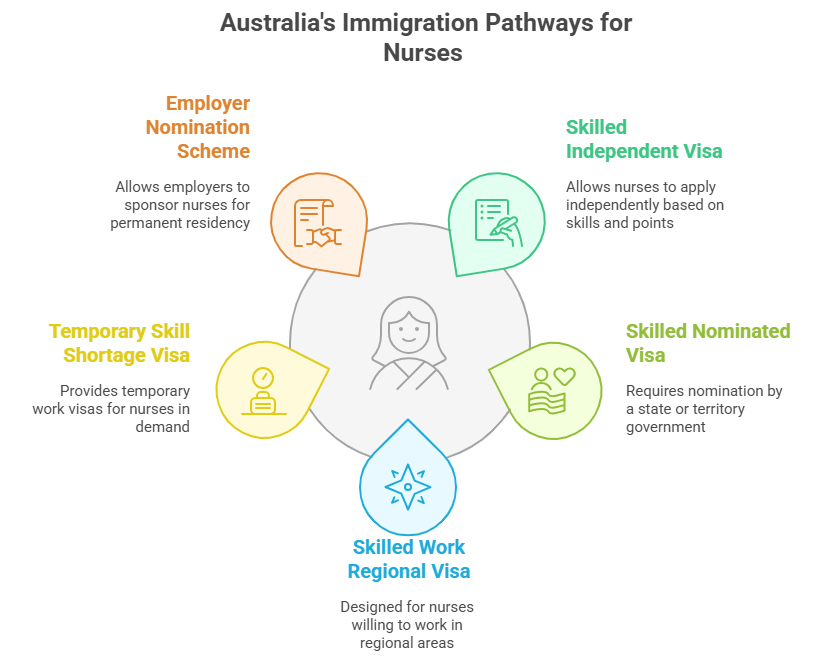
The Australian immigration pathways for nurses are as follows:
Skilled Independent Visa (Subclass 189)
The Skilled Independent Visa is a point-based immigration pathway for permanent residency in Australia. The Subclass 189 visa is suitable for registered nurses with prior work experience, a positive skills assessment, and high English proficiency.
- How it works: Nurses must submit an Expression of Interest (EOI) through SkillSelect, which will result in invitations being sent based on a points-based ranking.
- Benefits: Subclass 189 offers a streamlined route for Australia PR, full-time work rights without restrictions, and access to Australian Medicare.
- Employer sponsorship: Employer sponsorship is not mandatory for a Subclass 189 visa.
*Want to apply for Subclass 189? Consult Y-Axis to assist you with the process.
Skilled Nominated Visa (Subclass 190)
The Skilled Nominated Visa is an Australian PR pathway for nurses with state or territory nominations. Nurses wanting to work in specialised, high-demand sectors can apply through the Subclass 190 visa for nomination in an Australian state or territory.
- How it works: Submit an Expression of Interest (EOI) and then secure mandatory state nomination for applying.
- Benefits: Subclass 190 visas offer legal rights for full-time nursing jobs and provide a permanent residency pathway, with access to Medicare.
- Employer sponsorship: Although employer sponsorship is not required, Subclass 190 visa holders are required to reside and work in the nominated state or territory.
*Want to apply for Subclass 190? Consult Y-Axis to assist you with the process.
Skilled Work Regional (Provisional) (Subclass 491) Visa
The Skilled Work Regional (Provisional) Visa is a points-based visa that allows nurses to live and work in designated Australian regional areas. To be eligible for a Subclass 491 visa, you must have either a state or territory nomination or family sponsorship from a qualifying member in Australia.
- How it works: Submit an EOI and receive a state/territory nomination or a sponsorship from a qualifying family member. Having a job offer is not compulsory, but it can boost the credibility of your application.
- Benefits: Visa applicants can receive additional points for having a regional nomination and can also access a PR pathway through the Subclass 191 visa after 3 years, provided they meet the residency and income requirements.
- Employer sponsorship: Employer sponsorships are not needed for a Subclass 491 visa; instead, you must have a state or territory nomination (or) a family sponsorship from eligible family members in Australia.
Also, read...
What is Subclass 491 Visa in Australia?
Skill in Demand Visa (SID) (Subclass 482)
The Skill in Demand Visa, also known as the Subclass 482 visa, permits Australian healthcare employers to sponsor skilled nurses from overseas to make up for the critical workforces shortages. The Subclass 482 visa allows eligible nurses to work in Australia for a registered employer in any of the relevant occupations listed on the skills occupations list.
- How it works: Nurses must obtain an approved employer sponsorship and a job offer from an Australian healthcare provider authorized to sponsor.
- Benefits: You can access full-time working rights, with a PR pathway via employer-sponsored permanent visa options.
- Employer sponsorship: Mandatory Employer sponsorship is required.
*Want to apply for Subclass 482? Let Y-Axis guide you with the steps.
Employer Nomination Scheme (ENS) (Subclass 186)
The Employer Nomination Scheme (Subclass 186) is an employer-sponsored PR route for nurses to migrate to Australia for work. Through the Subclass 186 visa, eligible nurses can apply for permanent residency after receiving a nomination from an approved and verified Australian employer. Nurses seeking to migrate to Australia via the Subclass 186 visa must meet specific requirements, including skill, English language proficiency, work experience, and AHPRA registration, to qualify.
- How it works: Employers nominate nurses via the Direct Entry or Temporary Residence Transition stream, based on the applicant’s work experience in Australia
- Benefits: The processing of a Subclass 186 visa is faster, offering immediate permanent residence in Australia, unrestricted work rights, long-term job stability, and access to Medicare.
- Employer sponsorship: Subclass 186 requires mandatory employer sponsorship.
*Want to apply for Subclass 186? Let Y-Axis assist you with every step.
Eligibility Criteria for Nurses to Migrate to Australia
Nurses migrating to Australia must fulfill the required educational qualifications, work experience, and language requirements to qualify for the Australian work visa options. The eligibility criteria for migrating to Australia as a nurse include possessing a recognized and verified nursing qualification, a positive ANMAC skills assessment, and meeting other criteria such as age, character, and health.
Eligibility criteria for nurses to migrate to Australia are as follows:
- A Bachelor’s degree in nursing or equivalent recognized qualification
- Proof of language proficiency through tests like IELTS, OET, or PTE Academic.
- Registration with the Nursing and Midwifery Board of Australia (NMBA) via AHPRA (Australian Health Practitioner Regulation Agency).
- Positive skills assessment from the Australian Nursing and Midwifery Accreditation Council (ANMAC).
- At least 1 year of work experience in nursing occupations.
- Medical fitness certificate
- Police Clearance Certificate.
- Valid passport.
Read more…
What are the requirements for working in Australia as a nurse?
How to Apply for Australia Immigration as a Nurse?
The following are the steps to apply for Australian immigration as a nurse:
Step 1: Check your nursing qualifications and work experience to check whether you are eligible for nurse registration and to apply for Australian work visa options.
Step 2: Select a suitable Australian visa pathway for nurses, based on your profile (Subclass 189, 190, 491 for skilled visas and Subclass 482 and 186 for employer-sponsored visas)
Step 3: Register with the Nursing and Midwifery Board of Australia (NMBA/AHPRA) and fulfill the registration criteria.
Step 4: Complete the Skills Assessment by ANMAC (Modified/Full/Outcomes-Based, depending on eligibility).
Step 5: Complete the English proficiency tests (7 for each band in IELTS, B in each component for OET).
Step 6: Submit your Expression of Interest (EOI) through SkillSelect (which is only for skilled visa options).
Step 7: Submit your visa application, along with the required documents, after receiving an EOI.
Step 8: Complete the medical tests, character assessment, and a police clearance certificate
Step 9: Fly to Australia and begin working as a nurse after receiving visa approval.
*Are you looking for step-by-step assistance with Australian immigration? Contact Y-Axis, the world’s No. 1 overseas immigration consultancy, for end-to-end assistance!
FAQs
How to migrate to Australia from India for nurse jobs?
Nurses can migrate to Australia for nursing jobs through skilled immigration pathways, such as the Subclass 189, 190, or 491 visas, or through employer-sponsored visas like the Subclass 482 or 186. To successfully migrate to Australia as a nurse, it is mandatory to register with the AHPRA (Australian Health Practitioner Regulation Agency) or the NMBA (Nursing and Midwifery Board of Australia) and clear an ANMAC skills assessment, along with English language proficiency tests. You can apply for Australian visas through the SkillSelect system by submitting an Expression of Interest (EOI), completing the Skills assessment, meeting the language proficiency requirements, and undergoing other medical and criminal checks.
What visas are available for Indian nurses migrating to Australia?
Australian Immigration for nurses is possible through several skilled worker visa pathways, including Subclass 189, 190, 491, and employer-sponsored 482 or 186 visas. While it is mandatory to secure an employer sponsorship for 482 and 186 visas, regional or family sponsorship is sufficient to apply for the Subclass 491 visa. The visa pathways, such as the Skilled Nominated Visa (Subclass 190) and the Skilled Independent Visa (Subclass 189), require state nomination to increase the chances of selection; however, employer sponsorship is not necessary.
What are the English language requirements for nurses migrating to Australia?
For nurses migrating to Australia, you must fulfill the language requirements set by the Nursing and Midwifery Board of Australia (NMBA) and the Department of Home Affairs. You must secure a minimum 7.0 on IELTS Academic or OET “B” in each of the components as proof of English language proficiency.
How to get a credential assessment for nursing qualifications in Australia?
To get your nursing qualification and training assessed in Australia, you would be required to apply to the Australian Nursing and Midwifery Accreditation Council (ANMAC) for a skills assessment. The process of obtaining a credential assessment involves creating an online account, attaching the relevant documents, completing the fee payment, and awaiting the results, which may take around 6-12 weeks. The pathway depends on the country you belong to (Stream A, B, or C), with Stream B generally requiring an OSCE (Objective Structured Clinical Examination) in Australia and the NCLEX exam after submitting the documents.
What is the cost of migrating to Australia as a registered nurse?
The cost of migrating to Australia as a registered nurse depends on the skills assessment pathway, visa type, and other factors, including medical and police checks, living expenses, and relocation charges.
The table below has a complete breakdown of the total cost of migrating to Australia as a registered nurse:
| Cost Component | Estimated Cost (AUD) |
| ANMAC Skills Assessment | AUD 515 – 1,000 |
| English Language Test (IELTS / OET / PTE) | AUD 330 – 500 |
| Visa Application Fee (Subclass 189 / 190) | AUD 4,640 |
| Visa Application Fee (Subclass 491) | AUD 4,640 |
| Medical Examination | AUD 300 – 400 |
| Police Clearance Certificates | AUD 50 – 150 |
| Skills Assessment Document Verification | AUD 100 – 200 |
| Migration Agent Fees (Optional) | AUD 2,000 – 5,000 |
| Initial Relocation & Settlement | AUD 3,000 – 8,000 |
Which Australian states have the highest demand for registered nurses?
Popular Australian states, such as New South Wales (NSW), Victoria (VIC), and Queensland (QLD), have a high demand for registered nurses (RNs) due to the ongoing labour shortage in the healthcare sector. Australia's large population and diverse hospitality networks create a skilled labour shortage, leading to an increased demand for foreign nurses. Queensland, Victoria, and New South Wales offer better opportunities for growth for nurses, along with additional incentives within the nursing sector.
Can I apply for permanent residency in Australia as a nurse?
Yes, you can apply for permanent residency in Australia as a nurse through skilled migration pathways, which include points-tested visas (Subclass 189, 190, and 491) and employer-sponsored options (Subclass 482 and 186). Nurses can obtain Australian PR as they are currently in high demand due to ongoing labour shortages across various Australian states.
How to Verify Your Nursing License for Australian Registration?
To verify your nursing license for Australian registration, you must complete the online Self-check via the Nursing and Midwifery Board of Australia (NMBA) website. This enables you to check eligibility for different pathways based on your educational qualifications, work experience, and language proficiency. After self-checking online, you need to create and submit a portfolio and clear the OSCE exam before making the final visa application through the AHPRA portal.
How long does the Australian nursing registration process take for overseas nurses?
The Australian nursing registration process for overseas nurses takes around 1-6 months on average, if applied through the revised immigration pathways. However, the time taken to complete the registration process depends on the complexity of the application, the accuracy of the documents, and the selected Australian immigration pathway. The initial review is completed within 30 days. The AHPRA may take around 4 to 6 weeks to complete the application; specific international applications requiring review from an NMBA delegate may take 8 to 10 weeks. To avoid delays in approval, ensure the accuracy of the information provided, and submit documents carefully.
What documents are needed to migrate to Australia as a registered nurse?
Registered nurses (RNs) need to submit educational certificates, proof of language proficiency, and work experience as mandatory documents for the Australian immigration process.
The list of documents for nurses to migrate to Australia is as follows:
- Educational qualifications (Degree certificates)
- Proof of work experience (verification of registration, or statements of service from your employers, or a certificate of good standing from your native country's nursing board).
- Language proficiency test results (IELTS, OET, PTE, or TOEFL)
- ANMAC assessment letter.
- Proof of your registration with NMBA.
- Medical examination reports.
- Police Clearance Certificate.
- Passport
Tags:
Migrate to Australia
Australian immigration
Australian visas
registered nurse jobs in Australia
jobs in Australia for registered nurses
Nurse jobs abroad
Migration to Australia for Nurses
migrate to Australia as a nurse from India
Share
Options for you by Y-Axis

Get it on your mobile

Get News alerts

Contact Y-Axis
Latest Article
Popular Post
Trending Article

Posted On April 01 2026
Study vs Work Abroad – Which is Better for Indians in 2026?