

Don't know what to do ?
Get Free Counseling
Last Updated 22 July 2026
In-demand Job Opportunities in Qatar
Qatar offers excellent job opportunities due to its fast-growing economy, major infrastructure projects, and expansion in energy, aviation, healthcare, and IT sectors. The country has a strong demand for skilled workers, especially with the upcoming development programs and digital transformation. Qatar has one of the highest per-capita incomes in the world and offers tax-free salaries, modern workplaces, and a safe living environment. Qatar's labour market has strong and consistent demand for skilled professionals across Oil & Gas, Construction, Engineering, Healthcare, IT, Hospitality, and Education."
Below are some of the highest-paying job sectors in Qatar:
| Occupation | Average Salary Per Year (QAR) | Approx. Annual Salary (INR) |
|---|---|---|
| Oil & Gas | QAR 180,000 – 480,000 | ≈ ₹47.5 – ₹126.7 lakh/year |
| Engineering | QAR 150,000 – 420,000 | ≈ ₹39.6 – ₹110.9 lakh/year |
| Finance & Accounting | QAR 140,000 – 320,000 | ≈ ₹37.0 – ₹84.5 lakh/year |
| IT & Software | QAR 140,000 – 360,000 | ≈ ₹37.0 – ₹95.0 lakh/year |
| Healthcare | QAR 120,000 – 300,000 | ≈ ₹31.7 – ₹79.2 lakh/year |
| Construction | QAR 100,000 – 250,000 | ≈ ₹26.4 – ₹66.0 lakh/year |
| Education | QAR 90,000 – 200,000 | ≈ ₹23.8 – ₹52.8 lakh/year |
| Hospitality & Tourism | QAR 80,000 – 180,000 | ≈ ₹21.1 – ₹47.5 lakh/year |
Note: INR values calculated at 1 QAR ≈ ₹26.40 (July 21, 2026). Exchange rates fluctuate — verify the current rate before financial planning. All salaries are tax-free in Qatar — gross salary equals take-home pay.
Source: Planning and Statistics Authority (PSA) Qatar — Labour Force Survey 2024; Hays GCC Salary Guide 2026; Bayt.com Qatar Salary Data 2026
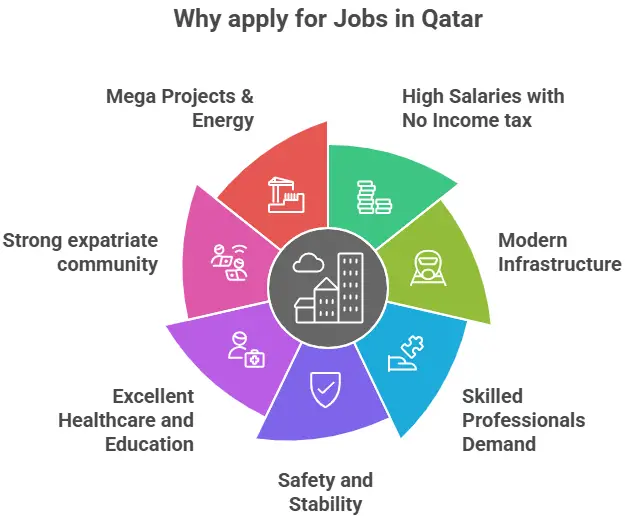
Why apply for Jobs in Qatar?
- High salaries with no income tax
- Modern infrastructure and fast-growing economy
- High demand for skilled workers
- Safe and stable country
- Excellent healthcare and education
- Strong expatriate community
- Opportunities in mega projects & energy sector
Qatar is known for innovation, advanced infrastructure, and leading industries such as LNG (liquefied natural gas), aviation, construction, and finance. Workplaces offer good work-life balance, strong employee policies, and multicultural work environments.
Qatar National Vision 2030 (QNV 2030) — What It Means for Indian Professionals
QNV 2030 is Qatar's long-term national development strategy focused on transforming the country from a hydrocarbon-dependent economy into a knowledge-based, diversified economy by 2030. For Indian professionals, Qatar National Vision 2030 is the single biggest driver of long-term job demand across four key pillars:
| QNV 2030 Pillar | Focus Areas | Most Relevant for Indians |
|---|---|---|
| Human Development | Education, skills, and healthcare workforce development | Doctors, nurses, teachers, and trainers |
| Social Development | Cultural institutions, sports, and community development | Hospitality, events, and social services professionals |
| Economic Development | Diversification, knowledge economy, and SME growth | IT, finance, engineering, and consulting professionals |
| Environmental Development | Sustainability and green infrastructure | Environmental engineers and urban planners |
What this means in practice for Indian professionals:
- Qatar's commitment to building a knowledge economy means sustained demand for data science, cybersecurity, IT, and digital transformation professionals through 2030
- Healthcare expansion under QNV 2030 has created one of the Gulf's fastest-growing medical workforces — medical professionals like Indian doctors and nurses are among the most recruited nationalities
- Infrastructure and construction projects tied to QNV 2030 continue well beyond the 2022 World Cup — engineering and project management roles remain in strong demand
- Education sector growth under QNV 2030 has opened important opportunities for Indian teachers, particularly in international curriculum schools in Education City
Note: QNV 2030 is a strategic framework — actual hiring timelines and sector demand vary by year and global energy market conditions. Indian professionals should target sectors where QNV 2030 investment is most active and confirmed.
Job Vacancy in Qatar
Qatar has an estimated number of 70000 and above of live job opportunities available in various sectors (Industry Estimate based on the data collected regarding different hiring platforms in 2026). More than 55% of jobs require skilled professionals, creating strong opportunities for foreign professionals, especially Indians.
Estimated Job Openings in Qatar by 2030:
| Occupation / Sector | Estimated Job Openings by 2030 |
|---|---|
| Oil & Gas | 35,000 |
| Engineering & Infrastructure | 30,000 |
| Healthcare & Nursing | 22,000 |
| IT & Digital Technology | 25,000 |
| Hospitality & Tourism | 18,000 |
| Education | 15,000 |
Step-by-Step Guide for Job Search in Qatar from India
Step 1: Search for jobs on trusted portals: LinkedIn, Bayt, Naukri Gulf, Indeed, and Qatar Energy Careers.
Step 2: Identify companies in Qatar that offer visa sponsorship for foreign workers.
Step 3: Prepare a simple and clear Gulf-standard CV; highlight your skills and experience.
Step 4: Apply directly to companies or through certified recruitment agencies.
Step 5: Attend online interviews explaining your experience and why you want to work in Qatar.
Step 6: Once selected, your employer will issue a job offer and start your Qatar Work Visa process.
Step 7: After visa approval, book your travel and move to Qatar to start working.
Looking for jobs in Qatar? Get support with Y-Axis resume marketing services.
Migrate to Qatar via a Work Visa
Foreign professionals must obtain a Qatar Work Visa and a Residency Permit to live and work legally. A job offer from a Qatar employer is required before applying. Tourists cannot convert a visit visa into a work visa inside Qatar. The employer is responsible for most of the visa process, including issuing the employment contract, work permit, and residency ID.
Types of Qatar Work Visas
Work Visa: For foreigners hired by a Qatar employer (valid 1–5 years).
Business Visa: For short-term business activities (up to 3 months).
Family Residence Visa: For workers bringing their family to Qatar.
Freelancer / Contract Visa: For short-term project-based workers.
GCC Resident Work Visa: For GCC residents with job offers.
Requirements for Qatar Work Visa
- Valid passport
- Passport-size photographs
- Job offer letter / employment contract
- Educational certificates (attested)
- Previous work experience letters
- Medical test (mandatory)
- Police clearance certificate
- Employer-issued Work Permit
- Proof of accommodation (provided by employer)
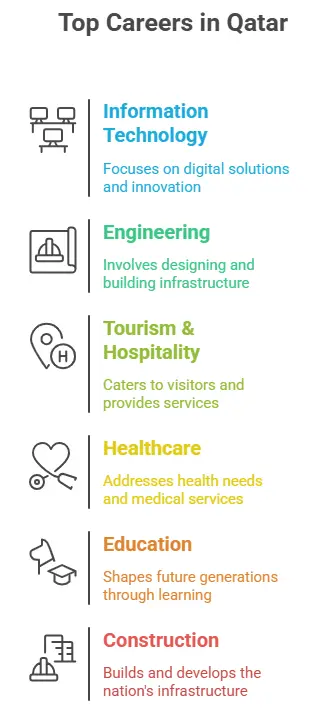
Top In-Demand Careers in Qatar
Information Technology:
Qatar is rapidly expanding its digital economy, with major investments in cybersecurity, smart cities, cloud systems, and fintech. The country needs skilled IT professionals to support digital transformation across government and private sectors. High-demand IT jobs include software developers, cloud engineers, cybersecurity analysts, and data scientists.
Engineering:
Qatar continues to invest heavily in LNG production, large-scale construction, and renewable energy projects. Because of this, engineering professionals are needed across multiple industries, especially energy, infrastructure, and utilities. In-demand roles include mechanical, electrical, civil, project, and maintenance engineers.
Tourism & Hospitality:
Qatar’s growing tourism industry, global events, and new hotels have increased demand for skilled hospitality workers. The country focuses on high-quality service and cultural tourism. Top jobs in demand include hotel managers, chefs, guest relations staff, and tour coordinators.
Healthcare:
Qatar’s healthcare system is expanding with new hospitals and medical centers. The country seeks qualified healthcare professionals to improve patient care and support specialized services. High-demand positions include nurses, doctors, lab technicians, and pharmacists.
Education:
Qatar’s education sector is growing due to rising student numbers and new international schools. The country needs teachers who can provide modern, student-centered learning. In-demand jobs include school teachers, university lecturers, and special education teachers.
Construction:
Ongoing infrastructure development, housing projects, and commercial expansion create strong demand in the construction sector. Skilled workers are needed for planning, supervision, and execution of projects. Popular jobs include civil engineers, architects, and construction supervisors.
Shortage Occupations in Qatar — Fast-Track Hiring for Indian Professionals
Indian professionals in the following shortage occupations benefit from expedited hiring processes and stronger employer demand in Qatar:
| Occupation | Sector | Why It's a Shortage Role |
|---|---|---|
| Petroleum & Reservoir Engineers | Oil & Gas | Qatar's LNG expansion requires specialist talent that is not readily available in the local workforce. |
| Mechanical & Electrical Engineers | Energy / Infrastructure | Major QNV 2030 infrastructure and energy projects require large engineering teams. |
| Civil Engineers & Project Managers | Construction | Continued infrastructure development following the 2022 FIFA World Cup. |
| Doctors & Medical Specialists | Healthcare | Expansion of hospitals and specialist healthcare facilities under Qatar National Vision 2030. |
| Registered Nurses | Healthcare | High patient-to-nurse ratios have created an ongoing shortage across the Gulf region. |
| ICT & Cybersecurity Professionals | Technology | The Digital Qatar initiative is driving demand for skilled technology professionals. |
| Data Scientists & AI Specialists | Technology | Growing smart city, AI, and fintech projects under Qatar National Vision 2030. |
| Finance & Accounting Professionals | Finance | Expansion of the Qatar Financial Centre and the country's banking sector. |
| Teachers (STEM & English) | Education | Increasing demand from international schools and institutions in Education City. |
| Hospitality & Hotel Management | Tourism | Growth in hotels, resorts, and tourism infrastructure across Qatar. |
| Oil & Gas Technicians | Energy | Specialized technical positions that cannot be fully met by the local workforce. |
Qatar Labour Laws & Worker Rights for Indian Professionals
Qatar has introduced some of the most significant labour reforms in the Gulf region — making it a more attractive and worker-friendly destination than many of its neighbours. Indian professionals should be aware of these reforms before accepting a job offer.
| Reform | Detail | Effective |
|---|---|---|
| Employer Change Without NOC | Workers can change employers without requiring a No Objection Certificate (NOC) from their current employer. | 2020 |
| Non-Discriminatory Minimum Wage | QAR 1,000/month basic salary + QAR 300 food allowance + QAR 500 housing allowance (if accommodation is not provided by the employer). | March 2021 |
| Exit Permit Abolished | Workers no longer need employer permission to leave Qatar. | January 2020 |
| Wage Protection System (WPS) | Employers must pay salaries electronically, helping protect workers from delayed or unpaid wages. | Active |
| Working Hours | Maximum of 8 hours per day and 48 hours per week; reduced to 6 hours per day during Ramadan. | Labour Law |
| Annual Leave | 3 weeks after 1 year of service and 4 weeks after 5 years of service. | Labour Law |
| End-of-Service Gratuity | Equivalent to 3 weeks' pay for each year of service after completing 1 year of employment. | Labour Law |
Why these reforms matter for Indians:
The impact of NOC abolition is that Indians are not tied to any particular company and can take a job with a better deal, even if it means leaving their current employer in many cases.
The minimum wage applies to all Indians, some precedence over contracts that do not provide food and accommodation — they are entitled to pay QAR 500 for food and accommodation in case the employer fails to provide them. The exit permit abolition means Indian professionals can travel home freely without employer approval — a major improvement from the previous system
Note: Some categories of workers — domestic workers and certain government-sector employees — have different rules. Indian professionals should verify their specific contract terms and sector before assuming all reforms apply to their situation.
A Short Overview of Employee Rights:
-
Maximum number of working hours is 8 hours per day and 48 hours per week, and 6 hours per day during the month of Ramadan.
-
Overtime rate is 25% more, night shifts attract a premium of 50% if conducted between 9 pm and 6 am.
-
Annual leave is of 3 weeks, after working for 1 year; and annual leave of 4 weeks after 5 years of service.
-
End of service benefits is 3 weeks of basic salary for each year of service.
-
Employers cannot withhold passports of employees.
-
Employers cannot require employees to work outdoors between 10 am and 3:30 pm from June 15 to September 15.
-
Employee salaries must be paid through WPS.
- Employees have the right to lodge complaints with the Workers Dispute Settlement Committees of the Ministry of Labour.
Steps to Apply for a Qatar Work Visa
Step 1: Receive a job offer from a registered Qatar employer.
Step 2: Employer applies for your Work Permit.
Step 3: Submit required documents.
Step 4: Complete medical test & biometrics.
Step 5: Receive your Qatar Work Visa and travel to Qatar.
Step 6: Employer processes your Qatar ID (Residency Card).
How Y-Axis Can Help
Y-Axis provides expert guidance for working in Qatar:
- Help collect and prepare documents
- Complete visa application checklist
- Create a strong application package
- Fill forms accurately
- Provide updates & follow-up
- Job search support to find a suitable job in Qatar
Other Work Visas:
Y-Axis snapshot
1M
Successful applicants
1500+
Experienced counselors
25Y+
Expertise
50+
Offices
Don't know what to do ?
Get Free Counseling
Looking for Inspiration
Explore what Global Indians have to say about Y-Axis in shaping their future