


Don't know what to do ?
Get Free Counseling
Why apply for a Malta work visa?
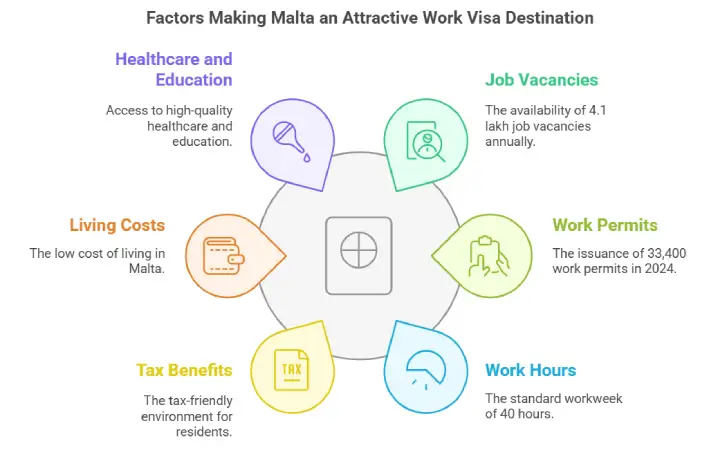
- 4.1 lakh job vacancies every year
- Issued 33,400 work permits
- Work 40 hours per week
- Tax friendly country
- Low cost of living
- High-quality healthcare and education
Malta is one of Europe's fastest-growing destinations for skilled foreign professionals. With a stable economy, booming digital sector, and one of the most affordable costs of living in the EU, Malta has become an attractive option for workers looking to build a career and a life in Europe.
Capital: Valletta | Population: 560,000 | Language: Maltese & English (both official); English is the primary language of business, tech, and international companies, making it one of the most accessible destinations in Europe for foreign professionals from day one.
*Interested to apply for a Malta work visa? Sign up with Y-Axis, for end-to-end assistance.
Benefits of Settling in Malta
Given below are the benefits of settling in Malta:
- Ranked among the safest countries in Europe .
- Progressive and inclusive multicultural society with a strong expat community.
- Affordable world-class healthcare with both public and private options.
- One of the highest GDP growth rates in EU.
- Average earnings per year EUR 20,000–35,000/year (approx. INR 18–32 lakhs).
- English is an official language, widely spoken in all business and professional settings.
- Tax incentives and exemptions for skilled foreign workers under the Highly Qualified Persons (HQP) scheme and other programs.
*Interested to work in Malta? Let Y-Axis assist you with the process.
Why Should Indians Migrate to Malta?
Here are the main reasons why Indians should consider immigrating to Malta:
- Malta has a growing and well-established Indian expat community.
- Malta faces a significant shortage of skilled workers across iGaming, fintech, technology, healthcare, and digital services.
- Malta's Single Permit allows skilled Indian professionals to live and work in Malta, typically valid for 1–2 years and renewable.
- After 5 years of legal residence, Indian professionals become eligible for long-term EU residence status with a direct pathway toward permanent residency.
- Malta's Key Employee Initiative (KEI) and Specialist Employee Initiative (SEI) are specifically designed to attract professionals in high-value roles.
Read more…
What are the benefits of Working in Malta?
What is a Malta Work Permit?
A Malta work permit allows non-EU citizens to reside and work in the country. It is a long-term visa that requires those seeking a work visa in Malta for more than 90 days. In addition to a work visa, an applicant needs a work permit and e-residency card to work in Malta.
Malta is quickly rising to the top of the global list of locations for work. Malta incentivizes foreign investment and actively promotes international worker relocation. Malta’s job market is thriving, with various opportunities for international talent. Malta's low unemployment rate means job seekers have a strong chance of securing employment.
Read more...
How can I get a Malta Work Visa?
Difference between a Malta Work Visa and a Malta Work Permit
| Factor | Malta Work Visa | Malta Work Permit |
|---|---|---|
| Definition | A Malta work visa allows an applicant to gain legal status to work in the country. | A Malta work permit allows an applicant to work for one specific employer who sponsored the visa. |
| Validity | 1–3 years | 1–2 years |
Types of Malta Work Visas or Work Permits
Malta work visa refers to all of the several kinds of work permits that the Maltese government issues; the details of the visas are given below:
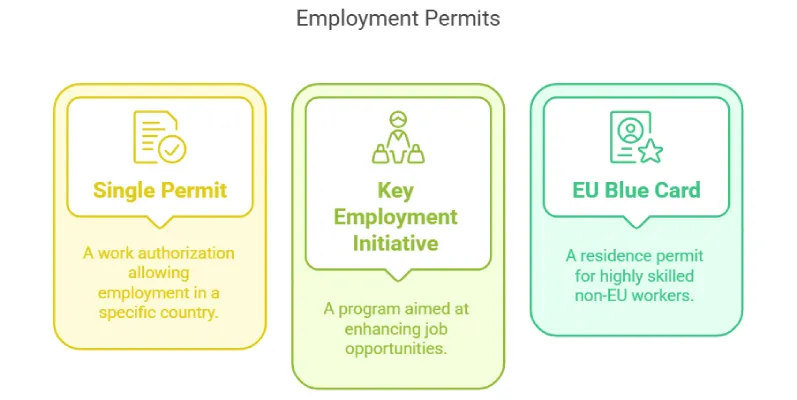
- Single Permit
- Key employment initiative
- EU Blue Card
Single Permit
A Malta Single Permit, also known as an e-residence card, is a work visa that enables the holder to live and work in Malta for the long term.
Key Employee Initiative
Malta recently introduced a new work permit for highly skilled workers called the Key Employee Initiative. This work visa is processed in five days, which is fairly quick. It is valid for one year and can be renewed for a maximum of three years.
EU Blue Card
The EU Blue Card is issued to highly qualified individuals who will work in a qualified position and earn at least 1.5 times the average annual salary in Malta. The Malta EU Blue Card is valid for a minimum of a year and can be renewed permanently if you continue to meet the job requirements.
Read more…
How to apply for a work permit to Malta?
Malta Work Visa Eligibility
Eligibility for Malta Single Permit
- Foreign nationals can apply
- Applicants can apply either by staying in Malta or outside
- Applicants need to have specific employment while having a single permit
Eligibility for Malta EU Blue Card
- Highly skilled individuals are eligible to apply
- Salary must be at least 1.5 times the average salary paid in Malta
Eligibility for Malta Key Employee Initiative
- Applicable to highly technical or managerial posts
- The average annual salary must be at least € 30,000
- Declaration from the employer stating that the applicant has the required credentials
- Certified copies of the relevant qualifications, warrants or work experience
Who is eligible to work in Malta?
Here is the eligibility criterion to work in Malta:
- Job offer from a Maltese employer
- Have the required education qualification
- Work experience
- Sufficient funds
- Health Insurance
- Clean criminal record
- Language proficiency: English or Maltese
Read more…
Malta to hold language, and culture courses for migrants
Malta Work Visa Requirements
Here is the list of documents that you need to submit when applying for a Malta work visa and work permit:
- Valid passport with at least two blank pages for the visa and entry stamp
- A completely filled and signed job visa application form
- Passport-sized photo with a light background
- Valid work contract
- Updated CV
- Medical Insurance: you must purchase travel health insurance with at least €30,000 coverage, which is valid for your trip.
- Proof of Accommodation
- Proof of financial means
- Flight itinerary
- Police clearance certificate
Job Market in Malta
Malta offers growing job opportunities for skilled professionals, particularly in technology, iGaming, finance, healthcare, construction, hospitality, and renewable energy. The country continues to experience strong demand across key industries, supported by economic stability, low unemployment, and an increasing reliance on foreign talent.
Valletta and Sliema are the main professional hubs, with Malta emerging as a recognised Mediterranean centre for fintech services.
Professionals with the right skills and experience have strong prospects of finding employment in Malta.
Also read...
What are the most in-demand jobs in Malta for the next 10 years?
Top Jobs in Malta for Indians
Malta is investing heavily in digital transformation, with its digital sector now accounting for nearly 20% of GDP. The country has streamlined its immigration framework for the Key Employee Initiative (KEI) and the Single Permit to attract Indian professionals in IT, engineering, and financial services.
| Industry | In-Demand Job Roles |
|---|---|
| IT & Software | Software Developers, Full Stack Engineers, Cloud Architects, DevOps Engineers, Cybersecurity Analysts, Data Scientists |
| iGaming & Fintech | Game Developers, Compliance Officers, Fraud Analysts, Risk Managers, Customer Support Specialists, Digital Marketers |
| Finance & Professional Services | Financial Analysts, Accountants, Auditors, Tax Advisors, Insurance Advisors, Business Process Specialists |
| Healthcare & Life Sciences | General Practitioners, Specialist Physicians, Registered Nurses, Pharmacists, Physiotherapists, Lab Technicians |
| Engineering & Construction | Civil Engineers, Structural Engineers, Mechanical Engineers, Electrical Engineers, Project Managers, Quantity Surveyors |
| Tourism & Hospitality | Hotel Managers, Restaurant Supervisors, Tour Guides, Event Coordinators, Front Office Executives, Customer Service Professionals |
| Renewable Energy & Environment | Solar Energy Engineers, Wind Energy Technicians, Environmental Consultants, Sustainability Analysts, Green Infrastructure Specialists |
| Logistics & Supply Chain | Warehouse Coordinators, Supply Chain Managers, Freight Logistics Specialists, Port Operations Staff |
Also, read...
Malta Job Market: Trends & Job Opportunities
Average Salary of Skilled Workers in Malta
Malta's national minimum wage stands at €994 per month in 2026, raised from €961 in 2025. Salaries vary by sector, experience, and location, with roles in iGaming, IT, and financial services commanding significantly higher compensation .
| Experience Level | Average Gross Salary (EUR / Year) | Approx. Salary (INR / Year) |
|---|---|---|
| Entry-Level | €18,000 – €26,000 | ≈ ₹16 – ₹23 LPA |
| Mid-Level | €26,000 – €45,000 | ≈ ₹23 – ₹40 LPA |
| Senior-Level | €45,000 – €76,000+ | ≈ ₹40 – ₹68 LPA |
How can Indians apply for a Malta Work Visa or Work Permit?
Step 1: Obtain a job offer from an employer in Malta
Step 2: Your employer in Malta must apply for a work visa or work permit through the official Identità portal
Step 3: Gather and arrange all required documents for the Malta work visa application.
Step 4: Complete the visa application and submit it with the required documents
Step 5: Schedule a biometric appointment and complete the biometric process
Step 6: Await a visa decision
Step 7: Once approved, you will receive a Residence Card to enter and work in Malta legally.
Read more…
How can I get a Work Visa for Malta?
How to Extend a Malta Work Visa?
A Malta work visa can be extended by one year. An applicant can follow these step-by-step processes to extend a Malta work visa:
Step 1: Start the renewal process 90 days before the visa expires
Step 2: Submit the required documentation
Step 3: Complete the health screening
Step 4: Submit the application 30 days prior to expiry
Step 5: Wait for the approval
Step 6: Get the extended Malta work visa
Malta Work Visa Processing times for Indians
The table below contains the average processing time of work visas in Malta:
| Visa Type | Processing Time | Notes |
|---|---|---|
| Single Permit | 2 – 3 months (up to 4 months max) | Average under 2 months if documents are complete |
| EU Blue Card | Within 90 days | Maximum processing time under EU rules |
| Key Employee Initiative (KEI) | 5 working days | Fast-track processing; requires managerial or highly technical role with minimum €45,000 salary |
Malta Work Visa fees for Indians
The table below has a complete overview of the Malta job visa fee for Indians:
| Visa Type | Application Type | Fee (From Aug 2025) |
|---|---|---|
| Single Permit | First application / Change of employer | € 600 |
| Single Permit | Renewal | €150 per year |
| Single Permit | Change of job designation | € 300 |
| Single Permit (Healthcare / Elderly Care) | All types | € 150 |
| KEI / SEI / EU Blue Card | First application | € 600 |
| KEI / SEI / EU Blue Card | Renewal | €150 per year |
Dependent Benefits for Malta Single Permit / KEI Holders
Spouses and children of Malta Single Permit and Key Employee Initiative (KEI) holders are entitled to family reunification and access to Malta's social support framework. The programme covers healthcare access, education options, and family support for legal residents.
| Category | Details |
|---|---|
| Family Reunification | Spouses aged 21 or above and children under 18, can join the main permit holder. The sponsor must hold a residence permit valid for at least one year and must have lived in Malta for 12 months. KEI holders may bring family earlier if earning at least €50,000 plus €6,000 for each additional dependent. |
| Spouse Work Rights | Dependants can apply for their own work permit, subject to employer sponsorship and permit category. Students enrolled at recognised institutions may participate in internships or placements under Maltese law. |
| Children's Education | Children of compulsory school age must enrol in school. KEI holders applying before 12 months must show confirmed private school admission. |
| Healthcare Access | KEI permit holders and dependants can access Malta’s public healthcare and social security benefits. |
| Child Support Benefits | Third-country nationals working and residing in Malta may qualify for Children's Allowance after six months of employment. Both parents must hold valid residence permits and household income must fall below €45,000. |
| Childcare Support | Malta offers private nurseries, daycare centres, and pre-schools, especially in urban areas. |
| Schengen Travel Benefit | Malta is part of the Schengen Area. Dependants holding valid Maltese residence permits can travel freely within Schengen countries, subject to the standard 90/180-day travel rules outside Malta. |
Pathway to Malta Permanent Residency / Citizenship
Foreign workers planning long-term settlement in Malta can transition from temporary work permits to long-term residency and eventually citizenship.
| Category | Details |
|---|---|
| Long-Term Residency | Skilled workers on a Single Permit or KEI can renew their permits, typically valid for up to 3 years subject to continued employment. Long-term EU residency becomes available after 5 years of continuous lawful residence. |
| Permit Validity & Renewal | Most permits are issued for 1 year, with some qualifying for 2–3 years. |
| Permanent Residency (PR) | Applicants may pursue citizenship by naturalisation based on residence in Malta. Eligibility requires 12 consecutive months of residence immediately before the application and at least 4 years of residence during the 6 years preceding that period. |
| PR Requirements | Applicants must demonstrate continuous lawful residence, financial stability, a clean criminal record, valid health insurance, and suitable accommodation. |
| Citizenship / Naturalisation | Standard naturalisation requires at least 5 years of residency, integration into society, language and civic knowledge exams, and written endorsements from two guarantors. |
| Language Requirements | Applicants must pass exams on English proficiency, Maltese history, and law. |
| PR Eligibility Timeline | Workers usually begin with a Single Permit valid for 1 year. This can be renewed for up to 3 years with continued employment. After 5 years of continuous residence, applicants may qualify for long-term EU residency. Citizenship may be considered after 5 years but typically takes 10–15 years in practice. |
| Dual Citizenship | Malta permits dual citizenship, allowing new citizens to retain their original nationality if permitted by their home country. Indian nationals obtaining Maltese citizenship may still retain OCI status for travel and residency benefits in India. |
How can Y-Axis help you?
Y-Axis, the world's top overseas immigration consultancy, provides unbiased immigration services tailored to each client based on their interests and requirements. Our impeccable services at Y-Axis include the following:
- Expert guidance/counseling for working in Malta.
- Assistance in applying for a visa.
- Coaching Services: IELTS/TOEFL Proficiency Coaching.
- Free career counseling; Book your slot today!
- Resume Marketing services to find related Jobs in Malta.
Other Work Visas
Don't know what to do ?
Get Free Counseling
Looking for Inspiration
Explore what Global Indians have to say about Y-Axis in shaping their future
Frequently Asked Questions