


Don't know what to do ?
Get Free Counseling
Last Updated 25 August 2026
Malta Job Market in 2026–30
Malta offers good job opportunities for skilled professionals in 2026. Malta's monthly unemployment rate stood at 3.5% in May 2026 (NSO), up 0.7 percentage points year-on-year. On a quarterly basis, the Labour Force Survey recorded 3.4% for Q4 2025, after a temporary dip to 2.7% in Q3 2025. Malta's rate remains close to the EU average but has been trending upward through 2026. Industries such as iGaming, Information Technology (IT), financial services, healthcare, construction, and tourism continue to hire workers. Malta welcomes skilled professionals from outside the EU, including Indian professionals, through work permit options such as the Malta Single Permit. Remote workers can also apply for the Nomad Residence Permit, which requires a minimum annual income of €42,000.
Key Highlights:
- Over 9,158 job vacancies.
- Job vacancies increased by 13.4% compared to the previous year.
- Malta's monthly unemployment rate stood at 3.5% in May 2026 (NSO), up 0.7 percentage points year-on-year. On a quarterly basis, the Labour Force Survey recorded 3.4% for Q4 2025, after a temporary dip to 2.7% in Q3 2025. Malta's rate remains close to the EU average but has been trending upward through 2026.
- The country has a strong and active workforce.
- Top hiring sectors include iGaming, IT, financial services, healthcare, construction, and tourism.
- Malta continues to recruit skilled workers from non-EU countries to address labour shortages.
- Indian professionals can apply for jobs through the Malta Single Permit pathway.
- The Nomad Residence Permit requires a minimum income of €42,000 per year (€3,500 per month).
Job Outlook in Malta
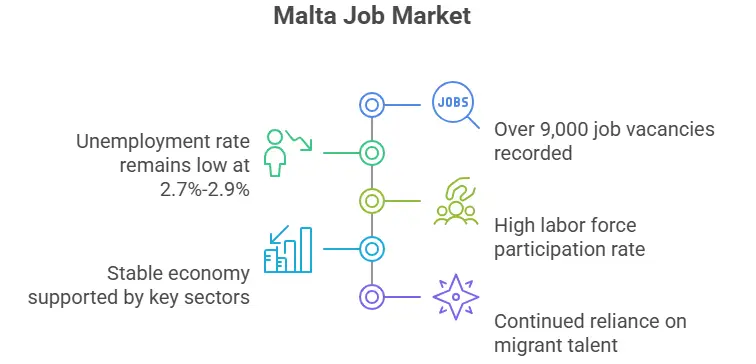
Understanding the job outlook in Malta can help professionals planning to work in Europe. Malta has a strong job market with growing demand for skilled workers across several industries. The country's stable economy, low unemployment rate, and ongoing labour shortages have created many opportunities for both local and international workers.
Malta showcased 10,022 job vacancies in Q1 2026 (NSO), an increase of 13.4% year-on-year. The job vacancy rate stood at 3.3% in Q1 2026 — the third-highest in the EU, behind only the Netherlands (4.0%) and Belgium (3.4%), and well above the EU average of 2.1% (Eurostat). Most job openings are in the private sector, with small and medium-sized businesses accounting for a large share of vacancies.
Some of the top hiring sectors in Malta include tourism, hospitality, healthcare, construction, manufacturing, financial services, information technology (IT), and iGaming. With an unemployment rate of just 2.7%, Malta continues to face a shortage of skilled workers and actively welcomes foreign talent, including professionals from India.
*Want to work in Malta? Let Y-Axis guide you with the process.
General Employment Trends for the year
Malta's labour market remains strong in 2026, with employers continuing to hire skilled workers across multiple industries. The country's low unemployment rate and growing economy are creating steady demand for both local and international talent.
Key employment trends in Malta include:
- Low unemployment rate of around 3.5%, resulting in strong demand for skilled workers.
- Growing number of job vacancies, with 3.3% of all jobs remaining unfilled in Q2 2025.
- Increased demand for professionals in Information Technology (IT), cybersecurity, fintech, data analytics, and digital services.
- Rising healthcare needs are creating opportunities for nurses, caregivers, healthcare assistants, and medical technicians.
- Growth in the tourism industry continues to support jobs in hospitality, restaurants, hotels, transportation, and customer service.
- Employers are increasingly recruiting foreign workers to address ongoing labour shortages.
- Strong demand remains for professionals with technical skills, digital expertise, and international work experience.
Factors Influencing Job Creation or Reduction in Malta
Several factors contribute to job growth and employment opportunities in Malta. Understanding these factors can help job seekers identify industries with strong hiring demand.
- Economic Growth: Malta's stable economy continues to create jobs in sectors such as tourism, transportation, financial services, and digital industries.
- Skills Shortages: A shortage of local skilled workers has increased demand for international professionals in healthcare, construction, hospitality, and IT.
- Technology and Innovation: The growth of industries such as iGaming, fintech, software development, and cybersecurity is creating new job opportunities for skilled workers.
- Government Policies: Work permit programs such as the Malta Single Permit and investments in digital infrastructure support business growth and employment.
- Ageing Population: The increasing need for healthcare and social care services has led to higher demand for nurses, caregivers, and healthcare professionals.
- Global Business and Tourism: International investment, tourism growth, and Malta's position as a business hub continue to create employment opportunities across various sectors.
In-Demand Industries and Occupations in Malta
The table below highlights some of the most in-demand occupations in Malta, along with their typical annual salary ranges.
| Occupation | Typical Salary Range (€ / Year) |
| Information Technology (IT) | €25,000 – €45,000 |
| Engineering | €28,000 – €42,000 |
| Financial Services / Accounting | €28,000 – €45,000 |
| Banking & Finance | €26,000 – €42,000 |
| Marketing & Digital | €22,000 – €35,000 |
| Healthcare (Doctors / Specialists) | €30,000 – €55,000 |
| Nursing | €18,000 – €28,000 |
| Teaching / Education | €20,000 – €30,000 |
| Hospitality & Tourism | €16,000 – €24,000 |
| Skilled Trades (Construction) | €18,000 – €28,000 |
*Read more…
Highest Paying Jobs in Malta for Indians
Workforce Demands across Different Regions in Malta
Job opportunities in Malta vary by region, with each area having a strong presence of specific industries. Understanding regional demand can help job seekers identify the best locations for employment. Malta’s job market is one of the most dynamic in the EU, driven by low unemployment and strong demand for both skilled and semi-skilled workers. Workforce needs vary across regions, with areas such as the Northern Harbour, Southern Harbour, Gozo, and the Northern Region showing particularly high hiring activity. These differences are shaped by the concentration of industries such as tourism, hospitality, iGaming, healthcare, construction, and administrative services. As a result, Malta continues to attract foreign professionals, including many from India, who are drawn by the country’s stable work environment, competitive salaries, and diverse employment opportunities.
| Region | Major Hiring Industries | Typical Salary Range (€ / Year) |
| Northern Harbour (Sliema, St. Julian's, Gżira) | iGaming, Information Technology (IT), Financial Services, Hospitality, Sales | €20,000 – €45,000 |
| Southern Harbour (Valletta, Paola, Marsa) | Public Administration, Logistics, Tourism, Retail | €18,000 – €38,000 |
| Northern Region (Mosta, Naxxar, Melliħa) | Construction, Healthcare, Education, Retail | €20,000 – €40,000 |
| Western Region (Rabat, Mdina, Żebbuġ) | Education, Agriculture, Tourism, Cultural Heritage Services | €18,000 – €30,000 |
| Gozo | Hospitality, Construction, Healthcare, Tourism | €18,000 – €32,000 |
Malta Minimum Wage 2026
Malta's national minimum wage for 2026 is €994/month (€229.44/week, €11,928/year) for employees aged 18 and over, effective from 1 January 2026. Several sectors — including hospitality, construction, and retail — have their own Wage Regulation Orders (WROs) that set higher sector-specific minimums.
*Also, read…
What are the most in-demand jobs in Malta for the next 10 years?
Impact of Technology and Automation in Malta
Malta’s job market has been significantly influenced by rapid advancements in technology and automation, creating both new opportunities and evolving skill requirements. As Malta continues to expand its digital economy, the demand for tech-savvy professionals, skilled workers, and digitally capable talent is steadily rising across multiple sectors.
Technological Advancements and Automation Shaping the Job Market
In recent years, Malta has undergone substantial technological transformation driven by growth in iGaming, Fintech, ICT services, financial services, and digital tourism. Automation and digital tools are increasingly integrated into business operations, improving efficiency and creating new job roles that require advanced technical expertise.
These developments are reshaping the professional landscape and highlighting the importance of continuous skill development. The country is experiencing strong demand for professionals in areas such as:
- Information technology (IT)
- Software development
- Cybersecurity
- Data analytics
- Digital marketing
- Financial compliance and Fintech
- Engineering and technical support
As Malta continues to implement its Digital Malta Strategy and invests in technological infrastructure, the job market will increasingly favour workers who possess digital and technical skills.
*Want to apply for jobs abroad? Avail Y-Axis Resume Marketing services to find the right one.
Single Permit Fees & Processing Timeline 2026
| Fee / Step | Amount / Duration |
|---|---|
| Government Application Fee (New Single Permit) | €600 |
| Renewal Fee (From Year 2) | €150 per year |
| Change of Employer Fee | €600 |
| Pre-Departure Course (Mandatory for First-Time Applicants from March 2026) | Up to 6 weeks |
| Standard Application Processing Time | 2–4 months |
| KEI Fast-Track Processing (For Roles Earning €45,000+ Per Year) | 5 working days |
Note: Figures are based on Identità Malta's 2025–2026 fee restructuring. Applicants should confirm the latest fees and processing timelines directly with Identità Malta before applying.
Skills in-demand in Malta
Employers in Malta increasingly seek candidates equipped with the right skills to support the country’s growing sectors, including iGaming, ICT, finance, hospitality, healthcare, construction, and professional services. As Malta’s digital transformation accelerates and businesses continue to expand, the demand for skilled professionals remains strong across various industries.
Key Skills Sought by Employers in Malta
Malta’s workforce trends show rising demand for individuals with both technical expertise and strong soft skills. Some of the most sought-after skills include:
Technical & Industry-Specific Skills
- Information Technology (IT) skills
- STEM skills (science, technology, engineering, mathematics)
- Software development and programming
- Cybersecurity and data protection
- Digital marketing and content management
- Financial analysis and compliance skills
- Accounting and bookkeeping
- Customer support and service skills
- Project management
- Skilled trades
Soft Skills and Workplace Competencies
- Communication and interpersonal skills
- Problem-solving and critical thinking
- Creativity and innovation
- Teamwork and collaboration
- Adaptability and flexibility
- Leadership skills
- Time management
- Emotional intelligence
- Multilingual proficiency (English is essential; Maltese is beneficial; other EU languages are a plus)
These skills are highly valued across Malta’s growing industries, especially in iGaming companies, Fintech firms, hospitality groups, healthcare institutions, education providers, construction companies, and customer service centres.
Importance of Upskilling or Reskilling for Job Seekers in Malta
As Malta’s job market continues to evolve, upskilling and reskilling have become essential for anyone seeking long-term career success. With rapid technological adoption and shifting workforce needs, job seekers must continuously build new competencies to stay competitive.
- Upskilling helps professionals adjust to new industry demands, enhance performance, and take on higher responsibilities.
- Reskilling allows workers to shift into new roles or industries experiencing strong growth, such as ICT, finance, healthcare, and digital services.
- Continuous learning fosters innovation, adaptability, and job relevance, making employees more resilient in a fast-changing labour market.
By investing in professional development, workers in Malta ensure they remain valuable in their roles and position themselves for future opportunities in the country’s expanding economy.
Remote Work and Flexible Arrangements in Malta
Remote and flexible work arrangements in Malta have become increasingly common as companies modernize their operations and adopt digital solutions. Many employers now offer hybrid schedules, remote work options, and flexible hours to help employees maintain a healthy work-life balance while supporting business productivity.
Malta Nomad Residence Permit (Digital Nomad Program)
- Malta offers an official digital nomad program known as the Nomad Residence Permit (NRP).
- This permit allows non-EU remote workers, including professionals from India, to live in Malta while working remotely for an employer or clients based outside Malta.
Key Features of the Malta Nomad Residence Permit
- Allows remote workers to live in Malta for 1 year, with the option to renew.
- Applicants must work for a foreign employer, be self-employed abroad, or run a company registered outside Malta.
- Applicants must earn a minimum gross annual income of €42,000 (approximately €3,500/month).
- Must have valid health insurance, a clean background, and proof of remote work capability.
- Holders may travel freely within the Schengen Zone, subject to standard entry rules.
This program makes Malta an attractive destination for digital nomads seeking a Mediterranean lifestyle while continuing their remote employment.
*Want to apply for a Malta Digital Nomad Visa? Let Y-Axis guide you with the process.
Exploring the Continuing Trend of Remote Work in Malta
Remote work in Malta has become a strong and growing trend, driven by advancements in digital infrastructure, business transformation, and increasing demand for flexible employment models.
Why Remote Work Is Expanding in Malta
- Employers can access a wider global talent pool, especially in industries such as iGaming, Information Technology (IT), financial services, and customer support.
- Employees benefit from a better work-life balance while enjoying Malta's attractive Mediterranean lifestyle.
- Digital transformation has increased the number of remote and hybrid job opportunities in IT, finance, administration, and customer service.
- The Maltese government supports remote workers through the Nomad Residence Permit (NRP), which allows eligible foreign professionals to live and work remotely from Malta.
- Many international companies now offer flexible working arrangements to attract and retain skilled talent.
Government Policies and Initiatives in Malta
The Government of Malta continues to strengthen its labour market by implementing policies designed to address workforce shortages, support economic growth, and attract skilled foreign talent. As Malta’s economy expands and demographic changes increase demand for workers, foreign professionals play an increasingly important role in supporting key industries.
Overview of Government Programs and Policies Influencing Employment
Malta actively recruits skilled and semi-skilled foreign workers to bridge labour shortages across essential sectors such as healthcare, construction, hospitality, financial services, ICT, and iGaming. Government bodies such as Jobsplus and Residency Malta administer programs that facilitate the recruitment of international talent and ensure smooth integration into the labour market.
Key policy initiatives supporting employment include:
- Streamlined work permit processes for non-EU nationals through the Single Permit system.
- The Nomad Residence Permit (NRP) for remote workers and digital professionals employed outside Malta.
- Skills development programs and collaborations with industry to address shortages in technical and digital roles.
- Investment in digital transformation, encouraging growth in ICT, Fintech, and iGaming sectors, which contributes to job creation.
- Economic Vision 2030, which focuses on building a future-ready workforce, improving productivity, and supporting innovation-driven industries.
- Malta’s small population and consistently low unemployment rate—one of the lowest in the EU—mean that foreign workers are essential to sustaining economic activity. Thousands of non-EU nationals are hired each year to meet local workforce demands across expanding sectors.
As Malta continues to modernize its labour market, government initiatives remain focused on improving talent attraction, enhancing work conditions, and supporting the integration of international workers to strengthen the country’s long-term growth.
Challenges and Opportunities for Job Seekers in Malta
Common Challenges
- High competition in popular sectors such as iGaming, finance, and administration
- Skill gaps for applicants lacking digital or technical skills
- Limited local experience, employers may prefer candidates with EU or Malta-specific work history
- Language requirements where some government and community-facing roles require basic Maltese
- Work permit timelines: standard Single Permit applications now take 2–4 months (8–16 weeks) from submission to decision. Since March 2026, all first-time applicants must also complete a mandatory Pre-Departure Course (up to 6 weeks) before their permit is finalised — factor in 3–5 months in total from job offer to start date. A Key Employee Initiative (KEI) fast-track exists for senior roles earning €45,000+/year, which can be processed in as little as 5 working days.
Tips for Success in Malta's Job Market
- Upgrade skills in ICT, compliance, finance, or customer service before applying
- Build your profile on LinkedIn and job platforms: Jobsplus Malta, MaltaPark, and LinkedIn
- Customise your CV to Maltese employer expectations, clear, concise, and achievement-focused
- Apply through Y-Axis, we connect skilled professionals directly with verified Maltese employers and handle the permit process
- Ensure your passport is valid for at least 12 months before applying
Malta vs Other EU Job Markets
Malta compares favourably with other EU relocation destinations for Indian professionals in the following ways:
- Lower cost of living than the Netherlands or Ireland,
- English as an official language (unlike Germany or the Netherlands),
- Oone of the highest job vacancy rates in the EU (3.3% in Q1 2026) reflecting strong ongoing demand.
Summary of Malta Job Outlook
Malta’s job outlook remains strong, with growing opportunities in key sectors such as ICT, iGaming, finance, tourism, hospitality, healthcare, construction, skilled trades, and customer support. The country’s low unemployment rate and continued economic expansion drive demand for both skilled and semi-skilled workers.
Industries like technology, fintech, cybersecurity, engineering, nursing, hospitality, and accounting continue to attract foreign professionals due to ongoing skill shortages. With a stable economy, diverse job opportunities, and increasing reliance on international talent, Malta remains a promising destination for career growth and long-term employment prospects in the EU.
*Want to apply for jobs abroad? Get in touch with experts at Y-Axis to guide you with the process.
Y-Axis snapshot
1M
Successful applicants
1500+
Experienced counselors
25Y+
Expertise
50+
Offices
Don't know what to do ?
Get Free Counseling
Looking for Inspiration
Explore what Global Indians have to say about Y-Axis in shaping their future