


Don't know what to do ?
Get Free Counseling
Last Updated 10-Apr-2026
Why apply for a German work visa?
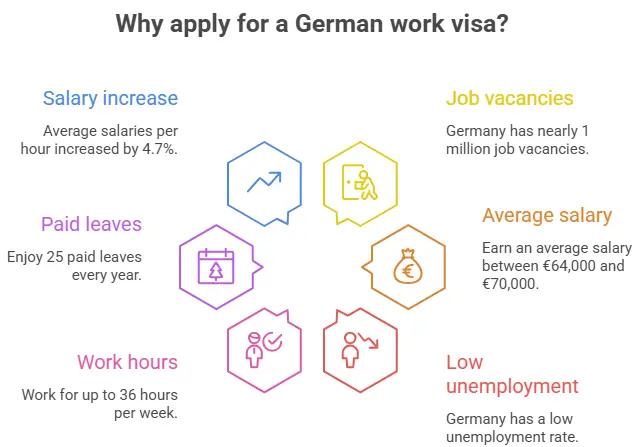
- Nearly 1 million job vacancies in Germany
- Earn an average salary between €64,000 and €70,000
- Low unemployment rate
- Work for up to 36 hours per week
- 25 paid leaves every year
- Average salaries per hour increased by 4.7%
Germany is one of the top destinations for professionals willing to work abroad. The country is known for its advanced technologies, well-built infrastructure, and an ever-growing job market, which is lucrative for foreign professionals. There is a huge demand for skilled foreign workers, and recently, Germany announced a fast-track EU Blue card for Indian techies. The updated policies will offer a golden opportunity for Indian tech talents, including recent graduates and IT professionals without a university degree.
*Want to work in Germany? Begin with a guide to Migrate to Germany Flipbook.
What is a German Employment Visa?
A German employment visa, or the National D Visa, is a mandatory entry permit for non-EU/EEA/Swiss citizens to reside and work in Germany. To qualify for a German employment visa, you will need an employment offer and recognized qualifications, as well as approval from the Federal Employment Agency. The visa precedes the residence permit, often allowing visa holders to take up employment for up to 4 years, with pathways to PR.
Also, read...
What are the questions asked in a German work visa interview?
Germany Work Visa from India
Germany is a well-liked destination for jobseekers worldwide because of its growing economy, job opportunities in various sectors, and high salaries. The government offers many work visa options for international workers and is currently looking for highly skilled workers in various sectors.
Germany offers high-paying job opportunities to students and job seekers. Some of the top job sectors in Germany include:
- Mechanical and automotive Sector
- Electrical and electronics industry
- Information technology and telecommunications
- Building and construction sector
- Health sector
Also, read…
Types of German Employment Visa
Germany Opportunity Card
Candidates from non-EU countries looking for a job can enter Germany with a Germany opportunity Card. This Card does not require proof of a permanent employment contract. Candidates recognized as skilled workers or scoring at least six points using the points system are eligible for an Opportunity Card.
Also, read...
How to apply for a Germany Opportunity Card?
EU Blue Card
The EU Blue Card is considered a work permit in Germany that is issued to skilled individuals. Individuals with EU Blue Card can work in any profession that has shortage of skilled workers. EU Blue Card allows the holder to stay and work in Germany for up to four years and then extend the stay if they still meet the requirements.
*Want to apply for an EU Blue Card? Y-Axis is here to guide you with the steps.
Benefits of German work permit
Germany offers many benefits to its employees, some of which are listed below:
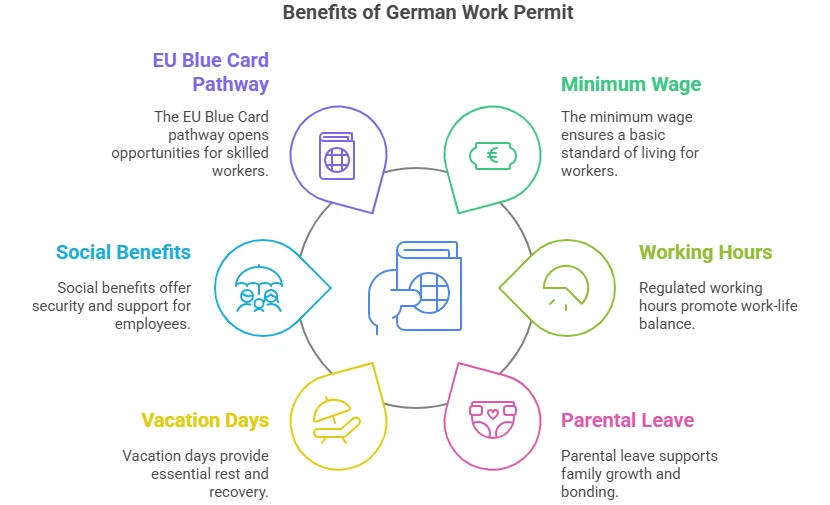
- In Germany, the minimum wage per hour is €12
- The average working week in Germany is 36 hours
- Parental leave allowance
- The minimum vacation right in Germany is 24 working days per year
- Enjoy social and healthcare benefits
- Pathway to obtain EU Blue Card in Germany
Also, read…
What are the most in-demand jobs in Germany for the next 10 years?
Eligibility of German work visa
To apply for a Germany work visa, candidates must have a confirmed job offer from a German employer and meet the qualification and salary requirements set by the Ausländerbehörde (Foreigners Authority) and the Federal Employment Agency (BA). Germany prioritises skilled professionals through the Skilled Immigration Act, which significantly widened access for Indian professionals since 2023. A clean criminal record and valid health insurance are mandatory for all applicants.
| Category | Details |
|---|---|
| Ideal Candidate Profile | Germany seeks IT professionals (software developers, data scientists, cybersecurity and cloud engineers), healthcare workers (doctors, nurses, physiotherapists), engineers (civil, mechanical, electrical, automation), researchers, STEM teachers, skilled tradespeople, and managers in multinational companies. The number of Indian workers in Germany has grown significantly, from 23,000 in 2015 to over 137,000 in 2024. |
| Education Requirements | A bachelor’s degree or higher is required for the Skilled Worker Visa and EU Blue Card. Vocational qualifications are accepted if recognised as equivalent to German standards. Degrees must be verified through the Anabin database or ZAB assessment. Regulated professions such as medicine and nursing require formal recognition (Anerkennung). |
| Work Experience | Relevant experience is required. IT roles need at least 2 years of experience, and a university degree may not be mandatory for some IT specialists. Engineering and healthcare jobs usually require 2–3 years, while senior roles need 5+ years. Indian work experience is accepted if qualifications meet German standards. |
| Language Requirements | German is not mandatory for visa approval under recent immigration reforms. English is commonly used in IT, engineering, and research roles. However, A1–B1 German skills are beneficial, especially for healthcare, education, and regulated professions. |
| Salary Thresholds | EU Blue Card (General jobs): €50,700/year minimum. EU Blue Card (Shortage jobs such as STEM, IT, healthcare): €45,934/year minimum. Skilled Worker Visa: salary must match German industry standards. Applicants over 45 must earn at least €55,770/year or show pension provision. |
| Additional Requirements | Applicants need a valid passport, Police Clearance Certificate (PCC), health insurance, and a confirmed job offer from a German employer. The employer must provide a Declaration of Employment form, and approval from the Federal Employment Agency (BA) may be required. Applications must be submitted at a German embassy or consulate, as Germany does not allow conversion from a tourist visa to a work permit inside the country. |
Also, read...
Germany to offer 90,000 work visas to Indian professionals
German work visa requirements
The following are the documents required to apply for German work visa:
- Contract letter by a German company
- Proof you have the required education qualification
- Educational certificates
- Proof of work experiences
- Resume or CV
- Health insurance coverage for foreign workers in Germany
- A cover letter that explains your purpose for stay
Also, read...
3 Million Jobs in Germany Over the Next Decade: Job Outlook and Work Visa Options
Job opportunities in Germany
Germany has one of the world's most powerful economies, with more than 1 million job opportunities. Some of the highest-paying job roles in the industry are listed below:
- Computer science / IT and software development
- Electronics engineering
- Mechanical engineering
- Account management and business analytics
- Nursing and Healthcare
- Civil engineering and architecture
The table given below has the list of job opportunities along with the average salaries.
| S. No | Designation | Active No of Jobs | Salary in Euro per Year |
|---|---|---|---|
| 1 | Full Stack Engineer / Developer | 480 | €59,464 |
| 2 | Front End Engineer / Developer | 450 | €48,898 |
| 3 | Business Analyst, Product Owner | 338 | €55,000 |
| 4 | Cyber Security Analyst, Cyber Security Engineer, Cyber Security Specialist | 300 | €51,180 |
| 5 | QA Engineer | 291 | €49,091 |
| 6 | Construction Engineer, Civil Engineer, Architect, Project Manager | 255 | €62,466 |
| 7 | Android Developer | 250 | €63,948 |
| 8 | Java Developer | 225 | €50,679 |
| 9 | DevOps / SRE | 205 | €75,000 |
| 10 | Customer Contact Representative, Customer Service Advisor, Customer Service Officer | 200 | €5,539 |
| 11 | Accountant | 184 | €60,000 |
| 12 | Chef, Commis-chef, Sous Chef, Cook | 184 | €120,000 |
| 13 | Project Manager | 181 | €67,000 |
| 14 | HR Manager, HR Coordinator, HR Generalist, HR Recruiter | 180 | €49,868 |
| 15 | Data Engineering, SQL, Tableau, Apache Spark, Python | 177 | €65,000 |
| 16 | Scrum Master | 90 | €65,000 |
| 17 | Test Engineer, Software Test Engineer, Quality Engineer | 90 | €58,000 |
| 18 | Digital Strategist, Marketing Analyst, Marketing Consultant, Social Media Marketing Manager, Growth Specialist, Sales Manager | 80 | €55,500 |
| 19 | Design Engineer | 68 | €51,049 |
| 20 | Project Engineer, Mechanical Design Engineer | 68 | €62,000 |
| 21 | Mechanical Engineer, Service Engineer | 68 | €62,000 |
| 22 | Electrical Engineer, Project Engineer, Controls Engineer | 65 | €60,936 |
| 23 | Manager, Director Pharma, Clinical Research, Drug Development | 55 | €149,569 |
| 24 | Data Science Engineer | 50 | €55,761 |
| 25 | Back End Engineer | 45 | €56,000 |
| 26 | Nurse | 33 | €33,654 |
Also, read…
Germany Job Market: Trends and Job Opportunities
Top in-demand occupations in Germany
Germany has a huge demand for international workers in areas such as Healthcare, Nursing, Finance, Management, Human Resources, Marketing and Sales, Accounting, Hospitality, Food Services, Manufacturing, etc. The demand for skilled and qualified workers in Germany is the major reason that it attracts immigrants from all over the world.
The list of the top 15 In-demand occupations in Germany is given below:
| Occupation | Annual Salary (Euros) |
|---|---|
| Engineering | €58,380 |
| Information Technology | €43,396 |
| Transportation | €35,652 |
| Finance | €34,339 |
| Sales & Marketing | €33,703 |
| Childcare & Education | €33,325 |
| Construction & Maintenance | €30,598 |
| Legal | €28,877 |
| Art | €26,625 |
| Accounting & Administration | €26,498 |
| Shipping & Manufacturing | €24,463 |
| Food Services | €24,279 |
| Retail & Customer Service | €23,916 |
| Healthcare & Social Services | €23,569 |
| Hotel Industry | €21,513 |
Read more...
Highest paying Job Opportunities in Germany
Average Salary of Skilled Workers in Germany
Germany is Europe's largest economy and ranks 6th highest for average salaries in the EU. Wages are governed by a combination of statutory minimum wage (€12.82/hour from January 2026) and sector-specific collective bargaining agreements. Workers benefit from 24–30 days of paid annual leave, universal healthcare, and strong social security protections.
| Experience Level | Average Gross Salary (EUR / Year) | Approx. Salary (INR / Year) |
|---|---|---|
| Entry-Level (0–2 years) | €30,000 – €48,000 | ≈ ₹28 – ₹44 LPA |
| Mid-Level (3–5 years) | €48,000 – €78,000 | ≈ ₹44 – ₹72 LPA |
| Senior-Level (5+ years) | €78,000 – €1,40,000+ | ≈ ₹72 LPA – ₹1.29 Cr PA |
Also, read...
Germany Faces Shortage of 40,000 Nurses; Indians in Strong Demand. Apply now!
How to apply for a German work visa from India
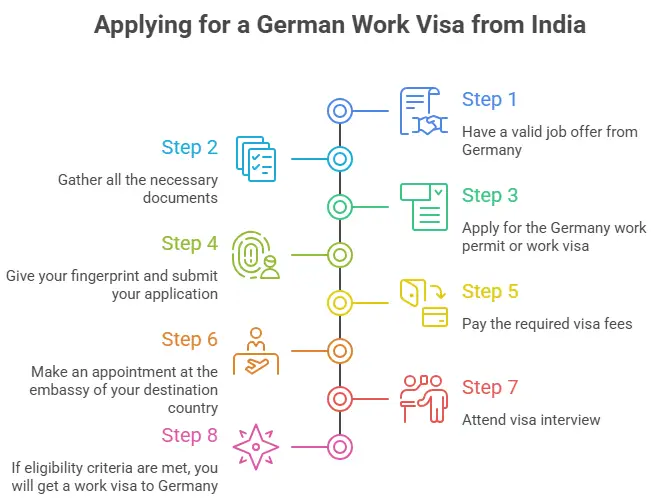
Step 1: Have a valid job offer from Germany
Step 2: Gather all the necessary documents
Step 3: Apply for the Germany work permit or work visa
Step 4: Give your fingerprint and submit your application
Step 5: Pay the required visa fees
Step 6: Make an appointment at the embassy of your destination country
Step 7: Attend visa interview
Step 8: If eligibility criteria are met, you will get a work visa to Germany.
Also, read...
How to apply for German work visa?
Tips to Avoid Germany Work Visa Rejection
Avoiding certain mistakes while applying for a German work visa can lead to a successful visa application, even on the first attempt. Here are certain tips to avoid German work visa rejection:
- Provide complete documentation
- Make sure to include adequate health insurance coverage
- Check for errors in the sponsorship letter
- Attach sufficient documents to demonstrate proof of funds
- Verify and cross-check to make sure the application is complete
Also, read...
Germany Eases Transit Rules for Indians Flying to the UK – Check Details Now!
Germany work visa from India processing time
The processing time for a German work visa takes around 1-3 months. It may vary depending on the number of applications received in the German Consulate embassy and the type of visa you are applying for.
Also, read...
Canada vs Australia vs Germany: Which Is the Best Country to Settle Abroad in 2026?
German work visa cost from India
The processing fee for a German work visa from India costs EUR 75 and may vary depending on the type of work visa.
| Visa Category | Application Fee (EUR) | Approx. INR |
|---|---|---|
| Short-Stay Schengen Visa – Adults (Type C) | € 90 | ≈ ₹8,200 |
| Short-Stay Schengen Visa – Children (6–12 years) | € 45 | ≈ ₹4,100 |
| Children under 6 years | Free | — |
| Long-Stay National Visa – Adults (Type D) — covers Work Visa, EU Blue Card, Opportunity Card | € 75 | ≈ ₹6,800 |
| Long-Stay National Visa – Minors under 18 | € 37.50 | ≈ ₹3,400 |
| EU Blue Card (Initial) | € 100 | ≈ ₹9,100 |
| Permanent Residence / Settlement Permit | €113 – €147 | ≈ ₹10,300 – ₹13,400 |
| VFS Global Service Charge (all applications) | ≈ INR 1,722 | — |
Also, read...
What are the fast-track hiring options in Germany for Skilled Professionals?
Dependent Benefits for Germany Work Visa Holders
Spouses and children of Germany work visa holders are entitled to a wide range of benefits through Germany's family reunification programme and the federal social welfare system.
| Category | Details |
|---|---|
| Dependent Visa / Family Reunification | Spouses and unmarried children under 18 can join the main applicant in Germany through the Family Reunification program. Both spouses must be 18 years or older. The main applicant must show stable income (about €1,200/month for two people plus €300 for each child), provide suitable housing, and have valid health insurance. The dependent permit is usually valid for 3–12 months and renewed with the main applicant’s permit. |
| Spouse Work Rights | Once the residence permit is issued, the spouse can work in Germany for any employer and in any field without needing a separate work permit or job offer. |
| Children’s Education | Children can attend free public schools in Germany. Education is compulsory from ages 6 to 16. Students can also access vocational training, higher secondary education, and universities, often at low or no cost. |
| Healthcare Access | Dependents are usually covered under the main applicant’s public health insurance. This includes doctor visits, hospital treatment, medicines, and dental care with very low personal costs. |
| Child Benefit (Kindergeld) | Families receive €259 per child per month (from 2026) until the child turns 18. Indian workers can receive this benefit once they start registered employment in Germany. Lower-income families may also receive an additional Child Supplement of up to €297 per month. |
| Parental Benefit (Elterngeld) | Parents can receive 65–100% of their net income for up to 14 months after childbirth, with a maximum payment of €1,800 per month. This benefit can be shared between both parents. |
| Childcare Support | Germany offers subsidised daycare (Kita) for children from age 1. Some families may receive free daycare, and additional support may cover school meals, supplies, and extracurricular activities. |
Also, read...
New update on Germany Citizenship, check how you can apply.
Pathway to Long-Term Residency in Germany
Germany's residency pathway is structured around continuous legal stay, employment history, language integration, and pension contributions. The 2024 Nationality Act reform significantly shortened timelines, making Germany one of the most accessible EU countries for Indian professionals seeking long-term settlement.
| Category | Details |
|---|---|
| Permanent Residency (PR) | Germany’s Settlement Permit (Niederlassungserlaubnis) allows people to live and work in Germany permanently without restrictions. Applicants usually need 5 years of legal residence, stable employment, B1 German language skills, completion of an integration course, and 60 months of pension contributions. Once granted, PR does not expire. |
| PR Fast-Track – EU Blue Card | EU Blue Card holders can apply for PR after 21 months with B1 German, or after 27 months with A1 German. This is the fastest PR pathway and is commonly used by IT, engineering, and healthcare professionals. |
| PR Fast-Track – Skilled Worker | Skilled workers with recognised qualifications can apply for PR after 3 years if they have stable employment and B1 German skills. Graduates from German universities can qualify after 2 years of work related to their degree. |
| Citizenship / Naturalisation | German citizenship generally requires 5 years of legal residence, B1 German skills, passing the citizenship test, financial stability, and a clean criminal record. In special cases with C1 German and strong integration, applicants may qualify in 3 years. Spouses of German citizens can apply after 3 years of residence and 2 years of marriage. |
| Language Requirements | B1 German is needed for the normal PR route and citizenship. A1 German is enough for the 27-month EU Blue Card PR route. B2 German improves job opportunities. Germany offers government-supported integration and language courses for newcomers. |
| PR Eligibility Timeline | Most workers start with a temporary visa (1–4 years). EU Blue Card holders may qualify for PR in 21–27 months, while skilled workers usually qualify in 3–5 years. Citizenship can be applied for after 5 years of residence, making the fastest route about 5 years for well-integrated professionals. |
| Dual Citizenship | Germany allows dual citizenship (since June 2024). However, India does not allow dual nationality, so Indians who become German citizens must give up their Indian citizenship. They can apply for OCI (Overseas Citizen of India) status to retain many benefits of living or travelling to India. |
*Interested in Germany immigration? Let Y-Axis guide you with the steps.
How Can Y-Axis Help You?
Y-Axis, the world’s No.1 Overseas Immigration Company, provides unbiased immigration services based on each client's interests and requirements.
The impeccable services of Y-Axis include:
- Free eligibility check through the German Immigration Points Calculator
- Coaching services: Expert CELPIP coaching, IELTS proficiency Coaching
- Free career consultation; book your slot today
- Complete guidance for German Immigration.
- Resume Marketing services to find suitable jobs in Germany
Don't know what to do ?
Get Free Counseling
Looking for Inspiration
Explore what Global Indians have to say about Y-Axis in shaping their future
Frequently Asked Questions