

Don't know what to do ?
Get Free Counseling
Last Updated 08 June 2026
About the Germany PhD Student Dependent Visa
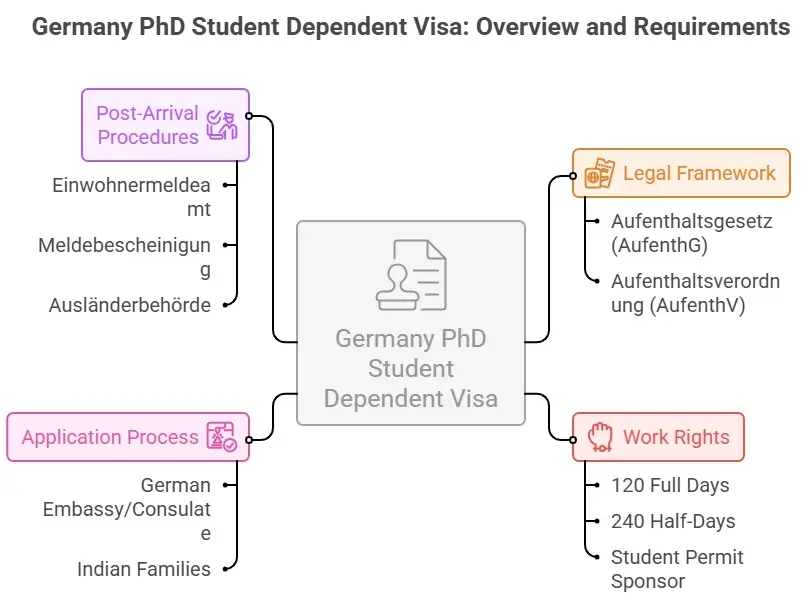
The Germany PhD student dependent visa formally a Family Reunification Permit (Familienzusammenführung) issued under Sections 27–36 of the Residence Act (Aufenthaltsgesetz / AufenthG) allows the spouse or registered partner and dependent children under 18 of an Indian PhD student enrolled at a German university to join them and reside legally in Germany for the duration of the doctoral programme.
One of the most significant advantages of the Germany PhD student dependent route is the A1 German language exemption. Under § 30 Abs. 1 Satz 3 Nr. 3 AufenthG, spouses joining PhD students (who hold university-level qualifications — Hochschulabschluss) are exempt from the standard A1 German language requirement that applies to most other spousal visa categories. This exemption removes a major barrier for Indian families where the spouse has not yet studied German.
The dependent visa for PhD student spouses is administered by the German Embassy or the German Consulate General in India at the visa stage. After arrival in Germany, the dependent registers with the local Einwohnermeldeamt (residents' registration office) and applies for a residence permit (Aufenthaltserlaubnis) at the Ausländerbehörde (Foreigners' Registration Office) in the city where the PhD student is based.
India is one of the largest source countries for international PhD students in Germany, with over 20,000 Indian students enrolled in German universities a significant proportion pursuing doctoral research in STEM, engineering, life sciences, and social sciences, including at institutions such as TU Munich, RWTH Aachen, Heidelberg University, TU Berlin, and the Max Planck Society research institutes.
Germany PhD Student Dependent Visa: Key Facts at a Glance
| Category | Details |
|---|---|
| Visa / Permit Type | Family Reunification Permit — National Visa (Type D) issued in India, followed by an Aufenthaltserlaubnis (Residence Permit) issued in Germany after arrival. |
| Legal Basis | §§ 27–36 AufenthG (Family Reunification); spouse under § 30, children under § 32, and sponsor’s PhD student residence permit under § 16b AufenthG. |
| Applicable For | Spouse or registered partner, and unmarried dependent children under 18, of a PhD student (Doktorand) enrolled at a recognized German university and holding a valid § 16b AufenthG residence permit. |
| Sponsor Category | Non-EU/EEA PhD student enrolled at a recognized German university and holding a valid Aufenthaltserlaubnis under § 16b AufenthG. |
| A1 Language Requirement | Generally waived for spouses of PhD students with a recognized university degree under § 30 Abs. 1 Satz 3 Nr. 3 AufenthG. |
| Work Rights — Spouse / Partner | Permitted to work in Germany in accordance with the conditions stated on the residence permit issued by the local immigration authority. |
| Work Rights — Children Under 18 | Not applicable. Germany generally permits only limited youth employment from age 15 and full-time employment from age 18. |
| Study Rights | Dependents may enroll in German educational institutions. School-age children can attend public schools free of charge, and spouses may pursue higher education. |
| Health Insurance | Mandatory. Eligible family members may be covered through statutory family health insurance (Familienversicherung), subject to German health insurance regulations. |
| Permit Duration | Usually aligned with the PhD student’s residence permit and renewed as required by the local Ausländerbehörde. |
| Path to Permanent Residence | Eligible dependents may qualify for a Niederlassungserlaubnis (Settlement Permit) after meeting Germany’s residence, language, integration, and legal requirements. |
Germany PhD Student Dependent Visa: Overview
The Germany PhD student dependent visa falls under Germany's family reunification framework, governed by the Aufenthaltsgesetz (AufenthG) and the associated Aufenthaltsverordnung (AufenthV). It allows non-EU/EEA family members of PhD students enrolled at German universities to reside in Germany for the duration of the doctoral programme, typically 3–5 years.
The work rights for dependents under this category are restricted to 120 full days or 240 half-days per calendar year, a critical distinction from the Germany work permit dependent visa route where spouses typically enjoy unrestricted employment. This restriction applies because the sponsor holds a student permit (§ 16b AufenthG), not a work permit. Indian families should factor this into their financial planning before applying.
After the family reunification visa is approved at the German Embassy or Consulate General in India, the dependent travels to Germany. Within the first two weeks of arrival, the dependent must register their address at the local Einwohnermeldeamt. This registration (Anmeldung) generates a Meldebescheinigung (registration certificate), which is a prerequisite for opening a German bank account, enrolling in health insurance, and applying for the Aufenthaltserlaubnis at the Ausländerbehörde.
Also, read...
Can I work in Germany without speaking German?
Benefits of the Germany PhD Student Dependent Visa for Indian Families
The Germany PhD student dependent visa offers Indian families a strong set of rights and practical advantages. Key benefits include:
- A1 German language exemption for spouse: Unlike the standard spouse visa, the PhD student route exempts the spouse from the A1 German language requirement removing a significant pre-departure preparation barrier for Indian families.
- Work rights for spouse — up to 120 full days per year: The dependent spouse may work up to 120 full working days or 240 half working days per calendar year without a separate work permit providing meaningful income-earning capacity during the PhD.
- Free GKV family health insurance: Spouse and children under 25 with no independent income qualify for free co-insurance under Germany's statutory health insurance (Gesetzliche Krankenversicherung — GKV Familienversicherung) via the PhD student's health insurance plan.
- Study rights for all dependents: Spouse and children may enrol in German educational institutions. The spouse may attend German universities, language schools, and vocational training programmes. Children attend German state schools free of charge.
- Free school education for children: School-age children may attend German state primary and secondary schools (Grundschule and Gymnasium) at no cost in the state of residence.
- German language course access: Many cities offer subsidised or free German integration courses (Integrationskurse) for family reunification permit holders directly supporting future Germany PR eligibility.
- Path to permanent residence: After 5 years of continuous legal residence in Germany, dependents can apply for a Niederlassungserlaubnis (settlement permit — Germany's permanent residence).
- Path to German citizenship: After 5 years of legal residence in Germany (reduced from 8 years under the Staatsangehörigkeitsgesetz reform effective June 2024), citizenship may be applied for subject to language, integration, and self-sufficiency requirements.
- Exceptionally high quality of life: Germany consistently ranks among the top countries globally for quality of education, public infrastructure, social security, and work-life balance with strong Indian communities in Munich, Berlin, Heidelberg, and Hamburg.
- Central European location: Germany's geographic position at the heart of Europe provides easy access to Schengen travel, professional opportunities across the EU, and a rich multicultural environment for Indian families.
*Want to apply for a Germany student visa? Let Y-Axis guide you through the process.
Germany's Expanding Research Opportunities for Indian Scholars
Germany continues to strengthen its position as a leading destination for international researchers, doctoral candidates, and academic professionals. With expanded research collaborations, scholarship opportunities, and streamlined visa pathways for Indian students and researchers, the country offers a supportive environment for pursuing advanced education and innovation.
Watch this video to learn about Germany's latest initiatives for Indian researchers, including research fellowships, doctoral study opportunities, visa pathways, post-study work options, and long-term settlement prospects. These developments can benefit not only PhD candidates and researchers but also their accompanying family members planning to build a future in Germany.
Watch to know more:
Who Is Eligible to Sponsor a Dependent in Germany as a PhD Student?
Germany's family reunification rules define specific eligibility criteria for PhD student sponsors. The following must be confirmed before submitting the dependent visa application at the German Embassy or Consulate in India.
PhD Student Sponsors Who CAN Sponsor Family
The following categories of Indian PhD students in Germany are eligible to sponsor immediate family members for a family reunification permit:
- PhD students (Doktoranden) enrolled at a recognised German university and holding a valid Aufenthaltserlaubnis under § 16b AufenthG
- PhD students employed as Wissenschaftliche Mitarbeiter (research associates) under a TV-L E13 or E14 employment contract at a German university — these students may hold a § 16b or § 18b AufenthG permit
- DAAD scholarship holders (Deutscher Akademischer Austauschdienst) enrolled in a doctoral programme at a German institution
- Alexander von Humboldt Research Fellowship holders conducting doctoral research in Germany
- DFG-funded (Deutsche Forschungsgemeinschaft) doctoral researchers at German universities or research institutes
- PhD students at Max Planck Society, Fraunhofer Society, or Helmholtz Association institutes registered as Doktoranden at affiliated universities
PhD Student Sponsors Who MAY NOT Be Eligible to Sponsor
- Students on a short-term language course or preparatory college (Studienkolleg) — not eligible as dependent visa sponsor
- Students who have not yet enrolled or been formally accepted into a doctoral programme — acceptance letter and enrolment (Immatrikulationsbescheinigung) required
- Students who cannot demonstrate adequate financial subsistence for themselves and all family members
- Students whose residence permit is about to expire — the PhD permit must have sufficient remaining validity to cover the family's anticipated residence period
Note: Eligibility requirements are administered by the German Embassy in India and the Ausländerbehörde in Germany. Rules are subject to change under German immigration law. Always verify current requirements with the German Embassy in New Delhi or the German Consulate General in Mumbai or Chennai before applying.
Also, read...
Can I work in Germany without speaking German?
Sponsor Requirements
| Requirement | Details |
|---|---|
| Valid PhD Student Permit | Must hold a valid Aufenthaltserlaubnis under § 16b AufenthG (or § 18b for research associate categories). The permit should remain valid for the anticipated duration of the family's stay in Germany. |
| University Enrollment | Must be formally enrolled (immatrikuliert) as a doctoral candidate at a recognized German university (staatlich anerkannte Hochschule). A current enrolment certificate (Immatrikulationsbescheinigung) is required. |
| Financial Subsistence (Lebensunterhalt) | Must demonstrate sufficient financial resources to support all accompanying family members without relying on German social assistance. Evidence may include a blocked account (Sperrkonto), employment contract, stipend, research assistantship, or scholarship award letter. |
| Accommodation in Germany | Must provide evidence of adequate housing (angemessener Wohnraum) suitable for the family size. A rental agreement (Mietvertrag) or proof of accommodation is typically required. |
| No Social Assistance Dependency | Sponsor should not be dependent on German social welfare benefits such as Bürgergeld or Sozialhilfe when applying for family reunification. |
| Residence in Germany | The sponsor must be legally residing in Germany and maintaining valid immigration status at the time the family reunification application is submitted. |
| Valid Permit Duration | The residence permit should have sufficient remaining validity. If the permit is close to expiry, renewal before submitting the family application is generally advisable. |
Also, read...
Dependent Eligibility Requirements
| Requirement | Details |
|---|---|
| Eligible Dependents | Legally married spouse or registered partner, as well as unmarried dependent children under 18 years of age (including biological, adopted, or step-children). |
| Marriage / Partnership Evidence | Original marriage certificate (Heiratsurkunde) or registered partnership certificate, duly apostilled and translated where required. |
| Children’s Evidence | Original birth certificate (Geburtsurkunde) for each child, along with any applicable custody or guardianship documents. |
| Visa Requirement for Indian Nationals | Indian citizens must apply for a German National Visa (Type D) for family reunification through the relevant German diplomatic mission or authorized visa application center in India. |
| Entry into Germany | Dependents must enter Germany using the approved National Visa (Type D) and comply with all immigration requirements upon arrival. |
| Residence with Sponsor | Dependents are expected to live with the PhD student sponsor in Germany, as cohabitation forms part of the family reunification conditions. |
| Good Character Requirement | Applicants should have a clean immigration and legal record and must disclose any previous visa refusals or immigration issues. |
| German Language Requirement | In many cases involving PhD student sponsors, spouses may qualify for an exemption from the standard A1 German language requirement, subject to applicable immigration regulations and supporting documentation. |
*Want to work in Germany? Let Y-Axis guide you with the process.
Work Rights for Germany PhD Student Dependent Visa Holders
This is the most important distinction between the Germany PhD student dependent visa and the Germany work permit dependent visa. Unlike spouses joining work permit holders — who typically receive unrestricted work rights — spouses joining PhD student permit holders (§ 16b AufenthG) receive restricted work rights under German law.
| Activity | Permitted for Dependents? |
|---|---|
| Employment (within permitted annual limits) | Yes. Dependents may undertake employment in accordance with the conditions stated on their residence permit and applicable German immigration regulations. |
| Employment Beyond Standard Limits | Additional authorization from the competent immigration authority (Ausländerbehörde) may be required, depending on the permit conditions and employment type. |
| Self-Employment or Freelance Work | Not automatically permitted. Separate approval from the Ausländerbehörde is generally required before commencing self-employed or freelance activities. |
| Mini-Job | Permitted, subject to applicable employment and immigration regulations. Specific conditions may vary depending on the residence permit category. |
| Study and Education | Yes. Dependents may enroll in German universities, language courses, vocational training programs, and other recognized educational institutions. |
| Access to Health Insurance | Yes. Dependents must maintain valid health insurance coverage and may be eligible for family co-insurance under Germany’s statutory health insurance system, subject to eligibility requirements. |
| Access to Social Benefits | Access to public benefits depends on immigration status, residence conditions, and eligibility under German social welfare regulations. |
| Children Under Working Age | Not applicable. Children must comply with German child labor laws and compulsory education requirements. |
| Work Rights After Sponsor Changes Status | Dependent work rights may expand if the sponsor transitions to another residence permit category, subject to updated immigration regulations and permit conditions. |
Note: The 120-day / 240-half-day work limit is a calendar-year limit, not a cumulative limit. It resets on 1 January each year. Working days should be tracked carefully. The Ausländerbehörde may ask for evidence of days worked during permit renewal. Exceeding the limit without authorisation constitutes a violation of the residence permit conditions.
Also, read...
Study Rights for Germany PhD Student Dependent Visa Holders
All dependents holding a German family reunification permit may study freely. There are no restrictions on enrolment in German educational institutions for family reunification permit holders.
| Study Aspect | Details for Dependents |
|---|---|
| Spouse / Partner | May enroll in German universities, universities of applied sciences (Hochschulen), language schools, or vocational training institutions, subject to the admission requirements of the chosen institution. |
| School-Age Children | May attend public primary and secondary schools in Germany. School attendance is compulsory for children residing in Germany in accordance with state education regulations. |
| German Language Courses | Dependents may participate in German language and integration courses offered by approved providers. Completion of such courses can support long-term settlement and integration objectives. |
| University / Higher Education | Dependent spouses may apply to German higher education institutions as international students and must meet the academic and language requirements of their chosen program. |
| Vocational Training (Ausbildung) | Dependent spouses may pursue vocational education and training opportunities, subject to applicable immigration and educational regulations. |
| Children’s Higher Education | Children who complete their secondary education in Germany may become eligible to apply to German universities and higher education institutions under the applicable admission rules. |
Also, read...
Germany student dependent visa
Germany PhD Student Dependent Visa Fees
| Fee Type | Amount (EUR) | Amount (INR Approx.) |
|---|---|---|
| National Visa (Type D) – Adult Spouse / Partner | €75 per applicant | Approximately INR 7,000 |
| National Visa (Type D) – Child Under 18 | €37.50 per child | Approximately INR 3,500 |
| National Visa (Type D) – Child Under 6 | Free | Not Applicable |
| Residence Permit (Aufenthaltserlaubnis) – Adult | €100 per applicant | Approximately INR 9,300 |
| Residence Permit (Aufenthaltserlaubnis) – Child Under 18 | €50 per child | Approximately INR 4,650 |
| Family Health Insurance (Familienversicherung) | Usually included for eligible dependents under the sponsor’s statutory health insurance plan | Not Applicable |
| German Integration Course | Subsidized rates may apply depending on eligibility and course provider | Varies |
| Certified Translation of Documents | Approximately €50–€200 per document | Approximately INR 4,650–18,600 |
| MEA Apostille (India) | As per applicable charges | Approximately INR 100–500 per document |
| Professional Consultancy Fees | Varies by service provider and package selected | As Applicable |
Note: Visa fees are set by the German government and are subject to revision. 1 EUR ≈ INR 93 (indicative only; rates fluctuate). Ausländerbehörde residence permit fees vary slightly by German federal state (Bundesland). Always verify current fees at the German Embassy website (india.diplo.de) before applying.
Also, read...
Germany Opens New Study and Research Pathways for Indians. Apply Now!
Germany PhD Student Dependent Visa Processing Time
| Stage | Estimated Time |
|---|---|
| Gathering and Organizing Supporting Documents | Approximately 2–8 weeks, depending on document availability, apostille requirements, and translation processing times. |
| Visa Appointment Booking | Approximately 4–12 weeks, subject to appointment availability at the relevant German diplomatic mission or visa application center. |
| National Visa (Type D) Processing | Typically 6–12 weeks after submission of the complete application and biometrics. |
| Visa Decision | Applicants are notified once a decision has been made and can collect their passport with the visa, if approved. |
| Travel to Germany | Can be arranged after visa issuance and within the validity period of the National Visa (Type D). |
| Address Registration (Anmeldung) | Must be completed after arrival in Germany within the timeframe specified by local registration authorities. |
| Residence Permit Appointment | Appointment waiting times vary by city and local immigration office workload. |
| Residence Permit Processing | Generally takes several weeks after the appointment and submission of all required documents. |
| Total Estimated Timeline | Approximately 5–10 months from initial preparation to receipt of the German residence permit, depending on individual circumstances and processing times. |
Note: Processing times are indicative. German Embassy India processes applications in submission order. Ausländerbehörde timelines vary significantly by city — Munich and Berlin typically have longer backlogs than smaller university cities such as Göttingen, Heidelberg, or Erlangen. Submitting a complete and accurate document set reduces the risk of additional information requests (Nachforderungen). Do not book flights to Germany before the national visa (Type D) is issued.
Also, read...
Documents Required for the Germany PhD Student Dependent Visa
Documents for Spouse / Registered Partner
- Valid passport
- Recent passport-sized biometric photographs as per German Embassy specifications
- Completed and signed German visa application form
- Original marriage certificate (Heiratsurkunde) — apostilled by MEA India and accompanied by certified German or English translation
- Proof of genuine and subsisting relationship — recent photographs together, correspondence, evidence of shared financial arrangements
- Copy of PhD student sponsor's valid Aufenthaltserlaubnis (German residence permit card — both sides)
- Copy of PhD student sponsor's valid passport (all pages with entries)
- Sponsor's Immatrikulationsbescheinigung (current enrolment certificate) from German university confirming doctoral enrolment
- Proof of financial subsistence — sponsor's employment contract (TV-L E13/E14), payslips (last 3 months), blocked account (Sperrkonto) statement, or scholarship award letter (DAAD, Humboldt, DFG)
- Proof of accommodation in Germany — rental contract (Mietvertrag) in sponsor's name showing property address and space adequate for the family
- Health insurance confirmation — statement from PhD student's GKV provider (e.g. TK, AOK, Barmer) confirming that the spouse will be co-insured under Familienversicherung on arrival
Documents for Dependent Children Under 18
- Valid passport for each child (minimum 12 months validity)
- Recent biometric passport-sized photographs for each child
- Completed German visa application form for each child
- Full birth certificate (Geburtsurkunde) showing both parents' names — apostilled by MEA India and certified German or English translation attached
- Notarised consent letter from the non-travelling parent where one parent does not travel (sole custody order where applicable)
- Proof of custody arrangement where parents are separated or divorced — court order (apostilled)
- Sponsor's residence permit and subsistence documents confirming support for the child
- GKV family health insurance confirmation covering the child
Sponsor's Supporting Documents (Required for Both Applications)
- Copy of all pages of the PhD student's valid German residence permit (Aufenthaltserlaubnis) — issued under § 16b AufenthG
- Current Immatrikulationsbescheinigung from the German university — must confirm doctoral enrolment and expected completion date
- Proof of financial subsistence — one or more of: TV-L employment contract (Wissenschaftlicher Mitarbeiter), payslips from last 3 months, current blocked account (Sperrkonto) statement showing minimum €11,208, or scholarship award letter
- Mietvertrag (rental contract) in sponsor's name for accommodation in Germany — must show address and number of rooms adequate for the family
- Meldebescheinigung (registration certificate) confirming sponsor's registered address in Germany — issued by the Einwohnermeldeamt
- Supervisor letter or Betreuungsvereinbarung (doctoral supervision agreement) from the university confirming the nature and expected duration of the doctoral research
Note: All documents not in German or English must be accompanied by certified translations into German or English. Documents issued in India — including marriage certificates and birth certificates — must be apostilled by the Ministry of External Affairs (MEA) in New Delhi or by the relevant state authority before submission to the German Embassy.
How to Apply for the Germany PhD Student Dependent Visa from India
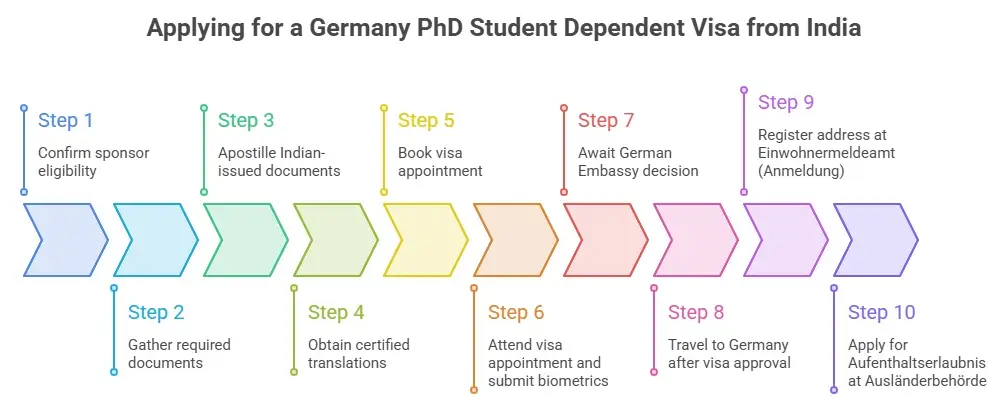
The step-by-step process to apply for the Germany family reunification visa for PhD student dependents from India is as follows:
Step 1: Confirm sponsor eligibility to verify that the PhD student is enrolled at a recognised German university, holds a valid § 16b AufenthG permit, and meets the financial subsistence and accommodation requirements for the number of family members applying.
Step 2: Gather all required documents such as passports, marriage certificate, birth certificates for children, sponsor's residence permit and enrolment certificate, payslips or scholarship letter, rental contract, and health insurance confirmation.
Step 3: Apostille all Indian-issued documents including marriage certificate, birth certificates, and all other official documents issued in India.
Step 4: Obtain certified translations for any documents not already in German or English must be translated by a certified translator.
Step 5: Book visa appointment for in-person biometrics.
Step 6: Attend visa appointment and submit biometrics.
Step 7: Await German Embassy decision which typically takes around 6–12 weeks.
Step 8: Travel to Germany after visa approval.
Step 9: Register address at Einwohnermeldeamt (Anmeldung) within 14 days of arrivalt.
Step 10: Apply for Aufenthaltserlaubnis at Ausländerbehörde in Germany with original documents including the Meldebescheinigung, passport, visa, sponsor's residence permit, and financial and housing evidence.
Financial Requirements for the Germany PhD Student Dependent Visa
The PhD student sponsor must demonstrate adequate financial means (gesicherter Lebensunterhalt) to support themselves and all family members throughout their stay in Germany without reliance on German social assistance (Bürgergeld or Sozialhilfe). This is assessed under §§ 5 and 27 AufenthG.
| Financial Requirement | Details |
|---|---|
| Subsistence Requirement | The sponsor must demonstrate sufficient financial resources to support themselves and accompanying family members without relying on public assistance. Financial requirements are assessed based on family size and living expenses. |
| Employment Income | Income from an employment contract, research position, or university appointment may be used as evidence of financial stability. Supporting documents such as employment contracts and recent payslips are typically required. |
| Blocked Account (Sperrkonto) | A blocked account may be accepted as proof of funds where applicable. The required amount depends on the applicant's circumstances and the number of accompanying dependents. |
| Scholarship or Stipend Income | Scholarship holders may use official award letters and funding confirmations to demonstrate sufficient financial support for themselves and their dependents. |
| Family Allowances | Eligible family-related allowances provided through scholarships or employment arrangements may be considered as part of the overall financial assessment. |
| No Reliance on Social Assistance | The sponsor should not depend on public welfare benefits intended for basic subsistence when applying for family reunification. |
| Bank Statements | Recent bank statements may be requested to verify regular income, available savings, and overall financial stability. |
Also, read...
Accommodation Requirements for the Germany PhD Student Dependent Visa
The PhD student sponsor must provide evidence of adequate accommodation (angemessener Wohnraum) in Germany for themselves and all family members. This is a mandatory requirement assessed under § 29 Abs. 1 Nr. 2 AufenthG.
Acceptable proof of accommodation includes a signed rental contract (Mietvertrag) in the sponsor's name showing the property address in Germany, the monthly rent, and the size of the property. The accommodation must be of a standard appropriate for the number of occupants, meeting the housing adequacy norms applied by the relevant Ausländerbehörde. Many authorities apply a guideline of approximately 12 square metres per person as a minimum.
Student dormitory rooms (Wohnheim) are generally not considered adequate for a family. If the PhD student has been living in a single dormitory room, they must arrange private rental accommodation before applying for the dependent visa. This is one of the most common preparatory steps Indian PhD students overlook before filing the family visa application.
If the sponsor moves to a new address during the application process or before the family arrives, an updated Mietvertrag and Meldebescheinigung must be provided to the German Embassy or Ausländerbehörde as soon as the change occurs.
Also, read...
Highest paying Job Opportunities in Germany
Permit Status for Germany PhD Student Dependent Visa Holders
After arriving in Germany and completing the Anmeldung at the Einwohnermeldeamt, dependents apply for a residence permit (Aufenthaltserlaubnis) at the local Ausländerbehörde. The permit status and conditions for each dependent category are as follows:
| Dependent | Permit Status | Key Conditions |
|---|---|---|
| Spouse / Registered Partner | Family Reunification Residence Permit | Eligible to reside with the sponsor in Germany, access education opportunities, and enjoy rights granted under the applicable residence permit. Permit validity generally aligns with the sponsor’s permit duration and must be renewed before expiry. |
| Dependent Children Under 15 | Child Family Reunification Residence Permit | May live and study in Germany with access to compulsory schooling and healthcare benefits, subject to local regulations. Permit remains linked to the sponsor’s legal residence status. |
| Dependent Children Aged 15–18 | Child Family Reunification Residence Permit | May continue secondary education and participate in permitted activities according to German regulations. Residence status is generally connected to the sponsor’s permit validity. |
Note: All family permit holders must maintain registered residence with the sponsor in Germany and notify the local Ausländerbehörde of any significant change in circumstances — including the PhD student's change of university, change of city, change of permit status, or completion of the doctoral programme.
Also, read...
Canada vs Australia vs UK vs Germany: Which Country Has the Fastest Visa Processing Time?
What Happens After PR: Planning Your Family's Future in Germany
Germany offers a well-defined long-term pathway for PhD students and their families. Here is what to expect at each stage:
- After the PhD is completed, the sponsor can apply for an 18-month job seeker visa (§ 20 Abs. 3 AufenthG — Aufenthaltserlaubnis zur Arbeitssuche für Hochschulabsolventen) to remain in Germany and find employment. The family's dependent permit can typically be maintained during this transition period.
- Once the PhD sponsor secures employment and transitions to a work permit — EU Blue Card (§ 18g AufenthG), Fachkräfte-Aufenthaltserlaubnis (skilled worker permit), or employer-specific permit — the dependent spouse's work rights upgrade to unrestricted employment, removing the 120-day annual cap.
- After 5 years of continuous legal residence in Germany on a valid Aufenthaltserlaubnis, the dependent can apply for a Niederlassungserlaubnis (settlement permit — §§ 9, 26 AufenthG). This requires B1 German proficiency, completion of an integration course, adequate pension contributions, and financial self-sufficiency.
- Germany EU Blue Card holders and their dependents may qualify for permanent residence in as few as 21 months (33 months for standard Blue Card holders) — significantly faster than the standard 5-year route — if the sponsor transitions to a Blue Card after the PhD.
- After 5 years of legal residence in Germany (reduced from 8 years under the Staatsangehörigkeitsgesetz reform of June 2024), the dependent may apply for German citizenship (Einbürgerung). This requires B1 German, renunciation of Indian citizenship (India does not permit dual citizenship), and financial self-sufficiency. Exceptions apply for minors born in Germany.
- Work rights held by the dependent under the family reunification permit continue unchanged into the Niederlassungserlaubnis, with no employment restrictions at any stage after the permit upgrade.
Also, read...
Germany Eases Transit Rules for Indians Flying to the UK – Check Details Now
Market Trends: Germany PhD Student Dependent Visa
- India sends the second-largest number of international students to Germany after China, with over 20,000 Indian students currently enrolled — a significant proportion in doctoral programmes at Germany's research-intensive universities and institutes.
- Demand for the Germany PhD student dependent visa from India has grown steadily as DAAD, Alexander von Humboldt, and DFG-funded positions for Indian doctoral researchers have increased, and as Indian IT, pharma, and engineering professionals increasingly pursue research doctorates in Germany.
- Germany's top PhD destinations for Indian students — TU Munich, RWTH Aachen, Heidelberg University, TU Berlin, Free University Berlin, and KIT Karlsruhe — are all located in cities with established Indian communities and strong family support infrastructure.
- The A1 German language exemption for PhD student dependent spouses is a significant policy advantage that Indian families increasingly recognise when comparing Germany against other European destinations such as the Netherlands, Sweden, or the UK.
- Growing numbers of Indian PhD students in Germany are transitioning to EU Blue Cards or skilled worker permits after completing their doctorates — a pathway that upgrades dependent spouse work rights to unrestricted employment and accelerates PR eligibility.
- Germany's Fachkräfteeinwanderungsgesetz (Skilled Worker Immigration Act) reforms — with phased implementations in 2023 and 2024 — have created additional pathways for PhD graduates to transition to permanent employment, increasing the long-term settlement appeal of the Germany PhD route for Indian families.
Also, read...
What are the fast-track hiring options in Germany for Skilled Professionals?
How Can Y-Axis Help with Your Germany PhD Student Dependent Visa?
As the world's No. 1 overseas immigration consultancy, Y-Axis has been providing reliable, personalised immigration services for 25+ years with over 10 lakh clients assisted. Our Germany immigration experts provide complete, end-to-end assistance including:
- Free eligibility assessment — confirm whether the PhD student sponsor qualifies to sponsor family and whether financial subsistence and accommodation requirements are met
- Personalised document checklist for the PhD student sponsor and all dependent family members — spouse, partner, or children
- German Embassy / Consulate visa application guidance, review, and submission support — including city-specific appointment strategies for New Delhi, Mumbai, Chennai, Bangalore, Hyderabad, and Kolkata
- MEA apostille coordination and certified German translation assistance for all Indian documents
- Blocked account (Sperrkonto) setup guidance — Fintiba or Deutsche Bank — with correct funding amounts for sponsor and dependents
- Accommodation documentation review — ensuring the Mietvertrag meets the adequacy standards expected by the Ausländerbehörde
- GKV family health insurance enrolment guidance — TK, AOK, Barmer, or equivalent
- Post-arrival Ausländerbehörde application support — Anmeldung guidance and Aufenthaltserlaubnis application preparation
- Annual permit renewal guidance — ensuring timely renewal before expiry in line with the PhD student's permit
- Integration course (BAMF Integrationskurs) enrolment guidance — supporting B1 attainment and future PR eligibility
- Transition planning — from PhD dependent permit through job seeker visa to work permit, EU Blue Card, Niederlassungserlaubnis, and German citizenship
- Germany study visa and enrolment support for the PhD student sponsor — including university application and blocked account setup
- Resume Writing assistance for the dependent spouse within the 120-day working limit and after transition to unrestricted work rights
|
Join over 10 lakh clients served by Y-Axis. Book a Free Germany Visa Consultation today. Call +91-7670800000 │ Email: info@y-axis.com │ Website: www.y-axis.com |
Y-Axis snapshot
1M
Successful applicants
1500+
Experienced counselors
25Y+
Expertise
50+
Offices
Don't know what to do ?
Get Free Counseling
Looking for Inspiration
Explore what Global Indians have to say about Y-Axis in shaping their future