

Posted on November 17 2026
Life in Canada for Immigrants: Jobs, Visas, Cost of Living & Residency

By , Editor & Director
Updated November 17 2026
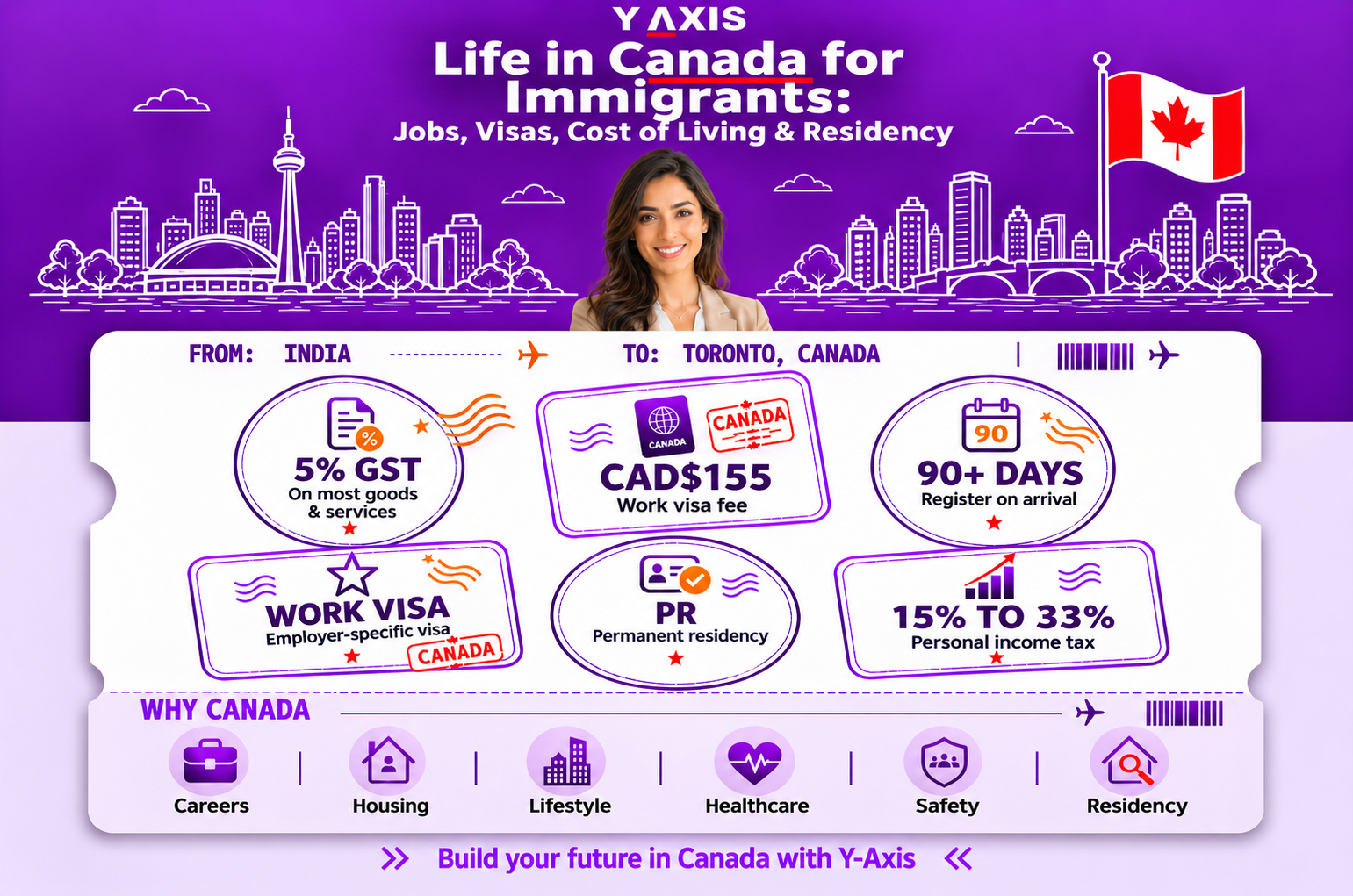
Life for immigrants in Canada offers strong salaries, public healthcare and one of the world’s clearest routes to permanent residency. Jobs are in high demand in IT, healthcare, engineering, skilled trades and transport. Most Indian professionals move through Express Entry, which gives permanent residency from the day you land. Others are nominated by a province through the Provincial Nominee Program (PNP) or move first with a job offer and an LMIA-based work permit. From 3 November 2026, Express Entry awards extra points for Canadian work experience and high-wage job offers. Permanent residents can apply for citizenship after 1,095 days in Canada within 5 years. Toronto, Vancouver, Calgary, Ottawa and Montreal are popular cities for expats.
Some quick facts about Canada are as follows:
|
Population |
Approximately 41.8 million residents |
|
Capital |
Ottawa (Toronto is the largest city) |
|
Official Languages |
English and French |
|
Currency |
Canadian Dollar (CAD) |
|
Popular Immigrant Hubs |
Toronto, Vancouver, Calgary, Ottawa, Montreal |
|
Economy |
Strong services, energy, technology, healthcare and construction sectors; growing demand for IT, healthcare, engineering, trades and transport professionals |
|
Typical Route to Long Stay |
Express Entry (Federal Skilled Worker, Canadian Experience Class or Federal Skilled Trades), the Provincial Nominee Program, or an LMIA-based work permit with a job offer |
|
Long-Term Residency |
Permanent residency through Express Entry, PNP or the Atlantic Immigration Program; citizenship after 1,095 days of physical presence in 5 years |
*Want to settle in Canada? Sign up with Y-Axis for end-to-end assistance.
Why Choose Canada to Migrate Abroad?
Canada runs a points-based Express Entry system for skilled workers from outside the country. It also offers provincial nomination, employer-driven programs and work permits for graduates.
Here is why you should choose a life in Canada:
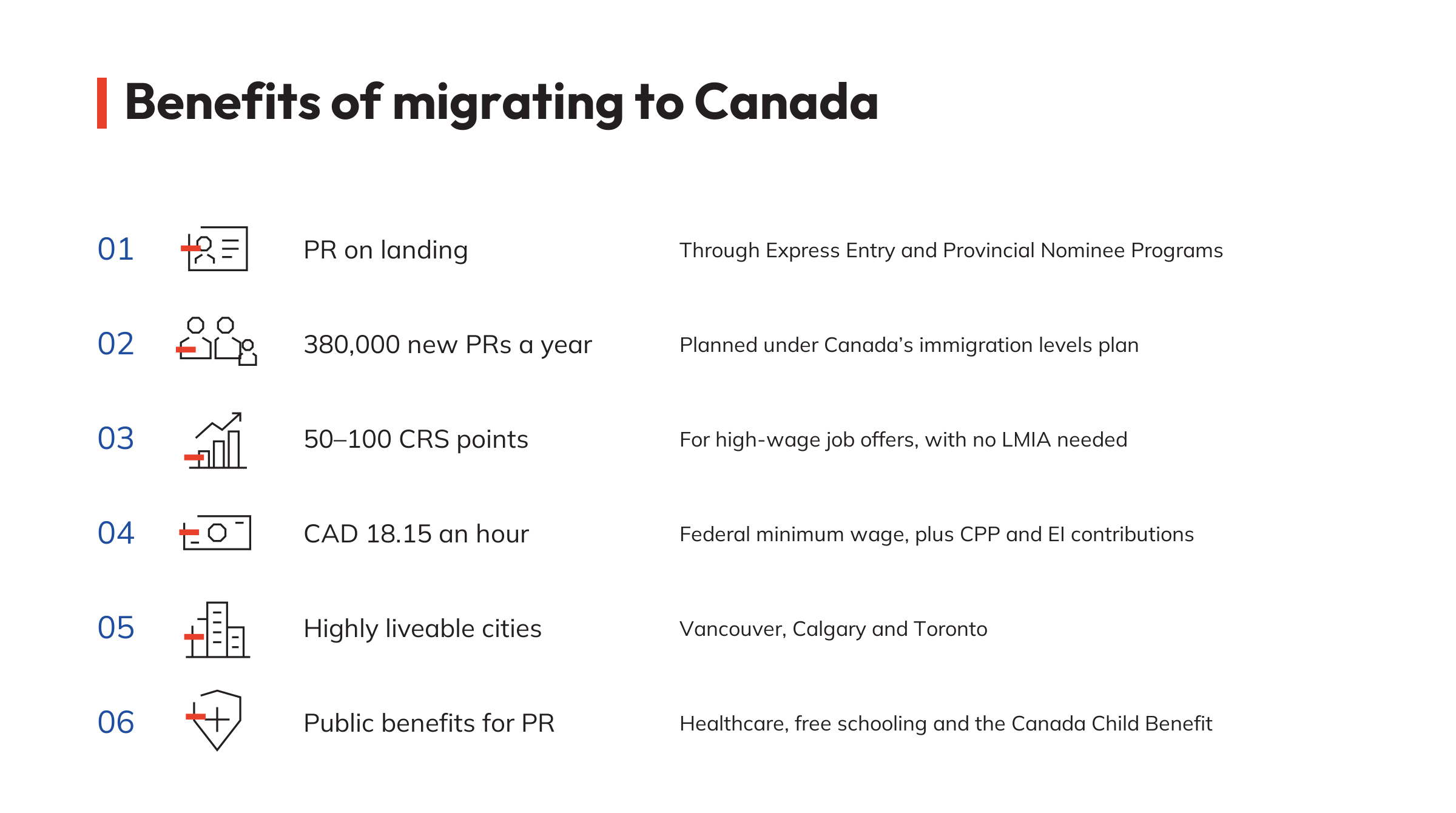
- Express Entry and PNP give permanent residency from the day you land in Canada.
- Canada plans to admit 380,000 new permanent residents each year from 2027 to 2029.
- From 3 November 2026, high-wage job offers can add 50 to 100 CRS points without an LMIA.
- The federal minimum wage is CAD 18.15 an hour from 1 April 2026, and employers contribute to the Canada Pension Plan (CPP) and Employment Insurance (EI).
- Vancouver, Calgary and Toronto regularly rank among the world’s most liveable cities.
- Permanent residents get public healthcare, free public schooling for children and access to the Canada Child Benefit.
Note: Indian passport holders need a Temporary Resident Visa (visitor visa) to visit Canada. You cannot work on a visitor visa. Anyone with a job offer must get the correct work permit, such as an LMIA-based work permit, before starting work.
*Want to work in Canada? Let Y-Axis assist you with the process.
Can I Move to Canada as an Indian Immigrant?
Most Indians move to Canada through Express Entry, a Provincial Nominee Program or an employer-sponsored work permit. Indian students can also study in Canada and later apply for a Post-Graduation Work Permit (PGWP).
The steps to migrate to Canada as an Indian professional are as follows:
Step 1: Check your eligibility on the official IRCC website (canada.ca); the Federal Skilled Worker Program needs at least 67 points out of 100
Step 2: Get an Educational Credential Assessment (ECA) for your degree from an approved body, such as WES
Step 3: Take an accepted language test, such as IELTS General Training, CELPIP or PTE Core, and aim for a high score to gain more CRS points
Step 4: Create an Express Entry profile, or secure a job offer from a Canadian employer with a positive LMIA
Step 5: Receive an Invitation to Apply (ITA), a provincial nomination or a work permit approval, depending on your route
Step 6: Submit your application online within 60 days of your ITA, with medical exams, police certificates, biometrics and proof of funds
Step 7: Land in Canada once you get your Confirmation of Permanent Residence (COPR) or work permit, then apply for a Social Insurance Number (SIN), open a bank account and get a local mobile number
Also, read…
Highest Paying Job Opportunities in Canada
Best Visa Options to Live in Canada
Canada offers several routes depending on your job offer, points, skills and study plans. The table below shows the main options and their route to long-term residence.
|
Visa Type |
Best For |
Duration |
Long-Term Pathway |
|
Express Entry – Federal Skilled Worker Program (FSWP) |
Skilled workers with 1 year of skilled work, CLB 7, an ECA and settlement funds; no job offer needed |
Permanent |
Permanent residency from landing; citizenship after 1,095 days in Canada |
|
Provincial Nominee Program (PNP) |
Skilled workers nominated by a province or territory (an Express Entry-linked nomination adds 600 CRS points) |
Permanent |
Permanent residency from landing; you are expected to live in the nominating province |
|
LMIA-Based Work Permit (incl. Global Talent Stream) |
Skilled workers with a job offer from a Canadian employer that has a positive LMIA |
Tied to the job offer, usually 1–3 years |
Can lead to permanent residency through the Canadian Experience Class after 1 year of skilled work in Canada |
|
Atlantic Immigration Program (AIP) |
Workers with a job offer from a designated employer in Nova Scotia, New Brunswick, PEI or Newfoundland and Labrador |
Permanent |
Permanent residency from landing, with settlement support from the employer |
|
Post-Graduation Work Permit (PGWP) |
International graduates of eligible Canadian colleges and universities |
Up to 3 years |
Canadian work experience can lead to permanent residency through the Canadian Experience Class |
Also, read…
Best Areas to Live in Canada
Canada’s job market and living costs vary by city. Choosing the right area can influence your commute, cost of living, housing expenses and overall quality of life.
The table below highlights the major Canadian cities and their best qualities for settlement abroad:
|
Area |
Best For |
Sightseeing |
Average Rent |
Job Market |
How Much You Can Save |
|
Toronto (Downtown & Inner Suburbs) |
Corporate professionals & expats |
CN Tower, Distillery District, Toronto Islands |
CAD 2,200-2,700/mo (1BR flat) |
Very strong, finance, IT & professional services |
Moderate, highest rents |
|
Brampton & Mississauga (Greater Toronto Area) |
Families & young professionals |
Gage Park, Square One, Lake Ontario waterfront |
CAD 1,900-2,300/mo (1BR flat) |
Strong, logistics, manufacturing & healthcare |
Good savings potential |
|
Vancouver & Surrey |
IT, film & healthcare professionals |
Stanley Park, Grouse Mountain, Granville Island |
CAD 1,900-2,700/mo (1BR flat) |
Strong, tech, film, ports & healthcare |
Moderate savings potential |
|
Calgary & Edmonton |
Engineers, energy & construction professionals |
Banff National Park nearby, Calgary Tower, West Edmonton Mall |
CAD 1,300-1,800/mo (1BR flat) |
Strong, energy, engineering & construction |
Strong savings potential |
|
Halifax (Atlantic Canada) |
Families & Atlantic Immigration Program applicants |
Peggy’s Cove, Halifax Waterfront, Citadel Hill |
CAD 1,600-2,100/mo (1BR flat) |
Good, healthcare, defence & ocean industries |
Good savings potential |
Note: Rents in Canada are usually advertised per month. Deposit rules vary by province. For example, landlords in Ontario can ask for last month’s rent, while landlords in British Columbia can ask for up to half a month’s rent. Figures vary by neighbourhood, size and distance from transit. Confirm current listings before budgeting.
Also, read…
Canada announces new Express Entry CRS points for high-wage job offers. Check Your Eligibility!
Cost of Living in Canada
Canada’s cost of living changes by location. Toronto and Vancouver cost the most, while Calgary, Edmonton, Winnipeg and Atlantic cities are more affordable.
Below is a breakdown of average monthly expenses for a single adult living outside the most premium areas:
|
Rent (1BR flat, outside prime areas, e.g. Brampton/Calgary) |
CAD 1,300-2,300/month |
|
Utilities (electricity, heating, water & internet) |
CAD 150-300/month |
|
Groceries |
CAD 400-600/month |
|
Public Transport (buses, subway & light rail) |
CAD 100-160/month for a monthly pass, depending on the city |
|
Healthcare |
Permanent residents use free provincial health insurance (funded through taxes); private insurance during a waiting period usually costs CAD 50-150/month for a single person |
|
Dining Out (per meal) |
CAD 20-30 (casual restaurant), CAD 60-100 (mid-range restaurant) |
|
Mobile & Internet |
CAD 100-150/month |
|
Entertainment & Leisure |
CAD 150-300/month |
Also, read…
What Are the Different Types of Canada Visas to Immigrate?
Is Canada Expensive Compared to Australia or the UK?
Canada is generally more affordable than Australia, especially outside Toronto and Vancouver. Living costs in Toronto and Vancouver are broadly similar to Sydney and London for rent.
Salaries for skilled professionals are high, and employers contribute to CPP and EI on your behalf. Many immigrants can save well, especially in Calgary, Edmonton and Atlantic Canada.
Downtown Toronto and Vancouver are the priciest areas. However, these cities also offer the most jobs in multinational companies, IT, finance and healthcare.
Also, read…
Canada Post-Graduation Work Permit (PGWP) for Indians\
Work in Canada
Canada’s job market is led by healthcare, technology, finance, construction and transport. Leading employers include RBC, TD Bank, Shopify, Bell Canada, Loblaw Companies and Air Canada.
The table below shows some of the most in-demand jobs in Canada for immigrants.
|
Occupation |
Average Monthly Salary (Gross) |
Demand Level |
Average Savings |
|
IT & Software Development |
CAD 6,500-10,000 |
High |
CAD 1,200-2,500/month |
|
Registered Nursing & Healthcare |
CAD 6,000-8,500 |
High |
CAD 1,000-2,000/month |
|
Civil, Mechanical & Electrical Engineering |
CAD 6,500-9,500 |
High |
CAD 1,200-2,300/month |
|
Accounting & Finance |
CAD 5,000-8,000 |
Moderate |
CAD 800-1,800/month |
|
Construction & Skilled Trades |
CAD 5,000-8,000 |
High |
CAD 900-2,000/month |
|
Teaching & Early Childhood Education |
CAD 4,000-7,500 |
High |
CAD 700-1,600/month |
Settling in Canada
Once you arrive in Canada, you need to apply for a Social Insurance Number, open a bank account, apply for a provincial health card and set up your day-to-day essentials.
Here is a quick overview of what to expect during your first weeks in the country:
|
Housing |
Healthcare |
Education for Children |
Banking & Financial Essentials |
|
Search on portals such as Rentals.ca, Kijiji and Zumper; viewings are common before you apply |
Permanent residents apply for a provincial health card, such as OHIP in Ontario or MSP in British Columbia |
Public schools are free for children of permanent residents and teach in English or French |
Open an account with RBC, TD, Scotiabank, BMO or CIBC |
|
Landlords often ask for references, proof of income and a credit check |
Some provinces have a waiting period of up to 3 months, so buy private insurance for the gap |
Children of many work permit holders can also study free in public schools |
Many banks offer newcomer packages and let you start the process before you arrive |
|
Allow 2-6 weeks to find a rental; most leases run for 12 months |
Many people use walk-in clinics while they look for a family doctor |
Private school fees can range from CAD 15,000 to CAD 40,000+ a year |
Apply for a Social Insurance Number (SIN) and use a secured credit card to build your credit history |
Also, read…
What are the fast-track hiring options in Canada for Skilled Professionals
Permanent Residency and Long-Term Residency in Canada
Long-term residency in Canada is mainly available through Express Entry, provincial nomination and employer-driven regional programs.
|
Express Entry (FSWP, CEC, FST) |
Permanent residency from landing; candidates are ranked by CRS score, with extra points for Canadian work experience and high-wage job offers from 3 November 2026 |
|
Provincial Nominee Program (PNP) |
Provinces nominate workers for local job needs; an Express Entry-linked nomination adds 600 CRS points |
|
LMIA-Based Work Permit to Canadian Experience Class (CEC) |
Work for 1 year in a skilled job in Canada, then apply for PR through the CEC; no proof of funds needed |
|
Atlantic Immigration Program / Rural Community Immigration Pilot |
Job offer from a designated employer in Atlantic Canada or a participating rural community leads to permanent residency |
|
Canadian Citizenship |
Usually needs 1,095 days of physical presence in the last 5 years, tax filing, CLB 4 language skills and a citizenship test (ages 18-54) |
Important note: Express Entry, PNP and Atlantic Immigration Program visas give permanent residency from the day you land. Permanent residents can live, work and study anywhere in Canada. The PR card is usually valid for 5 years. To keep your status, you must live in Canada for at least 730 days in every 5-year period. Citizenship usually needs 1,095 days of physical presence in 5 years. Canada allows dual citizenship, but India does not, so Indians who become Canadian citizens can apply for an OCI card.
Also, read…
How Can I Get Permanent Residency in Canada?
Dependent Benefits for Immigrants in Canada
Canada allows most permanent residency applicants and many skilled work permit holders to bring their partner and children.
Here are the benefits of securing a Canada dependent visa:
- Partners and dependent children can be included in Express Entry and PNP applications
- Spouses of workers in TEER 0 or 1, or selected TEER 2 and 3 jobs, can get an open work permit and work for any employer
- Children of permanent residents study free in Canadian public schools
- Permanent resident families can apply for provincial health insurance
- Eligible families can claim the tax-free Canada Child Benefit (CCB)
Also, read…
Canada Dependent Visa: Requirements, Application Process, Cost and Eligibility
Practical Settlement Checklist for Indians Moving to Canada
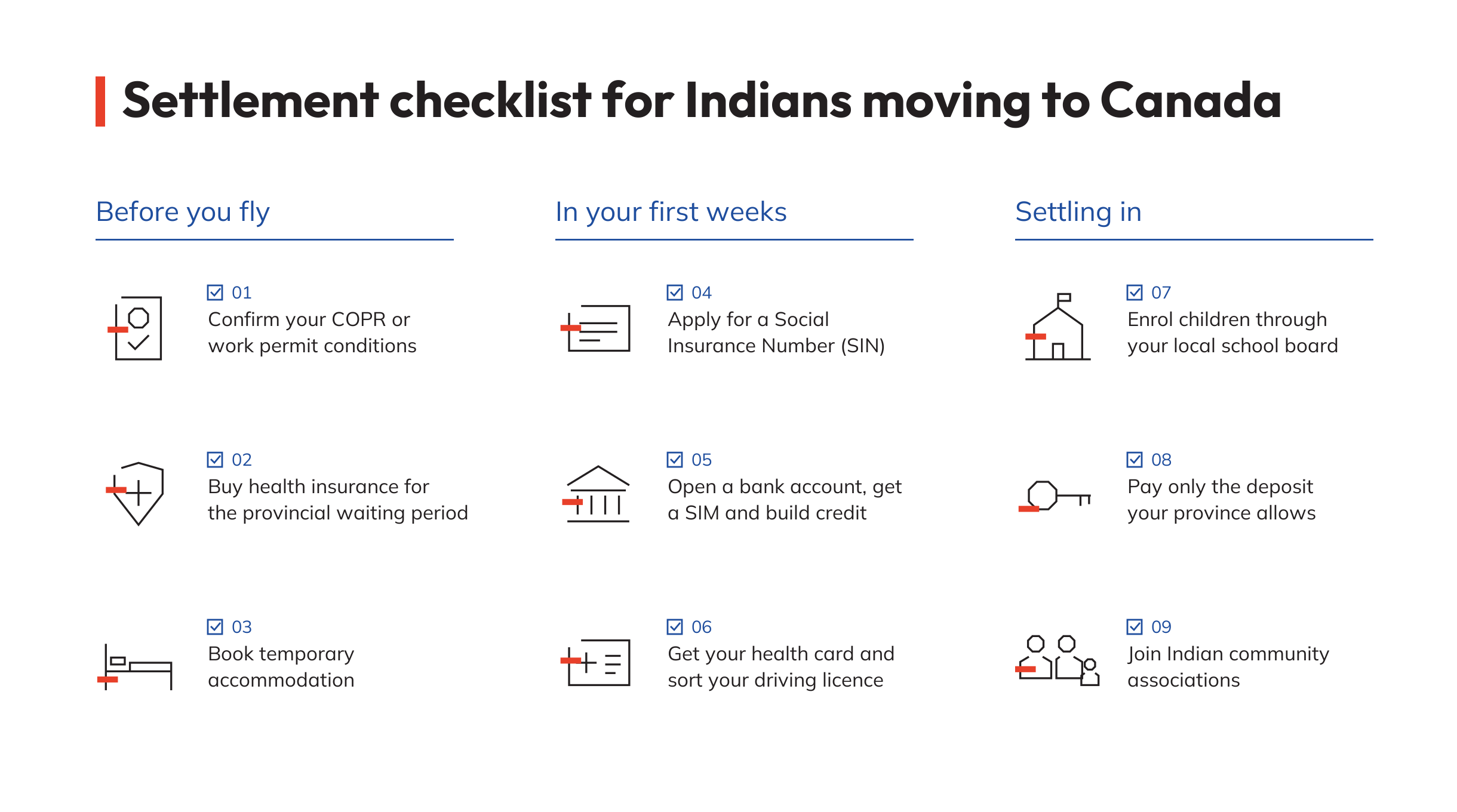
The steps for smooth transition to Canada for Indians are as follows:
Step 1: Confirm your COPR or work permit approval and its conditions before you travel, and do not use a visitor visa to start work
Step 2: Buy private health insurance before arrival to cover any provincial waiting period
Step 3: Book temporary accommodation, such as a serviced apartment, for your first few weeks
Step 4: Apply for a Social Insurance Number (SIN) online or at a Service Canada office soon after you arrive
Step 5: Open a bank account, buy a local SIM and start building your Canadian credit history
Step 6: Apply for your provincial health card, and check the rules to exchange or replace your Indian driving licence
Step 7: Enrol children in school early through your local school board
Step 8: Check your rental lease and pay only the deposit allowed under your province’s tenancy rules
Step 9: Join Indian community associations in your city for support and networking
*Are you looking for step-by-step assistance with Canada immigration? Contact Y-Axis, the world’s No. 1 overseas immigration consultancy!
FAQs
What is the easiest way for Indians to move to Canada?
Most Indians move to Canada through Express Entry, which covers the Federal Skilled Worker, Canadian Experience Class and Federal Skilled Trades programs. It gives permanent residency from the day you land. Another popular route is the Provincial Nominee Program, where a province nominates you based on local job needs. Some professionals first move on an LMIA-based work permit with a job offer. Students can also study in Canada, get a Post-Graduation Work Permit and later apply for PR using their Canadian work experience.
How many CRS points do I need for Canada PR?
There is no fixed CRS score for Canada PR. Each Express Entry draw sets its own cut-off. In 2026, Canadian Experience Class draws mostly needed scores above 500. French-language draws often had cut-offs near 400, and provincial nominee draws needed over 700 because a nomination adds 600 points. From 3 November 2026, candidates can also earn extra points for Canadian work experience or high-wage job offers. Cut-offs may change after this update, so check the latest draw results on the IRCC website.
Can I move to Canada without a job offer?
Yes. The Federal Skilled Worker Program under Express Entry does not need a job offer. You need at least 1 year of continuous skilled work experience, an Educational Credential Assessment, CLB 7 in English or French and at least 67 points on the eligibility grid. You must also show settlement funds of CAD 15,263 for a single applicant. A job offer is not compulsory, but a qualifying high-wage offer can now add 50 to 100 CRS points and improve your chances.
Is healthcare free for immigrants in Canada?
Canada has a public healthcare system run by each province. Permanent residents can apply for a provincial health card, which covers doctor visits and hospital care with no fee at the point of service. Many work permit holders also qualify, depending on the province and the length of their permit. Some provinces, such as British Columbia and Quebec, have a waiting period of up to 3 months. Newcomers should buy private health insurance to cover this gap.
What is the average salary in Canada for skilled workers?
Salaries in Canada depend on your job, experience and province. IT and software professionals usually earn CAD 6,500 to 10,000 a month before tax. Registered nurses earn about CAD 6,000 to 8,500 a month, and engineers earn CAD 6,500 to 9,500 a month. The federal minimum wage is CAD 18.15 an hour from 1 April 2026. Toronto, Vancouver and Calgary usually offer the highest pay, but living costs are also higher in Toronto and Vancouver.
Can I bring my family to Canada on a work permit?
Yes, but the rules depend on your job. Spouses of workers in TEER 0 or 1 occupations, or in selected TEER 2 and 3 occupations, can apply for an open work permit. The main worker must usually have at least 16 months left on their permit. Dependent children can join you on a study permit or visitor record. If you apply for permanent residency, you can include your spouse and dependent children in the same application.
Which city in Canada is best for Indian immigrants?
Toronto offers the largest job market and a large Indian community, especially in Brampton and Mississauga. Vancouver and Surrey suit IT, film and healthcare professionals, but rents are among the highest in Canada. Calgary and Edmonton offer lower living costs and jobs in energy, engineering and construction. Ottawa suits government and tech roles. Halifax and other Atlantic cities suit families and Atlantic Immigration Program applicants. The best city depends on your job, budget and visa route.
How much does it cost to live in Canada?
A single person outside the most expensive areas usually spends about CAD 2,400 to 3,800 a month. Rent for a one-bedroom flat ranges from about CAD 1,300 in Calgary or Edmonton to over CAD 2,300 in Toronto or Vancouver. Utilities cost around CAD 150 to 300 a month, and groceries cost CAD 400 to 600. A monthly transit pass costs about CAD 100 to 160. Mobile and internet plans in Canada are expensive, so compare providers before you sign up.
How much money do I need to show for Canada PR?
Federal Skilled Worker and Federal Skilled Trades applicants must show settlement funds. The current amount is CAD 15,263 for a single applicant, CAD 19,001 for 2 people and CAD 28,362 for a family of 4. You do not need to show funds if you apply under the Canadian Experience Class. You are also exempt if you are authorised to work in Canada and have a valid job offer. IRCC updates these amounts regularly, so check the official table before applying.
How can I get Canadian citizenship?
You can apply for Canadian citizenship after living in Canada for at least 1,095 days in the 5 years before you apply. Time spent in Canada as a temporary resident before PR can count as half-days, up to 365 days. You must file taxes, prove CLB 4 in English or French and pass a citizenship test if you are aged 18 to 54. Canada allows dual citizenship, but India does not. Indians who become Canadian citizens can apply for an OCI card.
Tags:
Canada immigration
living in Canada
cost of living in Canada
Canada PR
jobs in Canada for Indians
Share
Y - Axis services

Get it on your mobile

Get News Alerts

Contact Y-Axis
Latest Article
Popular Post
Trending Article
Posted On November 17 2026
Life in Canada for Immigrants: Jobs, Visas, Cost of Living & Residency