

Posted on September 18 2026
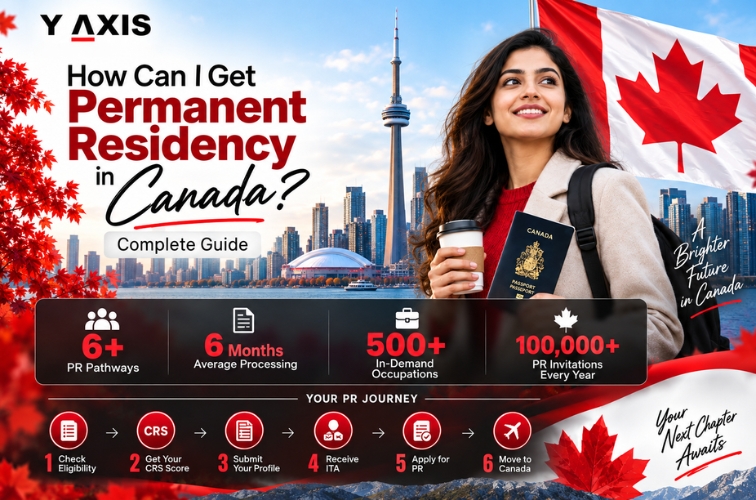
How Can I Get Permanent Residency in Canada?

By , Editor & Director
Updated September 19 2026
Canada has several immigration options for people who want to live and work in Canada permanently. The right option depends on your education, work experience, language skills, age, job, family situation and other requirements. For skilled workers, Express Entry and Provincial Nominee Programs (PNPs) are two important options. Canada also has regional immigration programs, family sponsorship and other pathways for eligible applicants. The application process is different for each program. It is important to understand the requirements before you create an immigration profile or apply for permanent residence.
*Willing to migrate to Canada on a PR visa? Get in touch with our experts to get FREE counselling.
What Are the Main Ways to Get Canada PR?
Canada has different immigration programs for skilled workers, families, international graduates and people who want to settle in specific regions. Some of the main ways to apply for Canadian permanent residence include:
|
PR Pathway |
Who It May Suit |
|
Skilled workers who meet the requirements of one of Canada's Express Entry programs |
|
|
Applicants whose skills and work experience are needed by a province or territory |
|
|
Regional Immigration Programs |
Eligible applicants who want to live and work in selected communities in Canada |
|
Skilled workers and international graduates who meet the requirements for participating Atlantic provinces |
|
|
Family Sponsorship |
Eligible family members of Canadian citizens or permanent residents |
|
Applicants who want to live in Quebec and meet its immigration requirements |
*Read more...
What are the PR pathways in Canada?
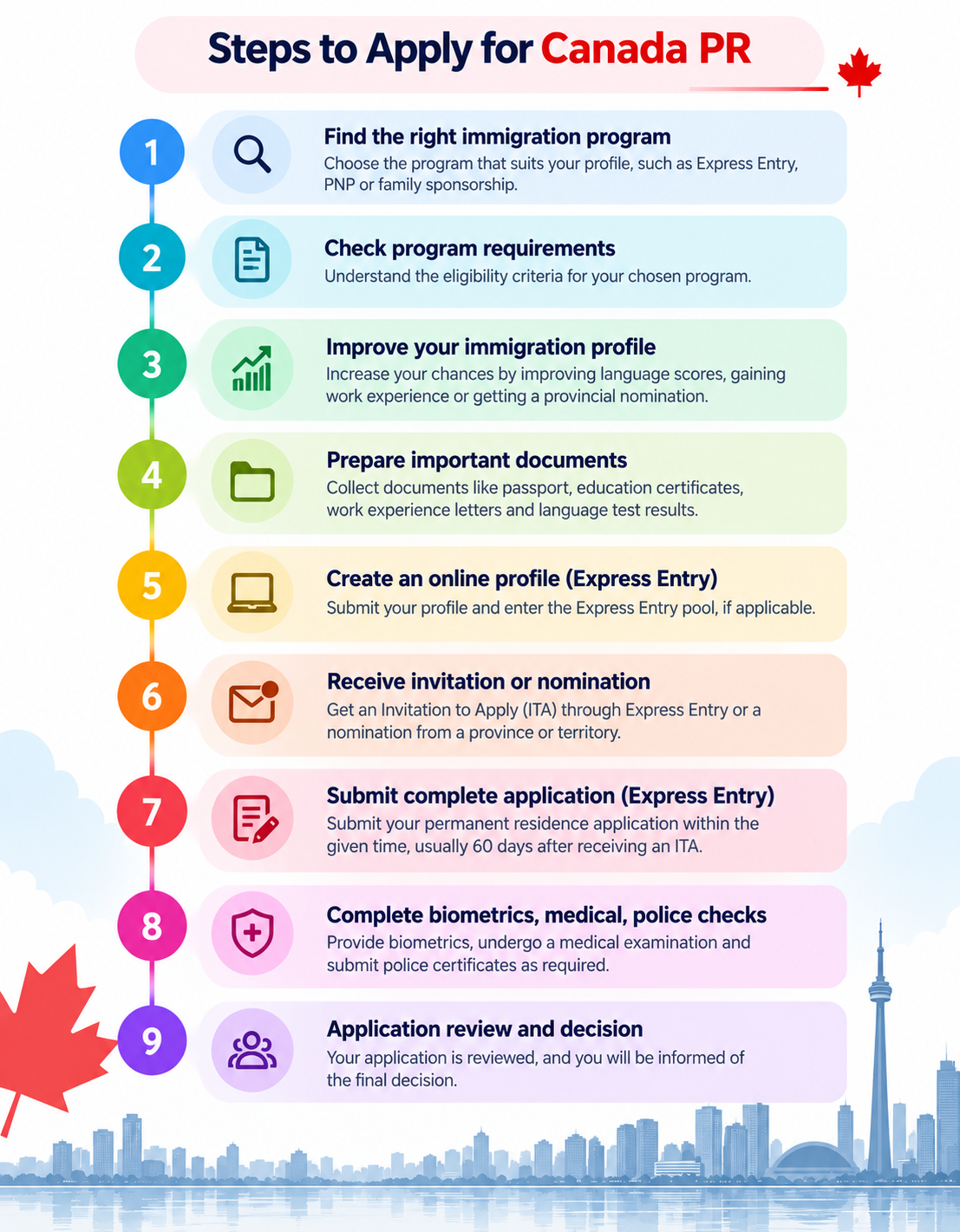
Steps to Apply for Canada PR
Step 1: First, find out which immigration program suits you. You may consider Express Entry, a Provincial Nominee Program, family sponsorship or another eligible pathway.
Step 2: Check the requirements of the program you want to use. Your age, education, work experience, language skills and other factors may affect your eligibility.
Step 3: You may be able to improve your immigration profile by getting a better language test score, gaining more skilled work experience or receiving a provincial nomination, depending on the program.
Step 4: Prepare important documents such as your passport, education certificates, work experience documents, language test results and other documents required for your application.
Step 5: If you qualify for Express Entry, you can create an online profile and enter the Express Entry pool. Other immigration programs may have their own application process.
Step 6: If you are selected, you may receive an invitation to apply for permanent residence or a nomination from a province or territory.
Step 7: If you receive an invitation through Express Entry, you generally have 60 days to submit your complete permanent residence application.
Step 8: Depending on your application, you may need to complete steps such as biometrics, a medical examination and police certificate checks.
Step 9: The immigration authorities will review your application and make a decision based on the rules of the program you applied through.
*Read more...
Canada PR Requirements
- Applicants aged 18–35 receive the highest age points.
- At least secondary school education is required for the Federal Skilled Worker Program.
- At least 1 year of continuous skilled work experience is generally required.
- A minimum CLB 7 language level is required for the Federal Skilled Worker Program.
- Foreign education usually requires an Educational Credential Assessment (ECA).
- Proof of funds starts at CAD 15,263 for one applicant, where settlement funds are required.
- Applicants must provide medical and police clearance documents when required.
- A job offer is not mandatory for the Federal Skilled Worker Program.
- Applicants must have an eligible TEER 0, 1, 2 or 3 occupation for the Federal Skilled Worker Program.
- Applicants must satisfy Canada's admissibility requirements.
*Check your eligibility to Canada through the Y-Axis Canada CRS Score Calculator.
Canada PR Cost and Processing Time
The cost of applying for Canada PR depends on the number of people included in the application. For one main applicant, the government application fee is CAD 990, plus a CAD 600 Right of Permanent Residence Fee. A spouse or partner also has a processing fee of CAD 990 and a CAD 600 right of permanent residence fee, while each dependent child costs CAD 270. A biometrics fee may also apply. Express Entry applications can often take around 6 months, but processing times can vary by program and application.
*Looking for help with overseas immigration? Contact Y-Axis, world’s number one immigration consultancy for guidance and visa assistance.
FAQs
What are the main ways to get permanent residency in Canada?
Canada offers several pathways to permanent residence. Skilled workers can consider Express Entry and Provincial Nominee Programs (PNPs), while eligible applicants may also use family sponsorship, regional immigration programs or Quebec immigration pathways. Each program has different eligibility rules based on factors such as education, work experience, language skills, occupation and family situation. Choosing a suitable pathway is an important first step.
How does Express Entry help me get Canada PR?
Express Entry is an online system used to manage applications for several skilled-worker immigration programs. Eligible candidates create a profile and enter the Express Entry pool. They receive a Comprehensive Ranking System (CRS) score based on factors such as age, education, language skills and work experience. Candidates who receive an invitation can submit their permanent residence application within the required time.
Can I get Canada PR through a Provincial Nominee Program?
Yes, eligible applicants can apply for permanent residence through a Provincial Nominee Program. Canadian provinces and territories have different streams for people with skills and experience that match their local needs. Some PNP streams are connected to Express Entry, while others operate separately. Requirements vary by province and stream, so applicants should check which provincial program matches their education, occupation and work experience.
Can I get Canada PR without a job offer?
Yes, a job offer is not required for every Canadian permanent residence program. For example, eligible applicants under the Federal Skilled Worker Program can qualify without a Canadian job offer. However, some provincial or employer-based immigration programs may require a job offer. Your immigration pathway, occupation, work experience, education and other factors determine whether a job offer is needed for your application.
Can Indians apply for permanent residency in Canada?
Yes, Indian citizens can apply for Canadian permanent residence if they qualify for an eligible immigration program. Many applicants from India explore Express Entry, Provincial Nominee Programs, family sponsorship and other pathways. Their eligibility can depend on age, education, work experience, language test results, occupation and family circumstances. Applicants should select a pathway based on their individual profile and current immigration requirements.
What documents are needed to apply for Canada PR?
The documents required depend on the immigration program and your personal situation. Common documents include a valid passport, educational certificates, language test results, work experience documents and police certificates. Some applicants may also need an Educational Credential Assessment, proof of funds, medical examination documents or provincial nomination documents. It is important to prepare accurate and complete documents before submitting your permanent residence application.
How can I improve my Canada PR profile?
You may be able to strengthen your profile by improving your English or French language score, gaining additional skilled work experience or completing further education. Canadian work or study experience may also provide additional opportunities under certain programs. A provincial nomination can significantly increase an Express Entry candidate's CRS score. The options available to you depend on your immigration program and personal circumstances.
How long does it take to get Canada PR?
There is no fixed processing time for every Canadian permanent residence application. The time can vary depending on the immigration program, application type, number of applications being processed and whether your application is complete. Processing can also change over time. Applicants should check the current processing information for their specific immigration program instead of relying on a general processing timeline.
Do I need proof of funds for Canada PR?
Some applicants need to show proof that they have enough money to support themselves and their family after moving to Canada. The amount depends on the size of the family and can change periodically. However, proof of funds is not required for every applicant or immigration pathway. For example, certain applicants with Canadian work experience may be exempt from this requirement.
What happens after I submit my Canada PR application?
After submitting your application, Canadian immigration authorities review the information and documents you provided. Depending on your application, you may need to complete biometrics, a medical examination or additional background checks. Immigration officers then assess your application according to the requirements of your program. If your application is approved, you receive instructions for completing the process and becoming a Canadian permanent resident.
Tags:
How to Get Canada PR
Canada Permanent Residency
Canada PR Process
Canada Immigration
Canada Express Entry
Canada PNP
Canada PR Eligibility
Canada PR Requirements
Canada Immigration for Skilled Workers
Canada PR for Indians
Share
Options for you by Y-Axis

Get it on your mobile

Get News alerts

Contact Y-Axis
Latest Article
Popular Post
Trending Article
Posted On September 18 2026
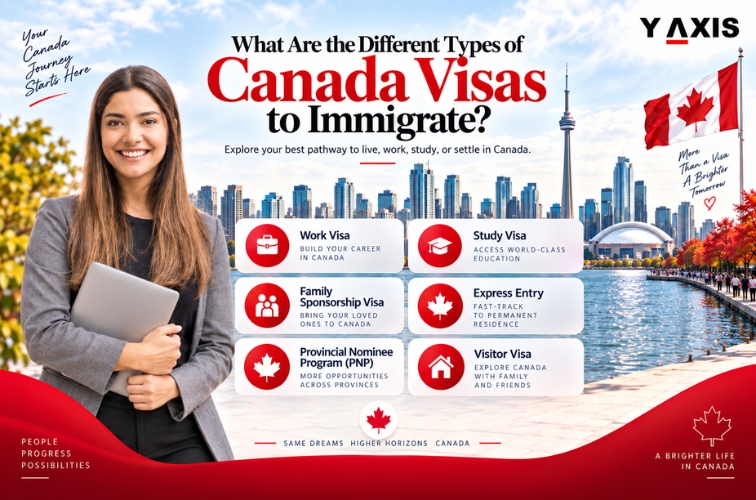
What Are the Different Types of Canada Visas to Immigrate?