


Posted on June 22 2026
Can I Immigrate to Canada with a One-Year Gap in My Work History?

By , Editor & Director
Updated June 26 2026
Yes, you can immigrate to Canada with a one-year gap in your work history. Immigration pathways in Canada, like the Express Entry system, do not have a rule that disqualifies applicants for having a career break. The career gap affects your immigration application by reducing your Comprehensive Ranking System (CRS). You must still meet the one-year work experience requirement for programs like the Federal Skilled Worker Program (FSWP) within the last ten years. A gap year in a professional's career does not disqualify them from working in Canada, but it must be accounted for honestly and clearly. Providing a Letter of Explanation (LOE) is strongly recommended for any gap of three months or more to streamline the process of Canadian immigration.
*Want to check if your profile qualifies for Canada PR despite a work gap?Avail Y-Axis free Eligibility Points Calculator to assess your profile.
Does a Work History Gap Disqualify You from Canada Immigration?
A work history gap does not automatically disqualify you from any of the main Canada PR pathways. IRCC does not penalise career breaks as long as the total qualifying work experience is within the specified limit, continuous or not.
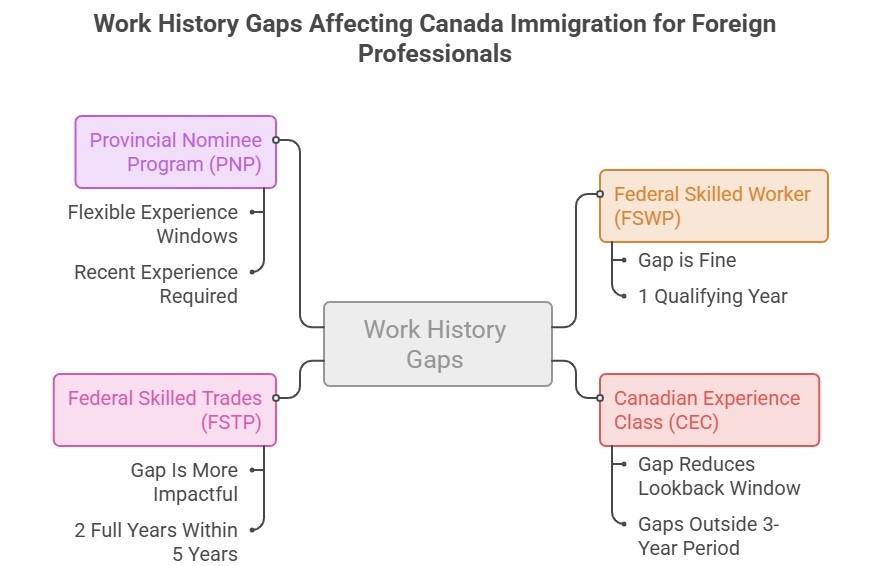
The table below specifies how a career gap affects the immigration process to Canada:
| Pathway | Minimum Experience Required | How a Gap Is Treated |
|---|---|---|
| Federal Skilled Worker (FSWP) | 1 year in the last 10 years | Gap is fine as long as you still have 1 qualifying year within the 10-year window |
| Canadian Experience Class (CEC) | 1 year Canadian experience in last 3 years | Gap reduces your lookback window — gaps must fall outside the qualifying 3-year period |
| Federal Skilled Trades (FSTP) | 2 years in last 5 years | Gap is more impactful — 2 full years must fall within 5 years |
| Provincial Nominee Program (PNP) | Varies by stream and province | Many streams have flexible experience windows; some require recent experience — verify per stream |
*Want to apply for a Canada work visa? Let Y-Axis assist you with the steps.
How Does a Work History Gap Affect Your CRS Score?
Your CRS score is calculated based on the amount of qualifying work experience you can claim and not the total years you have been working. A gap reduces the number of claimable years, which directly reduces your CRS points.
| Years of Work Experience Claimed | CRS Points (No Job Offer — Single Applicant) |
|---|---|
| Less than 1 year | 0 points — not eligible to enter the pool |
| 1 year | 40 points |
| 2 years | 53 points |
| 3 years | 64 points |
| 4 years | 72 points |
| 5 years or more | 80 points (maximum) |
If a one-year gap reduces your claimable experience from, say, 5 years to 4 years, you lose 8 CRS points. If it drops you from 2 years to 1 year, you lose 13 points. In a competitive pool where recent draws have cleared at 470–490+ CRS, every point counts.
Also, read...
Canada Eases Work Permit Rules for Provincial Nominee Applicants. Apply Now!
Canada Immigration Visa Pathways — Which Work Best with a Gap?
Some Canada PR pathways are more flexible with career gaps than others. The table below compares your best options.
| Pathway | Gap Flexibility | Best For |
|---|---|---|
| FSWP (Express Entry) | High — 10-year work experience window | Professionals with strong scores who had a gap early in their career |
| PNP — Non-Express Entry streams | High — many streams have flexible timelines | Applicants with lower CRS but in-demand occupations in a target province |
| PNP — Express Entry linked | Medium — CRS still applies | Applicants who get a provincial nomination to boost CRS by 600 points |
| Study Permit → PGWP → CEC | High — gap before studying does not matter | Applicants willing to study in Canada and gain fresh Canadian experience |
| Atlantic Immigration Program (AIP) | Medium — employer-driven, flexible | Applicants with a job offer from an Atlantic province employer |
| Rural and Northern Immigration Pilot | Medium — community-driven | Applicants open to smaller communities; employer offer required |
| CEC (Canadian Experience Class) | Low — 3-year window only | Best for those who already have Canadian work experience with no recent gap |
Also, read...
Canada Revises Digital Nomad Visa Rules for 2026. Check Your Eligibility Now!
How to Address a Work History Gap in Your Canada Immigration Application
A career gap is manageable if you document it clearly and proactively. IRCC officers review gaps not to penalise you, but to ensure your employment history is consistent with the work experience you are claiming.
Reasons acceptable for a year gap in your professional career while migrating to Canada
- Higher education or retraining — pursuing a degree, diploma, or professional certification
- Parental leave or caregiving responsibilities — for a child, parent, or family member
- Medical leave or illness — supported by a doctor's note or medical records
- Career transition — moving between industries or retraining for a new field
- Job loss and job search — particularly common during COVID-19 (2020–2021)
- Relocation — moving country, city, or waiting for a visa to be processed
- Travel or personal development — less persuasive but acceptable if brief
A Strong Letter of Explanation (LOE)
An LOE is not mandatory under IRCC rules, but it is strongly recommended for any gap of three months or longer. A well-written LOE does three things: it explains the reason for the gap; it confirms the gap did not affect your skills or occupational eligibility; and it demonstrates transparency, which builds officer trust.
- Keep it factual and brief — one to two paragraphs per gap
- State the start and end date of the gap clearly
- Give the reason honestly — do not exaggerate or minimise
- Confirm your skills and qualifications remain current
- Attach supporting documents where available (medical letters, enrolment certificates, birth certificates for parental leave)
Also, read...
Canada Updates Processing Times for Express Entry and Provincial Nominee Programs. Apply Now!
Watch to Know More: Canada Eases Work Permit Rules for Provincial Nominee Applicants
Learn about Canada's updated work permit policies for Provincial Nominee Program (PNP) applicants, including eligibility criteria, benefits, and how these changes can help skilled workers secure employment faster.
How to Immigrate to Canada with a One-Year Career Gap — Step by Step
Step 1: Check your total qualifying work experience based on NOC TEER 0, 1, 2, or 3 experience within the last 10 years (FSWP) or last 3 years (CEC).
Step 2: Calculate your CRS score by using the Y-Axis CRS Score Calculator to estimate your points with and without the gap years.
Step 3: Identify your best Canada permanent residence (PR) pathway.
Step 4: Write your Letter of Explanation with a concise and honest explanation of the gap period.
Step 5: Gather your documents such as Employment Reference Letters (covering all qualifying work periods), Educational Credential Assessment (ECA), language test results (IELTS/CELPIP/TEF), PCC from India, and passport.
Step 6: Create your Express Entry profile if selecting the Express Entry pathway for immigration.
Step 7: Wait for an Invitation to Apply (ITA) or apply for a PNP based on your CRS cut-off score..
Step 8: Submit your PR application within 60 days of receiving your ITA to secure your Canada PR.
*Are you looking for step-by-step assistance with Canada immigration? Contact Y-Axis, the world’s No. 1 overseas immigration consultancy!
FAQs
Does a one-year work history gap disqualify me from Canada PR?
No. A one-year work history gap does not disqualify you from Canada permanent residence. Canada's Express Entry system does not have a rule against career breaks. What matters is that you still meet the minimum qualifying work experience for your chosen program — one year within the last ten years for the Federal Skilled Worker Program (FSWP), or one year of Canadian experience within the last three years for the Canadian Experience Class (CEC). A gap is not penalised directly, but it may reduce the number of experience years you can claim, which affects your CRS score.
How does a work history gap affect my CRS score for Express Entry?
A work history gap reduces the total years of qualifying work experience you can claim in your Express Entry profile, which lowers your CRS points. Under the CRS:
- One year of foreign work experience earns 40 points
- Two years earns 53 points
- Three years earns 64 points
- Five or more years earns the maximum 80 points
If your gap reduces your claimable years — for example, from five years to four years — you lose 8 CRS points. In a competitive pool where draw cut-offs regularly exceed 470–490, this difference can be significant for your chances of receiving an Invitation to Apply.
What is a Letter of Explanation and do I need one for a work gap?
A Letter of Explanation (LOE) is a written statement you include with your Express Entry or PR application to explain any gaps in your employment history to the IRCC officer reviewing your file. It is not mandatory under IRCC rules, but it is strongly recommended for any gap of three months or longer. A good LOE:
- Clearly states the start and end date of the gap
- Provides an honest reason such as medical leave, higher education, parental responsibilities, or a career transition
- Confirms your skills remain current
- Includes supporting documents where possible
A clear LOE improves officer confidence and reduces processing delays.
Which Canada PR pathway is most flexible if I have a work history gap?
The Federal Skilled Worker Program (FSWP) is the most flexible option, as it has a ten-year work experience window — meaning a gap early in your career may not affect your qualifying years at all. Provincial Nominee Programs (PNPs) that operate outside Express Entry also tend to have flexible experience requirements and are worth exploring if your CRS score is below the typical cut-off. The study permit pathway — studying in Canada, obtaining a Post-Graduation Work Permit (PGWP), and gaining fresh Canadian experience — is also highly effective, as a gap before your studies becomes irrelevant.
Can I still qualify for Express Entry if my gap made my experience less than one year?
No. To enter the Express Entry pool under the Federal Skilled Worker Program, you must have at least one year of continuous qualifying work experience within the last ten years. If your gap has left you with less than one year of qualifying experience, you are not currently eligible for FSWP. However, you have alternatives:
- Continue working to accumulate the required year
- Explore PNP streams with different experience thresholds
- Apply for a Canadian study permit followed by a Post-Graduation Work Permit to gain fresh Canadian experience
- Pursue the Atlantic Immigration Program if you have a qualifying job offer
What types of work history gaps are acceptable to IRCC?
IRCC does not publish a formal list of acceptable gap reasons, but immigration officers consider context, honesty, and supporting documentation when reviewing career breaks. Commonly accepted reasons include:
- Higher education or professional retraining
- Parental or caregiving leave
- Medical leave supported by a doctor's note
- Job loss and active job searching (especially during 2020–2021 COVID-related disruptions)
- Relocation between countries or visa processing delays
- Career transitions between industries
Gaps due to personal travel or sabbatical are less persuasive but acceptable if brief and well explained. The key is to document your reason honestly with supporting evidence wherever possible.
Does a gap during COVID-19 (2020–2021) hurt my Canada PR application?
No. IRCC acknowledged the widespread employment disruption caused by COVID-19, and immigration officers are expected to assess COVID-era gaps with context. If your gap falls between March 2020 and late 2021, it is one of the most easily explained and accepted periods in recent immigration history. In your Letter of Explanation, state clearly that your gap was due to pandemic-related job loss, business closure, or travel restrictions. Attach any supporting documentation such as a redundancy letter or business closure notice if available. COVID gaps are routinely accepted and should not negatively affect a well-documented application.
How does a work history gap affect my Provincial Nominee Program (PNP) chances?
The impact of a work history gap on a PNP application depends on the specific stream and province. Many PNP streams outside Express Entry have more flexible experience requirements than the federal programs. For example, some streams accept experience from the last five years rather than the last three, and some employer-driven streams prioritise a current job offer over historical work continuity. However, Express Entry-linked PNP streams still depend on your CRS score, so a gap that lowers your CRS indirectly affects these streams. The best approach is to assess each province's available streams individually based on your occupation and current experience total.
Should I include all employment gaps in my Express Entry profile?
Yes. You must declare all periods of your employment history honestly in your Express Entry profile, including any gaps. IRCC verifies the dates in your profile against the Employment Reference Letters you submit. Inconsistencies between your declared dates and your supporting documents can lead to application refusal or, in serious cases, a finding of misrepresentation — which results in a five-year ban from Canadian immigration. It is always better to declare a gap honestly and explain it with a Letter of Explanation than to omit it or misrepresent dates. Transparency builds officer trust and protects your application.
How can Y-Axis help me immigrate to Canada with a work history gap?
Y-Axis provides complete Canada immigration support for professionals with career gaps. This includes:
- Free eligibility assessment to identify the best PR pathway for your specific gap situation
- CRS score calculation and optimisation strategy
- Advice on which PNP streams are most suitable for your occupation and experience total
- Letter of Explanation drafting guidance
- Document preparation support including Employment Reference Letters and ECA
- Express Entry profile creation
- End-to-end application management
Y-Axis has 25 years of experience helping Indian professionals achieve Canada PR across all Express Entry programs and PNP streams. Call +91-7670800000 or visit y-axis.com for a free consultation.
📞 Call: +91-7670800000
📩 Email: info@y-axis.com
🌐 Visit: https://www.y-axis.com
Tags:
Canada immigration
Express Entry
work history gap
Canada PR
CRS score
PNP
Canadian Experience Class
Federal Skilled Worker
Canada work visa
migrate to Canada
Share
Y - Axis services

Get it on your mobile

Get News Alerts

Contact Y-Axis
Latest Article
Popular Post
Trending Article
Posted On September 18 2026
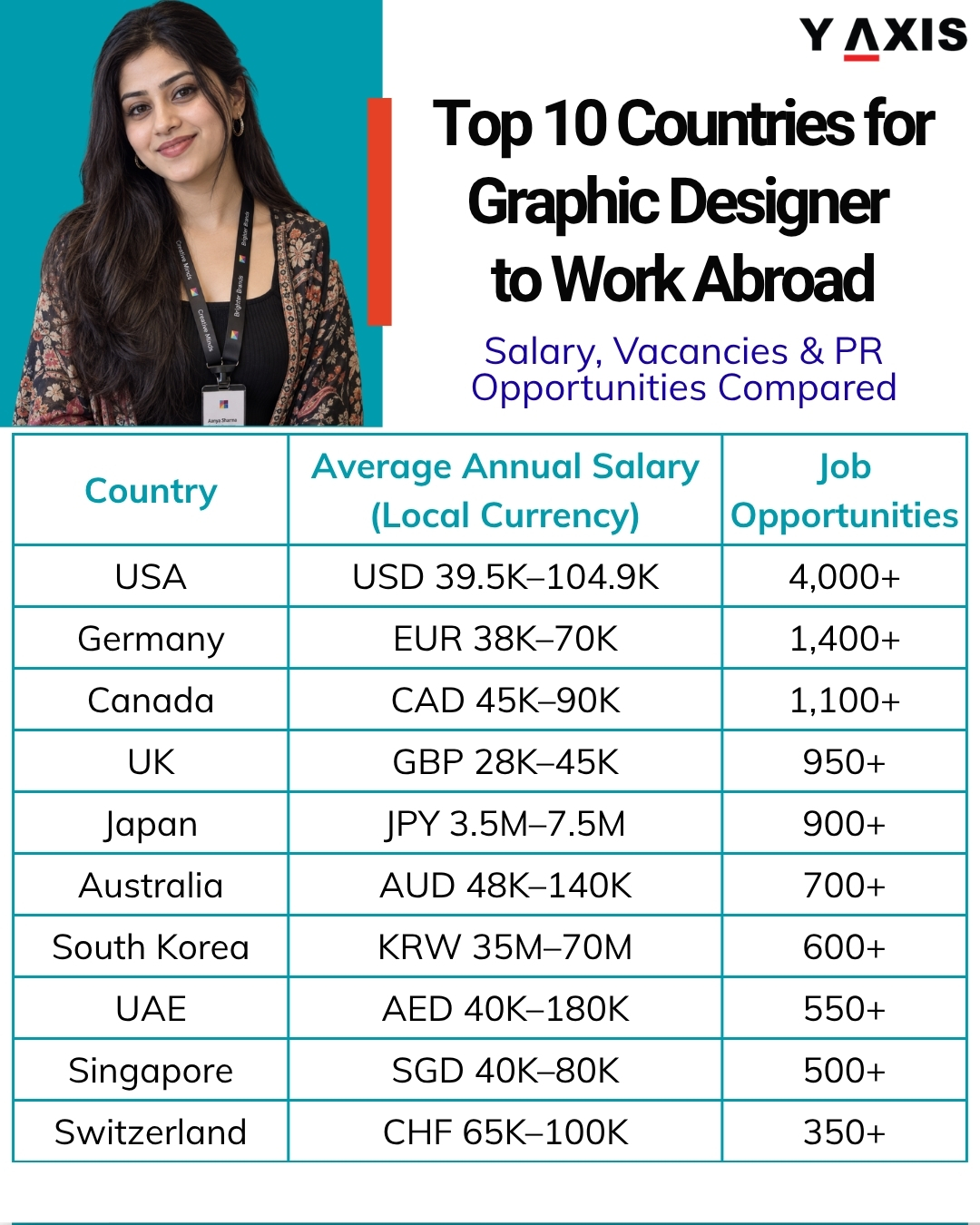
Top 10 Countries to Work Abroad as a Graphic Designer