


Posted on May 13 2026
Canada Updates Processing Times for Express Entry and Provincial Nominee Programs. Apply Now!

By , Editor & Director
Updated May 17 2026
Highlights: Canada Updates Processing Time for Express Entry and PNP Applicants
- The Canadian immigration department released updated processing times for permanent residence and citizenship applicants, effective May 12, 2026.
- The processing period for Express Entry and Provincial Nominee Program (PNP) applications was revised by a month.
- Wait times for the Atlantic Immigration Program (AIP) were reduced by 2 months, while the Parents and Grandparents Program (PGP) processing time was accelerated by 1 month.
- The CEC queue has increased by 6,000, while the base PNP inventory has increased by 2,000 applications.
- The Quebec Skilled Worker Selection Program (PSTQ) and the Quebec Business Class stream continue to process applications with a steady timeline.
*Want to check your eligibility for Canada? Try the FREE Y-Axis Canada CRS points calculator to get an instant score!
Canada’s Revised Timeline for PR and Citizenship Approval in 2026
Canada recently announced its revised immigration timelines on May 12, 2026, for different permanent residence pathways. Express Entry streams in Canada are subject to longer processing times for applications through the Federal Skilled Worker Program (FSWP) and the Provincial Nominee Program (PNP).
Certain streams for Canada permanent residence (PR) also saw reduced approval periods, while the Atlantic Immigration Program and the Parents and Grandparents Program will be processed faster.
Additionally, the time period for citizenship grants also experienced a significant increase in wait time.
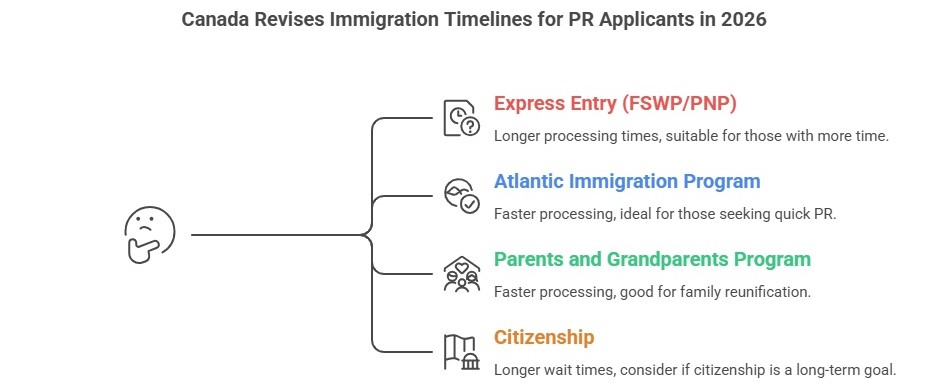
The table below highlights the revised timelines of different Canadian immigration streams:
| Stream | Sub-stream | New Processing Timeline |
|---|---|---|
| Express Entry | Canadian Experience Class (CEC) | 7 months |
| Express Entry | Federal Skilled Worker Program (FSWP) | 7 months |
| Provincial Nominee Program (PNP) | Enhanced PNP (via Express Entry) | 7 months |
| Provincial Nominee Program (PNP) | Base PNP (Non-Express Entry) | 14 months |
| Quebec Immigration | Skilled Worker Selection Program (PSTQ) | 11 months |
| Quebec Immigration | Quebec Business Class | 78 months |
| Atlantic Immigration Program | AIP | 38 months |
| Other Economic Programs | Start-Up Visa | More than 10 years |
| Other Economic Programs | Federal Self-Employed Persons Program | More than 10 years |
| Family Sponsorship | Spouse/Common-law Partner Inside Canada (Outside Quebec) | 25 months |
| Family Sponsorship | Spouse/Common-law Partner Outside Canada (Outside Quebec) | 16 months |
| Family Sponsorship | Parents and Grandparents Program (Outside Quebec) | 33 months |
| Citizenship | Citizenship Grant | 13 months |
| Citizenship | Renunciation of Citizenship | 7 months |
| Citizenship | Search of Citizenship Records | 17 months |
Also, read...
Canada’s Updated Immigration Timelines: What PR Applicants Should Know?
With Canada revising the processing timelines for Express Entry and PNP streams, applicants need to make early preparations and ensure accurate documentation.
Certain programs, such as the Atlantic Immigration Program and the Parents and Grandparents Program, offer better chances and faster processing for eligible candidates.
Given below are some tips for Canada PR applicants in 2026:
- Submit complete and error-free applications to avoid delays or additional document requests.
- Secure language test scores and ECA reports throughout the application process.
- Monitor Express Entry CRS trends and provincial nomination opportunities regularly.
- Apply early for high-demand immigration streams.
- Stay updated on IRCC processing changes and service standards.
- Consider alternative pathways like AIP or enhanced PNP streams based on eligibility.
- Maintain proof of funds and supporting financial documents in advance.
*Are you looking for step-by-step assistance with Canada immigration? Contact Y-Axis, the world's No. 1 overseas immigration consultancy.
For recent Canadian immigration updates, check out the Y-Axis Canada Immigration News Page.
FAQs
Why have Canada PR processing times increased in 2026?
Canada’s immigration processing times have increased mainly because of rising application inventories across Express Entry, Provincial Nominee Program (PNP), and family sponsorship streams. IRCC continues to receive a high volume of permanent residence applications while balancing annual immigration targets and staffing capacity. Categories like the Federal Skilled Worker Program and base PNP streams recorded significant backlog growth in recent months. Processing timelines can also be affected by application complexity, document verification, security checks, and provincial nomination volumes. Applicants are advised to submit complete applications and monitor official IRCC updates regularly to stay informed about expected waiting periods.
Which Canada immigration programs currently have the longest processing times?
Some of Canada’s longest processing timelines are currently seen under the Start-Up Visa and Federal Self-Employed Persons Program, both exceeding 10 years. Quebec Business Class applications are also experiencing extended wait periods of around 78 months. Among mainstream PR pathways, base Provincial Nominee Program applications currently take around 14 months, while Express Entry streams average approximately seven months. Family sponsorship applications for Quebec residents also remain lengthy in certain categories. Processing times continue to fluctuate depending on application inventory levels, annual immigration quotas, and IRCC’s operational priorities across different immigration streams and provinces.
What is the current Express Entry processing time in Canada?
As of May 2026, most Express Entry applications are taking approximately seven months to process. This includes both the Canadian Experience Class (CEC) and Federal Skilled Worker Program (FSWP) streams. Although IRCC’s official service standard remains six months for Express Entry applications, growing inventories and application volumes have increased actual wait times. Processing durations may vary depending on document completeness, background verification, medical checks, and demand under specific draws. Candidates should ensure all required documents are accurate and valid before submission to avoid unnecessary delays and improve their chances of smoother application processing.
How do Canada immigration backlogs affect PR applicants?
Growing immigration backlogs can lead to longer waiting periods, delayed decision-making, and uncertainty for permanent residence applicants. Applicants may need to maintain valid language test scores, passports, proof of funds, and employment documents for extended periods during processing. Delays can also impact travel plans, job transitions, education timelines, and relocation arrangements. In some cases, applicants may need to update expired documents while waiting for decisions. Immigration backlogs can additionally influence future draw trends and invitation rounds under Express Entry and PNP pathways. Staying informed about IRCC updates can help applicants better plan their immigration journey.
Which Canada immigration programs saw faster processing in 2026?
Despite increased delays across many streams, a few immigration categories experienced improved processing times in May 2026. The Atlantic Immigration Program (AIP) recorded a two-month reduction in wait time, while the Parents and Grandparents Program (PGP) also saw shorter timelines. These reductions may be linked to lower inventory levels and targeted processing efforts by IRCC. Applicants eligible for these pathways may benefit from comparatively improved processing efficiency. However, timelines can continue changing depending on future application volumes and policy updates. Candidates should still prepare all required documentation carefully before applying through these programs.
What is the difference between IRCC processing times and service standards?
IRCC processing times and service standards are different measures often confused by applicants. Processing times estimate how long applicants may wait for a final decision based on current inventories and historical trends. Service standards, on the other hand, are IRCC’s internal goals for completing approximately 80% of applications within a target timeframe. For example, Express Entry has a six-month service standard, but actual processing may exceed that due to backlogs and demand. Understanding this difference helps applicants set realistic expectations and better prepare for potential delays while tracking updates from Immigration, Refugees and Citizenship Canada.
Can delayed processing affect Express Entry CRS scores or eligibility?
Once a candidate receives an Invitation to Apply (ITA) and submits a complete PR application, delayed processing generally does not affect their CRS score. However, applicants must ensure that key documents such as passports, medical exams, police clearances, and language test results remain valid throughout the process. If documents expire during processing, IRCC may request updated versions. Delays may also indirectly affect future candidates waiting in the Express Entry pool, as changing draw trends and inventory levels can influence CRS cut-off scores. Applicants should therefore maintain updated profiles and monitor ongoing Express Entry developments carefully.
How can applicants reduce delays in Canada PR applications?
Applicants can reduce the chances of delays by submitting complete, accurate, and well-organized applications. Missing documents, incorrect information, expired test scores, or inconsistencies in work experience details can lead to additional verification requests and slower processing. Candidates should ensure their Educational Credential Assessment (ECA), language test results, proof of funds, employment records, and identification documents remain valid throughout the application process. Responding quickly to IRCC requests and regularly checking application status updates can also help avoid complications. Consulting experienced immigration professionals may further improve application quality and reduce avoidable processing setbacks.
Are Provincial Nominee Program applications taking longer in Canada?
Yes, certain Provincial Nominee Program applications are currently experiencing longer processing times in Canada. Base PNP applications submitted outside Express Entry increased to approximately 14 months in May 2026, while enhanced PNP applications linked to Express Entry remain around seven months. Rising inventories and growing demand for provincial nominations have contributed to these delays. Provinces continue to play a key role in selecting skilled workers aligned with regional labour market needs. Applicants considering PNP pathways should stay updated on nomination requirements, processing trends, and province-specific invitation rounds before submitting their applications.
What should Canada PR applicants prepare for in 2026?
Canada PR applicants in 2026 should prepare for potentially longer waiting periods and increased competition across major immigration pathways. Maintaining updated documents, valid language scores, proof of funds, and accurate employment records is essential throughout the application process. Applicants should also monitor Express Entry draw trends, provincial nomination opportunities, and IRCC processing updates regularly. Planning finances, career timelines, and relocation schedules carefully can help reduce stress during delays. Exploring alternative immigration programs such as AIP or enhanced PNP streams may also improve opportunities for eligible candidates seeking faster or more suitable pathways to Canadian permanent residence.
📞 Call: +91-7670800000
📩 Email: info@y-axis.com
🌐 Visit: https://www.y-axis.com
Tags:
Canada Express Entry
Provincial Nomination Program
Canada PNP
Canada citizenship
Atlantic Immigration Program
Canada PR
Canada immigration news
Canada permanent residence
migrate to Canada
FSWP
Share
Options for you by Y-Axis

Get it on your mobile

Get News alerts

Contact Y-Axis
Latest Article
Related Post
Trending Article

Posted On September 23 2026
Australia Updates Skilled Visa Processing Priorities for 2026. Check Your Eligibility!