


Posted on May 28 2026
Canada Revises Digital Nomad Visa Rules for 2026. Check Your Eligibility Now!

By , Editor & Director
Updated May 31 2026
Highlights: Canada Announces New Digital Nomad Guidelines for Remote Workers
- Canada has recently announced new Digital Nomad visa rules for remote workers in the country.
- As per the revised policies, remote workers in Canada must prove they work for foreign employers or international clients to hold a Digital Nomad visa status.
- Digital nomad visa holders can continue to stay and work remotely in Canada for up to 6 months without a work permit.
- Applicants for the visa will now require stronger financial proof and clear plans to leave Canada after their intended stay period.
- Family members travelling with digital nomad visa holders in Canada must apply separately for temporary resident status.
*Want to apply for Canada Digital Nomad Visa? Let Y-Axis guide you with the process.
Canada Strengthens Its Digital Nomad Entry Process for Global Professionals in 2026
Canada has officially released its digital nomad guidelines for 2026, introducing clearer rules for remote professionals planning to stay and work in the country. The new instructions mainly focus on better documentation and stronger proof of foreign employment or overseas income sources.
The updated policies for digital nomad visa holders aim to ensure smoother screening and greater transparency for visitors entering Canada who are working remotely for non-Canadian employers or clients.
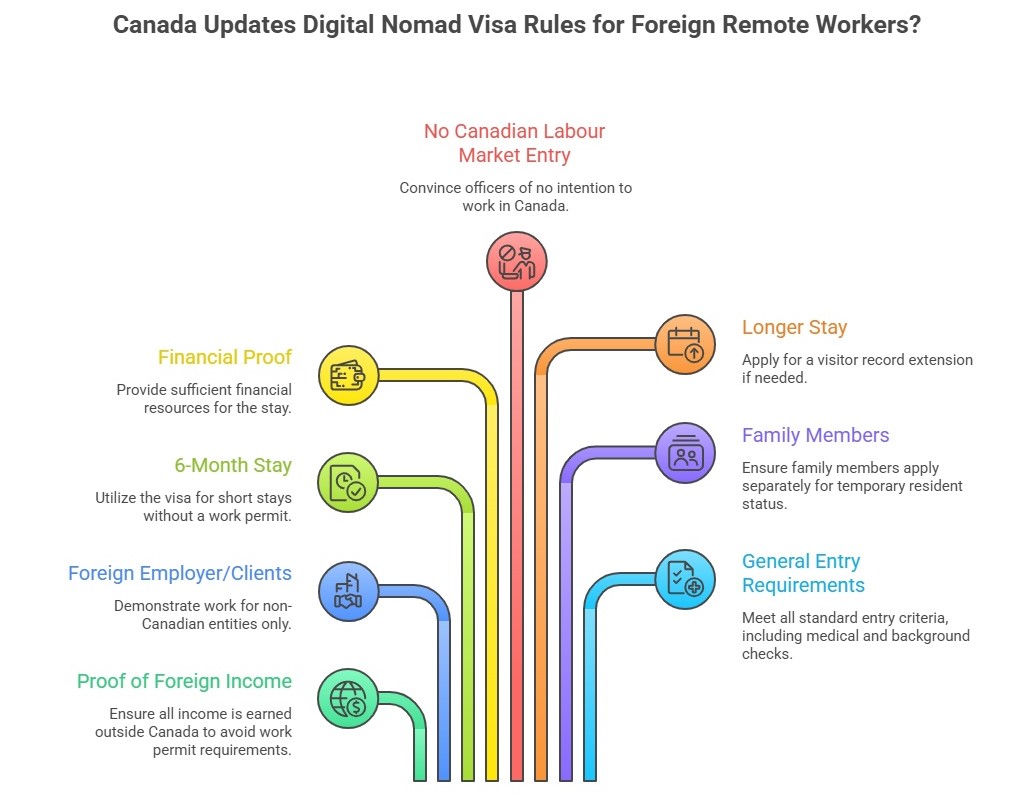
The key highlights of the updated digital nomad visa policies in Canada are as follows:
- Digital nomad visa holders must now provide proof that their income is earned entirely outside Canada.
- Remote workers must show they work for a foreign employer or international clients only.
- Eligible digital nomad visa applicants can still stay and work remotely in Canada for up to 6 months without a work permit.
- Applicants may need to provide stronger financial proof during entry assessment.
- Visitors must convince officers that they do not plan to enter the Canadian labour market.
- Digital nomads wanting to stay longer must apply for a visitor record extension.
- Accompanying family members must apply separately for temporary resident status.
- Applicants must still meet Canada’s general entry requirements, including medical, financial, and background checks.
Also, read...
Canada introduces a fast-track PR pathway for selected temporary workers. Apply now!
How will the Digital Nomad Visa updates affect Foreign Remote Workers?
Canada’s updated digital nomad guidelines may increase documentation requirements for foreign remote workers entering the country. While the pathway remains open, applicants may now need to prepare more carefully before travelling to Canada.
Here is how the new policies for the Digital Nomad visa will affect foreign remote workers in Canada:
- Proof of foreign income, remote employment contracts, and client details must be prepared before travel.
- Stronger financial evidence to confirm self-sufficiency during the stay.
- Clear evidence to show Digital Nomad visa workers are not intending to work in Canada for designated employers without proper authorisation.
- Longer stay intent would require an application for extensions or other suitable Canada work permit options.
*Are you looking for step-by-step assistance with Canada immigration? Contact Y-Axis, the world's No. 1 overseas immigration consultancy.
For recent Canadian immigration updates, check out the Y-Axis Canada Immigration News Page.
FAQs
What are Canada’s new digital nomad rules for 2026?
Canada has updated its digital nomad guidelines in 2026 to introduce stricter verification measures for remote workers entering as visitors. Immigration officers may now ask applicants to provide proof that their income comes entirely from outside Canada. Remote workers must also show that they are employed by foreign companies or provide services only to international clients. The new rules mainly focus on transparency and documentation. Canada still allows eligible digital nomads to stay and work remotely for up to six months without requiring a work permit under the visitor category.
Can digital nomads still work remotely in Canada without a work permit?
Yes, eligible digital nomads can still legally work remotely in Canada without a work permit if they work for foreign employers or overseas clients only. Canadian immigration rules consider this outside the Canadian labour market because the income source remains international. However, visitors must continue meeting all entry requirements, including financial proof, temporary stay conditions, and valid travel documents. The 2026 update does not remove the digital nomad option but increases document verification to ensure applicants genuinely qualify under the visitor exemption.
What documents may digital nomads need to show while entering Canada?
Digital nomads may now need to provide stronger proof of foreign employment or self-employment while entering Canada. Important documents can include remote work contracts, salary slips, client agreements, bank statements, tax records, proof of foreign business registration, and evidence of international income sources. Immigration officers may also ask applicants to show proof of accommodation, return travel plans, and financial capacity to support themselves during their stay. Carrying complete and organised documents can help make the entry process smoother and reduce delays at the border.
How long can a digital nomad stay in Canada?
Most digital nomads entering Canada as visitors can stay for up to six months at a time, depending on the duration approved by the border officer. The exact length of stay is decided during entry assessment and may vary by case. If remote workers want to remain longer in Canada, they may need to apply for a visitor record extension before their authorized stay expires. Applicants should maintain valid visitor status throughout their stay and continue meeting all immigration conditions while living and working remotely in Canada.
Does Canada allow freelancers and self-employed digital nomads?
Yes, Canada allows freelancers and self-employed professionals to enter as digital nomads if they work only for clients located outside Canada. Freelancers must prove that their business income comes entirely from foreign sources and that they are not entering the Canadian labour market directly. Self-employed applicants may need additional documentation such as invoices, client contracts, business registration papers, or tax records. The updated 2026 rules place more importance on proving international income sources clearly during the immigration assessment process.
Can digital nomads work for Canadian employers after entering Canada?
Digital nomads cannot automatically begin working for Canadian employers under the visitor exemption. To work for a Canadian company legally, individuals usually need proper work authorization unless they qualify under a separate work permit exemption. The updated guidelines clarify that remote workers entering as digital nomads must not participate in the Canadian labour market without authorization. Those who later receive eligible job offers may explore Canadian work permit options separately depending on their qualifications, employer sponsorship, or immigration pathway eligibility.
Will Canada’s new digital nomad rules make entry harder?
The new rules may increase scrutiny and document checks for some applicants, but they do not close Canada’s digital nomad pathway. Genuine remote workers with proper foreign income proof and strong documentation can still qualify for visitor entry. The main change is that immigration officers may now verify employment details and financial sources more carefully than before. Preparing accurate documents in advance can improve approval chances and help avoid issues during border assessment. Overall, Canada continues welcoming international remote professionals under its visitor framework.
Can family members accompany digital nomads to Canada?
Yes, family members can accompany digital nomads to Canada, but they must apply separately for their own temporary resident status. Each accompanying family member must meet Canada’s visitor requirements independently. Immigration officers may assess financial capacity, travel plans, and supporting documents for the entire family during the application or entry process. Spouses and children should carry proper identification, passports, travel records, and proof of relationship. Approval for one family member does not automatically guarantee approval for all accompanying applicants.
What financial proof is required for digital nomads in Canada?
Canada does not publish a fixed minimum bank balance for digital nomads, but visitors must show they can financially support themselves during their stay. Immigration officers may review bank statements, salary records, freelance income proof, savings, accommodation plans, and return travel arrangements. The 2026 update highlights stronger financial scrutiny for remote workers entering Canada. Applicants should demonstrate stable income sources and enough funds to cover living expenses without seeking employment in Canada. Strong financial proof can improve credibility during immigration assessment.
Is Canada still a good destination for digital nomads in 2026?
Yes, Canada remains one of the attractive destinations for digital nomads due to its high quality of life, modern cities, internet infrastructure, and multicultural environment. The updated 2026 rules mainly focus on clearer screening procedures rather than limiting remote workers entirely. Professionals who maintain valid foreign employment and proper documentation can still enjoy temporary remote work stays in Canada. Many digital nomads also explore future pathways such as work permits, permanent residency programs, or provincial immigration opportunities after gaining Canadian exposure.
📞 Call: +91-7670800000
📩 Email: info@y-axis.com
🌐 Visit: https://www.y-axis.com
Tags:
Canada digital nomad visa
Canada work visa
work in Canada
Canada immigration news
migrate to Canada
Canada PR
Canada permanent residence
foreign remote workers in Canada
Canada temporary residence
Canada visitor visa
Share
Options for you by Y-Axis

Get it on your mobile

Get News alerts

Contact Y-Axis
Latest Article
Related Post
Trending Article

Posted On October 09 2026
Ontario Boosts Medical Licensing Support for 200 Internationally Trained Doctors.Check Your Eligibility!