

Posted on December 17 2025
Top 10 Countries for Healthcare Professionals to Work Abroad: Salary, Demand & PR Opportunities Compared

By , Editor
Updated March 08 2026
Healthcare professionals are in high demand across the world. Countries are facing shortages of doctors, nurses, and medical staff due to the ageing population, growing healthcare needs, and increasing number of hospitals and medical infrastructure. Because of this, many countries are actively hiring skilled healthcare professionals from overseas and providing benefits.
Working abroad gives healthcare professionals a chance of better salaries, stable jobs, modern medical facilities, and internationals work experience. Some countries offer high salaries while others provide easier pathways to immigration and permanent residency (PR) options. Choosing the right country depends on factors such as expected salary, visa approval process, long-term settlement plans, and work-life balance.
Some of the main reasons healthcare professionals choose to work abroad include:
- Lack of qualified doctors and nurses across many countries
- Better salaries and strong job security
- Fast-track work visas and PR pathways
- Opportunity to work in advanced medical systems
- Better work-life balance and employee benefits
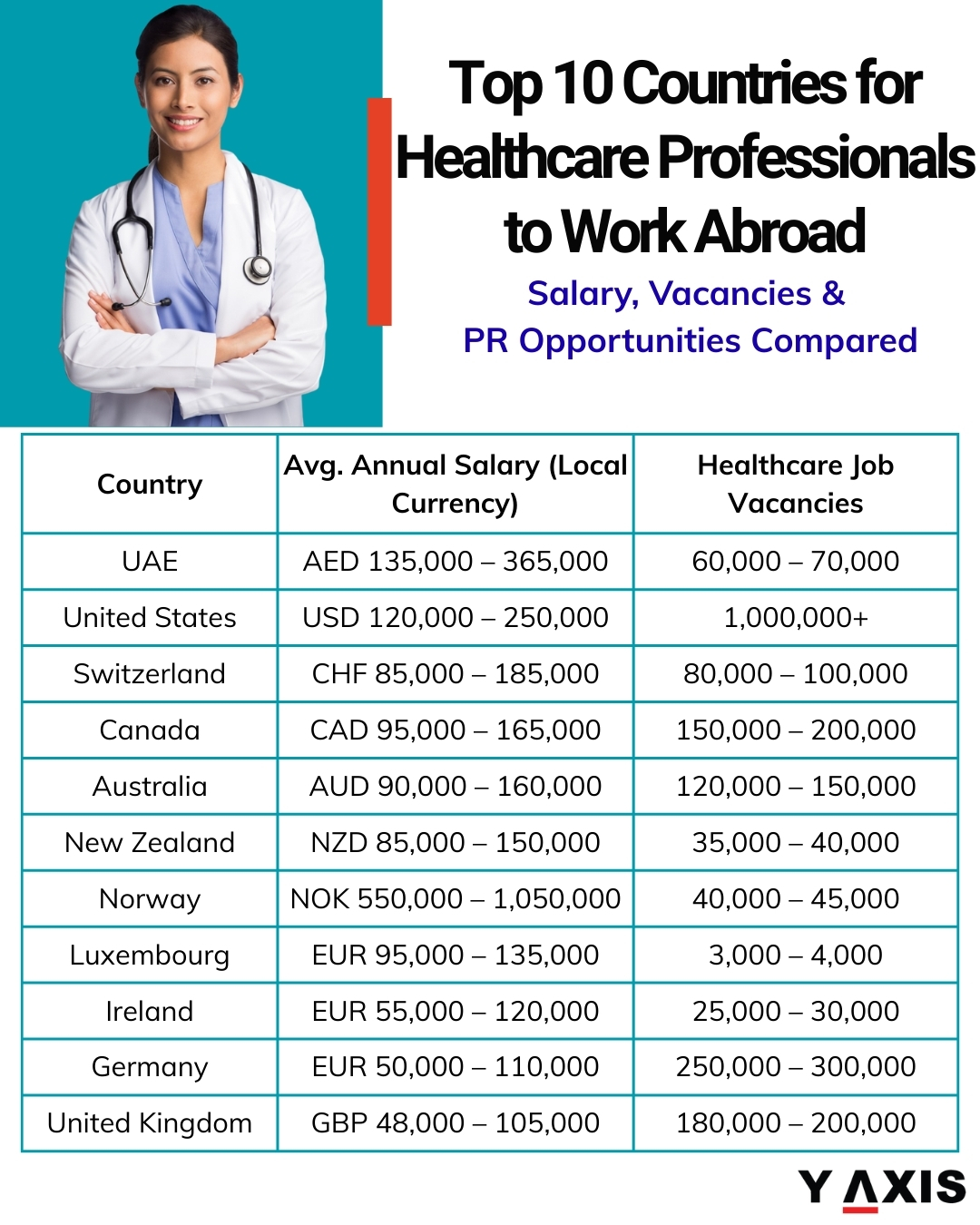
The table below shows the best countries for healthcare professionals based on average annual salaries and estimated job vacancies, to build a successful healthcare career abroad:
|
Country |
Avg. Annual Salary |
Healthcare Job Vacancies |
|
United States |
₹1.0 Cr – ₹2.1 Cr |
1,000,000+ |
|
Switzerland |
₹75 Lakh – ₹1.65 Cr |
80,000 – 100,000 |
|
Canada |
₹58 Lakh – ₹1.25 Cr |
150,000 – 200,000 |
|
Australia |
₹54 Lakh – ₹1.15 Cr |
120,000 – 150,000 |
|
Germany |
₹46 Lakh – ₹1.0 Cr |
250,000 – 300,000 |
|
United Kingdom |
₹50 Lakh – ₹1.08 Cr |
180,000 – 200,000 |
|
New Zealand |
₹46 Lakh – ₹1.0 Cr |
35,000 – 40,000 |
|
Ireland |
₹54 Lakh – ₹1.15 Cr |
25,000 – 30,000 |
|
Norway |
₹46 Lakh – ₹91 Lakh |
40,000 – 45,000 |
|
United Arab Emirates |
₹37 Lakh – ₹1.0 Cr |
60,000 – 70,000 |
|
Luxembourg |
₹2.3 Cr – ₹2.9 Cr |
3,000 – 4,000 |
*Willing to work abroad? Y-Axis will guide you through a step-by-step process.
Best Countries for Indian Healthcare Professionals to Work Abroad
Healthcare systems in many countries are actively hiring skilled medical professionals from overseas to meet their workforce shortages. Each country offers different advantages based on salary levels, demand for healthcare roles, and job stability. Some countries focus on immediate hiring needs, while others support long-term settlement opportunities for foreign healthcare professionals. The table below explains why each country is considered a top destination for Indian healthcare professionals.
|
Country |
Why It Is a Top Choice for Healthcare Professionals |
|
Luxembourg |
Offers very high salaries, modern hospitals, strong demand for doctors and nurses, and EU Blue Card options with long-term residence benefits. |
|
United States |
Has the greatest demand for healthcare professionals, high salary potential, advanced medical systems, and clear Green Card pathways for doctors and nurses. |
|
Switzerland |
Provides excellent salaries, high-quality healthcare infrastructure, strong work-life balance, and priority work permits for shortage healthcare roles. |
|
Canada |
High demand across all healthcare roles, easier PR pathways through Express Entry and PNPs, good salaries, and family-friendly settlement options. |
|
Australia |
Consistent demand for nurses and doctors, competitive salaries, fast-track skilled visas, and strong PR opportunities under skilled migration programs. |
|
Germany |
Large shortage of nurses and doctors, structured qualification recognition, EU Blue Card benefits, and clear long-term settlement pathways. |
|
United Kingdom |
NHS actively recruits overseas healthcare professionals, offers the Health and Care Worker Visa, faster visa processing, and PR after an eligible stay. |
|
New Zealand |
Healthcare roles are on the Green List, offering straight-to-residence options, good work-life balance, and steady demand across regions. |
|
Ireland |
High demand for nurses and doctors, Critical Skills Employment Permit with faster PR eligibility, and an English-speaking work environment. |
|
Norway |
Strong demand due to an ageing population, good salaries, excellent work-life balance, and stable long-term residence options. |
|
United Arab Emirates |
Tax-free income, modern hospitals, high demand for specialist doctors and nurses, and long-term residency options like the Golden Visa. |
In-Demand Jobs in Healthcare Across Top Countries
Most countries are facing a shortage of trained doctors, nurses, and medical staff, which is creating more job opportunities for overseas professionals. The table below shows the most in-demand healthcare job roles across the top countries:
|
Country |
In-demand Healthcare Job Roles |
|
Switzerland |
Specialist Doctors, General Physicians, Registered Nurses, Elder Care Nurses, ICU Nurses, Anaesthetists, Physiotherapists, Radiology Technicians |
|
Canada |
Family Doctors, Specialist Doctors, Registered Nurses, Nurse Practitioners, Personal Support Workers, Licensed Practical Nurses (LPNs), Home Care Aides, Medical Laboratory Technologists |
|
Australia |
Registered Nurses, General Practitioners, Specialist Doctors, Aged Care Nurses, Mental Health Nurses, Midwives, ICU Nurses, Emergency Care Nurses, Occupational Therapists |
|
Germany |
Registered Nurses, Geriatric Nurses, General Physicians, Specialist Doctors, Healthcare Assistants, Midwives, Physiotherapists, Elder Care Assistants |
|
United States |
Specialist Doctors, Registered Nurses, Nurse Practitioners, Physician Assistants, Medical Technologists, ICU Nurses, Surgical Technicians, Radiology Technologists, Physical Therapists |
|
United Kingdom |
NHS Doctors, Registered Nurses, Midwives, Mental Health Professionals, Allied Health Workers, Paramedics, Radiographers, Occupational Therapists, Healthcare Support Staff |
|
United Arab Emirates |
Specialist Doctors, General Practitioners, Registered Nurses, ICU Nurses, Medical Technicians, Emergency Nurses, Radiology Technicians, Dialysis Nurses |
|
New Zealand |
Registered Nurses, General Practitioners, Specialist Doctors, Aged Care Professionals, Mental Health Nurses, Midwives, Community Nurses, Disability Support Professionals |
|
Luxembourg |
Specialist Doctors, General Practitioners (GPs), Hospital Physicians, Registered Nurses, Elder Care Nurses, Clinical Specialists, Medical Laboratory Technicians |
|
Ireland |
Registered Nurses, Specialist Doctors, General Practitioners, Clinical Nurse Specialists, Midwives, Mental Health Nurses, ICU Nurses, and Elder Care Nurses |
|
Norway |
Registered Nurses, Elder Care Nurses, General Physicians, Mental Health Nurses, Home Care Nurses, Rehabilitation Nurses, Disability Care Professionals |
Visa Options for Healthcare Professionals in Different Countries
Many countries offer special work visas for doctors, nurses, and other healthcare professionals. These visas are designed to help hospitals and healthcare systems hire skilled professionals from overseas. In most cases, these visas are employer-sponsored, require professional licensing, and also provide a clear path to permanent residency (PR) after a few years of work.
|
Country |
Main Visa Options for Healthcare Professionals |
|
Germany |
EU Blue Card and Skilled Worker Visa allow qualified healthcare professionals to work in Germany after qualification recognition and language approval. |
|
Switzerland |
L and B work permits are issued through employer sponsorship, with PR possible after a long-term legal stay. |
|
United States |
H-1B for speciality roles, EB-2 and EB-3 for employment-based Green Cards, and J-1 visas for medical training and residency programs. |
|
Canada |
Express Entry, Provincial Nominee Programs, and employer-sponsored work permits support healthcare professionals with PR options. |
|
Australia |
Skilled Independent (189), Skilled Nominated (190), and employer-sponsored visas (482, 186) allow long-term work and settlement. |
|
United Kingdom |
Health and Care Worker Visa and Skilled Worker Visa offer direct work rights and PR eligibility after the required stay period. |
|
Norway |
Skilled Worker Residence Permit is issued after healthcare licensing approval and a valid job offer. |
|
New Zealand |
Accredited Employer Work Visa, Straight to Residence, and Work to Residence pathways support healthcare roles. |
|
Luxembourg |
Work Permit for Salaried Workers and EU Blue Card allow employment and long-term residence options. |
|
Ireland |
Critical Skills and General Employment Permits lead to Stamp 4 (PR) after eligibility. |
|
United Arab Emirates |
Employer-sponsored work visas and Golden Visas are available for qualified healthcare professionals. |
Fast-Track Hiring Options for Healthcare Professionals by Country
To meet urgent hospital and healthcare system needs, many countries provide fast-track hiring options for healthcare professionals. These options help reduce visa processing time, give priority to shortage roles, and offer quicker access to PR or long-term residence. Doctors, nurses, and specialists often receive priority processing under these programs.
|
Country |
Fast-Track Hiring Options Explained |
|
Germany |
The Fast-track Skilled Worker Procedure speeds up visa processing once the employer initiates the application. |
|
Switzerland |
Healthcare shortage roles receive priority approval for work permits. |
|
United States |
EB-2 National Interest Waiver and Schedule A for nurses allow faster Green Card processing without labour certification delays. |
|
Canada |
Category-based Express Entry draws and fast-track Provincial Nominee Programs prioritise healthcare professionals. |
|
Australia |
Healthcare roles receive priority processing under skilled migration and employer-sponsored visas. |
|
United Kingdom |
The Health and Care Worker Visa offers faster decisions, lower fees, and quicker entry. |
|
Norway |
Applications are processed faster once healthcare licensing is approved. |
|
New Zealand |
Green List roles, such as doctors and nurses, qualify for Straight to Residence without long waiting periods. |
|
Luxembourg |
EU Blue Card applications are processed faster for highly skilled healthcare professionals. |
|
Ireland |
Critical Skills Employment Permit offers quicker approval and faster PR eligibility. |
|
United Arab Emirates |
Golden Visa provides fast-track long-term residency for senior doctors and medical specialists. |
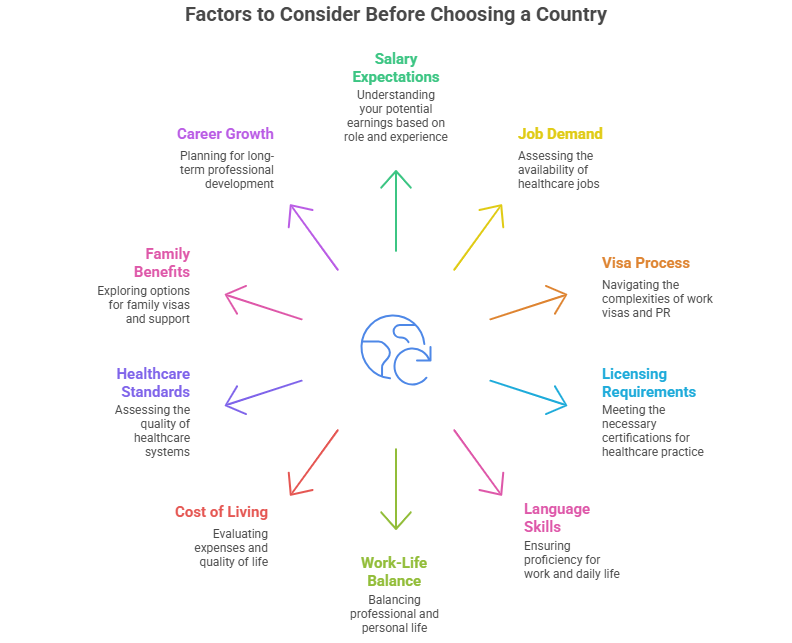
Key Factors to Consider Before Choosing a Country
- Your expected salary based on your role and experience
- Demand for healthcare professionals and job vacancies
- Work visa and permanent residency (PR) process
- Licensing and registration requirements for doctors or nurses
- Language requirements for work and daily communication
- Work-life balance and working hours
- Cost of living and quality of life
- Healthcare system standards and hospital infrastructure
- Family benefits and dependent visa options
- Long-term career growth and settlement opportunities
*Start your healthcare career abroad with end-to-end support from Y-Axis.
Eligibility Requirements to Work Abroad as a Healthcare Professional
While requirements vary by country, most healthcare professionals must have:
- Recognised medical or nursing qualification
- Relevant work experience
- Language proficiency (IELTS / OET / local language)
- Professional licensing or registration
- Valid job offer or skills assessment
Licensing & Registration Requirements by Country
Before working abroad, healthcare professionals must get their qualifications recognised and complete local licensing or registration in the destination country. This process ensures that doctors, nurses, and medical staff meet the country’s professional, language, and safety standards. Licensing is usually mandatory before or after receiving a job offer, depending on the country.
Germany
- Doctors and nurses must get their qualifications recognised by German authorities.
- Nurses usually apply through the Anerkennung (recognition) process.
- Doctors must obtain an Approbation (medical licence).
- German language skills (usually B1/B2) are mandatory.
- Licensing is required before starting work.
Switzerland
- Foreign healthcare qualifications must be recognised by the Swiss Red Cross (SRC) for nurses.
- Doctors must register with MEBEKO.
- Strong language skills in German, French, or Italian are required.
- Licensing approval is needed before applying for a work permit.
United States
- Doctors must clear the USMLE exams and complete residency requirements.
- Nurses must pass the NCLEX-RN
- State-level licensing is required for both doctors and nurses.
- English proficiency is mandatory.
- Licensing can take time, but it offers strong long-term career benefits.
Canada
- Doctors must get credentials verified through the Medical Council of Canada (MCC).
- Nurses must register with provincial nursing bodies.
- Language tests like IELTS or CELBAN are required.
- Some provinces allow supervised practice while completing licensing steps.
Australia
- Healthcare professionals must register with AHPRA.
- Nurses need a qualification assessment and English language proof.
- Doctors may need AMC exams depending on their background.
- Registration is required before visa approval in most cases.
United Kingdom
- Doctors must register with the GMC (General Medical Council).
- Nurses must register with the NMC (Nursing & Midwifery Council).
- English language test (IELTS or OET) is required.
- UK offers clear and structured licensing steps.
Norway
- Licensing is handled by the Norwegian Directorate of Health.
- Healthcare professionals must get qualification recognition first.
- Norwegian language skills are mandatory.
- Approval is required before starting work.
New Zealand
- Doctors must register with the Medical Council of New Zealand (MCNZ).
- Nurses must register with the Nursing Council of New Zealand (NCNZ).
- English language proficiency is required.
- Some roles allow provisional registration initially.
Luxembourg
- Healthcare qualifications must be recognised by the Ministry of Health.
- Doctors and nurses need professional registration approval.
- Language skills in French, German, or Luxembourgish are important.
- Licensing is required before applying for work permits.
Ireland
- Doctors must register with the Irish Medical Council (IMC).
- Nurses must register with NMBI.
- English language tests are required.
- Ireland provides clear licensing guidance for overseas professionals.
United Arab Emirates (UAE)
- Doctors and nurses must clear licensing exams through DHA, HAAD, or MOH (based on emirate).
- DataFlow verification is mandatory.
- English proficiency is required.
- Licensing must be completed before employment.
Countries that Offer the Fastest PR for Healthcare Professionals
Many countries offer fast and clear permanent residency (PR) pathways for healthcare professionals because of shortages of doctors, nurses, and medical staff. Some countries allow healthcare professionals to apply for PR within 1–2 years, while others may take 3–5 years, depending on work experience, visa type, and local licensing rules. Fast PR options help healthcare professionals enjoy job security, long-term settlement, family benefits, and access to public services.
Choosing a country with a shorter PR timeline is important for professionals who want stability, career growth, and a better quality of life. The table below shows countries that offer faster PR pathways for healthcare professionals.
|
Country |
Estimated PR Timeline for Healthcare Professionals |
|
Canada |
6 months to 2 years |
|
Australia |
1 – 3 years |
|
New Zealand |
1 – 2 years |
|
United Kingdom |
5 years |
|
Germany |
21 – 33 months |
|
Ireland |
2 – 5 years |
|
Norway |
3 years |
|
Luxembourg |
2 – 5 years |
|
United States |
2 – 5 years (Green Card) |
|
United Arab Emirates |
No direct PR (long-term Golden Visa available) |
*Looking for Healthcare jobs abroad? Talk to Y-Axis, the world’s no. 1 overseas immigration company for complete guidance and visa support.
FAQs
Which country offers the fastest PR for healthcare professionals?
Major countries like Canada, New Zealand, Australia and Germany offer some of the fastest PR options for healthcare professionals. Canada allows PR through Express Entry and PNPs, often within 6 months to 2 years. New Zealand offers Straight to Residence for doctor and nurses under the Green List. Australia provides PR in 1 to 3 years through skilled or employer-sponsored visas. While Germany allows PR in about 21 to 33 months with the EU Blue Card. These countries give priority to healthcare roles due to strong demand and vacancies.
Do healthcare professionals need licensing before applying for a job abroad?
Yes, healthcare professionals generally need to meet the licensing requirements before they start working abroad. This process checks whether your education, skills, and experience meet the specific country's medical standards. In some countries, you can apply for jobs while licensing is in progress, but final approval is required before joining work. Licensing usually includes qualification recognition, language tests like IELTS or OET, and professional exams. Getting a license early improves job chances, speeds up visa processing, and helps you start work without delays.
Which countries offer fast-track visas for doctors and nurses?
Many countries offer fast-track visas for doctors and nurses to support immediate healthcare needs. Countries like Canada, Australia, UK, Germany, New Zealand, Ireland and USA provides faster visa processing for healthcare professionals. These visas often have fast approvals, lower processing time, and clear PR pathways. Some countries also allow direct work permits or residence options for doctors and nurses working in shortage occupations.
Can healthcare professionals work abroad without PR initially?
Yes, most countries allow doctors, nurses, and medical professionals to start working on a temporary work visa or an employer-sponsored visa first. After gaining local work experience and meeting eligibility requirements, they can later apply for permanent residency (PR). This is a common and safe pathway, used by many healthcare professionals worldwide.
Do healthcare organizations sponsor visas for overseas healthcare professionals?
Yes, healthcare organizations do sponsor visas for overseas healthcare professionals in many countries. Public and private healthcare organizations, including medical centers, clinics and care facilities, regularly hire doctors, nurses, and allied health professionals from abroad. Once a job offer is given, the organization usually supports the work visa application and helps with required documents. In countries like the UK, Canada, Australia, Germany and the UAE, employer sponsorship is a common route for healthcare roles.
Are healthcare jobs abroad permanent or contract-based?
Healthcare jobs abroad can be both permanent and contract-based, depending on the country, employer, and visa type. Most healthcare professionals start with a fixed-term or contract job, usually for 1 to 3 years. These contracts can often be renewed or converted into permanent roles after gaining local experience. In countries like Canada, Australia, UK and Germany, healthcare professionals can move from contract jobs to long-term employment and PR. Permanent jobs offer better stability, benefits and career growth, while contract roles help professionals enter the country faster.
Which healthcare role has the fastest immigration pathway?
Healthcare roles like registered nurses, general practitioners (GPs), and specialist doctors usually have the fastest immigration pathways. These roles are in high demand in many countries, so governments give them priority for work visas, fast-track hiring, and permanent residency (PR). Nurses often get quicker visa approvals and PR options because hospitals need them immediately. Overall, roles that are important to public healthcare systems move faster through immigration than non-clinical roles.
Are healthcare professionals included in shortage occupation lists?
Yes, healthcare professionals are included in shortage occupation lists in many countries. Most countries officially list roles like doctors, nurses, midwives, aged care professionals, and allied health professionals as shortage occupations. This is because hospitals and healthcare systems do not have enough trained staff to meet patient needs. Countries such as Canada, UK, Australia, Germany, New Zealand, and Ireland regularly update these lists to support healthcare recruitment from overseas.
Can healthcare professionals bring family members on work visas?
Yes, healthcare professionals can usually bring their family members when they move abroad on a work visa. Most countries allow doctors, nurses, and other healthcare professionals to apply for dependent visas for their spouse and children. In many cases, spouses are also allowed to work full-time, and children can study in public schools. Countries like Canada, Australia, the UK, Germany, Ireland, and New Zealand offer strong family-friendly visa policies. Family members can often apply for permanent residency (PR) together once the main applicant becomes eligible.
Is local language mandatory for healthcare jobs in Europe?
Yes, local language is mandatory for most healthcare jobs in Europe, especially for roles that involve direct patient care. Healthcare professionals like doctors, nurses, and allied health employees usually need to speak the local language because they must communicate clearly with patients, families, and medical teams. Countries such as Germany, Norway, Switzerland, France, and Austria require language levels like B1 or B2 before licensing or starting work. In English-speaking countries like the UK and Ireland, only English is required. Some countries allow you to start learning the local language after arrival, but language skills are essential for long-term work and licensing.
What are the age limits for migrating as a healthcare professional?
Most countries do not have a strict age limit for healthcare professionals migrating abroad. What matters more is your qualifications, work experience, language skills, and licensing approval. However, some points-based PR systems give higher points to younger applicants, usually between 25 - 40 years. Older professionals can still migrate through employer sponsorship, shortage occupation visas, or healthcare-specific programs, even above 45 years.
Tags:
Healthcare jobs abroad
Doctors and nurses jobs overseas
Work abroad healthcare professionals
Healthcare visa and PR
Overseas healthcare careers
Medical jobs abroad
Healthcare immigration guide
Best countries for healthcare jobs
Share
Options for you by Y-Axis

Get it on your mobile

Get News alerts

Contact Y-Axis
Latest Article
Popular Post
Trending Article

Posted On April 01 2026
Study vs Work Abroad – Which is Better for Indians in 2026?