


Posted on January 16 2026
How can I migrate to Canada as an AI Specialist?

By , Editor
Updated January 27 2026
You can migrate to Canada as an AI Specialist through tech-based streams, such as STEM draws through Express Entry, or the Ontario Tech or BC Tech streams under the Canada PNP program. You can also immigrate to Canada as an AI specialist via employer-driven work permits, such as the GTS (Global Talent Stream), which offers faster visa processing times for eligible tech roles, or via an LMIA-exempt work permit under the IMP (International Mobility Program). As an AI specialist, you can immigrate to Canada through permanent residence programs as well as work permit pathways, based on your qualifications, work experience, and employment status.
*Want to work in Canada? Let the Y-axis guide you with the steps.
Immigration Pathways in Canada for AI Specialists
Canada offers both a work permit pathway and a permanent residency program for AI specialists to migrate to Canada.
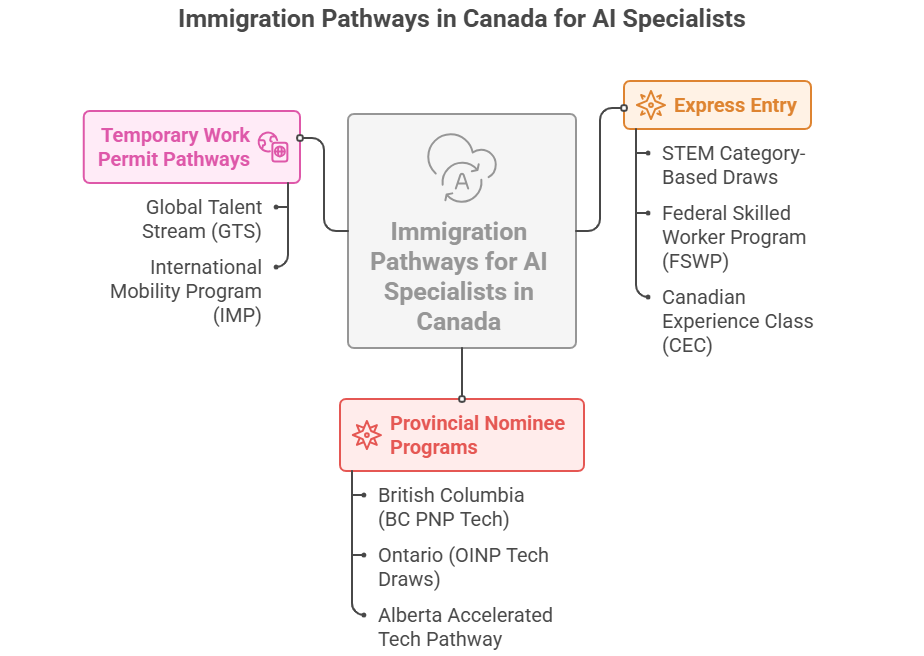
The immigration pathways in Canada for AI specialists are as follows:
Express Entry
AI specialists can migrate to Canada through the Express Entry program, which manages applications for programs such as the Federal Skilled Worker Program (FSWP) and the Canadian Experience Class (CEC). Candidates are assessed using the CRS points calculator or the Comprehensive Ranking System (CRS), which considers factors such as age, work experience, language proficiency, and education. Higher CRS scores indicate better chances of getting an ITA (Invitation to Apply) for Canada PR. As an AI specialist, you can migrate through the FSWP, CEC, and STEM-category-based draws.
STEM Category-Based Draws
IRCC regularly conducts Express Entry draws, which also include STEM category-based draws, targeting occupations such as technology, engineering, science, and mathematics. AI specialists are employed in various roles, including artificial intelligence engineers, software developers, data scientists, and information systems analysts. The minimum CRS scores differ by the type of draw held, the program, and the labour market requirements.
Also, read...
When is the next Canada PR draw?
Federal Skilled Worker Program (FSWP)
The Federal Skilled Worker Program (FSWP) is one of the best options for AI specialists with prior work experience (Foreign or Canadian), language proficiency skills, and recognized educational qualifications. To qualify for FSWP as a skilled AI specialist, you will be required to meet specific criteria and participate in the Express Entry pool, through which you will be selected depending on your CRS score.
*Want to apply for FSWP? Let Y-Axis assist you with the process.
Canadian Experience Class (CEC)
The Canadian Experience Class (CEC) is for AI specialists who have worked in Canada on a valid work permit and gained Canadian work experience. Candidates with a minimum of 12 months of eligible Canadian work experience can apply for PR via the Express Entry program, making it a great choice for AI specialists with work and permanent residency plans.
*Want to apply for Express Entry? Let Y-Axis guide you with the steps.
Provincial Nominee Programs (PNPs)
Canada PNP is one of the second most preferred Canadian immigration pathways. Through the Canada PNP, Canadian provinces can nominate skilled workers depending on their labour market needs. AI specialists are one of the highly sought-after professionals, with provinces conducting PNP draws through tech-focused PNP streams. Having a provincial nomination can boost your CRS score by 600 additional points, improving your chances of receiving an ITA for Canada PR.
Some of the most common PNP programs for AI specialists to choose from are as follows:
British Columbia PNP (Tech Priority Occupations)
British Columbia targets specific technology-related occupations and conducts BC PNP Draws via the provincial nomination program. To qualify, you will generally need a valid job offer from a verified employer in British Columbia.
Want to apply for BC PNP? Let Y-Axis guide you with the steps.
Ontario Immigrant Nominee Program (Tech Draws)
Ontario regularly conducts technology-based nomination rounds to select skilled professionals in software, AI, and data-related fields. Applicants who are selected through the OINP draws can work in top AI hubs like Ottawa, Waterloo, and Toronto, while also being able to transition to PR.
*Want to apply for OINP? Let Y-Axis help you with the process.
Alberta Accelerated Tech Pathway
Alberta provides an accelerated nomination pathway for tech professionals, including AI specialists. To qualify for the Accelerated Tech Pathway, you must already be working in the province or have an employment offer in any of the qualifying tech occupations.
*Want to apply for Canada PNP? Let Y-Axis help you with the process.
Temporary Work Permit Pathways for AI Specialists
The two main work permit pathways through which AI specialists can migrate to Canada are as follows:
Global Talent Stream (GTS)
The GTS, or Global Talent Stream, is an employer-based work permit pathway listed under the TFWP (Temporary Foreign Worker Program). You must have a positive LMIA, along with meeting other eligibility criteria, to qualify for the GTS stream. While it does not lead to PR, an AI specialist can gain quality Canadian work experience, which can later be beneficial during PR applications.
Read more…
All you need to know about Canada's Global Talent Stream
International Mobility Program (IMP)
The IMP, or the International Mobility Program, allows specific foreign workers to acquire LMIA-exempt work permits under categories such as intra-company transferees. The eligibility to qualify for the IMP depends on the category and the selected occupation. Through the International Mobility Program, you can also benefit from expedited visa processing.
*Want to apply for the International Mobility Program? Talk to experts at Y-Axis to guide you with the steps.
Eligibility Criteria for AI Specialists to Migrate to Canada
The eligibility criteria for an AI specialist to migrate to Canada depend on the immigration pathway. However, the general list of eligibility criteria for migrating to Canada as an AI specialist is as follows:
- Work experience: Have at least 12 months of skilled work experience in an AI-based, data science, or advanced software occupation listed in NOC TEER 0, 1, 2, or 3
- Educational qualifications: Have completed a Bachelor’s, Master's, or Doctorate in Artificial Intelligence, Computer Science, Data Science, Engineering, or a relevant field. You will need an ECA if you have completed your studies outside Canada.
- Language proficiency skills: Must submit proof of language proficiency through tests like IELTS, CELPIP, TEF, or TCF. (The minimum language proficiency levels depend on the type of program or occupation.)
- Proof of funds: You will need to submit evidence of sufficient funds when applying through the FSWP program.
- Admissibility requirements: You must complete a medical examination, along with a Police Clearance Certificate and a valid passport.
*Looking for AI specialist jobs in Canada? Avail Y-Axis Resume Marketing Services to find the right one.
How to Apply for Canada Immigration as an AI Specialist?
While the Canada immigration process varies based on the selected pathway, given below is a general step-by-step process to migrate to Canada as an AI specialist:
Step 1: Check if you are eligible for the Canadian immigration pathways that are available for AI specialists
Step 2: If yes, choose an immigration pathway that best suits your skills, experience, language proficiency level, and long-term career goals
Step 3: Get an ECA (Educational Credential Assessment) if you have done your studies outside Canada
Step 4: Select the correct NOC code as per your job role; the NOC code must be related to data science, AI, or advanced software development.
Step 5: Create an Express Entry profile or submit your application or profile under the most relevant PNP stream (based on the program you choose)
Step 6: If you choose the Express Entry program, you will be required to enter the Express Entry pool and obtain a CRS score based on your education, age, qualifications, experience, and language proficiency skills.
Step 7: Get an ITA (Invitation to Apply) to qualify for PR via a provincial nomination or the Express Entry draw
Step 8: Complete your application for PR within the given deadline, along with your medical certificate, police clearance certificate, proof of funds, and biometrics.
Step 9: Await a decision from the IRCC, and upon approval, you will get your Confirmation of Permanent Residence (COPR).
Step 10: Fly to Canada and start working as an AI specialist
Note: A job offer is not a mandatory prerequisite and is only required for specific immigration pathways.
*Are you looking for step-by-step assistance with Canada immigration? Contact Y-Axis, the world’s No. 1 overseas immigration consultancy, for end-to-end assistance!
FAQs
Are AI specialists currently in demand in Canada?
Yes, AI specialists are currently in high demand in Canada due to a significant labour and talent shortage across sectors such as AI analysis, finance, technology, operations, and healthcare. The need for AI specialists in Canada is further accelerated by rapid AI adoption across diverse industries, compelling the country to hire AI specialists from abroad to establish a steady workforce.
What are the immigration pathways to Canada for AI specialists from India?
The major immigration pathways to Canada for AI specialists from India include the federal Express Entry system, various Provincial Nominee Programs (PNPs), and other Temporary Work Permit pathways such as the Global Talent Stream (GTS) and the International Mobility Program (IMP). These immigration pathways for AI specialists offer both a temporary work/residence permit and long-term permanent residence in Canadian provinces.
How to apply for a work visa in Canada as an AI specialist?
To get a Canadian work visa as an AI specialist, you need a relevant degree, prior work experience, and dedicated skill sets in AI/ML. An AI specialist needs to secure a valid job offer with Labour Market Impact Assessment (LMIA), appear for language proficiency tests, and apply for the work visa via the IRCC online portal. Submit the necessary documents, such as biometrics, a passport, and educational proof, to apply for a work permit through common Canadian immigration pathways for AI specialists.
What is the average salary of AI specialists working in Canada?
The average salary of an AI specialist working in Canada ranges around CAD 120,000 annually. The average compensation may vary from CAD 82,000 to CAD 146,000 per year, depending on educational qualifications, skill sets, location, and prior work experience.
How to get employer sponsorship for AI jobs in Canada?
To secure employer sponsorship for AI jobs in Canada, you need a strong profile with relevant qualifications, work experience, and advanced training/certification to develop AI-based skill sets. Other necessary criteria for employer sponsorship in Canada include language proficiency, ECA (Educational Credential Assessment), and a well-structured resume. AI specialists should target companies in major tech hubs such as Toronto, Vancouver, and Montreal to increase their chances of receiving sponsored job offers.
Which Canadian provinces have the highest demand for AI specialists?
The major Canadian provinces with the highest demand for AI specialists include Ontario, Quebec, and British Columbia, which are experiencing significant labour shortages in technical sectors. These provinces are also Canada’s core hubs with extensive research, AI-centred jobs, competitive salaries, and streamlined immigration pathways for foreign AI specialists.
Which Canadian immigration programs prioritize AI skills?
Canada’s several economic and skilled immigration pathways, such as the Express Entry Stream, PNP streams, and the Global Talent Stream (GTS), target AI specialists in priority sectors of the country. The STEM-category-based draw in Express Entry is dedicated to AI specialists with the necessary work experience, qualifications, and skills. Various Provincial Nominee Programs (PNPs) have tech-specific streams that AI specialists can apply to migrate to Canada. The GTS is part of a Global Talent Stream, which fast-tracks work permits for AI specialists in high-demand tech sectors.
What is the relocation cost for migrating to Canada as an AI specialist?
The total cost of relocation for AI specialists migrating to Canada may range from CAD 15,000 to CAD 30,000 or more per person, including mandatory government fees, travel expenses, and initial settlement charges. The average relocation expenditure may increase if you are accompanied by dependents and have other lifestyle choices.
What documents are needed to migrate to Canada as an AI specialist?
To migrate to Canada as an AI specialist, you need to have a valid job offer/project contract, mandatory proof of language proficiency, an Educational Credential Assessment (ECA), an experience letter, and other supporting documents. AI specialists migrating to Canada should have the following documentation:
- Valid job offer with an employment contract.
- Language proficiency test results (IELTS/CELPIP for English and TEF/TCF for French).
- Educational Credential Assessment (ECA).
- Provincial nomination certificate (for PNPs).
- Work experience letter.
- Proof of sufficient funds.
- Police Clearance Certificate.
- Medical exam report.
- Valid passport.
Can AI specialists apply for permanent residence in Canada (PR)?
Yes, AI specialists can apply for Canada permanent residence (PR) via immigration pathways such as the Express Entry System through the Federal Skilled Worker and Canadian Experience Class streams, and Provincial Nominee Programs (PNPs) to target tech jobs and long-term settlement in various Canadian provinces. Canada offers streamlined immigration programs for AI specialists seeking stable work opportunities and permanent residence.
Tags:
AI jobs in Canada
Jobs in Canada
Jobs in Canada for Indians
Canada work visa
Express Entry
Canada immigration pathways for AI specialists
migrate to Canada as an AI specialist
Canada PNP
Work in Canada
Canada immigration
AI engineer in Canada
Share
Options for you by Y-Axis

Get it on your mobile

Get News alerts

Contact Y-Axis
Latest Article
Popular Post
Trending Article

Posted On April 01 2026
Study vs Work Abroad – Which is Better for Indians in 2026?