

Don't know what to do ?
Get Free Counseling
Last Updated 12 August 2026
Highest Paying Jobs in Canada for Indians
Canada is one of the top countries for Indians looking for better career opportunities. It offers a strong economy, good salaries, high living standards, quality healthcare, and different ways to become a permanent resident. Every year, thousands of skilled professionals move to Canada to build their careers.
In 2026, Canada continues to face worker shortages in many industries, including healthcare, engineering, skilled trades, information technology (IT), education, transportation, and scientific research. To fill these jobs, Immigration, Refugees and Citizenship Canada (IRCC) is inviting more skilled workers through Express Entry category-based draws and employer-sponsored work permits.
According to Canada's 2026–2028 Immigration Levels Plan, the country plans to welcome 380,000 permanent residents in 2026, with a strong focus on skilled workers. Canada also encourages temporary foreign workers with Canadian work experience to become permanent residents. Whether you work in IT, engineering, healthcare, accounting, teaching, or skilled trades, Canada offers excellent job opportunities, competitive salaries, and a clear pathway to build a successful career and settle permanently.
| Highlights | Details |
|---|---|
| Annual Permanent Resident Target | 380,000 |
| Major Immigration Focus | Skilled Workers |
| Economic Immigration Share | Approximately 64% |
| Priority Occupations | Healthcare, STEM, Skilled Trades, Education, Research, Aviation, Defence |
| Main Immigration Pathways | Express Entry, Provincial Nominee Program (PNP), Employer-Sponsored Work Permits |
| Average Weekly Earnings | Continued year-over-year growth according to Statistics Canada |
| Work Permit Programs | Temporary Foreign Worker Program (TFWP), International Mobility Program (IMP) |
| Express Entry | Category-based selection for priority occupations |
Know more about job salaries in Canada
Why apply for Jobs in Canada from India?
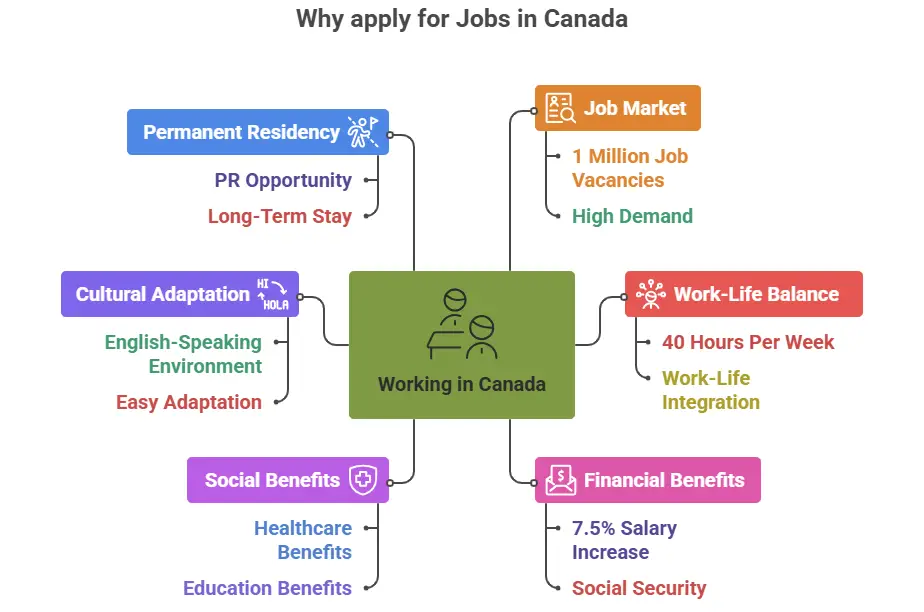
People across the globe including Indians are interested in living in Canada because of its luxurious lifestyle, unmatched beauty, income in dollars, and other such benefits. But before you decide to move to Canada. Here are the benefits of working in Canada:
- Over 495,000 job vacancies in Canada (Q4 2025)
- Work only for 40 hours per week
- Average hourly wages growing at 3.7% year-on-year (June 2026)
- Healthcare and education benefits for families.
- Enjoy social security benefits
- English-speaking environment, easy for Indians to adapt.
- Opportunity to apply for Permanent Residency (PR) after working.
Highest Paying Jobs in Canada for Indians
Canada offers good salaries in many high-demand industries. How much you earn depends on your job, the province you work in, your experience, your employer, and your qualifications. To check the latest and most accurate salary information, use the Government of Canada's Job Bank. It provides official salary data, including low, median, and high wages for different occupations across Canada.
The table below provides indicative annual salary ranges for major sectors based on official labour market data and current market trends.
| Occupation / Sector | Typical Annual Salary (CAD) | Typical Annual Salary (INR) |
|---|---|---|
| Engineering | CAD 75,000 – 120,000 | ₹46–74 lakh |
| Information Technology | CAD 80,000 – 130,000 | ₹49–80 lakh |
| Healthcare | CAD 75,000 – 140,000 | ₹46–86 lakh |
| Marketing & Sales | CAD 60,000 – 110,000 | ₹37–68 lakh |
| Banking & Finance | CAD 70,000 – 120,000 | ₹43–74 lakh |
| Nursing | CAD 70,000 – 110,000 | ₹43–68 lakh |
| Education | CAD 60,000 – 100,000 | ₹37–62 lakh |
| Accounting | CAD 65,000 – 110,000 | ₹40–68 lakh |
| Hospitality | CAD 45,000 – 80,000 | ₹28–49 lakh |
| Skilled Trades | CAD 60,000 – 110,000 | ₹37–68 lakh |
Read more...
What are the most in-demand Jobs in Canada for next 10 years?
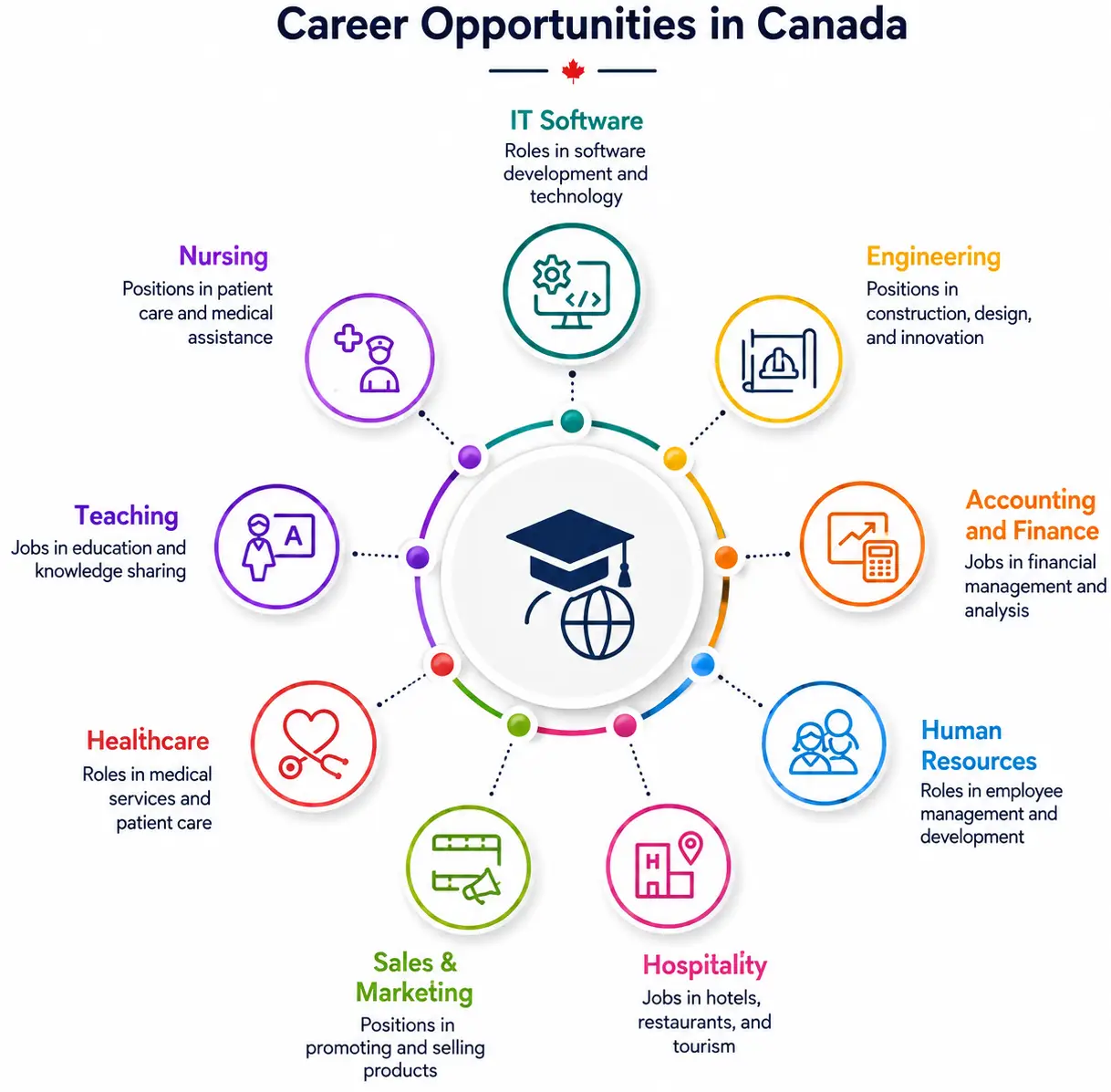
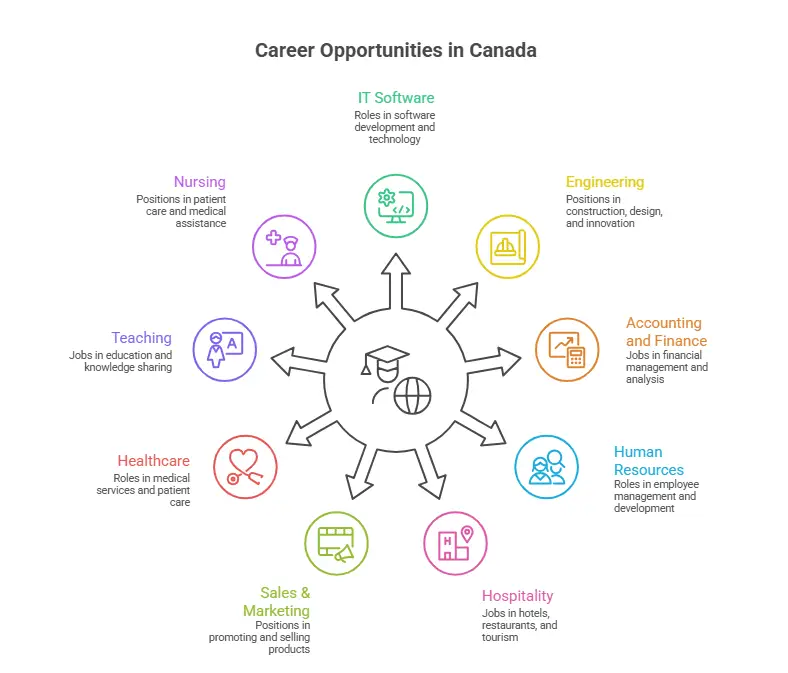
Number of Job Opportunities in Canada by 2030
With strong economic growth, there are many job vacancies in Canada for Indian professionals in key sectors such as IT, healthcare, and finance. As the demand for skilled professions continues to grow, Canada is expected to create thousands of new jobs by 2030 in those sectors.
| Occupation | Number of Jobs |
|---|---|
| Healthcare | 248,000 |
| Accounting & Finance | 163,000 |
| Engineering | 100,000 |
| IT & Software | 95,000 |
| Hospitality | 90,000 |
| Marketing & Sales | 85,200 |
| Teaching | 80,000 |
| Nursing | 67,495 |
| Human Resources & Management | 64,300 |
Willing to work in Canada? Y-Axis is here to provide complete assistance!
National Average Salary in Canada
The average salary in Canada is around CAD 70,000 per year. However, your salary depends on your job, work experience, industry, and the province where you work. According to Statistics Canada, wages have continued to increase across many industries in recent years.
Professionals working in healthcare, IT, engineering, finance, and management usually earn more than the national average. Jobs in hospitality, retail, and other entry-level service industries generally offer lower salaries.
Provincial Salary Differences
Salaries vary across Canada's provinces and territories.
- Alberta offers some of the highest salaries, especially in the energy, engineering, and construction sectors.
- Ontario has good salary opportunities in finance, IT, healthcare, and consulting.
- British Columbia pays competitive salaries, particularly in IT and healthcare, but the cost of living is also higher.
- Quebec generally offers slightly lower salaries, but the cost of living is more affordable.
- Atlantic provinces usually have lower average salaries, but there is strong demand for workers in healthcare, skilled trades, and education.
Read about....
Top Careers in Canada for Indians
IT Jobs in Canada
Canada's IT industry is one of the fastest-growing sectors, offering excellent career opportunities for skilled professionals. Software engineers, developers, AI specialists, cybersecurity experts, and data scientists are in high demand across the country. The table below highlights the major IT occupations, their NOC codes, TEER levels, and average salary ranges in Canada.
| Category | Details |
|---|---|
| Primary Occupations | Software Engineer, Software Developer, Cloud Engineer, AI Engineer, Cybersecurity Specialist, DevOps Engineer, Data Scientist |
| NOC & TEER |
Software Engineer: NOC 21231 (TEER 1) Software Developer: NOC 21232 (TEER 1) Data Scientist: NOC 21211 (TEER 1) Cybersecurity Specialist: NOC 21220 (TEER 1) |
| Entry-Level Salary | CAD 65,000–80,000 per year |
| Mid-Level Salary | CAD 85,000–110,000 per year |
| Experienced Salary | CAD 115,000–150,000+ per year |
Looking for IT jobs in Canada? Y-Axis is here to provide complete assistance
Engineering Jobs in Canada
Canada has a strong demand for engineering professionals across industries such as infrastructure, construction, transportation, renewable energy, manufacturing, and mining. Civil, mechanical, and electrical engineers are among the most sought-after professionals, offering competitive salaries and excellent career growth opportunities.
| Category | Details |
|---|---|
| Major Engineering Jobs | Civil Engineering, Mechanical Engineering, Electrical Engineering, Industrial Engineering, Mining Engineering, Chemical Engineering |
| NOC & TEER |
Civil Engineer: NOC 21300 (TEER 1) Mechanical Engineer: NOC 21301 (TEER 1) Electrical Engineer: NOC 21310 (TEER 1) |
| Entry-Level Salary | CAD 60,000–80,000 per year |
| Average Salary | CAD 85,000–105,000 per year |
| Experienced Salary | CAD 120,000–150,000+ per year |
Looking for engineering jobs in Canada? Y-Axis is here to provide personalized guidance!
Accounting and Finance Jobs in Canada
Canada's banking and finance sector offers excellent career opportunities for skilled professionals. Occupations such as accountants, financial analysts, auditors, and investment analysts are in high demand, especially in major cities like Toronto, Vancouver, Calgary, and Montréal. These roles provide competitive salaries, stable employment, and good career growth.
| Category | Details |
|---|---|
| Popular Roles | Chartered Professional Accountant (CPA), Financial Analyst, Auditor, Investment Analyst, Financial Controller |
| NOC & TEER |
Accountant: NOC 11100 (TEER 1) |
| High-Demand Provinces | Ontario, British Columbia, Alberta |
| Entry-Level Salary | CAD 60,000–70,000 per year |
| Average Salary | CAD 80,000–100,000 per year |
| Experienced Salary | CAD 120,000–170,000 per year |
Looking for finance jobs in Canada? Y-Axis is here to provide complete assistance!
Human Resources Management Jobs in Canada
Human Resources (HR) professionals play an important role in managing recruitment, employee relations, training, and workplace policies. HR managers, recruiters, and compensation specialists are in demand across Canada as businesses continue to expand and build skilled workforces.
| Category | Details |
|---|---|
| Popular Positions | HR Generalist, HR Business Partner, HR Manager, Recruitment Specialist, Compensation Consultant |
| NOC & TEER |
Human Resources Manager: NOC 10011 (TEER 0) |
| Job Outlook | Organizations across Canada require HR professionals to manage recruitment, employee engagement, workforce planning, training, and compliance with workplace regulations. |
| Entry-Level Salary | CAD 55,000–70,000 per year |
| Average Salary | CAD 80,000–100,000 per year |
| Experienced Salary | CAD 120,000–160,000 per year |
Looking for HR jobs in Canada? Y-Axis is here to provide complete assistance.
Hospitality Jobs in Canada
Canada's hospitality industry continues to grow with the rise in tourism and international travel. Hotels, restaurants, resorts, and event management companies are hiring skilled professionals for a variety of roles. Hospitality careers offer good job opportunities, career growth, and competitive salaries across several provinces.
| Category | Details |
|---|---|
| Popular Positions | Hotel Manager, Restaurant Manager, Chef, Food Service Supervisor, Event Manager |
| NOC & TEER |
Restaurant Manager: NOC 60030 (TEER 0) Chef: NOC 62200 (TEER 2) |
| Job Outlook | Canada's hospitality sector is recovering steadily, creating strong demand for professionals in hotels, restaurants, tourism, and event management. |
| High-Demand Provinces | British Columbia, Ontario, Alberta |
| Entry-Level Salary | CAD 40,000–50,000 per year |
| Average Salary | CAD 55,000–70,000 per year |
| Experienced Salary | CAD 80,000–100,000 per year |
Looking for hospitality jobs in Canada? Y-Axis is here to provide personalized assistance!
Sales & Marketing Jobs in Canada
Sales and marketing professionals are in demand across many industries in Canada, including technology, retail, healthcare, and financial services. Roles such as marketing managers, sales managers, digital marketing specialists, and business development managers offer excellent career growth and competitive salaries.
| Category | Details |
|---|---|
| Popular Careers | Marketing Manager, Sales Manager, Digital Marketing Specialist, Brand Manager, Business Development Manager |
| Growing Industries | Technology, Retail, Healthcare, Financial Services |
| Entry-Level Salary | CAD 50,000–65,000 per year |
| Average Salary | CAD 70,000–90,000 per year |
| Experienced Salary | CAD 110,000–140,000 per year |
Looking for sales and marketing jobs in Canada? Y-Axis is here to provide complete assistance
Healthcare Jobs in Canada
Healthcare is one of Canada's fastest-growing and most in-demand sectors due to an ageing population and the increasing need for medical services. Professionals such as nurses, physicians, pharmacists, physiotherapists, and medical laboratory technologists have excellent career opportunities and are among the priority occupations for Canadian immigration.
| Category | Details |
|---|---|
| Major Occupations | Registered Nurse, Physician, Pharmacist, Physiotherapist, Medical Laboratory Technologist, Social Worker |
| NOC & TEER |
Registered Nurse: NOC 31301 (TEER 1) Licensed Practical Nurse: NOC 32101 (TEER 2) Physician: NOC 31100 (TEER 1) Pharmacist: NOC 31120 (TEER 1) Physiotherapist: NOC 31202 (TEER 1) Social Worker: NOC 41300 (TEER 1) |
| Entry-Level Salary | CAD 65,000–80,000 per year |
| Average Salary | CAD 90,000–120,000 per year |
| Experienced Salary | CAD 150,000+ per year (depending on the occupation) |
Looking for healthcare jobs in Canada? Y-Axis is here to provide complete assistance.
Teaching Jobs in Canada
Canada continues to hire qualified teachers to meet the growing demand in schools across the country. Teachers with expertise in mathematics, science, French, special education, and early childhood education have strong job opportunities and competitive salaries.
| Category | Details |
|---|---|
| Popular Teaching Fields | Mathematics, Science, French, Special Education, Early Childhood Education |
| NOC & TEER |
Secondary School Teacher: NOC 41220 (TEER 1) Elementary School Teacher: NOC 41221 (TEER 1) Early Childhood Educator: NOC 42202 (TEER 2) |
| Entry-Level Salary | CAD 55,000–70,000 per year |
| Average Salary | CAD 70,000–90,000 per year |
| Experienced Salary | CAD 100,000–120,000 per year |
Looking for teaching jobs in Canada? Y-Axis is here to provide complete assistance!
Nursing Jobs in Canada
Registered Nurses are among the most in-demand healthcare professionals in Canada. Due to ongoing labour shortages, nurses have excellent employment opportunities, competitive salaries, and multiple pathways to work and settle permanently in Canada.
| Category | Details |
|---|---|
| Popular Occupations | Registered Nurse, Licensed Practical Nurse |
| NOC & TEER |
Registered Nurse: NOC 31301 (TEER 1) Licensed Practical Nurse: NOC 32101 (TEER 2) |
| Job Outlook | Nurses continue to be one of Canada's highest-priority occupations and are in strong demand across hospitals, clinics, long-term care facilities, and community healthcare services. |
| Immigration Benefits | Eligible for Express Entry category-based selection, Provincial Nominee Programs (PNPs), strong employment demand, and faster immigration opportunities in many provinces. |
| Entry-Level Salary | CAD 65,000–80,000 per year |
| Average Salary | CAD 85,000–105,000 per year |
| Experienced Salary | CAD 110,000–130,000+ per year |
Searching for Nursing jobs in Canada? Y-Axis is here to provide complete assistance!
Express Entry Category-Based Selection for High-Demand Occupations
Canada's Express Entry system is one of the fastest ways for skilled workers to become permanent residents. In 2026, Immigration, Refugees and Citizenship Canada (IRCC) continued to invite professionals working in occupations that are in high demand across the country. Through category-based selection, candidates in priority occupations have a better chance of receiving an Invitation to Apply (ITA) for permanent residence, even if their Comprehensive Ranking System (CRS) score is lower than the general draw cut-off.
Express Entry Priority Categories
The table below shows the priority categories under Canada's Express Entry category-based selection and their purpose.
| Category | Purpose |
|---|---|
| Healthcare & Social Services | Fill labour shortages in healthcare and social service occupations. |
| STEM (Science, Technology, Engineering and Mathematics) | Support Canada's growing technology and innovation sectors. |
| Skilled Trades | Meet the demand for workers in construction, manufacturing, and industrial trades. |
| Education | Recruit qualified teachers and early childhood educators. |
| French-language Proficiency | Encourage more French-speaking immigrants to settle outside Quebec. |
| Transport | Recruit professionals for transport-related occupations. |
| Physicians with Canadian Work Experience* | Invite eligible physicians with Canadian work experience. |
| Senior Managers with Canadian Work Experience* | Support experienced senior managers working in Canada. |
| Researchers with Canadian Work Experience* | Attract researchers contributing to Canada's innovation and research sectors. |
| Skilled Military Recruits* | Support eligible military recruits with the required skills. |
Note: These categories require Canadian work experience as a specific eligibility condition, in addition to meeting general Express Entry criteria.
NOC and TEER
Canada uses the National Occupational Classification (NOC) 2021 system to group different occupations. Every job in Canada has:
- A 5-digit NOC code
- A TEER (Training, Education, Experience and Responsibilities) level
The table below explains the different TEER categories.
| TEER Level | Description |
|---|---|
| TEER 0 | Management jobs |
| TEER 1 | Professional jobs that usually require a university degree |
| TEER 2 | Technical jobs that usually require a college diploma or apprenticeship training |
| TEER 3 | Jobs that require shorter college education, apprenticeship, or job-specific training |
| TEER 4 | Jobs that usually require a high school education and some job-specific training |
| TEER 5 | Jobs that need short-term training and little formal education |
Most Express Entry programs accept occupations under TEER 0, TEER 1, TEER 2, and TEER 3, depending on the immigration program and eligibility requirements.
How to Find Your NOC Code
Your eligibility for Canadian immigration depends on the work you do every day, not just your job title. It is important to choose the correct NOC code before applying.
Follow these steps to find your NOC code:
Step 1: Search for your occupation using the Government of Canada's NOC Finder.
Step 2: Read the job description and main duties carefully.
Step 3: Make sure your work experience matches most of the listed duties.
Step 4: Check the TEER level before creating your Express Entry profile or applying for a work permit.
How can Indians get Jobs in Canada?
Indians looking for a job in Canada can apply online through trusted portals, company websites, and recruiting agencies. Following the right steps can increase your chances of getting hired.
The step by step process to apply for jobs in Canada are listed below:
Step 1: Check Your Eligibility
Step 2: Prepare a Canadian-Style Resume and Cover Letter
Step 3: Search for Jobs Online on trusted job portals, company career pages and take help from recruiting agencies.
Step 4: Submit your applications to positions that match your skills and qualifications.
Step 5: Attend Interviews with Canadian companies and showcase your skills effectively.
Step 6: Once selected, you receive a job offer from a Canadian employer, and you can start your journey to work in Canada.
Want to apply for jobs in Canada? Avail Y-Axis Resume marketing services to find the right one.
How can Indians move to Canada on a Work Permit?
Indians can move to Canada on a Work Permit by getting a valid job offer from a Canadian employer. Once the employer provides a job offer and, if needed, a Labour Market Impact Assessment (LMIA), applicants can apply for a work permit online. After approval, they can travel to Canada and start working legally.
Canada Work Permit Application Process
A Canada Work Permit allows foreign nationals to work legally in Canada for a specific employer, occupation, and duration. International workers willing to work in Canada temporarily must obtain a work permit. Candidates wishing to work in Canada permanently must apply for a Canada PR visa. Aspirants must apply through the Temporary Foreign Workers Program (TFWP) and International Mobility Program for a temporary work visa.
Canadian employers require Labour Market Impact Assessment (LMIA) documents to invite foreign nationals through the TFWP. No LMIA is required for IMP Candidates wanting to get a Canada PR to migrate to Canada. However, they must apply through Express Entry or the Provincial Nominee Program.
Types of Canada work visa
Canada has two types of work visas through which candidates can apply to work there. They are:
1. Employer-specific Work Permit
An employer-specific work permit allows you to work according to certain conditions specified by your employer.
2. Open Work Permit
Open work permits consist of two sub-categories, which are:
- Unrestricted work permits: These permits allow applicants to work in any part of Canada and with employers of their choice. A restricted work permit allows the applicants to work for specific employers, which restricts their freedom of movement.
- Restricted work permits: A restricted work permit will let the candidates work for only specific employers; this restricts their freedom of movement.
List of few Open Canada work permits:
- Temporary Work Permits for Partners
- Temporary Resident Permit
- Post-Graduation Work Permit
- World Youth Program Permit
- Bridging Open Work Permit
- Regular Open Work Permit
- Atlantic Immigration Program (AIP) Spousal Permit
The list of programs for which Canada open work permits can be used:
- Working Holiday Visa
- Young Professionals Visa
- International Experience Canada
- Federal Skilled Worker Program
- Canadian Experience Class
- Federal Skilled Trades Program
- Provincial Nominee Program
- International Co-Op Program
Canada Work Permit Requirements
To apply for a Canada Work Permit, you need the following requirements:
- A valid passport
- Relevant experience in the field of the job you are applying for.
- A valid job offers from a company in Canada.
- Proof of sufficient funds to support yourself
- Medical Insurance.
- Police Clearance Certificate.
- You should follow all rules and laws while in Canada.
- Proof you will exit Canada once your work permit expires.
Read more...
What are the minimum requirements to get jobs in Canada?
Canada Work Visa for On-Shore Candidates
On-shore applicants are those who are already living in Canada on a study, work, or visitor permit. The eligibility criteria for candidates who apply from within Canada are as follows:
- Candidates must have work or study permits.
- The spouse/ common-law partner or parents must have valid study or work permits.
- For the post-graduation work permit (PGWP), the study permit of candidates should still be valid.
- Candidates must have a temporary work permit with a minimum validity of six months.
- Candidates must wait for Canada PR visas to be processed.
- Applicants need to be recognized as current refugees or protected persons by IRCC.
- Candidates can also work in Canada even without a work permit. However, they must apply for work visas to switch jobs.
Canada Work Visa for Off-Shore Candidates
Off-shore applicants are those who are living outside Canada and want to apply for a work visa before entering the country.
The eligibility criteria for candidates who apply from outside Canada are as follows:
- Candidates must meet the requirements based on the country of their origin when migrating to Canada.
- Candidates must apply for a work visa before they plan to enter Canada
- Candidates may also apply for work permits after arriving in Canada if
- They are sanctioned electronic authorizations
- Candidates need to meet other requirements, depending on the type of work permit for which they have applied.
Steps to apply for a Canada Work Permit
- Step 1: Check if you meet all the eligibility rules for a Canada Work Permit.
- Step 2: Calculate your points based on your education, work experience, and other factors.
- Step 3: Create a profile and apply online through the Express Entry portal.
- Step 4: If you get an Invitation to Apply (ITA), submit your full application with documents and fees.
- Step 5: Wait for approval from IRCC and get your work permit or PR.
How Y-Axis Helps You to Work in Canada?
Y-Axis, a leading immigration consultancy, offers honest and reliable services to help you achieve your goals. Our main services for Canada include:
- Free eligibility check through Canada Immigration Points Calculator
- Resume Marketing services to find related jobs in Canada
- Resume writing, marketing, LinkedIn marketing, and resume zapping to make your profile stand out to top Canadian employers and improve your chances of getting jobs.
- Expert guidance/consultation for Canada Immigration
- Coaching services: Expert CELPIP coaching, IELTS proficiency Coaching
- Free career counselling; book your slot today
- Complete guidance while applying for a Canada PR visa
Y-Axis snapshot
1M
Successful applicants
1500+
Experienced counselors
25Y+
Expertise
50+
Offices
Don't know what to do ?
Get Free Counseling
Looking for Inspiration
Explore what Global Indians have to say about Y-Axis in shaping their future