


Don't know what to do ?
Get Free Counseling
Last Updated: 20-Aug-2026
Masters in Italy: Top Universities, Courses, Fees, Eligibility & More
Italy is one of the top destinations in Europe for international students. According to QS 2025, Italy ranks 10th globally for international student enrollment and offers 500+ English-taught Master's (Laurea Magistrale) programs. Public universities have affordable tuition fees ranging from €900–€4,000 per year (approximately ₹81,000–₹3.6 lakhs). Through the ISEE Parificato income assessment, eligible Indian families may qualify for very low or even near-zero tuition fees. Whether you want to study MS in Italy in engineering, data science, computer science, or pursue an MBA at Bocconi University, Italy provides high-quality education at a much lower cost than many universities in the UK or the USA.
More than 6,000 Indian students studied in Italy during 2024–25, and the number continues to grow every year. A Master's degree in Italy, officially known as a Laurea Magistrale, is recognised across the European Union and in many countries worldwide. After graduation, international students can apply for a 12-month job-search residence permit. In addition, Italy has announced nearly 500,000 work visas for 2026–2028, creating excellent career opportunities for graduates who want to build their future in Italy.
Below are the quick facts for Master in Italy 2026:
| Detail | Information |
|---|---|
| Programs Available | 500+ English-taught Master's (Laurea Magistrale) programs at public and private universities |
| Duration | 2 years (120 ECTS credits) |
| Fees – Public Universities | €900–€4,000 per year (approximately ₹81,000–₹3.6 lakhs at ₹90/€) |
| ISEE Parificato Benefit | Eligible Indian families (annual income below ₹22–25 lakhs) may qualify for very low or near-zero tuition fees |
| Top Universities | Politecnico di Milano (QS #98), Sapienza University of Rome (QS #128), University of Bologna (QS #138) |
| Best Scholarships | MAECI: Monthly stipend + full tuition waiverIYT (Invest Your Talent in Italy): €1,000/month stipend + internship opportunity |
| Main Intake | September (around 80% of Master's programs) |
| Secondary Intake | February (limited programs) |
| Application Window | November 2025 – January 2026 (for September 2026 intake) |
| Visa Type | Italy Type-D National Student Visa (processing time: 90–120 days) |
| Post-Study Stay | 12-month job-search residence permit after graduation |
*Are you looking to study in Italy? Y-Axis is here to guide you through the entire process!
Why Study a Masters in Italy?
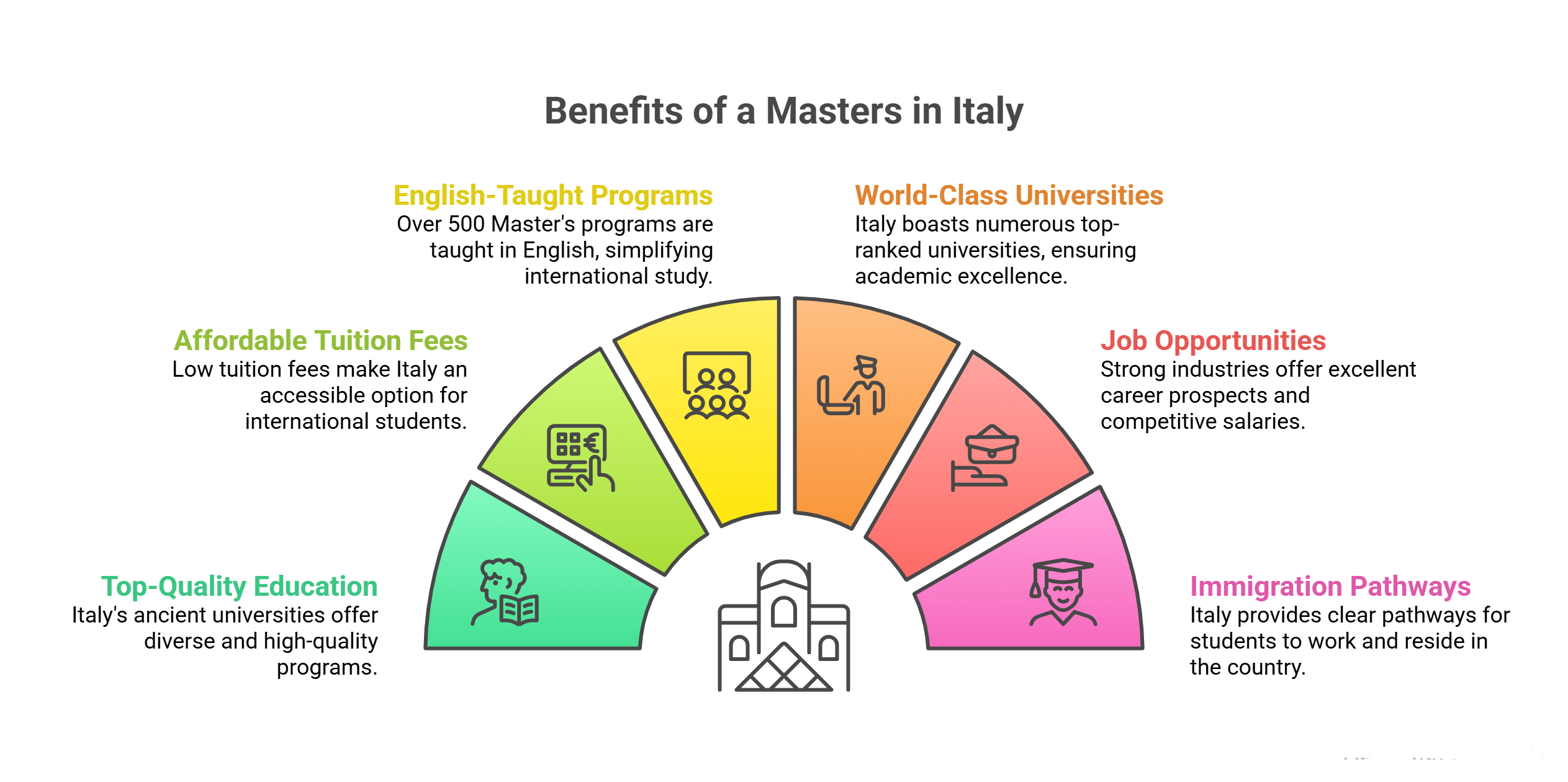
- Top-Quality Education: Italy has some of the oldest and most famous universities in the world. University of Bologna is the oldest university still active today. Students can choose from many courses like engineering, science, design, business, arts, and humanities.
- Affordable Tuition Fees: Public universities in Italy have low fees, usually between €900 and €4,000 per year. This is much cheaper than countries like the USA or UK. In many cases, fees depend on your family income, so some students may pay very low fees or even study for free.
- English-Taught Programs: Italy offers more than 500 Master’s programs in English. This helps international students study easily without needing to learn Italian.
- World-Class Universities: Italy has many top-ranked universities. Over 40 universities are listed in QS World Rankings, and more than 50 are in global rankings, showing strong education quality.
- Job Opportunities and Career Growth: Italy has strong industries like manufacturing, fashion, design, healthcare, IT, and engineering. After completing a Master’s degree, students can find good job opportunities. Salaries usually range from €30,000 to €80,000 per year, depending on the field.
- Immigration Pathways: After finishing a Master’s degree, students can stay in Italy for up to 12 months to search for a job. Once they get a job, they can apply for a work visa. After living and working for 5 years, they can apply for Permanent Residency. Highly skilled workers can also apply for the EU Blue Card, which can lead to PR faster (around 3 years).
What Is Laurea Magistrale?
Laurea Magistrale is Italy's official 2-year postgraduate degree and is equivalent to an international Master's degree. It requires 120 ECTS credits and is recognised across Italy, the European Union (EU), and many countries worldwide. When Italian universities advertise English-taught Master's programs, they are usually referring to Laurea Magistrale degrees.
A Laurea Magistrale is different from a Master universitario (Master's course), which is usually a 1-year professional programme and is not equivalent to an official Master's degree. Students who want to build an international career or continue with a PhD should choose a Laurea Magistrale.
The degree is recognised by CIMEA, Italy's official organisation for evaluating academic qualifications, making it easier for graduates to pursue higher education or employment in Italy and other countries.
If you are searching online for "MS in Italy" or "Master's in Italy," both terms generally refer to Laurea Magistrale programmes offered by Italian universities.
Top Universities for Masters Programs in Italy
Italy has many well-known universities that offer high-quality education. These universities provide excellent Master’s programs in fields like engineering, technology, business, design, medicine, and arts. Many Italian universities are also ranked among the top universities in the world.
One big advantage of studying in Italy is the low cost of education. Public universities charge affordable fees, and students from low-income families may even get full fee waivers. This makes Italy a great option for international students who want a good education at a lower cost.
Below is a list of some top universities in Italy for Master’s programs, along with their rankings and average yearly fees.
| University | QS World University Rankings 2026 | Average Tuition Fee/Year (EUR) | Average Tuition Fee/Year (Approx. INR*) |
|---|---|---|---|
| Politecnico di Milano | 98 | €3,000–€4,000 | ₹2.7–₹3.6 lakhs |
| Sapienza University of Rome | 128 | €800–€1,000 | ₹72,000–₹90,000 |
| University of Bologna | 138 | €2,000–€3,000 | ₹1.8–₹2.7 lakhs |
| University of Padua | 234 | €1,200–€2,800 | ₹1.08–₹2.52 lakhs |
| Politecnico di Torino | 315 | €2,000–€4,000 | ₹1.8–₹3.6 lakhs |
| University of Milan | 301 | €1,500–€3,000 | ₹1.35–₹2.7 lakhs |
| University of Pisa | 343 | €1,000–€2,000 | ₹90,000–₹1.8 lakhs |
| University of Rome Tor Vergata | 355 | No tuition fee (for eligible students under fee-waiver schemes) | ₹0 (eligible students) |
| University of Turin | 402 | €1,500–€3,000 | ₹1.35–₹2.7 lakhs |
| University of Florence | 404 | €900–€2,000 | ₹81,000–₹1.8 lakhs |
Top 10 Universities for Engineering and Technology in Italy
Italy is well known for its strong education in engineering and technology. Many universities offer advanced courses in areas like mechanical engineering, civil engineering, computer science, and robotics. These universities have modern labs, research facilities, and good industry connections, which help students get better job opportunities after graduation.
| University | QS World University Ranking 2026 | Average Tuition Fee/Year (EUR) | Average Tuition Fee/Year (Approx. INR*) |
|---|---|---|---|
| Politecnico di Milano | 98 | €3,000–€4,000 | ₹2.7–₹3.6 lakhs |
| Sapienza University of Rome | 128 | €800–€1,500 | ₹72,000–₹1.35 lakhs |
| University of Bologna | 138 | €2,000–€3,000 | ₹1.8–₹2.7 lakhs |
| University of Padua | 234 | €1,500–€2,800 | ₹1.35–₹2.52 lakhs |
| University of Milan | 301 | €1,500–€3,000 | ₹1.35–₹2.7 lakhs |
| Politecnico di Torino | 315 | €2,000–€4,000 | ₹1.8–₹3.6 lakhs |
| University of Florence | 404 | €900–€2,000 | ₹81,000–₹1.8 lakhs |
| University of Naples Federico II | 551–600 | €1,000–€2,500 | ₹90,000–₹2.25 lakhs |
| Scuola Superiore Sant'Anna Pisa | Top Research University | €1,000–€3,000 | ₹90,000–₹2.7 lakhs |
| University of Genova | 601–650 | €900–€2,000 | ₹81,000–₹1.8 lakhs |
Top 10 Universities for Business and Management in Italy
Italy is a great place to study business and management, especially because of its strong industries in finance, fashion, and international trade. Many universities offer MBA and management courses with global recognition. Students also get chances for internships and networking with top companies.
| University | QS World Ranking 2026 | Average Tuition Fee/Year (EUR) | Average Tuition Fee/Year (Approx. INR*) |
|---|---|---|---|
| Politecnico di Milano (Design) | 98 | €3,000–€4,000 | ₹2.7–₹3.6 lakhs |
| Sapienza University of Rome | 128 | €800–€1,500 | ₹72,000–₹1.35 lakhs |
| University of Bologna | 138 | €2,000–€3,000 | ₹1.8–₹2.7 lakhs |
| University of Padua | 234 | €1,500–€2,800 | ₹1.35–₹2.52 lakhs |
| University of Milan | 301 | €1,500–€3,000 | ₹1.35–₹2.7 lakhs |
| University of Trento | 401–450 | €1,500–€3,000 | ₹1.35–₹2.7 lakhs |
| University of Florence | 501–600 | €900–€2,000 | ₹81,000–₹1.8 lakhs |
| Ca' Foscari University of Venice | 501–600 | €1,500–€3,000 | ₹1.35–₹2.7 lakhs |
| University of Pavia | 601–650 | €1,000–€4,500 | ₹90,000–₹4.05 lakhs |
| Scuola Normale Superiore Pisa | Top Research University | No tuition fee | ₹0 (for eligible students) |
*Want to pursue MBA in Italy? Contact Y-Axis for end-to-end
Top 10 Universities for Arts, Design and Humanities in Italy
Italy is famous worldwide for its art, culture, and design. It is one of the best countries to study subjects like fashion, architecture, fine arts, and humanities. Students get practical exposure, creative learning, and opportunities in global industries like fashion and design.
| University | QS World Ranking 2026 | Average Tuition Fee/Year (EUR) | Average Tuition Fee/Year (Approx. INR*) |
|---|---|---|---|
| Politecnico di Milano (Design) | 98 | €3,000–€4,000 | ₹2.7–₹3.6 lakhs |
| Sapienza University of Rome | 128 | €800–€1,500 | ₹72,000–₹1.35 lakhs |
| University of Bologna | 138 | €2,000–€3,000 | ₹1.8–₹2.7 lakhs |
| University of Padua | 234 | €1,500–€2,800 | ₹1.35–₹2.52 lakhs |
| University of Milan | 301 | €1,500–€3,000 | ₹1.35–₹2.7 lakhs |
| University of Trento | 401–450 | €1,500–€3,000 | ₹1.35–₹2.7 lakhs |
| University of Florence | 501–600 | €900–€2,000 | ₹81,000–₹1.8 lakhs |
| Ca' Foscari University of Venice | 501–600 | €1,500–€3,000 | ₹1.35–₹2.7 lakhs |
| University of Pavia | 601–650 | €1,000–€4,500 | ₹90,000–₹4.05 lakhs |
| Scuola Normale Superiore Pisa | Top Research University | No tuition fee | ₹0 (for eligible students) |
Top MS Specializations in Italy
Italy is well known for its design, engineering, fashion, business, and technology education. Many students choose Italy for their Masters because the country offers industry-focused programs, strong research opportunities, and good career options after graduation. Most Masters programs in Italy are 2 years long.
Today, fields like Artificial Intelligence, Data Science, Fashion, Mechanical Engineering, and Architecture are highly in demand. Italy has a strong job market in automotive, design, IT, fashion, healthcare, and manufacturing. Choosing the right specialization can improve your chances of getting a good job after completing your Masters.
|
MS Specialization |
Universities Offering the Course |
Duration |
Tuition Fee (EUR per year) |
|
Artificial Intelligence & Machine Learning |
Politecnico di Milano, University of Bologna, Sapienza |
2 years |
€0 – €4,000 |
|
Data Science & Analytics |
University of Milan, Bocconi, University of Padua |
2 years |
€0 – €3,000 |
|
Computer Science & IT |
Politecnico di Milano, Sapienza, University of Bologna |
2 years |
€0 – €4,000 |
|
Mechanical Engineering |
Politecnico di Milano, Politecnico di Torino, University of Bologna |
2 years |
€2,000 – €4,000 |
|
Fashion & Design |
Politecnico di Milano, Bocconi, Domus Academy |
2 years |
€4,000 – €14,000 |
|
Electrical & Electronic Engineering |
Politecnico di Milano, University of Padua, University of Naples |
2 years |
€2,000 – €4,000 |
|
Architecture & Urban Design |
Politecnico di Milano, Politecnico di Torino, Sapienza |
2 years |
€3,000 – €4,500 |
|
Business Administration & Finance |
Bocconi, LUISS, University of Bologna |
2 years |
€2,000 – €14,000 |
|
Renewable Energy & Environment |
Politecnico di Milano, University of Padua, University of Trento |
2 years |
€2,000 – €4,000 |
|
Food Science & Agriculture |
University of Bologna, University of Milan, University of Naples |
2 years |
€1,000 – €3,000 |
*Confused about which course to pursue? Avail Y-Axis course recommendation services to choose the best.
Cost of studying a Masters in Italy for Indian Students
Italy is one of the most affordable countries in the world to study a Masters degree. Most public universities charge very low fees, so the total cost of doing a Masters in Italy is much lower compared to the USA, UK, or Australia. On average, The total yearly cost for a Masters in Italy ranges between ₹7.2 lakhs and ₹31.5 lakhs, depending on the university, tuition fees, and living expenses., depending on whether you choose a public or private university. Private universities usually charge between €6,000 and €20,000 per year. In addition to tuition fees, students should plan for living expenses, which usually cost around €700–€1,200 per month. The overall cost can be higher in cities like Milan and Rome because rent and living costs are more expensive there.
Tuition Fees for International Students
- Most public universities in Italy charge between €900 and €4,000 per year for Masters programs.
- Fees are often calculated based on family income (the ISEE system). Students from lower-income families may pay very little or even nothing.
- Some top research universities like Scuola Normale Superiore charge no tuition fees at all.
- Private universities charge full tuition fees, usually between €6,000 and €20,000 per year.
- Some elite business schools like Bocconi can charge up to €40,000 or more for MBA programs.
- Public universities remain the most affordable option for international students in Italy.
Living Costs in Major Cities in Italy
| City | Avg. Monthly Rent (EUR) | Avg. Monthly Food (EUR) | Est. Monthly Living Cost (EUR) |
|---|---|---|---|
| Rome | €500 – €800 | €150 – €250 | €1,000 – €1,400 |
| Milan | €700 – €1,100 | €200 – €350 | €1,200 – €1,800 |
| Bologna | €400 – €650 | €150 – €250 | €900 – €1,200 |
| Florence | €450 – €700 | €150 – €250 | €950 – €1,250 |
| Padua / Trento / Pisa | €350 – €550 | €130 – €200 | €750 – €1,000 |
Total Cost of Studying a Masters in Italy
It is important for students to understand the full cost before planning to study in Italy. Even though public universities charge very low fees, students still need to budget for living expenses, accommodation, health insurance, and other academic costs.
Estimated Yearly Cost for a Masters in Italy:
- Tuition Fees (Public): €0 – €4,000 per year (₹0 – ₹3.6 lakhs)
- Tuition Fees (Private): €6,000 – €20,000 per year (₹5.4 – ₹18 lakhs)
- Living Expenses: €7,500 – €14,000 per year (₹6.7 – ₹12.6 lakhs)
- Health Insurance: €200 – €500 per year (₹18,000 – ₹45,000)
For Indian students, the overall yearly cost of studying a Masters in Italy generally falls within:
- €7,700 – €18,500 per year (₹6.9 – ₹16.7 lakhs) at public universities
- €14,000 – €35,000 per year (₹12.6 – ₹31.5 lakhs) at private universities
The final cost depends on the city you live in, your lifestyle, and your accommodation choice. Planning your budget carefully will help cover tuition, rent, food, transport, insurance, and other study-related expenses.
*Read more...
What Is ISEE Parificato for Indian Students?
ISEE Parificato is Italy's income assessment system for international (non-EU) students. It is used to calculate your family's financial situation based on your annual income and assets in India. Italian universities use this assessment to decide whether you qualify for reduced tuition fees, scholarships, and DSU regional grants.
For many Indian students, the ISEE Parificato system can significantly lower the cost of studying in Italy. Families with an annual income of around ₹22–25 lakhs or less may qualify for an ISEE value below €23,000–€26,000, which can provide 50–100% tuition fee reductions. Eligible students may also receive DSU regional scholarships worth up to €7,910 per year, along with benefits such as free or subsidised accommodation and meal allowances.
ISEE Parificato Income Thresholds & Fee Reduction for Indian Students
| ISEE Value | Approx. Annual Indian Family Income (INR) | Tuition Fee Reduction | DSU Grant Eligibility |
|---|---|---|---|
| €0–€13,000 | Below ₹11.7 lakhs/year | Up to 100% reduction (near-zero tuition) | Full DSU grant – up to €7,910/year, free or subsidised housing, and meal benefits |
| €13,000–€23,000 | ₹11.7–₹20.7 lakhs/year | 75–100% reduction | Partial DSU grant, cash allowance, and reduced housing costs |
| €23,000–€40,000 | ₹20.7–₹36 lakhs/year | 25–75% reduction | Partial DSU financial support |
| Above €40,000 | Above ₹36 lakhs/year | Standard tuition fees apply | Not eligible for DSU grants |
Scholarships for Studying Masters in Italy
Italy is one of the best countries to study a Masters degree because it offers many scholarships to help students reduce their financial burden. These scholarships help cover tuition fees, living expenses, travel costs, and health insurance. Many scholarships are funded by the Italian government, private universities, regional governments, and the European Union.
Students planning to study a Masters in Italy should carefully check the eligibility criteria, required documents, and deadlines before applying.
Below are some of the most popular scholarships for international students who want to pursue a Masters in Italy:
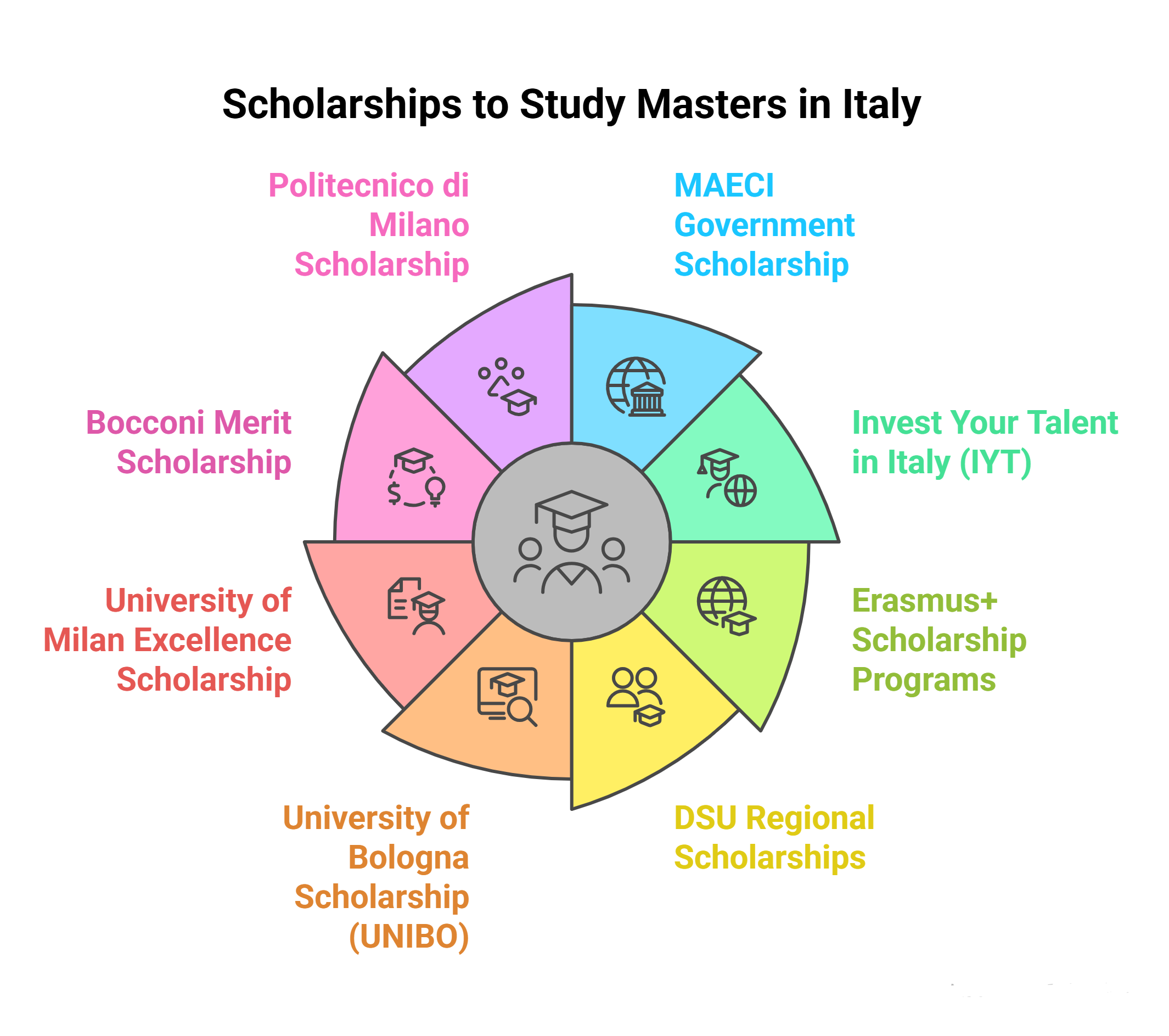
- MAECI Government Scholarship (Italy): Funded by the Italian Ministry of Foreign Affairs, this is one of the most popular scholarships for international students. It provides a monthly stipend of approximately €900, health insurance, and often a full tuition fee waiver. It is available for Masters, PhD, and research programs. Indian students must be under 28 years old to apply.
- Invest Your Talent in Italy (IYT): This special scholarship is designed for students from India and other selected countries. It supports Masters programs in Engineering, ICT, Architecture, Design, and Economics. It provides a monthly stipend of €900 and includes a mandatory 3-month internship at an Italian company, giving students both a degree and real work experience.
- Erasmus+ Scholarship Programs: Erasmus+ is a European Union program that gives financial support for tuition fees and living expenses. Some Masters programs allow students to study in multiple European countries, including Italy.
- DSU Regional Scholarships: These are need-based scholarships offered by Italian regional authorities. They can cover full tuition fee exemption, free meals, free housing, and an annual allowance of up to €5,200. Students from low-income families are eligible.
- University of Bologna Scholarship (UNIBO): The University of Bologna offers scholarships worth €6,500 along with tuition fee exemptions for outstanding international Masters students.
- University of Milan Excellence Scholarship: The University of Milan offers 60 fully funded scholarships worth €8,000 each, plus 100 full tuition fee exemptions for international students.
- Bocconi Merit Scholarship: Bocconi University offers merit-based scholarships for top-performing international students enrolling in English-taught Masters programs.
- Politecnico di Milano Scholarship: This scholarship covers tuition fees and provides financial support for outstanding international students in engineering and design programs.
*Also read.....
Eligibility Criteria for Indian Students to Apply for Masters in Italy
- A 3-year Bachelor's degree is required to apply for a Masters program.
- A minimum CGPA of 7.5/10 or 55–60% marks in your Bachelor's degree is generally expected by most universities.
- Students must submit 10th and 12th certificates as proof of previous education.
- A Statement of Purpose (SOP) is mandatory for admission.
- A Letter of Recommendation (LOR) is required by most universities.
- For English-taught programs, an IELTS score of at least 6.0–6.5 or TOEFL score of 85–100 is required. Some universities also accept a Medium of Instruction (MOI) letter from your previous university.
- For Italian-taught programs, students must have at least B2 level Italian language proficiency.
- Some business programs may require GMAT or GRE scores.
Documents Required for Indian Students to Study a Masters in Italy
Indian students must prepare the following documents while applying for a Masters program in Italy:
- Valid passport (valid for at least 3 months after course end date)
- Completed university application form
- 10th and 12th mark sheets and certificates (attested and apostilled by MEA)
- Bachelor's degree certificate and transcripts (apostilled)
- Statement of Purpose (SOP)
- Letter(s) of Recommendation (LOR)
- IELTS or TOEFL scorecard for English-taught programs
- Italian language certificate (B2 level), if the course is in Italian
- Updated CV/Resume
- Proof of financial resources (bank statement of at least ₹6–8 lakhs or equivalent)
- Declaration of Value (DOV), required for Indian students, issued by the Italian Consulate in India
- UNIVERSITALY pre-enrollment certificate, mandatory for all non-EU students
- Health insurance proof
- Passport-size photographs
What Is the Declaration of Value (DOV)?
The Declaration of Value (Dichiarazione di Valore - DOV) is an official document issued by the Italian Embassy or Consulate in India. It confirms that your Indian educational qualification is genuine and shows the level of your degree according to the Italian education system. Most non-EU students applying to Italian public universities need a DOV during the admission process.
The DOV helps Italian universities assess whether your qualification meets the entry requirements for a Master's programme. Without this document, your application may not be accepted unless the university allows an alternative qualification evaluation.
DOV Key Details for Indian Students
| Requirement | Details |
|---|---|
| Issued by | Italian Embassy in New Delhi or Italian Consulates in Mumbai, Chennai, or Kolkata |
| Purpose | Verifies the authenticity and academic level of your Indian degree for admission to Italian universities |
| Who needs it? | Most non-EU students applying to Italian public universities |
| Documents Required | Apostilled degree certificate, apostilled academic transcripts, passport copy, passport-size photographs, and completed application form |
| Processing Time | Approximately 4–8 weeks |
| Application Fee | Around €30–50 (approximately ₹2,700–₹4,500) |
| Official Website | Italian Embassy in India (ambaindia.esteri.it) |
How to Apply for Masters in Italy?
Step 1: Choose the Masters program and university you want to apply to.
Step 2: Check the eligibility requirements such as CGPA, language scores, and degree requirements.
Step 3: Take the required language test – IELTS, TOEFL, or Italian proficiency test if needed.
Step 4: Prepare all necessary documents like transcripts, degree certificate, SOP, LORs, CV, and passport copy.
Step 5: Get your academic documents apostilled by the Ministry of External Affairs (MEA) in India.
Step 6: Complete the mandatory pre-enrollment process on the UNIVERSITALY portal. This is required for all non-EU students applying to Italian universities.
Step 7: Fill out the online application form on the university website and pay the application fee if required.
Step 8: Wait for the admission offer letter from the university. Once selected, proceed with the student visa process.
When Are the Deadlines to Apply for Masters in Italy 2026?
Italy offers two intakes for Master's (Laurea Magistrale) programmes:
- September Intake: The main intake, with around 80% of Master's programmes available.
- February Intake: A smaller intake with limited courses and seats.
For the September 2026 intake, most universities accept applications between November 2025 and May 2026, depending on the institution. Since the Declaration of Value (DOV) takes 4–8 weeks, it is recommended to start the DOV process at least six months before your planned intake to avoid delays in admission and visa processing.
Note: Applications for the September 2026 intake are already open or will begin between October and November 2025 at many universities. The UNIVERSITALY pre-enrolment portal also opens during this period for international students.
Application Deadlines for Top Universities (September 2026 Intake)
| University | Application Window (September 2026 Intake) | Notes |
|---|---|---|
| Politecnico di Milano | November 2025 – April 2026 | Multiple admission rounds; apply early for scholarship consideration |
| Sapienza University of Rome | February – April 2026 | Deadlines vary by programme |
| University of Bologna | November 2025 – January 2026 | Early applications also qualify for scholarship consideration |
| University of Padua | January – May 2026 | Multiple application rounds available |
| Bocconi University | October 2025 – January 2026 | Merit scholarship applications are submitted with admission applications |
Italy Masters Intake Summary (2026–2027)
| Intake | Availability | Application Period | Recommended DOV Start Time |
|---|---|---|---|
| September 2026 (Primary) | Around 80% of Master's programmes | November 2025 – May 2026 (varies by university) | March 2026 or earlier |
| February 2027 (Limited) | Around 20% of Master's programmes | September – October 2026 | August 2026 or earlier |
Can You Study Masters in Italy Without IELTS?
Yes, you can study for a Master's in Italy without IELTS at several Italian universities that accept a Medium of Instruction (MOI) letter from your previous institution as proof of English language proficiency. However, not all universities accept MOI letters, so you should always check the language requirements for your chosen programme before applying.
Many universities, including the University of Bologna, Sapienza University of Rome, and the University of Padua, accept MOI letters for selected Master's programmes. However, some universities, such as Politecnico di Milano, require an official English language test like IELTS or TOEFL for many engineering programmes and do not accept MOI letters.
English Language Requirements for Master's in Italy
| Requirement | Details |
|---|---|
| IELTS Score | Usually 6.0–6.5, depending on the university and programme |
| TOEFL iBT Score | Generally 85–100, accepted by most universities |
| Medium of Instruction (MOI) | Accepted by several universities for selected programmes |
| Universities Accepting MOI | University of Bologna, Sapienza University of Rome, University of Padua (programme-specific) |
| Universities Requiring IELTS/TOEFL | Politecnico di Milano (many engineering programmes require IELTS or TOEFL) |
Italy Student Visa
Indian students who receive admission to an Italian university must apply for an Italian student visa before travelling. The Type D National Visa is required for programs longer than 90 days. This visa allows you to stay in Italy legally for the duration of your Masters program. It is important to apply early because visa processing can take up to 90 days.
After arriving in Italy with a Type D student visa, students must apply for a Residence Permit (Permesso di Soggiorno) within 8 days of arrival. This permit is valid for one year and must be renewed throughout your degree.
Below are the main requirements for an Italy student visa for Indian students:
- Valid biometric passport (issued within last 10 years, valid for at least 3 months after course end)
- Recent passport-size photographs
- Letter of admission from a recognized Italian university
- UNIVERSITALY pre-enrollment certificate (mandatory for all non-EU students)
- Proof of financial resources (bank statement showing at least €5,000–€7,000)
- Educational qualification documents – 10th, 12th, and Bachelor degree, all apostilled by MEA
- Declaration of Value (DOV) for academic documents – issued by the Italian Consulate in India
- Proof of accommodation in Italy (lease agreement or university hostel booking confirmation)
- Health insurance valid for Italy
- Proof of language proficiency – IELTS or TOEFL for English-taught programs
Important: Visa processing can take up to 90 days. Apply at least 3 months before your course start date.
Students should also check the official Italian Embassy or VFS Global website for any updated requirements before applying.
*Want to apply for an Italy student visa? Contact Y-Axis for end-to-end guidance.
Job Opportunities After Masters in Italy
Italy has a growing demand for skilled workers, especially in engineering, technology, healthcare, fashion, design, and tourism. The Italian government has announced nearly 500,000 work visas for 2026–2028, which directly benefits international graduates seeking work in Italy. Key industries offering job opportunities are automotive, manufacturing, IT, fashion, and design, with average annual salaries ranging from €30,000 to €100,000 depending on the job role and experience.
After completing your Masters and finding a job, you may be eligible for Permanent Residency after completing 5 years of legal stay and work in Italy. For highly skilled workers, the EU Blue Card offers a faster pathway of just 3 years.
Students can also work part-time up to 20 hours per week during term time and full-time during university holidays, with average hourly pay of €7–€12.
The table below lists high-paying jobs in Italy along with the average annual salary range:
| Occupation | Average Annual Salary (EUR) |
|---|---|
| IT and Software Engineering | €50,000 – €100,000 |
| Healthcare / Medicine | €40,000 – €100,000 |
| Mechanical / Civil Engineering | €45,000 – €80,000 |
| Business and Finance | €35,000 – €70,000 |
| Fashion and Design | €32,000 – €80,000 |
| Sales and Marketing | €30,000 – €65,000 |
| Architecture | €35,000 – €65,000 |
| Teaching / Research | €50,000 – €90,000 |
| Tourism and Hospitality | €24,000 – €40,000 |
| STEM fields (general) | €40,000 – €80,000 |
How Can Y-Axis Help You Study in Italy?
Y-Axis provides complete support for students who want to pursue their Masters in Italy. We guide you at every step of the process to make your study abroad journey smooth and successful.
At Y-Axis, we offer:
- Y-Path to help you choose the right course and university based on your profile
- Y-Axis Coaching Centre to improve your scores in IELTS, TOEFL, GRE, and GMAT
- Complete guidance for the Italy student visa process including University pre-enrollment
- Expert support in writing strong and genuine SOPs and LORs
- Help with apostille of documents and Declaration of Value (DOV)
Our team ensures you receive the right advice and assistance from course selection to visa approval.
Don't know what to do ?
Get Free Counseling
Looking for Inspiration
Explore what Global Indians have to say about Y-Axis in shaping their future