


Don't know what to do ?
Get Free Counseling
Last Updated: 26-Jun-2026
MBA in Italy 2026: Top B-Schools, Fees, Scholarships & Visas
Italy is one of the best countries in Europe for an MBA. You can study at top business schools like SDA Bocconi, MIP Politecnico di Milano, and LUISS, all of which have triple accreditation. MBA programs in Italy are more affordable than similar courses in the UK or the USA. Italy is the 8th largest economy in the world (World Bank GDP data, 2024) and is well known for industries such as fashion, luxury, automotive, and finance, making an Italian MBA valuable for your career. Around 6,000–6,100 Indian students are studying in Italy (Italian Embassy India, 2024). They choose Italy for its affordable tuition fees, a 12-month post-study job search permit, and opportunities to work across the European Union.
MBA tuition fees in Italy start from around €19,000 (about ₹17.1 lakh) at MIB Trieste, which is lower than many MBA programs in the UK, where fees range from £15,000 to £40,000. More than 80% of SDA Bocconi MBA graduates find jobs within six months of graduation (SDA Bocconi Employment Report 2024). After completing an MBA, graduates can earn between €35,000 and €92,000 per year (around ₹31.5 lakh–₹82.8 lakh), depending on the industry, job role, and city.
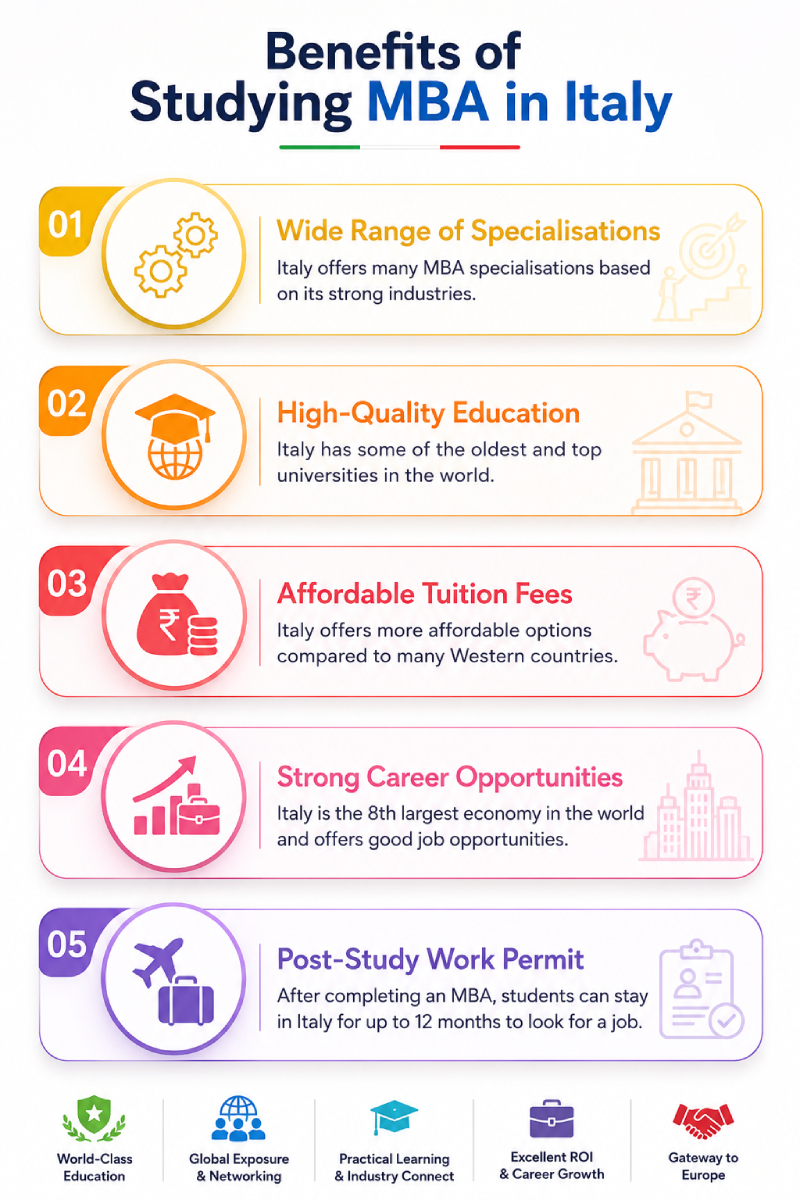
Why Study MBA in Italy?
Wide Range of Specialisations
Italy offers many MBA specialisations based on its strong industries. Students can choose a course that matches their interests and career goals. Popular options include:
- Design, Fashion, and Luxury Goods Management
- International Business
- Finance and Corporate Banking
- Automation and Robotics
- Digital Transformation and Innovation
- Supply Chain and Operations
- Entrepreneurship and Startups
- Sustainability and ESG
These specialisations help students gain deep knowledge in one field. Most MBA programs are taught in English, so Indian students can study easily. Learning basic Italian can help you get better job opportunities after graduation.
High-Quality Education
Italy has some of the oldest and top universities in the world, like the University of Bologna. Business schools focus on practical learning, case studies, projects, and leadership skills. Top schools like SDA Bocconi and POLIMI are ranked among the best globally. Many universities also have international accreditation and strong connections with global companies. Students also get a chance to study in a multicultural environment and build global networks.
Affordable Tuition Fees
Studying MBA in countries like the USA, UK, or Canada can be very expensive. Italy offers more affordable options. Some public universities have very low fees or even free programs for international students. Private universities also have lower fees compared to many Western countries. Students can also apply for scholarships and work part-time (up to 20 hours per week), making it a cost-effective option.
Strong Career Opportunities
Italy is the 8th largest economy in the world and offers good job and internship opportunities. It is home to famous companies like Ferrari, Lamborghini, Gucci, Armani, UniCredit, and Luxottica. MBA graduates can find jobs in finance, consulting, marketing, and luxury brands. Milan is a major business hub with many job opportunities. MBA graduates often earn high salaries in Italy and across Europe.
Post-Study Work and Residence Permit
After completing an MBA, students can stay in Italy for up to 12 months to look for a job. Italy’s location also allows access to job opportunities across the European Union. Once you get a job, you can apply for a work permit or an EU Blue Card for skilled professionals. Over time, you can also apply for permanent residency.
*Want to study in Italy? Contact Y-Axis for complete guidance
What Are the Top MBA Colleges in Italy?
Italy is one of the best countries in Europe to study an MBA. It has both public and private business schools that offer high-quality education and good job opportunities. Italy has 5 MBA programs ranked among the top 100 in the world (QS Global MBA Rankings), making it a popular choice for students who want to study abroad.
MBA programs in Italy focus on practical learning, leadership, and real business experience. Most programs require 2–3 years of work experience and usually take 12 to 24 months to complete. After finishing the course, students can explore job opportunities in Italy with a post-study work option.
Italian business schools have strong connections with global companies, especially in industries like fashion, luxury, automotive, and finance. Many MBA programs include internships, live projects, and networking events to help students gain real-world experience. Universities also offer modern campuses, good research facilities, and career support.
Italy also offers a rich culture, a safe environment, a strong economy, and a central location in Europe. This helps students build an international career and connect with professionals from different countries.
Below is the list of top universities offering MBA programs in Italy:
| University / Business School | Annual Fees (EUR) | Annual Fees (INR Approx.) | Duration | GMAT Required? |
|---|---|---|---|---|
| SDA Bocconi School of Management | €62,000–€72,000 | ₹55.8L–₹64.8L | 12 months | 600+ (No waiver) |
| MIP Politecnico di Milano | €36,000–€45,000 | ₹32.4L–₹40.5L | 12–18 months | 550+ (Waivable) |
| LUISS Business School | €25,000–€35,000 | ₹22.5L–₹31.5L | 12–18 months | Waivable (3+ years' experience) |
| MIB Trieste School of Management | €19,000–€24,000 | ₹17.1L–₹21.6L | 12 months | Not required |
| Bologna Business School | €19,000–€28,000 | ₹17.1L–₹25.2L | 12–18 months | 550+ or waivable |
| Rome Business School | €17,500–€22,000 | ₹15.8L–₹19.8L | 12–24 months | Not required |
| University of Bologna (Public) | €0–€2,000 | ₹0–₹1.8L | 24 months | Not required |
| Sapienza University of Rome (Public) | €156–€2,000 | ₹0.14L–₹1.8L | 24 months | Not required |
| University of Padua (Public) | €0–€2,000 | ₹0–₹1.8L | 24 months | Not required |
*Read more....
Most affordable Universities in Italy
Top QS Ranking MBA Universities in Italy
Italy has some of the top business schools that offer MBA programs recognised around the world. These universities are known for good education, strong industry connections, and good job opportunities after graduation. Many Indian students choose these MBA programs to build their management and leadership skills.
Below is a list of top MBA universities in Italy along with their QS Global MBA Rankings:
| Name of the University | QS Global MBA Ranking 2026 | Approx. MBA Fees (EUR) |
|---|---|---|
| SDA Bocconi School of Management | 20 | €62,000 – €72,000 |
| POLIMI Graduate School of Management | 65 | €36,000 – €45,000 |
| LUISS Business School | 95 | €25,000 – €35,000 |
| MIB Trieste School of Management | 151 | €19,000 – €24,000 |
| Bologna Business School | 251+ | €22,000 – €28,000 |
| Rome Business School | 251+ | €18,000 – €25,000 |
In-Demand MBA Courses in Italy
Italy offers many MBA programs for international students. These programs focus on specific specialisations and are mainly offered by private business schools, so they usually have tuition fees. MBA courses in Italy help students gain practical business knowledge, leadership skills, and global exposure.
Below is a table showing popular MBA specialisations along with their duration and approximate yearly tuition fees:
| Name of the Programme | Duration | Popular Specialisations | Approx. Annual Tuition Fee |
|---|---|---|---|
| MBA in International Business | 12–24 months | Global Business, International Trade, Cross-Cultural Management | €15,000 – €45,000 |
| MBA in Finance | 12–24 months | Corporate Finance, Investment Banking, Financial Management | €20,000 – €55,000 |
| MBA in Fashion, Design & Luxury | 12–18 months | Luxury Brand Management, Retail Strategy, Fashion Marketing | €20,000 – €45,000 |
| MBA in Marketing | 12–24 months | Digital Marketing, Brand Management, Market Strategy | €15,000 – €40,000 |
| MBA in Supply Chain Management | 12–24 months | Logistics, Operations Management, Global Supply Chain | €15,000 – €38,000 |
| MBA in Innovation & Entrepreneurship | 12–24 months | Startup Management, Technology Innovation, Venture Building | €18,000 – €40,000 |
| MBA in Data & Technology Management | 12–24 months | Big Data, Business Analytics, Digital Transformation | €20,000 – €45,000 |
| Executive MBA (EMBA) | 12–24 months (Part-time) | Leadership, Strategy, Senior Management | €30,000 – €72,000 |
Types of MBA Programs in Italy
Italy offers different types of MBA programs for students and working professionals. You can choose a program based on your work experience, career goals, and schedule.
Full-Time MBA:
A Full-Time MBA usually takes 12 to 18 months. It is best for students who are early in their careers or want to change their career path. This program gives complete business knowledge and often includes internships, company projects, or consulting work.
Executive MBA (EMBA):
The Executive MBA is for professionals with 5 or more years of work experience. It allows you to continue working while studying. The program focuses on leadership skills, decision-making, and senior management roles. Schools like SDA Bocconi and POLIMI are highly ranked for Executive MBA programs.
Part-Time MBA:
A Part-Time MBA is a flexible option for working professionals. Classes are usually in the evenings or on weekends. It takes around 2 to 3 years to complete, so students can manage both work and studies.
Specialised / International MBA:
This type of MBA focuses on specific industries where Italy is strong, such as fashion, luxury goods, and international business. It may include study trips, company visits, and real industry projects. Students also build strong global connections.
Online MBA:
An Online MBA allows students to study from anywhere. For example, POLIMI’s International Flex MBA is ranked among the top online MBA programs globally. It is a good option for those who want flexibility while studying.
MBA Fee in Italy: How Much Does It Cost to Study?
The total cost of studying an MBA in Italy depends on the university and the type of program you choose. MBA fees in Italy usually range from €25,000 to €80,655 (around ₹23 lakh to ₹73 lakh).
MBA Tuition Fees in Italy
The cost mainly depends on whether you study at a public or private university:
- Public universities are more affordable and may charge only a small semester fee
- Private universities have higher fees but offer specialised MBA programs, global exposure, and strong industry connections
Cost of Living in Italy
Apart from tuition fees, students also need to manage living expenses. On average, it costs around €700 to €1,000 per month for daily needs.
| Expense | Estimated Monthly Cost (EUR) |
|---|---|
| Accommodation | €350 – €600 |
| Food | €200 – €300 |
| Health Insurance | €80 – €150 |
| Study Materials | €20 – €40 |
| Transport | €30 – €60 |
| Internet & Mobile | €20 – €40 |
| Other Personal Expenses | €50 – €150 |
Total Estimated Cost of MBA in Italy
When you combine tuition fees and living costs:
- Public university MBA: €10,000 – €20,000 + living costs
- Private university MBA: €30,000 – €80,000+ including living costs
Italy also offers scholarships and part-time work options (up to 20 hours per week), which can help reduce expenses. Overall, Italy gives good quality education at a more affordable cost compared to many other countries.
What GMAT Score Is Required for MBA in Italy?
Most Italian business schools recommend a GMAT score of 550 or above for MBA admission. SDA Bocconi generally requires a minimum score of 600, with an average class GMAT of 675–700. A GMAT score of 700+ can improve your chances of receiving merit-based scholarships at leading business schools. Many institutions, including LUISS Business School, Bologna Business School, and MIP Politecnico di Milano, may waive the GMAT requirement for applicants with strong work experience. Schools such as MIB Trieste, Rome Business School, and several public universities do not require a GMAT score.
GMAT Score Requirements for MBA in Italy
| Business School | Minimum GMAT | Average GMAT (2025) | GMAT Waiver | Scholarship Recommendation |
|---|---|---|---|---|
| SDA Bocconi School of Management | 600 | 675–700 | No | 700+ for Merit Scholarship |
| MIP Politecnico di Milano | 550 | 620 | Case-by-case | 650+ for Merit Scholarship |
| LUISS Business School | 550 | 580–610 | Yes (3+ years' experience) | 600+ recommended |
| Bologna Business School | 550 | 570–600 | Yes (5+ years' experience) | 600+ recommended |
| MIB Trieste School of Management | Not required | N/A | Not required | N/A |
| Rome Business School | Not required | N/A | Not required | N/A |
| University of Bologna (Public) | Not required | N/A | Not required | N/A |
| Sapienza University of Rome (Public) | Not required | N/A | Not required | N/A |
What Are the MBA Application Deadlines in Italy?
Most Italian business schools follow round-based admissions for the September 2026 intake. Applying in Round 1 gives you the best chance of receiving scholarships and completing your Italy Type-D Student Visa process on time. Since visa processing usually takes 90–120 days, it is advisable to apply as early as possible after receiving your admission offer.
MBA Application Deadlines in Italy (September 2026 Intake)
| Business School | Round 1 | Round 2 | Round 3 / Final Round | Scholarship Priority |
|---|---|---|---|---|
| SDA Bocconi School of Management | October 2025 | January 2026 | April 2026 | Round 1 – Highest scholarship consideration |
| MIP Politecnico di Milano | November 2025 | January 2026 | March 2026 | Round 1 recommended |
| LUISS Business School | December 2025 | February 2026 | April 2026 | Round 1 recommended |
| Bologna Business School | November 2025 | February 2026 | March 2026 | Round 1 recommended |
| MIB Trieste School of Management | October 2025 | Rolling admissions | Until May 2026 | Early application preferred |
| Rome Business School | November 2025 | February 2026 | Rolling admissions | Early application preferred |
Which MBA Programs in Italy Do Not Require GMAT?
Many Italian business schools do not require a GMAT score or offer GMAT waivers for experienced professionals. Public universities such as the University of Bologna, Sapienza University of Rome, and the University of Padua do not require GMAT for admission. Private institutions like MIB Trieste School of Management and Rome Business School also admit MBA students without a GMAT score. Schools such as MIP Politecnico di Milano, LUISS Business School, and Bologna Business School may waive the GMAT requirement for applicants with strong academic and professional profiles.
If you are an Indian student with 3–5 years or more of work experience, you can apply to several MBA programs in Italy without taking the GMAT. Many Italian business schools value professional achievements and leadership experience more than standardised test scores.
| Business School | GMAT Status | Waiver Condition |
|---|---|---|
| MIB Trieste School of Management | Not Required | No GMAT required |
| Rome Business School | Not Required | No GMAT required |
| University of Bologna (Public) | Not Required | Public university – No GMAT |
| Sapienza University of Rome (Public) | Not Required | Public university – No GMAT |
| University of Padua (Public) | Not Required | Public university – No GMAT |
| LUISS Business School | Waivable | 3+ years of work experience |
| Bologna Business School | 550+ or Waivable | 5+ years of work experience |
| MIP Politecnico di Milano | Case-by-case | Strong profile with 5+ years of experience |
| SDA Bocconi School of Management | Required (600+) | No waiver available |
Top Scholarships for Indian Students to Study MBA in Italy
Indian students who want to study an MBA in Italy can apply for many scholarships offered by the Italian government, universities, and private organisations. These scholarships help reduce the cost of tuition fees, living expenses, travel, and even health insurance in some cases. Some scholarships are based on academic performance, while others are need-based or depend on entrance exam scores like GMAT.
Applying for scholarships can make studying in Italy much more affordable. Many universities automatically consider students for scholarships during admission, while some require a separate application. It is always better to apply early and check the eligibility criteria carefully.
Below is a clear list of scholarships available for Indian students:
| Scholarship | Provider | Scholarship Value | GMAT Requirement | Application Deadline (2026 Intake) | Eligibility |
|---|---|---|---|---|---|
| Bocconi Merit Award | SDA Bocconi School of Management | Up to 70% tuition waiver (≈₹39L savings) | 700+ recommended | October 2025 (Round 1) | Strong academic profile and high GMAT score |
| MIP Merit Scholarship | MIP Politecnico di Milano | 20–40% tuition waiver (≈₹6.5L–₹16L savings) | 650+ recommended | November 2025 (Round 1) | Academic excellence and work experience |
| Italian Government Scholarship (MAECI) | Italian Ministry of Foreign Affairs | Full tuition + €900 monthly stipend | Not required | Usually March–April | Open to international students based on merit |
| LUISS Excellence Scholarship | LUISS Business School | 20–50% tuition waiver | 600+ recommended | December 2025 (Round 1) | Academic merit and interview performance |
| DSU Regional Scholarship | Italian Regional Authorities | €2,000–€8,000 per year + accommodation | Not required | Varies by region (September–October) | Income below the required limit and enrolled student |
| Bologna Business School Scholarship | Bologna Business School | 20–50% tuition waiver | 550+ recommended | November 2025 | Academic merit |
| MIB Trieste Scholarship | MIB Trieste School of Management | 20–30% tuition waiver | Not required | October 2025 | Merit and interview performance |
| Erasmus+ Scholarship | European Union | €500–€1,000 monthly stipend | Not required | Varies by programme | Students enrolled in an eligible Erasmus+ programme |
*Want to apply for scholarships to study in Italy? Contact Y-Axis for expert guidance
Study MBA in Italy at Low or No Tuition Fee
Italy gives students a chance to study an MBA at a low cost, especially at public universities. These universities are funded by the government and usually have very low tuition fees. In many cases, students only need to pay a small semester fee for administration and other basic services.
Below is a list of public universities that offer MBA or management-related programs at low or almost no tuition fees:
| University | Estimated Tuition Fee | Key Feature |
|---|---|---|
| University of Bologna | €0 | World's oldest university; strong in business and management |
| Sapienza University of Rome | €0 | One of Europe's largest universities; ranked 151 globally |
| University of Padua | €0 | Known for excellence scholarships and research-focused programs |
| University of Milan | €0 | Strong in economics, finance, and international business |
| University of Turin | €0 | Good for engineering management and technical MBA programs |
| Politecnico di Milano | €0 – €5,000 | Top technical university; strong in innovation and technology management |
*Read more....
Eligibility Requirements to Pursue MBA in Italy
Each university in Italy can set its own admission rules. However, most MBA programs follow similar basic requirements. To get admission into an MBA program in Italy, Indian students generally need:
Bachelor's Degree: Applicants must have a recognised undergraduate degree from a reputed university. A minimum academic score of 60% is required for Indian students.
Work Experience: Most MBA programs in Italy require 2 to 3 years of relevant work experience. Some universities, however, do not require work experience at all — making Italy more accessible than countries like the USA or UK.
GMAT / GRE Scores: Many universities ask for a valid GMAT or GRE score. A GMAT score of 550 or above is generally preferred, though some universities may waive this requirement. At SDA Bocconi, a GMAT score above 700 is required to be eligible for a full tuition waiver scholarship.
English Language Proficiency: If the MBA program is taught in English, students must show proof of English proficiency. Common minimum scores are:
- TOEFL: 80–100
- IELTS: 6.0–7.0
If the program is in Italian, proof of Italian language skills may be required.
Letters of Recommendation (LOR): Students usually need to submit 2–3 recommendation letters from professors or employers who can confirm their academic and professional abilities.
Statement of Purpose (SOP): A written statement explaining why you want to study an MBA, your career goals, and why you chose that particular university.
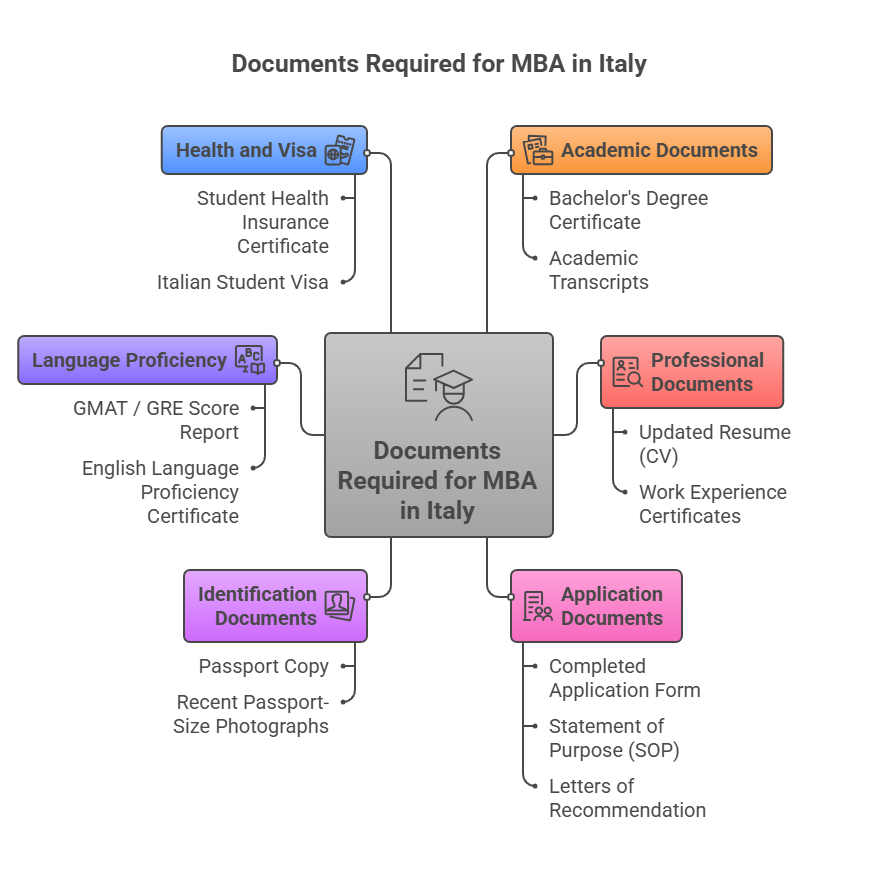
Documents Required for MBA in Italy
To apply for an MBA program in Italy, Indian students generally need the following documents:
- Completed application form
- Bachelor's degree certificate
- Academic transcripts
- Updated resume (CV)
- Work experience certificates
- Statement of Purpose (SOP)
- Letters of Recommendation
- Passport copy
- GMAT / GRE score report (if required)
- English language proficiency certificate (IELTS/TOEFL)
- Student health insurance certificate
- Recent passport-size photographs
- Italian student visa
Step-by-Step Guide to Applying for an MBA in Italy
Applying for an MBA in Italy involves several important steps. Students must plan early and follow each step carefully to ensure a smooth admission process.
Step 1: Research and Choose the MBA Program. Begin by researching MBA programs that match your career goals, budget, and work experience. Compare universities based on tuition fees, duration, specialisations, and language of instruction before shortlisting your options.
Step 2: Check Eligibility Requirements Carefully, review the admission criteria of each university. Make sure you meet the academic qualifications, required work experience, and language proficiency standards. Some universities may also ask for GMAT scores.
Step 3: Prepare Required Documents, Collect and organise all necessary documents such as your bachelor's degree certificate, academic transcripts, resume, statement of purpose, letters of recommendation, work experience certificates, and passport copy.
Step 4: Arrange Financial Resources Plan your finances in advance by calculating tuition fees and living expenses. Explore scholarships, education loan options, and part-time work opportunities. You will also need proof of financial means for your Italian student visa application.
Step 5: Submit the Online Application Apply through the university's official website or through the Italian government's Universitaly portal, which is used by many Italian universities for international student applications. Upload all documents and pay the application fee if required.
Step 6: Receive Admission Offer If your application is successful, the university will send you an admission letter. You may need to confirm your acceptance and pay a deposit to secure your seat.
Step 7: Apply for an Italian Student Visa After receiving the admission letter, apply for an Italian Type D Student Visa. Arrange health insurance, proof of financial funds, and attend the visa appointment at the Italian Embassy or Consulate in India.
Step 8: Arrange Accommodation and Travel Once the visa is approved, arrange accommodation near your university, either through student dormitories or private rentals and plan your travel to Italy.
Step 9: Complete Enrolment in Italy After arriving in Italy, apply for your Permesso di Soggiorno within 8 days of arrival. Register your address, complete the enrolment process at the university, and begin your MBA program.
What Is the Average Salary After an MBA in Italy?
MBA graduates in Italy can earn between €35,000 and €92,000 per year, depending on their industry, job role, and location. The highest salaries are offered in consulting, finance, and technology. Jobs in Milan usually pay 20–30% more than similar roles in other Italian cities because it is the country's financial and business hub.
Average Salary After MBA in Italy by Industry
| Industry | Entry Salary (EUR/Year) | Entry Salary (INR Approx.) | Mid-Level Salary (3–5 Years) | Top Employers |
|---|---|---|---|---|
| Finance & Investment Banking | €45,000–€65,000 | ₹40.5L–₹58.5L | €70,000–€110,000 | UniCredit, Mediobanca, Goldman Sachs |
| Management Consulting | €50,000–€70,000 | ₹45L–₹63L | €80,000–€130,000 | BCG, Bain & Company, McKinsey, Accenture |
| Fashion & Luxury | €35,000–€55,000 | ₹31.5L–₹49.5L | €60,000–€90,000 | LVMH, Gucci, Prada, Moncler |
| Technology & Digital | €40,000–€60,000 | ₹36L–₹54L | €65,000–€100,000 | Google, Microsoft, IBM, Accenture |
| Automotive & Manufacturing | €40,000–€60,000 | ₹36L–₹54L | €65,000–€90,000 | Ferrari, Lamborghini, Stellantis, CNH |
| Healthcare & Pharmaceuticals | €38,000–€55,000 | ₹34.2L–₹49.5L | €60,000–€85,000 | Novartis, Roche, Pfizer |
| FMCG & Consumer Goods | €35,000–€50,000 | ₹31.5L–₹45L | €55,000–€80,000 | Barilla, Ferrero, Unilever |
Is an MBA in Italy Worth It for Indian Students?
Yes. An MBA in Italy is a good choice for Indian students looking for a high-quality education at a lower cost than many MBA programmes in the UK or the USA. Italy is home to several triple-accredited business schools (AACSB, EQUIS, and AMBA), offers access to the European job market, and provides a 12-month post-study job search permit. Graduates can build careers in consulting, finance, luxury, technology, and manufacturing across Europe.
MBA in Italy vs UK vs USA
| Destination | Tuition Fees | Living Cost (1 Year) | Average Entry Salary | Estimated ROI | Post-Study Work Option |
|---|---|---|---|---|---|
| Italy (Top Business School) | €62,000–€72,000 (₹55.8L–₹64.8L) | €12,000–€15,000 | €50,000–€85,000 (₹45L–₹76.5L) | 2–3 years | 12-month job search permit |
| Italy (Public University) | €0–€2,000 (₹0–₹1.8L) | €12,000–€15,000 | €35,000–€55,000 (₹31.5L–₹49.5L) | Less than 1 year | 12-month job search permit |
| UK | £15,000–£40,000 (₹17L–₹45L) | £18,000–£22,000 | £45,000–£65,000 (₹51L–₹73.5L) | 2–4 years | 2-year Graduate Route Visa |
| USA | $30,000–$90,000 (₹25L–₹75L) | $20,000–$30,000 | $70,000–$120,000 (₹58L–₹100L) | 3–5 years | OPT (up to 3 years for STEM), then H-1B |
Why choose Italy?
- Lower tuition fees than many MBA programmes in the UK and USA
- Internationally recognised, triple-accredited business schools
- Access to jobs across the European Union
- 12-month post-study job search permit
- Strong opportunities in finance, consulting, luxury, fashion, and manufacturing
What Are the Post-Study Work Options After an MBA in Italy?
After completing your MBA, you can apply for a 12-month job search permit (Permesso di Soggiorno per Attesa Occupazione). This allows you to stay in Italy while looking for a job. Once you receive a job offer, you can change your status to an Italian work permit and continue your career in Italy or other parts of Europe.
Post-MBA Career Path in Italy
| Option | Details |
|---|---|
| 12-Month Job Search Permit | Stay in Italy for up to 12 months after graduation to find a job. |
| Work Permit Conversion | Convert your student permit to a work permit after securing employment. |
| EU Blue Card | Available to highly skilled professionals who meet the salary requirements. |
| Italian Permanent Residence | Apply after 5 years of continuous legal residence in Italy. |
| Italian Citizenship | You may become eligible after 10 years of legal residence, subject to Italian citizenship rules. |
The best cities for MBA graduates are Milan, Rome, and Turin. Milan is the leading destination for careers in finance, consulting, technology, luxury, and multinational companies, offering the highest salaries and the largest number of job opportunities.
Are MBA Programs in Italy Available in English?
Yes, many MBA programs in Italy are completely taught in English. This makes it easy for Indian students and other international students to study without needing to know the Italian language. In most universities, classes, assignments, group projects, and exams are all conducted in English. Students from different countries join these programs, so English is commonly used for communication in the classroom.
However, learning basic Italian can be very useful if you plan to stay in Italy after your MBA. Even though your course is in English, many local companies prefer employees who can speak Italian. Knowing the language can help you find better job opportunities, communicate easily with colleagues, and manage daily activities like shopping, travel, and social interactions. It can also help you adjust faster to life in Italy and improve your chances of building a long-term career there.
Build Your Management Career in Italy
Studying an MBA in Italy is a great option for students who want global career growth. Top companies like Amazon, Deloitte, PwC, Ferrari, and Luxottica hire MBA graduates from Italian universities. Italy offers strong education, practical learning, and good job opportunities in a major European economy. MBA programs are recognised worldwide and are especially strong in areas like fashion, luxury, and automotive industries. After graduation, students can use post-study work options to find jobs and grow their careers. With the right planning and university choice, an MBA in Italy can help you gain global exposure, strong management skills, and a successful long-term career in Europe.
How Can Y-Axis Help You?
Y-Axis provides complete support for students who want to study in Italy. We offer clear, step-by-step guidance and personalised assistance throughout your study abroad journey.
Our services include:
- Free eligibility assessment for Italian universities.
- Expert guidance in choosing the right MBA program and university.
- IELTS/PTE coaching if required for English-taught programs.
- Assistance with SOP, LOR, and university applications.
- Support with Italy student visa documentation and interview preparation.
Don't know what to do ?
Get Free Counseling
Looking for Inspiration
Explore what Global Indians have to say about Y-Axis in shaping their future