

Don't know what to do ?
Get Free Counseling
Last Updated: 28-July-2026
Study in Italy for Free: Top Universities, Eligibility & Admission Process
Italy is one of the cheapest countries in Europe for higher education. International students, including Indians, can study in public universities at very low cost, and sometimes even for free. In 2026, most public universities in Italy still follow an income-based fee system, which makes education affordable for many students.
Unlike Germany, where tuition is mostly free for everyone, Italy uses a system called ISEE. This system decides how much you need to pay based on your family’s financial situation. Sticker-price tuition fees before ISEE-based reduction usually range from €900 to €4,000 per year.
After ISEE-based reduction, many Indian students from low-income families pay between €0 and €1,500 per year, which is much cheaper compared to other countries.
If your family income (ISEE) is low, you may qualify for a full fee waiver, meaning you can study for free or at a very low cost. However, if you do not submit your income documents, you will be charged the maximum tuition fee. So, it is very important to provide these documents.
Even the highest tuition fees in Italy are still cheaper compared to many other European countries. With the help of scholarships, studying in Italy becomes highly affordable while offering a degree that is recognized worldwide.
*Are you looking to study in Italy? Y-Axis is here to guide you through the entire process!
Why Study in Italy for Free?
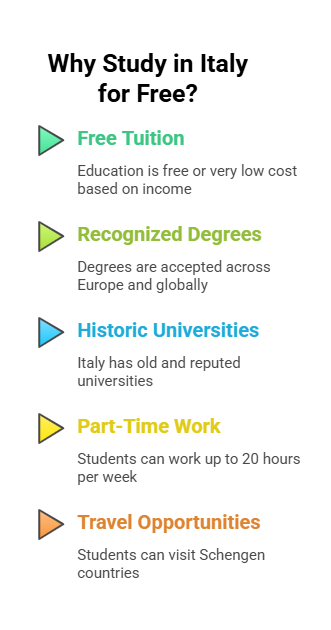
- Free or Very Low Tuition Fees: Many public universities offer free education or very low fees based on your family income (ISEE), making it possible to study at almost no cost.
- Globally Recognized Degrees: Italy follows the Bologna education system, so your degree is accepted across Europe and many other countries.
- Top and Historic Universities: Italy has some of the oldest and most reputed universities, such as University of Bologna, giving you quality education at low cost.
- Part-Time Work Options: Students can work up to 20 hours per week, helping them manage living expenses while studying.
- Travel Across Europe: With an Italian student visa, you can visit around 25 countries in the Schengen area, giving you more exposure and travel opportunities.
Best Affordable Universities in Italy for International Students
Public universities in Italy have some of the lowest tuition fees in Europe. The average sticker-price fees before ISEE reduction are between €900 and €4,000 per year, depending on the course and university. With the ISEE income system and scholarships, many students can study for free or pay very little.
Politecnico di Milano has reached a major milestone by entering the top 100 universities in the world, ranking 98th. Other top universities in Italy also perform well, including Sapienza University of Rome, University of Bologna, University of Padua, Politecnico di Torino, and University of Milan.
|
University |
Location |
QS World Ranking 2026 |
Annual Fee Range (per year) |
|
Politecnico di Milano |
Milan |
98 |
€890 – €3,900 |
|
Sapienza University of Rome |
Rome |
101–150 |
€300 – €1,500 |
|
University of Bologna |
Bologna |
154 |
€0 – €3,000 |
|
University of Padua |
Padua |
201–250 |
€900 – €4,000 |
|
Politecnico di Torino |
Turin |
301–350 |
€900 – €2,600 |
|
University of Milan |
Milan |
301–350 |
€900 – €3,500 |
|
University of Florence |
Florence |
401–450 |
€900 – €3,000 |
|
University of Naples Federico II |
Naples |
401–450 |
€800 – €2,500 |
|
University of Pavia |
Pavia |
401–500 |
€900 – €4,500 |
|
University of Genoa |
Genoa |
501–550 |
€700 – €2,500 |
|
University of Turin |
Turin |
501–600 |
€800 – €3,000 |
Steps to Study in Italy for Free for Indian Students
Step 1: Choose the Right Course and University
Choose a public university and course that you like. Check if the course is in English or Italian. Also check the intake (usually September/October) and the fee system based on family income.
Step 2: Check Eligibility Requirements
- For bachelor’s programs, you must complete Class 12 with good marks.
- For master’s programs, you need a related bachelor’s degree.
- Some courses like medicine, architecture, and veterinary may need entrance exams.
Step 3: Complete Pre-Enrollment on UNIVERSITALY
Pre-enrollment is required for most courses. You need to apply through the UNIVERSITALY portal, which is made for international students. This step is important before applying for a student visa.
Step 4: Meet Language Requirements
For English courses, you may need IELTS (6.0–6.5) or TOEFL. Some universities also accept MOI (Medium of Instruction), Cambridge certificates, or interviews. For Italian courses, you must show proof of Italian language skills.
Step 5: Submit Your Application
Apply through the university’s official website. You will need documents like academic marksheets, language scores, SOP, recommendation letters, passport copy, and CV.
Step 6: Get ISEE Parificato for Fee Reduction
International students need ISEE Parificato to show their family income. This helps reduce tuition fees by 50% to 100%. It is also needed for scholarships.
Step 7: Get Admission and Declaration of Value (DOV)
After getting admission, you may need a Declaration of Value from the Italian Consulate in India. This confirms that your Indian education is valid in Italy. You can also use a CIMEA certificate instead.
Step 8: Apply for an Italian Student Visa (Type D)
Apply for a long-term student visa (D Visa) for courses longer than 90 days. After reaching Italy, you can apply for a residence permit to stay legally. Visa processing may take up to 90 days, so apply early.
Step 9: Apply for Residence Permit (Permesso di Soggiorno)
After arriving in Italy, apply for your residence permit within 8 working days at Poste Italiane. This allows you to live and study in Italy legally.
*Planning to do masters in Italy? Contact Y-Axis for complete guidance
ISEE Parificato for International Students
ISEE Parificato is the financial assessment certificate used to calculate tuition fees and scholarship eligibility for international students in Italy. Since family income is earned outside Italy, international students must obtain an ISEE Parificato through an authorized CAF (Tax Assistance Centre) after arriving in Italy or as instructed by their university.
Most public universities and regional scholarship authorities require this certificate.
Documents Required
- Family composition certificate
- Family income proof (usually from two years before the application year)
- Bank balance certificates
- Property ownership documents or a nil-property certificate
- Apostilled and officially translated Italian versions of all documents
How to Get an ISEE Parificato?
Step 1: Collect and apostille the required financial documents.
Step 2: Get the documents officially translated into Italian.
Step 3: Submit them to the CAF office partnered with your university.
Step 4: Receive the ISEE Parificato certificate (typically within 10–20 days) and upload it before university deadlines.
Indicative Tuition Fee Based on ISEE
| ISEE Value | Typical Tuition Outcome |
|---|---|
| Below €24,000–€27,000 | Full tuition waiver (only regional tax payable) |
| €24,000–€40,000 | Significant tuition reduction |
| €40,000–€90,000 | Partial tuition reduction |
| Above €90,000 or no ISEE | Maximum university tuition fee |
Declaration of Value (DOV) for Indian Students
The Declaration of Value (Dichiarazione di Valore) is an official document issued by the Italian Embassy or Consulate that confirms your Indian educational qualification is valid for higher education in Italy.
Many universities also accept the CIMEA Statement of Comparability as an alternative.
How to Obtain a DOV?
Step 1: Apostille your educational certificates through the Ministry of External Affairs (MEA).
Step 2: Get certified Italian translations.
Step 3: Submit your application through the appropriate Italian Embassy, Consulate, or VFS Global centre.
Step 4: Receive the Declaration of Value and submit it to your university during enrollment.
Processing Time: Approximately 20–60 working days.
DSU Regional Scholarships in Italy
The DSU (Diritto allo Studio Universitario) scholarship is a regional financial aid program available to eligible international students studying at public universities in Italy.
Depending on your financial situation, DSU may provide:
- Full tuition fee waiver
- Annual scholarship grant
- Subsidized or free university accommodation
- Discounted or free meals at university canteens
Eligibility
Applicants generally need:
- An eligible ISEE Parificato
- Asset values below the regional threshold
- Admission to a participating Italian university
Application Process
Step 1: Obtain your ISEE Parificato.
Step 2: Register on the regional DSU portal.
Step 3: Submit the online application with supporting documents.
Step 4: Wait for the provisional ranking.
Step 5: If selected, receive the tuition waiver and scholarship payments.
Note: Scholarship amounts, eligibility criteria, and deadlines vary by region and university. Always check the official regional DSU authority for the latest information.
Requirements for Indian Students to Study in Italy for Free
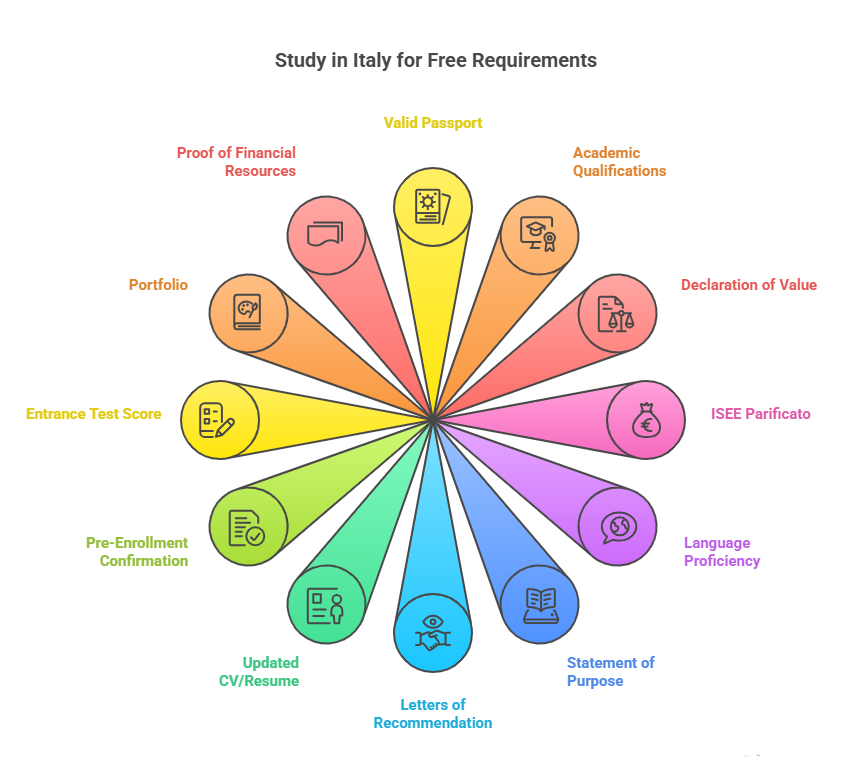
Indian students applying to public universities in Italy must typically prepare:
- Valid Passport
- Academic Qualifications: Class 12 transcripts for bachelor's or a relevant bachelor's degree for master's
- Declaration of Value (DOV) / CIMEA Certificate: Validates your Indian academic credentials in the Italian system
- ISEE Parificato: Income document to qualify for tuition reduction or scholarships
- Language Proficiency Proof: IELTS/TOEFL for English programs; Italian language certificate for Italian-taught programs
- Statement of Purpose (SOP): Explaining academic background, career goals, and reasons for choosing Italy
- Letters of Recommendation (LORs): Typically required for master's programs
- Updated CV/Resume
- UNIVERSITALY Pre-Enrollment Confirmation
- Entrance Test Score: For competitive programs such as medicine, architecture, or veterinary science
- Portfolio: For design, architecture, or fine arts programs
- Proof of Financial Resources: Required for the student visa application
Cost of Living in Italy for Students
On average, international students might expect to spend between €10,800 and €13,200 per year on housing, food, transportation, and other personal expenses. This translates to roughly €900–€1,100 per month depending on the city.
- Accommodation (Rent): €500 – €650/month
- Food & Groceries: €200 – €250/month
- Health Insurance: €200 – €300/year (approximately €17–€25/month)
- Transportation:€60 – €100/month
- Personal & Miscellaneous: €60 – €100/month
Southern cities like Palermo (€600–€800/month) and smaller university towns offer the lowest living costs, while Rome, Milan, and Florence are typically more expensive.
For the student visa, applicants must show proof of financial means of at least €5,977.79 per year, or €459.83 per month during the academic year.
Fully Funded Scholarships to Study in Italy
Italy offers several fully funded and merit-based scholarships for international students, including Indian students. These scholarships can cover tuition fees, living expenses, accommodation, health insurance, and monthly stipends.
| Scholarship | Funding | Eligibility |
|---|---|---|
| MAECI Italian Government Scholarship | €9,000 for 9 months, tuition fee exemption at participating universities, health and accident insurance | International students applying for Master's, PhD, research, AFAM, or Italian language programmes |
| DSU Regional Scholarship | Full tuition waiver, annual grant of approximately €2,500–€7,900, subsidized accommodation, and meal benefits | Students meeting the regional ISEE and asset eligibility requirements |
| Invest Your Talent in Italy (IYT) | Around €1,000 per month for 9 months, tuition fee exemption at partner universities, internship opportunity, and free Italian language course | International Master's students in Engineering, Technology, Design, Economics, and Management with English proficiency (B2 or higher) |
| University of Bologna – International Talents @ Unibo | €6,500 per year (renewable for up to two years) plus full tuition fee waiver | Outstanding international Master's students selected based on academic merit |
| University of Padua – Padua International Excellence Scholarship | €8,000 per year plus full tuition fee waiver (regional taxes apply) | High-achieving international students admitted to eligible English-taught Bachelor's and Master's programmes |
| Bocconi University Scholarships | Full tuition fee waiver worth approximately €12,000–€14,000 per year, with possible accommodation support | Outstanding international undergraduate and Master's applicants |
| Scuola Normale Superiore PhD Scholarships | Full tuition waiver, accommodation, and research funding | International PhD applicants with excellent academic records |
| Gran Sasso Science Institute (GSSI) PhD Fellowships | Full tuition, accommodation, meal support, and monthly fellowship | International students applying for eligible PhD programmes |
*Read more.....
Italy vs Germany vs France: Where Can You Study at the Lowest Cost?
Italy, Germany, and France are among the most popular study destinations in Europe. While Germany offers tuition-free education at most public universities, Italy stands out for its income-based tuition fee reductions and generous DSU scholarships, making it one of the most affordable options for eligible Indian students. France has fixed tuition fees for most non-EU students, although scholarships and exemptions are available.
| Feature | Italy | Germany | France |
|---|---|---|---|
| Public University Tuition (Non-EU Students) | €900–€4,000/year sticker price (income-based through ISEE); many eligible students pay only €0–€1,500/year after reduction | Tuition-free at most public universities; semester contribution of €100–€400 (Baden-Württemberg charges €1,500/semester) | €2,895/year (Bachelor's) and €3,941/year (Master's) for most non-EU students (from September 2026), with limited exemptions |
| Can Tuition Be Free? | Yes, through ISEE-based tuition waivers and DSU scholarships | Yes, except for mandatory semester contribution | Only through scholarships or tuition fee exemptions |
| Financial Proof for Student Visa | €534.41/month (approximately €6,947.33 per academic year for AY 2026/27) | Approximately €11,900/year in a blocked account | Approximately €615/month |
| Average Living Costs | €900–€1,100/month | €950–€1,100/month | €1,000–€1,200/month |
| Major Scholarships | DSU Regional Scholarship, MAECI Scholarship, Invest Your Talent in Italy | DAAD Scholarships, Deutschlandstipendium | Eiffel Excellence Scholarship, Charpak Scholarship |
| Part-time Work During Studies | Up to 20 hours per week | 140 full days or 280 half days per year | Approximately 20 hours per week (up to 964 hours annually) |
Begin Your Journey to Affordable Education in Italy
Studying in Italy at low or no cost is a great opportunity for Indian students who want a high-quality education without spending too much money. Italy has top-ranked public universities, a long history of education, and many courses in English. Because of this, Italy is becoming one of the most popular study destinations for Indian students.
In most public universities, tuition fees depend on your family income and can even become zero with the ISEE Parificato system. But students should plan everything early, including admission, income documents, and visa process. Important steps like pre-enrollment on UNIVERSITALY, getting the Declaration of Value, and applying for DSU or government scholarships need proper planning and early action.
The effort you put in now like choosing the right university, preparing good academic documents, and applying for scholarships can help you get international exposure, practical learning in top universities, and better career opportunities in Europe and other countries.
How Can Y-Axis Help You Study in Italy for Free?
Y-Axis provides complete support for students who want to study in Italy at low-cost or tuition-free public universities. We guide you at every step, from choosing the right university to getting your student visa successfully.
When your goal is to study in Italy for free, it is important to select the right public university and understand the ISEE system, scholarships, and admission process. Our experts help you find universities that match your academic profile and career goals while maximizing your chances of studying at low or no cost.
At Y-Axis, we offer:
- Y-Path Guidance to help you choose the right low-cost or tuition-free university and program based on your academic background
- Y-Axis Coaching Centre to improve your IELTS, TOEFL
- Complete support for UNIVERSITALY pre-enrollment and university applications
- Guidance for ISEE Parificato documentation to reduce tuition fees
- Support in preparing strong SOPs, LORs, and academic documents
- Assistance with scholarship applications like DSU and MAECI
- Step-by-step guidance for the Italy student visa (Type D) and residence permit process
Don't know what to do ?
Get Free Counseling
Looking for Inspiration
Explore what Global Indians have to say about Y-Axis in shaping their future