

Don't know what to do ?
Get Free Counseling
Last Updated 27 May 2026
About the Ireland Student Dependent Visa
The Ireland student dependent visa allows the spouse, civil partner, and dependent children of a PhD student to join them in Ireland. If you are pursuing an Ireland-accredited doctorate, your family can apply for family reunification without any waiting period. Your family does not need to wait until you graduate.
Not all students in Ireland can bring their family. Only PhD students studying for a doctorate accredited in Ireland qualify as eligible sponsors for immediate family reunification. Undergraduate students, master’s students, and language course students on Stamp 2 cannot bring their family at the study stage. This is a critical distinction you must understand before applying.
Dependents who are granted the Ireland student dependent visa travel to Ireland on a D – Join Family visa. After arrival, they register with Ireland’s Immigration Service Delivery (ISD) and receive an Irish Residence Permit (IRP) card with Stamp 3 immigration permission. This allows them to live and study in Ireland. The permission is tied to the duration of the PhD programme and must be renewed annually.
India is home to a fast-growing community of doctoral students in Ireland. Irish universities offer world-class research environments in technology, science, engineering, and business. The Ireland student dependent visa gives Indian PhD students a clear pathway to bring their families while they complete their studies.
Ireland Student Dependent Visa: Key Facts at a Glance
| Category | Details |
|---|---|
| Visa Type | D – Join Family Visa (long-stay entry visa); Irish Residence Permit (IRP) with Stamp 3 on arrival |
| Applicable For | Family dependents of non-EEA PhD students enrolled in an Ireland-accredited doctorate programme |
| Sponsor Category | Category B sponsor under Ireland’s Non-EEA Family Reunification Policy — immediate family reunification, no waiting period |
| Waiting Period | None — PhD student sponsors may apply for family reunification immediately without any minimum residence period |
| Work Rights — Spouse / Partner | No work rights — Stamp 3 does not permit employment or engagement in business, trade, or profession |
| Work Rights — Children aged 16–18 | Stamp 1G may apply — may take up employment without a separate employment permit (subject to official confirmation with ISD) |
| Study Rights | Yes — all dependents may study in Ireland; school-age children may attend Irish schools |
| Access to Public Healthcare | Not permitted — Stamp 3 holders must hold private health insurance; publicly funded hospitals and services are not accessible |
| Permission Duration | Tied to PhD programme duration — must be renewed annually |
*Want to check your eligibility for the Ireland Student Dependent Visa? Sign up with Y-Axis for a free profile evaluation.
Ireland Student Dependent Visa: Overview
The Ireland student dependent visa is the official route through which spouses, civil partners, and dependent children of PhD students can live in Ireland. It falls under Ireland’s Non-EEA Family Reunification Policy, not a standalone visa category. Dependents must first obtain a D – Join Family visa before travelling to Ireland. After arrival, they register with the Immigration Service Delivery (ISD) and receive an Irish Residence Permit (IRP) card.
Only PhD students whose doctorate is accredited in Ireland are eligible to act as sponsors for immediate family members. Regular Stamp 2 students whether on undergraduate, master’s, or English language programmes are not eligible to bring family at the study stage. This is one of the most important rules in Irish immigration for non-EEA students.
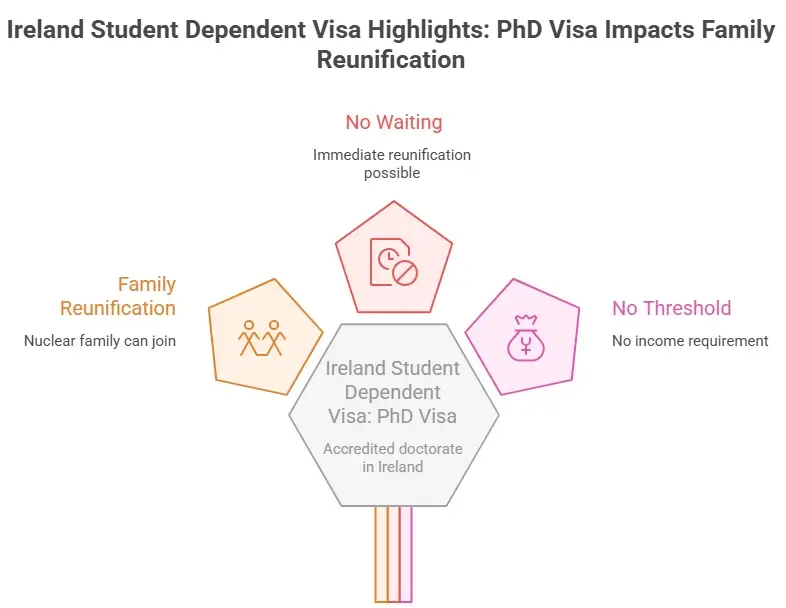
Ireland’s Non-EEA Family Reunification Policy was revised in November 2025. Under the updated policy, PhD student permission holders are classified as Category B sponsors eligible for immediate family reunification with their nuclear family (spouse or civil partner, and dependent children under 18). There is no waiting period and no minimum income threshold required for nuclear family members.
Benefits of the Ireland Student Dependent Visa for Indian Families
The Ireland student dependent visa offers Indian PhD students and their families a meaningful opportunity to live together in Ireland during the doctoral programme. Key benefits include:
- No waiting period: PhD students can sponsor family members immediately, from the start of their programme.
- No income threshold: Category B sponsors (PhD students) do not need to meet a minimum income requirement to sponsor their spouse, civil partner, or children under 18.
- Study rights for all dependents: Spouse and children may enrol in Irish educational institutions.
- School education for children: School-age dependent children may attend Irish primary and secondary schools.
- Annual permission renewal: The family can remain in Ireland for the full duration of the PhD with annual renewals.
- Safe, English-speaking environment: Ireland offers a natural English-language setting, high living standards, and strong personal safety.
- Access to Irish academic and research culture: Dependents can attend universities, language schools, and professional programmes.
- Pathway to better rights: After graduation, if the PhD holder secures a Critical Skills Employment Permit (CSEP), the spouse immediately becomes eligible for Stamp 1G (full work rights without a separate permit).
- Proximity to Europe: Ireland’s EU membership gives the family access to European travel and cultural opportunities.
- Stamp 3 is reckonable residence: Time on Stamp 3 counts towards Irish citizenship by naturalisation requirements.
Also, read...
Who is Eligible to Sponsor a Dependent in Ireland?
This is the most important rule for non-EEA students in Ireland. Not all students can bring their family. Ireland’s immigration rules are very specific about which students qualify as sponsors.
Students Who CAN Sponsor Family
The following non-EEA students are classified as Category B sponsors and are eligible for immediate family reunification with nuclear family members:
- PhD students studying for a doctorate accredited in Ireland — most relevant category for this page
- ISD-approved scholarship programme students
- Intra-company transferees
- Critical Skills Employment Permit (CSEP) holders
- Researchers on Hosting Agreements
- Full-time non-locum doctors in employment
Students Who CANNOT Sponsor Family
The following non-EEA students in Ireland are NOT eligible to bring family members at the study stage:
- Undergraduate students (bachelor’s degree, Stamp 2)
- Master’s degree students (Stamp 2)
- English language course students (Stamp 2)
- All other higher education programme students on Stamp 2
- Students on Stamp 2A
- Holders of Stamp 3
Note: After graduation, if an undergraduate or master’s graduate secures a Critical Skills Employment Permit (CSEP), they become a Category B sponsor and can bring their family immediately.
Also, read...
Ireland Announces €10,000 Scholarships for International Students Starting January 29 – Apply Now
PhD Student (Sponsor) Requirements
| Requirement | Details |
|---|---|
| Study Type | Must be enrolled in a full-time doctorate (PhD) programme accredited by an Irish university or institution |
| Immigration Status | Must hold a valid Stamp 2 Irish Residence Permit as a PhD student in Ireland |
| Programme Accreditation | The doctorate must be accredited in Ireland — distance-learning or overseas-accredited programmes are not eligible |
| Residency in Ireland | Must be residing in Ireland at the time of the family reunification application |
| Accommodation in Ireland | Must show evidence of suitable accommodation in Ireland for the sponsor and dependent family members |
| Financial Self-Sufficiency | Must show sufficient funds to support the family without relying on Irish public funds or State benefits |
| Private Medical Insurance | Must hold private medical insurance; dependent must also be covered by private health insurance |
| Good Character | Must be a person of good character with no criminal record or immigration violations |
Also, read...
Ireland Offers ₹75 Lakh Scholarships for Indian Students – Apply Now
Dependent Eligibility Requirements
| Requirement | Details |
|---|---|
| Eligible Dependents | Legally married spouse or civil partner; unmarried dependent children under 18 (biological, adopted, or step-children) |
| Entry Visa for Visa-Required Nationals | Visa-required nationals (including Indian citizens) must obtain a D – Join Family visa before travelling to Ireland |
| Non-Visa-Required Nationals | Must inform the immigration officer at the Irish port of entry of the purpose as family reunification; passport inscribed accordingly |
| Relationship Evidence | Marriage certificate or civil partnership certificate (spouse); birth certificate (children); relationship must be genuine and subsisting |
| Legal Entry into Ireland | Must enter Ireland legally; those unlawfully present may have their application refused |
| Residence with Sponsor | Both sponsor and dependent must be residing in Ireland at the time of the family dependent application |
| No Public Funds | Must not rely on Irish State benefits, public housing, welfare, or other public funds |
| Good Character | Must be a person of good character and obey Irish laws |
| Previous Visa Refusals | Must declare any previous visa refusals from any country; original refusal letters must be submitted |
Work Rights for Ireland Student Dependent Visa Holders
This is a key area where the Ireland student dependent visa differs from some other dependent visa routes. Dependents of PhD students receive Stamp 3 immigration permission. Stamp 3 does not permit the holder to work or engage in any business, trade, or profession.
| Activity | Permitted for Dependent? |
|---|---|
| Full-time or part-time employment | No — Stamp 3 does not permit employment of any kind |
| Self-employment or freelance work | No — Stamp 3 prohibits engagement in any business, trade, or profession |
| Voluntary work (charity or non-profit) | Permitted in limited circumstances — verify conditions with ISD before starting |
| Study and education | Yes — Stamp 3 holders may enrol in educational programmes and courses |
| Access to public health services | No — Stamp 3 holders cannot access publicly funded hospitals or services; private health insurance required |
| Children under 16 — work rights | Not applicable — children under 16 are below the minimum working age in Ireland |
| Children aged 16–18 — work rights | Stamp 1G may apply, allowing work without a separate employment permit — subject to official confirmation with ISD |
| Work rights after sponsor gets CSEP | Spouse / de facto partner immediately becomes eligible for Stamp 1G (full unrestricted work rights) when the PhD graduate secures a Critical Skills Employment Permit |
Note: When the PhD student graduates and secures a Critical Skills Employment Permit (CSEP), the spouse or de facto partner qualifies for Stamp 1G permission which grants full and unrestricted work rights for any employer, in any sector, without a separate work permit.
*Want to apply for Ireland work visa? Let Y-Axis guide you with the process.
Study Rights for Ireland Student Dependent Visa Holders
All dependents holding Stamp 3 permission in Ireland may study. This includes the spouse, partner, and dependent children. There are no restrictions on enrolment in Irish educational institutions for Stamp 3 holders.
| Study Aspect | Details for Dependents |
|---|---|
| Spouse / Partner | May enrol in any Irish educational institution — universities, colleges, language schools, and professional programmes |
| School-age children | May attend Irish primary and secondary state schools; education is free for all resident children |
| English language courses | Available at local colleges; ESOL (English for Speakers of Other Languages) programmes are widely available |
| Further Education (FE) colleges | No restriction — dependents may enrol in vocational courses, diplomas, and professional certifications |
| University / higher education | Dependents may apply to any Irish university; note that international tuition fees apply unless the dependent holds Stamp 4 or Long Term Residence status |
| Student finance (SUSI / loans) | International students on Stamp 3 are generally not eligible for SUSI grants or student loans |
| Postgraduate programmes | No restriction on enrolment; tuition at international rates applies for most Stamp 3 holders |
*Want to study in Ireland? Let Y-Axis guide you with the process.
Ireland Student Dependent Visa Fees
| Fee Type | Amount (EUR) | Amount (INR approx.) |
|---|---|---|
| D – Join Family Visa — Single Entry | €60 per applicant | ₹5,580 approx. |
| D – Join Family Visa — Multi-Entry | €100 per applicant | ₹9,300 approx. |
| IRP Registration — First Time (after arrival) | No fee | Not applicable |
| IRP Annual Renewal Fee (per person) | €300 per person | ₹27,900 approx. |
| Document certified translation (per document, if required) | €50–€150 approx. | ₹4,650–₹13,950 approx. |
| Private health insurance (annual, approx.) | €400–€1,500 approx. | ₹37,200–₹1,39,500 approx. |
| Y-Axis Professional Consultancy Fee | As per service package | As per service package |
Ireland Student Dependent Visa Processing Time
| Stage | Estimated Time |
|---|---|
| Gathering and organising supporting documents | 2–4 weeks |
| Online AVATS visa application completion | 1–3 days once all documents are ready |
| Biometrics appointment (if required by visa office) | 1–3 weeks (varies by location) |
| Visa office / Irish Embassy decision time | Within 12 months of receipt of all required documentation — applications are processed in date order |
| Travel to Ireland after visa approval | At the applicant’s convenience after visa is stamped |
| IRP registration appointment after arrival | Within 90 days of arrival — book via the ISD Customer Service Portal |
| IRP card delivery by post | Approximately 1–2 weeks after successful registration |
| Total estimated timeline (from application to IRP card) | 3–15 months depending on visa office workload and completeness of documentation |
Note: Processing times are indicative. Applications are processed in date order. Submitting a complete and accurate set of documents at the time of application reduces the risk of delays or requests for additional information. Do not book travel before you know the outcome of your visa application.
Documents Required for the Ireland Student Dependent Visa
Documents for Spouse / Civil Partner
- Valid passport.
- Recent passport-sized photographs.
- Completed AVATS online visa application form
- Signed personal letter of application
- Marriage certificate or civil partnership certificate
- Proof of genuine and subsisting relationship
- Detailed 6-month bank statements for the applicant
- Detailed 6-month bank statements for the sponsor (PhD student)
- Proof of suitable accommodation in Ireland
- Sponsor’s evidence of PhD status
- Private health insurance
Documents for Dependent Children (Under 18)
- Valid passport for each child
- Recent colour passport photographs for each child
- Full birth certificate showing both parents’ names
- Court order confirming sole custody (where one parent has sole custody)
- Sworn affidavit from the non-travelling parent consenting to the child’s travel and residence in Ireland (where joint custody applies)
- Signed letter of application submitted by the parent (sponsor)
- 6-month bank statements of the sponsor showing financial support for the child
- Evidence of accommodation in Ireland for the child
- Sponsor’s IRP card and university enrollment confirmation
Sponsor’s Supporting Documents
- Clear copies of all pages of the sponsor’s current passport
- Copy of the sponsor’s current IRP card confirming PhD student status (Stamp 2)
- Official letter from the Irish university or institution confirming enrolment in an accredited doctorate programme (full-time, in Ireland)
- Confirmation that the doctoral programme is accredited in Ireland
- Detailed 6-month bank statements of the sponsor
- Proof of suitable accommodation in Ireland for the sponsor and family
Note: All documents not in English or Irish must be accompanied by a full certified translation. Original documents must be submitted. Birth certificates, marriage certificates, and other official documents issued outside the EEA or Switzerland must be attested or apostilled as genuine by the Ministry of Foreign Affairs of the issuing country before submission.
Also, read...
How to Apply for the Ireland Student Dependent Visa from India
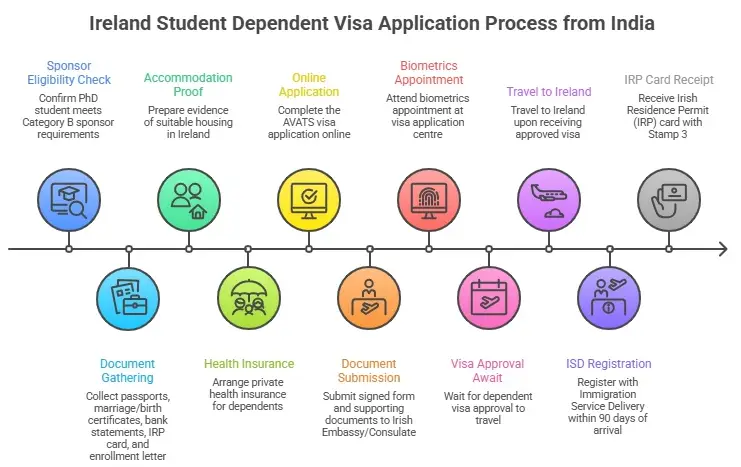
The step-by-step process to apply for the Ireland student dependent visa is as follows:
Step 1: Confirm the PhD student’s eligibility as a Category B sponsor.
Step 2: Gather all required documents such as passports, marriage certificate or birth certificates, 6-month bank statements, sponsor’s IRP card, and university enrollment letter.
Step 3: Prepare proof of suitable accommodation in Ireland for the sponsor and dependent family members.
Step 4: Arrange private health insurance for the dependent(s).
Step 5: Complete the online AVATS visa application through the official site..
Step 6: Submit the signed form along with all supporting documents to the relevant Irish Embassy or Consulate in India.
Step 7: Attend a biometrics appointment at the visa application centre on the scheduled date.
Step 8: Await the dependent visa approval to fly to Ireland.
Step 9: Upon receiving the approved dependent visa, travel to Ireland.
Step 10: Register with the Immigration Service Delivery (ISD) within 90 days of arrival.
Step 11: Receive the Irish Residence Permit (IRP) card with Stamp 3.
Financial Requirements for the Ireland Student Dependent Visa
The PhD student sponsor must demonstrate the ability to financially support themselves and all dependent family members without relying on Irish public funds or State benefits. There is no fixed minimum income threshold for PhD student sponsors (Category B) bringing their family (spouse and children under 18).
| Financial Requirement | Details |
|---|---|
| Income threshold for nuclear family (spouse, civil partner, children under 18) | No fixed minimum income threshold required for Category B sponsors (PhD students) sponsoring nuclear family members — financial self-sufficiency must be demonstrated through bank statements |
| Bank statements required | Detailed 6-month statements for both applicant and sponsor, covering the period immediately before the application |
| No reliance on public funds | Sponsor and dependents must not rely on Irish State benefits, welfare, public housing, or other public funds at any time |
| PhD stipend or scholarship income | Stipends, scholarship funding, and research grants are accepted as evidence of income — must be documented and verifiable |
| Accommodation costs evidence | Bills, rent, or mortgage documents to show the sponsor’s regular living expenses in Ireland |
| Health insurance costs | Evidence of valid private health insurance for sponsor and all dependents must be available |
| Dependent parents or adult children (Category B) | A 2-year waiting period applies for PhD student sponsors sponsoring dependent parents or dependent adult children with serious medical conditions — financial and medical evidence required; subject to official confirmation |
Also, read...
Jobs in Ireland for Indians: How to Land a Job & Apply for a Work Visa
Accommodation Requirements for the Ireland Student Dependent Visa
The revised Non-EEA Family Reunification Policy, updated in November 2025, introduced a clear accommodation requirement. Sponsors must provide evidence of suitable accommodation in Ireland for themselves and all dependent family members. This is a mandatory requirement at the time of the visa application.
Acceptable proof of accommodation includes a signed tenancy agreement in the sponsor’s name, a letter from the Irish university confirming on-campus or university-managed accommodation, evidence of property ownership, or a statutory declaration from the occupant or owner of the property. The accommodation must be suitable for the number of family members who will be residing there. Overcrowded or substandard accommodation may result in a visa refusal.
Private Health Insurance Requirements
All dependents travelling to Ireland on a D – Join Family visa must hold valid private health insurance. Stamp 3 holders are not permitted to use publicly funded hospitals or services. Private health insurance ensures dependents have access to medical care without placing a burden on the Irish health system.
- Private health insurance must be valid from the date of entry into Ireland.
- The visa officer may request evidence of insurance during the application assessment.
- Insurance must cover the dependent for the full duration of their stay in Ireland.
- You may be asked to present evidence of insurance to the Immigration Officer at the port of entry.
- Both the sponsor and all dependents must hold valid private health insurance.
Immigration Permission (Stamp Type) for Dependents
After arriving in Ireland and registering with ISD, dependents receive the following immigration permissions:
| Dependent | Immigration Permission (Stamp) | Key Conditions |
|---|---|---|
| Spouse / Civil Partner | Stamp 3 | May reside and study in Ireland; cannot work, engage in business, trade, or profession; cannot access publicly funded health services; must hold private health insurance; must renew annually |
| Children under 16 years | No IRP stamp required in most cases | May attend Irish schools; passport inscribed at port of entry; follows the sponsor’s permission period |
| Children aged 16–18 years | Stamp 1G (subject to official confirmation with ISD) | May take up employment without a separate employment permit; may study; linked to sponsor’s permission period |
| Dependent adult children (serious condition) | Stamp 3 — assessed case by case | Limited eligibility: must demonstrate serious medical or psychological condition making independent life unsustainable; 2-year waiting period applies for PhD student sponsors |
Note: Time spent on Stamp 3 is reckonable residence for the purposes of applying for Irish citizenship by naturalisation subject to meeting the overall residency and other requirements under Irish law.
What Happens After the PhD: Plan Your Family’s Future in Ireland
If you plan to stay in Ireland after completing your doctorate, your family rights can improve significantly with the right employment permit. Here is what to expect:
- After graduation, most non-EEA PhD graduates receive Stamp 1G (Third Level Graduate Programme) up to 24 months to find employment. Family reunification is not available at the Stamp 1G stage.
- Once the graduate secures a Critical Skills Employment Permit (CSEP), they become a Category B sponsor again. The spouse or de facto partner immediately qualifies for Stamp 1G with full and unrestricted work rights for any employer in Ireland, without a separate work permit.
- After 2 years on a CSEP, the permit holder becomes eligible for Stamp 4 with stronger work, study, and residence rights for the entire family.
- After 5 years of legal residence in Ireland, Long Term Residency can be applied for.
- Time spent on Stamp 3 (dependent visa) counts towards reckonable residence for Irish citizenship by naturalisation.
Also, read...
Highest paying Jobs in Ireland for Indians
Market Trends: Ireland Student Dependent Visa
- India is one of the largest source countries for non-EEA PhD students at Irish universities. Indian doctoral students are enrolled at Trinity College Dublin, University College Dublin, University College Cork, NUI Galway, Dublin City University, and other leading Irish research institutions.
- Ireland’s pharmaceutical, technology, and research sectors are among the strongest in Europe — attracting Indian PhD students in STEM fields and generating growing demand for the Ireland student dependent visa from Indian families.
- The revised Non-EEA Family Reunification Policy (November 2025) maintained PhD student sponsors as Category B preserving their right to immediate family reunification with no income threshold for nuclear family members.
- Accommodation requirements were strengthened under the November 2025 policy update. Sponsors must provide clear evidence of suitable housing for all family members at the time of the application.
- Ireland’s English-speaking environment, EU membership, low crime rate, and world-class universities continue to make it a top destination for Indian PhD researchers and their families.
- Growing numbers of Indian graduates who complete doctorates in Ireland are transitioning to Critical Skills Employment Permits unlocking Stamp 1G work rights for their spouses and a clearer pathway to Irish permanent residency and citizenship.
Also, read...
How Can Y-Axis Help with Your Ireland Student Dependent Visa?
As the world’s No. 1 overseas immigration consultancy, Y-Axis has been providing reliable, personalised immigration services for 25+ years with over 10 lakh clients assisted. Our Ireland immigration experts provide complete, end-to-end assistance including:
- Free eligibility assessment — confirm whether the PhD student qualifies as a Category B sponsor under Ireland’s current Non-EEA Family Reunification Policy
- Personalised document checklist for the PhD student and all dependent family members
- AVATS online visa application guidance, review, and submission support
- Supporting letter preparation — university enrolment confirmation, accommodation letters, and relationship evidence guidance
- Private health insurance guidance — identifying suitable options for Ireland
- Accommodation evidence support — helping document suitable housing
- Bank statement guidance — ensuring financial documentation meets visa officer requirements
- Post-arrival IRP registration assistance — appointment booking and required documents
- Annual Stamp 3 renewal guidance — ensuring timely renewal to avoid lapses in permission
- Post-PhD career planning — CSEP application support to unlock Stamp 1G work rights for the spouse
- Long-term Ireland immigration roadmap — from PhD student dependent visa through to Stamp 4, Long Term Residency, and Irish citizenship
- General Employment Permit (GEP) or CSEP profile evaluation for graduating PhD students
- BLS International / Irish Embassy submission guidance for Indian applicants
- Resume and Ireland job search assistance for graduating PhD students
Join over 10 lakh clients served by Y-Axis. Book a free Ireland Visa Consultation today.
Call +91-7670800000 | info@y-axis.com | www.y-axis.com
Y-Axis snapshot
1M
Successful applicants
1500+
Experienced counselors
25Y+
Expertise
50+
Offices
Don't know what to do ?
Get Free Counseling
Looking for Inspiration
Explore what Global Indians have to say about Y-Axis in shaping their future