


Posted on April 11 2026
Jobs in Ireland for Indians: How to Land a Job & Apply for a Work Visa

By , Editor & Director
Updated April 21 2026
Ireland is one of the top destinations for Indian professionals seeking career opportunities abroad. Foreign professionals are migrating to Ireland due to its strong economy, growing demand for skilled talent, and the presence of global companies across multiple job sectors. Some of the most in-demand sectors in Ireland include information technology, healthcare, engineering, finance, and pharmaceuticals, all of which have high levels of job vacancies. Skilled workers are being actively recruited across these in-demand fields to address Ireland's workforce shortage. To find a job in Ireland, Indian professionals need a relevant educational qualification and a comprehensive portfolio aligned with the country's job standards. Upon job confirmation, professionals must apply for an Irish work visa, such as a Critical Skills Employment Permit or General Employment Permit, based on their qualifications and criteria.
*Want to apply for an Ireland work visa? Let Y-Axis guide you with the process.
Benefits of Working in Ireland
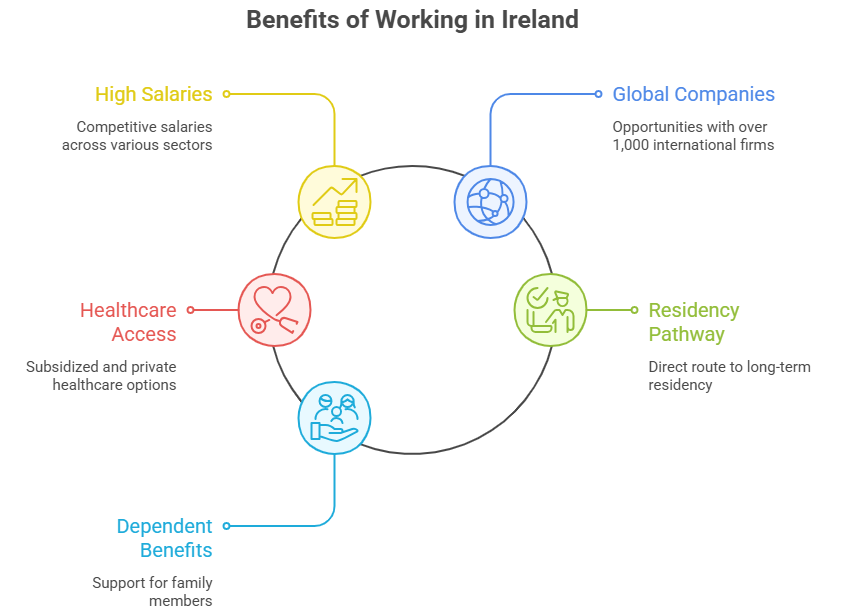
Working in Ireland provides access to a high quality of life, strong employee protection laws, healthcare facilities, and competitive salaries across the tech, finance, and healthcare sectors.
The benefits of working in Ireland as a foreign professional are as follows:
- High average gross median salary of around €55,000+ across technology, construction, and banking & finance.
- 1,000+ global companies for sales, tech, customer service, and operations professionals.
- Subsidized healthcare access.
- Private health insurance.
- Direct pathway to long-term residency and permanent settlement.
- Dependent benefits for Ireland work permit holders.
Also, read...
Highest paying Jobs in Ireland for Indians
In-demand jobs in Ireland for Indians
The in-demand jobs in Ireland are mainly centered around technology, engineering, healthcare, and finance sectors. The growing skills shortage across these sectors has led the country to attract foreign talent through competitive salaries, long-term work permits, and streamlined Ireland PR pathways. Some of the most in-demand jobs in Ireland for Indians include roles in information technology, such as software developers, data analysts, cybersecurity specialists, and cloud engineers. The healthcare sector in Ireland also has a high demand for skilled foreign professionals due to an aging population requiring elderly care services.
| Sector | In Demand Roles | Avg. Monthly Salary (EUR) | Approx. in INR | Qualification Required |
|---|---|---|---|---|
| IT and Technology | Software Engineer, Data Analyst, Cloud Architect, Cybersecurity Specialist, DevOps Engineer, AI ML Engineer | €4,500 to €7,500 | ₹4.1L to ₹6.8L | Bachelor's or Master's in Computer Science, IT or related field. MNC experience preferred |
| Pharma and Life Sciences | Pharmaceutical Scientist, QC Analyst, Regulatory Affairs Specialist, Biomedical Engineer, Lab Technician, Validation Engineer | €4,000 to €6,500 | ₹3.6L to ₹5.9L | Degree in Pharmacy, Chemistry, Biochemistry or Life Sciences. GMP knowledge preferred |
| Healthcare and Medicine | General Physician, Registered Nurse, Specialist Doctor, Physiotherapist, Radiographer, Pharmacist | €3,200 to €7,500 | ₹2.9L to ₹6.8L | Medical or Nursing degree plus CORU or IMC registration |
| Finance and Banking | Financial Analyst, Risk Manager, Compliance Officer, Fund Accountant, Auditor, Investment Analyst | €4,500 to €7,000 | ₹4.1L to ₹6.4L | Finance or Economics degree. ACA, CFA or CPA preferred |
| Engineering Civil and Electrical | Civil Engineer, Electrical Engineer, Structural Engineer, Project Manager, Quantity Surveyor | €3,800 to €5,500 | ₹3.5L to ₹5.0L | Bachelor's or Master's in Engineering. Engineers Ireland membership preferred |
| Renewable Energy | Wind Energy Engineer, Solar Technician, Energy Project Manager, Environmental Engineer, Sustainability Consultant | €3,500 to €5,500 | ₹3.2L to ₹5.0L | Engineering or Environmental Science degree with project experience |
| Manufacturing and MedTech | Production Engineer, Mechatronics Engineer, Medical Device Technician, Quality Manager, Process Engineer | €3,500 to €5,200 | ₹3.2L to ₹4.7L | Bachelor's degree in Engineering or related field. Experience in manufacturing or medical devices preferred |
Also, read...
Ireland Job Market in 2026-30
How to find a job in Ireland from India?
To find a job in Ireland from India, you need to research in-demand job roles across the developing sectors. Foreign professionals need to prepare a comprehensive resume/CV aligned with the Irish job market and network on a reliable job search platform to connect with authorized employers.
The steps to find a job in Ireland for Indians are as follows:
Step 1: Identify in-demand sectors in Ireland facing critical skill shortages, such as IT, engineering, healthcare, and finance.
Step 2: Select job roles that are aligned with your field, qualification, and experience from reliable job search platforms.
Step 3: Draft a comprehensive resume/CV that describes your work experience, skills, and qualifications to meet the Irish job market standards.
Step 4: Optimize and register your LinkedIn profile to reflect expertise in demand in Ireland.
Step 5: Connect with recruiters on LinkedIn to build a professional network with an Irish employer.
Step 6: Appear for interviews for the job roles you are shortlisted for.
Step 7: Await offer letter/employment contract upon job confirmation.
Step 8: After receiving the offer letter, apply for a work permit with the necessary documents.
Step 9: Submit the work visa application once your work permit is approved.
Step 10: Upon work visa approval, migrate to Ireland to work in skilled roles.
Also, read...
How Can I Migrate to Ireland as a Software Engineer?
Ireland work visa for Indians
An Ireland work visa for Indians requires a job offer from an authorized Irish employer. Upon securing an employment permit and meeting requirements, foreign professionals can apply for an Ireland work visa. The requirements for an Ireland work visa include a minimum salary of €30,000+, relevant qualifications, and a long-stay D visa application. It takes around 6–8 weeks to process an Irish work visa from India. The overall approval period may vary depending on the permit type and the accuracy of the documents.
| Permit Type | Who It's For | Eligibility Criteria | Validity Period | Processing Time | Renewable |
|---|---|---|---|---|---|
| General Employment Permit (GEP) | Non-EEA workers in construction, manufacturing, logistics, hospitality, healthcare support, and trades | Confirmed job offer, minimum salary €36,605 (from March 2026), Labour Market Needs Test required, employer must advertise role for 28 days, 50% workforce must be EEA nationals | Up to 2 years (1 year for fixed-term contracts) | 4 to 10 weeks | Yes, renewable; eligible for Stamp 4 after 57 months |
| Critical Skills Employment Permit (CSEP) | Highly skilled professionals in IT, engineering, healthcare, pharma, finance, and science | Minimum salary €40,904 (listed roles) or €68,911 (non-listed), relevant degree or 5+ years experience, 2-year job offer required, no LMNT | Up to 2 years | 4 to 8 weeks | Yes; eligible for Stamp 4 after 21 months |
| Seasonal Employment Permit (SEP) | Workers in agriculture, horticulture, and seasonal hospitality | Approved seasonal employer, no degree required, seasonal job offer required | 3 to 7 months within a 12-month period | 4 to 8 weeks | No; must reapply each season |
| Intra-Company Transfer Permit (ICT) | Senior managers, specialists, and trainees transferred within multinational companies | Minimum salary €49,523 (senior roles), 6 months company experience (1 month for trainees), no LMNT | Up to 2 years (extendable to 5 years) | 3 to 8 weeks | Yes; extendable up to 5 years |
| Researcher / Academic Permit | Non-EEA academics and researchers joining Irish institutions | Hosting agreement with accredited institution, PhD or advanced qualifications required | Duration of research project (up to 2 years) | 2 to 6 weeks | Yes; eligible for Stamp 4 after 21 months |
| Contract for Services Permit | Employees of foreign companies working on Irish service contracts | 6 months overseas employment, minimum salary €40,000, LMNT required unless critical skills role | Duration of contract (up to 5 years) | 4 to 10 weeks | Yes; renewable within 5-year cap |
| Internship Employment Permit | Non-EEA students seeking work experience in Ireland | Enrolled in overseas university, internship mandatory, role must be on Critical Skills list, minimum wage €14.15/hour | Maximum 12 months | 3 to 6 weeks | No; single-use permit |
| Reactivation Employment Permit | Former permit holders who lost status due to employer issues | Must previously hold permit, loss of status not applicant’s fault, no LMNT required | Up to 2 years (extendable to 3 years) | 4 to 8 weeks | Yes; eligible after 5 years |
| Dependent / Partner / Spouse Permit | Dependants of Critical Skills or Hosting Agreement holders | Available for dependants, all occupations except domestic work, no LMNT required | Up to 2 years (linked to primary permit) | 4 to 8 weeks | Yes; renewable |
| Sport and Cultural Employment Permit | Professionals in sports and cultural sectors | Relevant qualifications, employer must be a registered organisation | Up to 2 years | 4 to 8 weeks | Yes; extendable |
*Want to work in Ireland? Sign up with Y-Axis for end-to-end assistance.
Eligibility requirements for the Ireland work visa
To apply for an Irish work visa, you need to secure a valid job offer with an employment contract meeting the minimum salary threshold.
The eligibility criteria to apply for an Ireland work visa are as follows:
- Employment contract/job offer letter.
- Valid Employment Permit from the Department of Enterprise, Trade and Employment (DETE).
- Educational degree/diploma (Bachelor’s/Master’s).
- Minimum salary threshold (€30,000+ to €64,000+)
- Proof of a positive Labor Market test.
- Medical/travel insurance.
- Valid passport.
Also, read...
Ireland Offers ₹75 Lakh Scholarships for Indian Students – Apply Now
How to apply for an Ireland work visa from India?
Applying for an Ireland work visa from India requires you first to secure a job offer from an Irish employer meeting the salary requirements. Upon securing the employment permit via the Employment Permits Online System (EPOS), foreign nationals can apply for the work visa (standard Long-Stay D Visa).
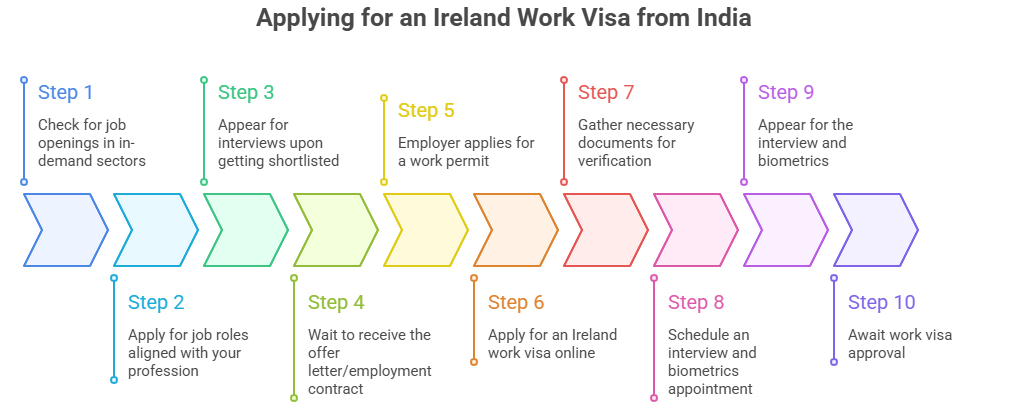
The steps to apply for an Ireland work visa from India are as follows:
Step 1: Check for job openings across in-demand sectors in Ireland, such as IT, engineering, and healthcare.
Step 2: Apply for job roles aligned with your profession across reliable job search platforms.
Step 3: Appear for interviews upon getting shortlisted for the roles.
Step 4: Upon job confirmation, wait to receive the offer letter/employment contract.
Step 5: The employer applies for a work permit (e.g., Critical Skills or General Employment Permit) through the DETE.
Step 6: Upon securing the work permit, apply for an Ireland work visa online via the official website.
Step 7: Gather the necessary documents for verification, including a passport, work permit, insurance, and proof of funds.
Step 8: Schedule an interview and biometrics appointment at the nearest VFS Global Center in India.
Step 9: Appear for the interview, have your documents verified, and have your biometrics collected on the scheduled date.
Step 10: Await work visa approval to fly to Ireland for long-term work and settlement.
*Are you looking for step-by-step assistance with overseas immigration? Contact Y-Axis, the world’s No. 1 overseas immigration consultancy, for end-to-end assistance!
FAQs
Is Ireland currently hiring foreign workers?
Yes, Ireland is actively hiring foreign workers this year to fill a large skills gap across sectors such as healthcare, technology, engineering, construction, and hospitality. Foreign workers need a valid employment contract and work permit, such as a Critical Skills Permit or a General work permit, to live and work in the country.
What are the most in-demand jobs in Ireland?
The most in-demand jobs in Ireland span sectors such as technology, healthcare, and engineering. These sectors are booming, with high job vacancies driven by technological advances, and require foreign talent to build a strong workforce. Top roles for foreign professionals in Ireland include software developers, data analysts, cybersecurity specialists, nurses, pharmacists, and mechanical/civil engineers.
Is it easy for Indians to find a job in Ireland?
Yes, it is easy for Indians with high educational qualifications and skills across high-demand sectors like IT, healthcare, engineering, and finance to find jobs in Ireland. Indian workers need to secure a sponsored job offer and a Critical Skills Employment Permit to work legally in Ireland.
Can Indians apply for Irish work visas without a job offer?
No, Indians cannot apply for an Irish work visa without a job offer. Indian workers must secure a valid employment contract/permit from an Irish employer, and must apply for an Irish work visa. Upon job confirmation, the Irish employer will provide the Critical Skills Employment Permit required for a work visa.
What documents are required for an Irish work visa from India?
The documents required to apply for an Irish work visa from India are as follows:
- Application Summary Sheets
- Original/copy of the Employment permit issued by the Department of Enterprise, Trade and Employment (DETE)
- Job offer letter/employment contract
- Valid passport
- Education degree/diploma
- Proof of sufficient funds
- Medical/travel insurance coverage
- Valid passport
What qualifications do I need to work in Ireland?
To work in Ireland, you must have the following qualifications:
- Valid job offer from a certified Irish employer
- A university degree (Level 8 or higher on the Irish Qualifications Framework) or equivalent
- Professional work experience
- Specialized technical skills
What is the average salary of foreign workers in Ireland?
The average salary of foreign workers in Ireland is around €44,202 to €45,000. The monthly gross salary for mid-level foreign workers is approximately € 3,683. Critical Skills Employment Permit holders earn higher salaries, up to €60,000, for specialized and senior roles.
Which cities in Ireland are best for Indian workers?
The best cities in Ireland for Indian workers include Dublin, Cork, Galway, and Limerick, with strong job markets in tech, pharma, and finance. Cities like Dublin have high job vacancies, while Cork, Galway, and Limerick have comparatively lower cost of living and high-demand industries.
How long does it take to get an Irish work visa from India?
The processing time of an Irish work visa from India is approximately 4 to 10 weeks. The average processing time may vary by permit type, with long-stay employment visas taking 3 to 4 months to be approved.
What is the success rate for an Irish work visa from India?
The success rate for Ireland's work visa from India is very high due to streamlined immigration pathways and opportunities for long-term work. Ireland's work visa success rate for Indians is estimated to be around 92% to 96% due to high demand for Indian skilled workers in Ireland's skills-shortage job market.
Tags:
working in Ireland
work in Ireland
in-demand jobs in Ireland
Ireland work visa for Indians
Ireland work visa
Ireland work visa from India
Ireland immigration
migrate to Ireland
highest-paying jobs in Ireland
jobs in Ireland for Indians
Share
Options for you by Y-Axis

Get it on your mobile

Get News alerts

Contact Y-Axis
Latest Article
Popular Post
Trending Article

Posted On October 14 2026
Australia’s New Student Visa Rules: What Indian Students Need to Know in 2026