


Don't know what to do ?
Get Free Counseling
Last Updated 18-May-2026
About the Ireland Work Dependent Visa
The Ireland Work Dependent Visa also called the Ireland Join Family (Long Stay D) Visa allows the spouse, de facto partner, and dependent children of an Irish employment permit holder to come and live in Ireland. Once granted, dependants can register for an Irish Residence Permit (IRP) and, in most cases, also work in Ireland.
If your spouse or parent holds a Critical Skills Employment Permit (CSEP), a Hosting Agreement as a researcher, or is a doctor on Stamp 1H, your family can apply to join them in Ireland straight away with no waiting period. For General Employment Permit (GEP) holders and other employment permit types, a 12-month waiting period applies before the family can apply.
The Ireland Work Dependent Visa is the official family reunification pathway for non-EEA nationals whose family members are working in Ireland on a valid employment permit. It is governed by Ireland’s Non-EEA Family Reunification Policy, which was updated in November 2025.
The number of Indian professionals working in Ireland on Critical Skills and General Employment Permits has grown sharply in recent years, especially in technology, healthcare, and engineering. This makes the Ireland Work Dependent Visa one of the most sought-after family visas for Indian families.
*Want to apply for Ireland work dependent visa? Sign up with Y-Axis for end-to-end assistance.
Ireland Work Dependent Visa: Key Facts at a Glance
|
Category |
Details |
|
Visa Type |
Long Stay ‘D’ – Join Family Visa / Ireland Work Dependent Visa under Non-EEA Family Reunification Policy |
|
Applicable For |
Dependants of Critical Skills Employment Permit (CSEP) holders, General Employment Permit (GEP) holders, Intra-Corporate Transferee (ICT) permit holders, researchers on Hosting Agreements, doctors on Stamp 1H, and other qualifying employment permit holders |
|
Who Can Apply |
Legally married spouse or civil partner; de facto partner (relationship of 2+ years); dependent children under 18; and older children who are wholly financially dependent on the permit holder |
|
Waiting Period |
CSEP holders, researchers on Hosting Agreement, and doctors on Stamp 1H: no waiting period. All other employment permit holders: 12-month waiting period |
|
Work Rights for Spouse |
Spouses and partners of CSEP, GEP, and ICT holders: Stamp 1G – full work rights, no separate employment permit needed. Other dependants may apply for a Dependant/Partner/Spouse Employment Permit (free, no Labour Market test) |
|
Work Rights for Children |
Children of CSEP, GEP, and ICT holders receive Stamp 1G at age 16 – no separate employment permit required (from November 2025) |
|
Study Rights |
Yes – children entitled to free state primary and secondary education in Ireland; spouses can access colleges and universities without restriction |
|
Visa Fee (Single Entry) |
€60 (approx. INR 5,580) |
|
Visa Fee (Multi-Entry) |
€100 (approx. INR 9,300) |
|
IRP Renewal Fee |
€300 per renewal (approx. INR 27,900) |
|
Processing Time |
Up to 12 months from receipt of all required documentation (subject to application volumes) |
|
Financial Requirement |
Sponsor must meet minimum income requirement: €30,000+ per year (varies by permit type and family size) |
|
Health Insurance |
Must be held at time of entry – may be requested by immigration officer at port of entry |
|
Language Requirement |
None specified |
|
Application Method |
Online via AVATS (www.visas.inis.gov.ie) + submission of supporting documents to Irish visa office or embassy |
|
Citizenship Pathway |
After 5 years of reckonable residence in Ireland (out of last 9 years) – including 1 year continuous residency immediately before application. India allows dual citizenship — Irish passport holders can retain Indian OCI status |
Ireland Work Dependent Visa: Overview
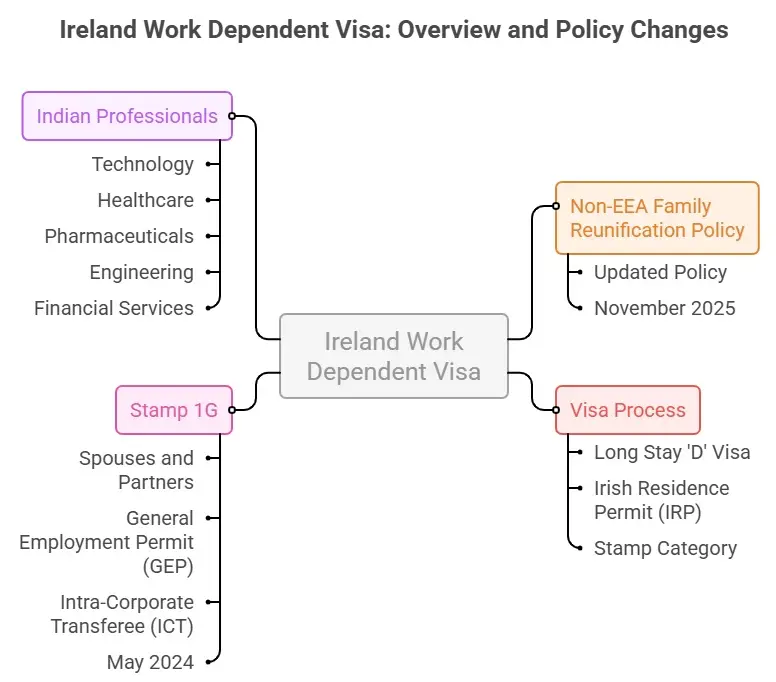
The Ireland Work Dependent Visa is the immigration pathway that allows the families of Irish employment permit holders to live together in Ireland. It falls under Ireland’s Non-EEA Family Reunification Policy, which was updated in November 2025.
Unlike some countries, Ireland does not have a single ‘dependent visa’ card. Instead, a family member is granted a long stay ‘D’ visa to travel to Ireland. Once there, they register with the Irish immigration authorities and receive an Irish Residence Permit (IRP) with a stamp category that defines their rights including whether they can work.
Since May 2024, spouses and partners of General Employment Permit (GEP) and Intra-Corporate Transferee (ICT) permit holders have been upgraded to Stamp 1G meaning they can work freely in Ireland without needing a separate employment permit. This major policy change means that almost all spouses and partners of work permit holders in Ireland now have full, unrestricted work rights.
Indian professionals are one of the largest groups working in Ireland on employment permits, particularly in technology, healthcare, pharmaceuticals, engineering, and financial services. This creates a high and growing demand for the Ireland Work Dependent Visa from Indian families.
Benefits of the Ireland Work Dependent Visa for Indian Families
The Ireland Work Dependent Visa gives Indian families a strong and comprehensive package in one of Europe’s fastest-growing economies. The benefits include:
- Full work rights for spouses and partners with no separate employment permit needed for most permit holders.
- Free state primary and secondary education for dependent children.
- Access to Ireland’s public healthcare system (HSE) after registration.
- Spouses can study at any Irish college or university without restriction.
- Dependent children of CSEP, GEP, and ICT holders receive Stamp 1G at age 16 with full work rights without a separate permit.
- Clear pathway to Irish citizenship after 5 years of residence.
- Ireland allows dual citizenship — Indian nationals can become Irish citizens and continue to hold OCI (Overseas Citizen of India) status.
- Ireland is an English-speaking EU member state — Irish citizenship opens doors to live and work across all 27 EU countries.
- No language test requirement for dependants.
- Strong job market especially in technology, pharmaceuticals, financial services, and healthcare.
Also, read...
Highest-paying jobs in Ireland for Indians
Ireland Work Visa & PR Pathway Explained
Planning to join your spouse or family in Ireland on a dependent visa? Understanding Ireland’s growing job market, long-term settlement opportunities, and PR pathways can help you make informed decisions for your future abroad. This video explains why Ireland continues to attract skilled professionals and families in 2026, especially through the Critical Skills Employment Permit pathway.
Watch to Know More:
Who Is Eligible for the Ireland Work Dependent Visa?
Eligible Dependants
The following family members of a primary Irish employment permit holder may apply for the Ireland Work Dependent Visa:
- Legally married spouse in a marriage recognised under Irish law.
- Civil partner in a registered civil partnership recognised under Irish law.
- De facto partner — a committed relationship similar to marriage but without formal registration. Must demonstrate at least 2 years of relationship.
- Unmarried dependent children under 18 years of age — biological, adopted, or step-children.
- Older children (18 and above) who are wholly financially dependent on the permit holder and cannot support themselves independently.
Note: Parents, siblings, grandparents, and other extended family members are generally not eligible under this route. They may be considered only in exceptional or compassionate circumstances.
Sponsor (Primary Applicant) Requirements
|
Requirement |
Details |
|
Employment Permit Type |
Must hold a valid Irish employment permit — Critical Skills, General, ICT, Hosting Agreement (researcher), or doctor on Stamp 1H |
|
Minimum Residence (for GEP & others) |
Must have been working in Ireland for at least 12 months before the family can apply (CSEP, researchers, Stamp 1H: no waiting period) |
|
Minimum Income |
€30,000+ per year as a baseline (varies by permit type and number of dependants – see Financial Requirements section) |
|
Employment Contract |
Must have a valid employment contract of at least 1 year from the proposed date of family entry |
|
No Public Funds |
Must not be relying on Irish state welfare or public funds |
|
Good Character |
Must not have criminal record or immigration violations that would prevent sponsorship |
|
Continuing Residence |
Must currently be resident and working in Ireland at the time of the family’s application |
*Want to apply for Ireland work visa? Let Y-Axis guide you with the process.
Dependant Eligibility Requirements
|
Requirement |
Details |
|
Visa (if visa-required national) |
Must be granted a long stay ‘D’ – Join Family visa before travelling to Ireland (applies to Indian nationals) |
|
Genuine Relationship |
Must demonstrate a genuine and subsisting relationship with the sponsor — evidence of face-to-face meetings, correspondence, photographs required |
|
De Facto Partners |
Must show relationship of at least 2 years in duration |
|
Financial Dependence |
Must demonstrate genuine financial dependence on the sponsor for living costs |
|
No Public Funds |
Family member must not be relying or intending to rely on Irish state welfare |
|
Legal Entry |
Must enter Ireland legally – unlawful presence at time of application can result in refusal |
|
Good Character |
Must be of good character and comply with Irish laws |
|
Children (additional) |
Must be unmarried and under 18; or wholly financially dependent if over 18; living with sponsor as part of family unit |
|
Previous Visa Refusals |
All previous visa refusals for any country must be declared – non-disclosure results in refusal |
Can Ireland Work Dependent Visa Holders Work in Ireland?
Yes — and Ireland’s rules on this have become significantly more favourable in recent years. Here is a complete breakdown of work rights for each category of dependant:
|
Dependant Category |
Work Rights |
Stamp Issued |
|
Spouse/partner of CSEP holder, researcher (Hosting Agreement), or doctor (Stamp 1H) |
Full work rights — no separate employment permit required from day of registration |
Stamp 1G |
|
Spouse/partner of General Employment Permit (GEP) holder |
Full work rights — no separate employment permit required (change effective May 2024) |
Stamp 1G |
|
Spouse/partner of Intra-Corporate Transferee (ICT) holder |
Full work rights — no separate employment permit required (change effective May 2024) |
Stamp 1G |
|
Dependent children of CSEP, GEP, or ICT holders turning 16 |
Full work rights — no separate employment permit required (change effective November 2025) |
Stamp 1G |
|
Other adult dependants of other permit types |
May apply for a Dependant/Partner/Spouse Employment Permit — no Labour Market Needs Test required, applications are free of charge, no sector restriction except domestic operative |
Stamp 3 with permit |
|
Dependants of other employment permit holders |
Must apply for their own employment permit in the relevant category |
Stamp dependent on permit |
|
Work Activity |
Permitted for Spouse/Partner (Stamp 1G)? |
|
Full-time employment (any sector) |
Yes — unrestricted; no separate employment permit required |
|
Part-time employment |
Yes — unrestricted |
|
Self-employment / freelance work |
Yes — permitted under Stamp 1G conditions |
|
Change employer freely |
Yes — no restriction on employer |
|
Work anywhere in Ireland |
Yes — no geographic restriction |
|
Work for any sector |
Yes — no sector restriction under Stamp 1G |
|
Domestic operative role |
Not permitted under Dependant/Partner/Spouse Employment Permit (other permit types may apply) |
|
Separate Irish employment permit required? |
No — Stamp 1G holders work without a separate permit |
Also, read...
Study Rights for Ireland Work Dependent Visa Holders
Dependants on an Irish residence permit can study at any registered Irish educational institution without restriction. This includes school-age children, who receive free state education, and adult spouses who can attend colleges and universities.
|
Study Aspect |
Details for Dependants |
|
Spouse / Partner |
Can study full-time or part-time at any Irish university, college, or vocational school without restriction on their Stamp 1G or Stamp 3 permission |
|
School-age children |
Compulsory free state education in Irish primary and secondary schools for all children residing in Ireland |
|
English language courses |
Available at Irish language schools and colleges — most ETB (Education and Training Board) English courses are subsidised |
|
Further Education (FE) colleges |
Dependants may enrol in vocational training, QQI qualifications, apprenticeships, and professional certification courses |
|
Irish universities |
Dependants can apply to any Irish university; study fees may vary depending on immigration status and duration of residence |
|
Apprenticeships |
Stamp 1G holders can access Irish apprenticeship programmes — paid employment with structured training |
Ireland Work Dependent Visa Fees
|
Fee Type |
Amount (EUR) |
Amount (INR approx.) |
|
Single Entry ‘D’ Join Family Visa |
€60 |
INR 5,580 approx. |
|
Multi-Entry ‘D’ Join Family Visa |
€100 |
INR 9,300 approx. |
|
Visa fee is non-refundable |
Applies even if application is refused or withdrawn |
— |
|
IRP (Irish Residence Permit) Renewal Fee |
€300 per renewal |
INR 27,900 approx. |
|
Dependant/Partner/Spouse Employment Permit (if applicable) |
Free of charge |
No fee |
|
Document translation (per document, if required) |
€50 to €150 approx. |
INR 4,650 to INR 13,950 approx. |
|
Irish citizenship application fee |
€175 (application) + up to €950 (certification) |
INR 16,275 + INR 88,350 approx. |
|
Y-Axis Professional Consultancy Fee |
As per service package |
As per service package |
Note: EUR to INR based on approximate rate of 1 EUR = INR 93. Visa fees apply to most non-EEA nationals. Family members of Irish citizens may be exempt from visa fees — confirm with Y-Axis advisers.
Ireland Work Dependent Visa Processing Time
|
Stage |
Estimated Time |
|
Gathering and organising documents |
2 to 4 weeks |
|
Online AVATS visa application submission |
1 to 3 days once documents are ready |
|
Visa processing by Irish Visa Office / Embassy |
Up to 12 months from receipt of all required documentation |
|
Travel to Ireland and registration with GNIB / Immigration Office |
Within 90 days of arrival in Ireland |
|
IRP (Irish Residence Permit) issuance |
At registration appointment after arrival |
|
IRP renewal |
Apply before current permission expires; €300 fee |
|
Total typical timeline from application to arrival |
6 to 12+ months depending on visa office and application completeness |
Note: Processing times reflect the detailed assessment required for family reunification. High application volumes are currently causing delays at the Domestic Residence and Permissions Division. Submitting a complete document set at the time of application significantly reduces the risk of delays or requests for additional information.
Documents Required for the Ireland Work Dependent Visa
Documents for Spouse / Civil Partner / De Facto Partner
- Valid current passport — must be valid for at least 12 months
- Signed and dated AVATS online visa application summary form
- Two recent colour passport photographs (not more than 6 months old)
- Signed letter of application: full contact details, reason for coming to Ireland, details of sponsor
- Marriage certificate or civil partnership certificate (recognised under Irish law)
- For de facto partners: evidence of at least 2 years of genuine relationship — photographs, correspondence, travel records, joint accounts
- Proof of face-to-face meetings with the sponsor (visit records, passport stamps, photographs)
- Evidence of financial dependency on the sponsor
- Bank statements (6 months) from your own account
- Bank statements (6 months) from the sponsor’s account
- Details of any previous visa refusals for any country
Documents for Dependent Children
- Valid current passport for each child
- Signed AVATS visa application summary form for each child
- Two recent colour passport photographs for each child
- Full birth certificate showing both parents’ names
- For adopted children: adoption order
- For children from a previous relationship: court order granting custody; sworn affidavit from the other parent consenting to the child’s travel
- Evidence of financial dependency on the sponsor
- School enrolment or attendance records (if applicable)
Documents for the Sponsor (Primary Employment Permit Holder)
- Clear copy of all pages of their current passport
- Copy of their current Irish Residence Permit (IRP card)
- Copy of their current Irish employment permit (or Hosting Agreement / Stamp 1H letter)
- Employment contract of at least 1 year from the family’s proposed date of entry — showing annual salary
- 3 recent consecutive payslips from their Irish employer
- Employment Detail Summary (formerly P60) or Revenue notice of assessment if self-employed
- 6 months’ bank statements from their Irish bank account
- For GEP holders: evidence of 12 months’ employment in Ireland before the family application
Note: All documents not in English or Irish must be accompanied by a certified translation. Official documents issued outside the EEA (such as birth and marriage certificates) must be attested or apostilled as genuine by the Ministry of Foreign Affairs in the issuing country. Y-Axis can provide a personalised document checklist based on the sponsor’s permit type and family circumstances.
How to Apply for the Ireland Work Dependent Visa?
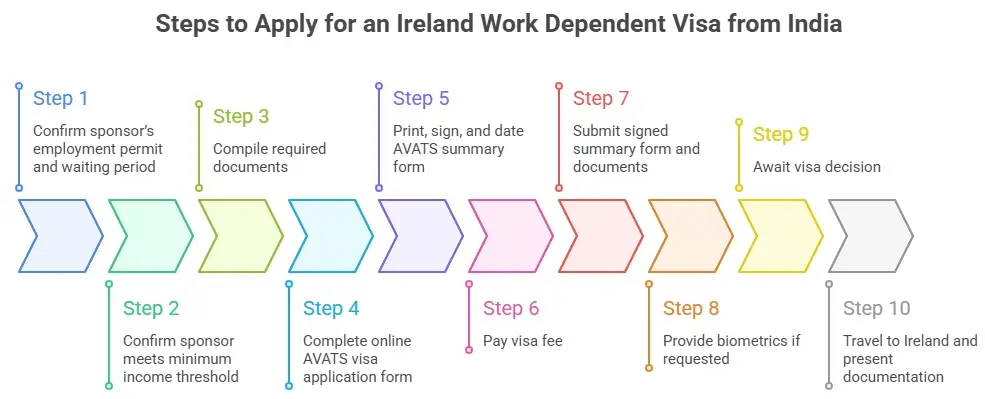
The steps to apply for an Ireland Work Dependent Visa from India are as follows:
Step 1: Confirm the sponsor’s employment permit type and whether the 12-month waiting period applies or not.
Step 2: Confirm that the sponsor meets the minimum income threshold for the number of family members applying.
Step 3: Compile all required documents: passports, marriage/birth certificates, relationship evidence, sponsor’s employment and financial documents.
Step 4: Complete the online AVATS visa application form at www.visas.inis.gov.ie for each family member.
Step 5: Print, sign, and date the AVATS summary form generated by the system.
Step 6: Pay the visa fee: €60 (single entry) or €100 (multi-entry) per applicant.
Step 7: Submit the signed summary form and all supporting documents to the relevant Irish Visa Office or Embassy (e.g., the Irish Embassy in New Delhi for Indian applicants).
Step 8: Provide biometrics if requested by the Irish visa office.
Step 9: Await the visa decision (up to 12 months from submission of complete documentation).
Step 10: On receiving the ‘D’ visa, travel to Ireland and present documentation to the immigration officer at the port of entry.
Step 11: Register with the Irish immigration registration office to receive the Irish Residence Permit (IRP) with the appropriate stamp (Stamp 1G or Stamp 3).
Step 12: Begin living and working in Ireland with full rights as per the stamp category.
Also, read...
Jobs in Ireland for Indians: How to Land a Job & Apply for a Work Visa
Financial Requirements for the Ireland Work Dependent Visa
The sponsor must demonstrate that they can financially support themselves and their dependants without relying on Irish public funds. This is a key requirement under Ireland’s Non-EEA Family Reunification Policy.
|
Financial Requirement |
Details |
|
Minimum income baseline |
€30,000+ per year as a general baseline for family reunification. Actual thresholds vary by permit type and number of dependants. |
|
General Employment Permit holders |
From 1 March 2026: minimum annual salary of €36,605 required. Actual GEP minimum applies; sponsor must also meet the family reunification income threshold. |
|
Critical Skills Employment Permit holders |
Minimum €40,904 per year (if on the Critical Skills Occupation List) or €68,911 if not on the list. CSEP holders are generally well above family reunification income thresholds. |
|
Income evidence required |
3 recent consecutive payslips from Irish employer; Employment Detail Summary / Revenue P60; employment contract showing annual salary |
|
Bank statement requirement |
6 months’ consecutive bank statements from the sponsor’s Irish bank account; 6 months’ bank statements from the dependant’s own account |
|
No public funds |
Both sponsor and dependants must not be relying on or applying for Irish welfare payments, social housing, or other state benefits |
|
Larger family sizes |
Higher income thresholds apply for sponsors bringing multiple dependants – confirm the applicable threshold with Y-Axis advisers before applying |
Note: Income thresholds are subject to periodic review and update by the Irish government. Always confirm the current applicable threshold with Y-Axis advisers before submitting your application.
Also, read...
Ireland Offers ₹75 Lakh Scholarships for Indian Students – Apply Now!
Accommodation Requirements for the Ireland Work Dependent Visa
Ireland’s family reunification policy requires that dependants and the sponsor normally live together as a family unit. Evidence of shared accommodation may be requested during the application or at registration.
|
Accommodation Requirement |
Details |
|
Living together as a family unit |
Sponsor and dependants must normally live together. They must not be living separately or apart on a permanent basis. |
|
Evidence that may be required |
Tenancy agreement or mortgage documents in the sponsor’s name at the Irish address; utility bills; evidence of living at the same address |
|
Adequate accommodation |
The home must be adequate for the family size. The visa officer may consider whether the accommodation is suitable. |
|
Living arrangement changes |
If the sponsor moves home in Ireland, dependants should update the immigration office of the new address. |
Language Requirements for the Ireland Work Dependent Visa
There is no formal language test requirement for dependants applying for the Ireland Work Dependent Visa or for registering an Irish Residence Permit. This is a significant advantage over some other countries’ dependent visa programmes.
Ireland is an English-speaking country, so most dependants can communicate effectively from arrival without needing a separate language qualification. However, ETB (Education and Training Board) English language classes are widely available across Ireland and are subsidised or free for eligible residents.
Ireland Work Dependent Visa: Validity and Key Conditions
|
Situation |
Rule |
|
Initial permission granted |
Permission is typically aligned to the sponsor’s permission period or granted for a set period – registered via IRP card |
|
IRP renewal |
€300 renewal fee; must be renewed online before expiry; continued eligibility must be demonstrated |
|
Work rights on Stamp 1G |
Full and unrestricted from the date of IRP registration – no separate employment permit needed |
|
Sponsor changes employer |
Dependant’s permission is not automatically revoked if sponsor changes employer, provided the sponsor continues to hold a valid employment permit |
|
Sponsor’s permit expires or is revoked |
Dependant’s right to remain in Ireland may be affected – consult Y-Axis immediately if this situation arises |
|
Relationship breakdown |
Dependant’s permission is not automatically revoked on separation – each case assessed individually. Consult Y-Axis for guidance. |
|
Child turns 18 |
Must apply independently if they no longer qualify as a dependent child – may apply for their own employment permit or further education permission |
|
Pathway to Irish citizenship |
5 years of reckonable residence (from Stamp 1G, Stamp 3, or other valid permission) out of the last 9 years; must include 1 continuous year immediately before applying |
Pathway to Irish Citizenship for Work Dependent Visa Holders
The Ireland Work Dependent Visa is the first step in a clear pathway to Irish citizenship. The total timeline from first arrival as a dependant to Irish citizenship is approximately 6 to 7 years.
|
Step |
Details |
|
Step 1: Ireland Work Dependent Visa |
Apply and receive a long stay ‘D’ Join Family visa; travel to Ireland and register for an Irish Residence Permit (IRP) |
|
Step 2: Build Reckonable Residence |
Accumulate 5 years of reckonable residence in Ireland out of the last 9 years. This includes time on Stamp 1G, Stamp 3, and other valid permission categories. |
|
Step 3: Apply for Irish Citizenship (Naturalisation) |
Apply online via ISD. Fee: €175 (application) + up to €950 (certification). Must have 1 year of continuous residence in Ireland immediately before application. |
|
Processing Time for Citizenship |
Approximately 19 months from application submission |
|
Irish Citizenship Benefit |
Irish passport — visa-free or visa-on-arrival access to approximately 190 countries. Full right to live and work in all 27 EU member states. |
|
Dual Citizenship and India |
Ireland permits dual citizenship. Indian nationals can become Irish citizens AND retain their Indian OCI (Overseas Citizen of India) status. Confirm the latest Indian government policy on OCI with Y-Axis advisers. |
Market Trends: Ireland Work Dependent Visa
- Ireland is one of the top European destinations for Indian technology professionals, with major global companies including Google, Meta, LinkedIn, Microsoft, and Salesforce operating large campuses in Dublin.
- The number of Critical Skills Employment Permits granted to Indian nationals has grown significantly year on year, creating a growing pipeline of dependants eligible to join them in Ireland.
- In May 2024, Ireland extended Stamp 1G (free work rights) to spouses and partners of General Employment Permit holders — a major policy change that benefited thousands of Indian families already in Ireland.
- In November 2025, the Non-EEA Family Reunification Policy was revised, introducing updated eligibility criteria, income thresholds, and documentation requirements.
- From November 2025, dependent children of CSEP, GEP, and ICT holders receive Stamp 1G at age 16 — removing the need for a separate employment permit.
- Ireland allows dual citizenship — making Irish naturalisation an attractive long-term option for Indian professionals and their families who want both an EU passport and to retain their Indian connections.
- Ireland’s strong GDP growth, English-speaking environment, and EU membership continue to make it one of the most sought-after destinations for Indian skilled workers and their families.
Also, read...
How Can Y-Axis Help with Your Ireland Work Dependent Visa?
As the world’s No. 1 overseas immigration consultancy, Y-Axis has been providing reliable, personalised immigration services for 25+ years with over 10 lakh clients assisted. Our Ireland immigration experts provide complete, end-to-end assistance including:
- Free eligibility assessment — confirm whether your family qualifies based on the sponsor’s permit type, income, and residence period.
- Personalised document checklist for CSEP, GEP, ICT, and other work permit dependent applications.
- AVATS online visa application preparation, review, and submission support.
- Guidance on apostilling and attesting Indian government documents (birth certificates, marriage certificates) for Irish visa purposes.
- Sponsor employment and financial document compilation — ensuring documents meet the exact requirements of the Irish Visa Office.
- Relationship evidence guidance for de facto partner applications.
- IRP registration assistance after arrival in Ireland.
- Stamp 1G employment rights guidance for spouses and partners — communicating with Irish employers.
- Long-term Ireland immigration roadmap — from dependent visa to IRP renewal to Irish citizenship (naturalisation).
- Dependent/Partner/Spouse Employment Permit applications (free of charge) where applicable.
- OCI card guidance for Indian nationals after naturalisation as Irish citizens.
- Resume and Irish job search assistance for dependent spouses seeking employment after arrival.
- Post-arrival support — IRP renewals, address updates, school enrolment, and healthcare registration.
Join over 10 lakh clients served by Y-Axis. Book a Free Ireland Visa Consultation today. Call +91-7670800000 | info@y-axis.com | www.y-axis.com
Y-Axis snapshot
1M
Successful applicants
1500+
Experienced counselors
25Y+
Expertise
50+
Offices
Don't know what to do ?
Get Free Counseling
Looking for Inspiration
Explore what Global Indians have to say about Y-Axis in shaping their future