


Don't know what to do ?
Get Free Counseling
Last Updated: 05-June-2026
MBA in Germany for Indian Students 2026: Top Universities, Costs & Career Outcomes
Germany has become one of the most preferred destinations for Indian students pursuing an MBA abroad. With affordable tuition fees, globally recognised universities, a strong economy, and excellent career opportunities, Germany offers great value for international students. Many public universities charge low or no tuition fees, making Germany a cost-effective alternative to countries like the UK and the US.
An MBA in Germany allows students to gain international business exposure while accessing job opportunities in sectors such as technology, finance, consulting, engineering, and manufacturing. The country also offers post-study work options and pathways to long-term residence for qualified graduates.
For Indian students, studying MBA in Germany can be a smart investment, combining quality education with strong career prospects. This guide covers top universities, admission requirements, tuition fees, living costs, scholarships, career opportunities, salaries, visa requirements, and return on investment after graduation.
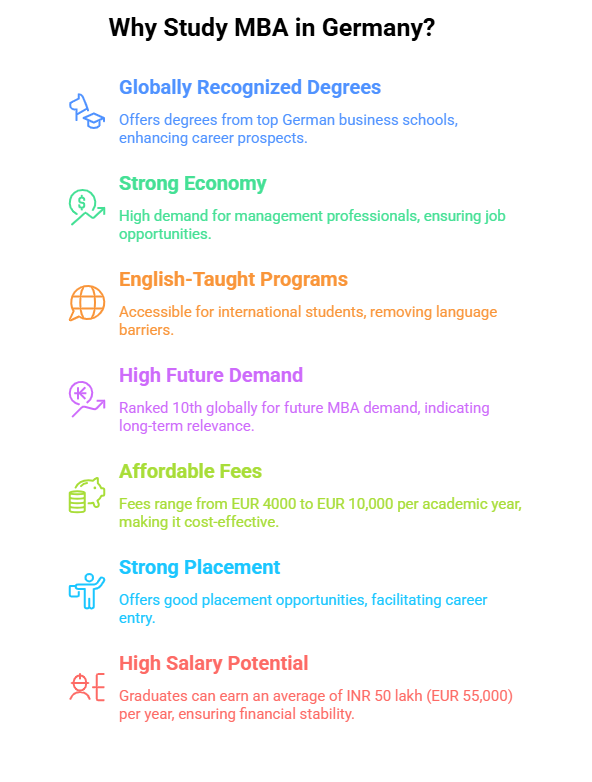
Why Study MBA in Germany?
- Globally recognized MBA degrees from top German business schools
- Strong economy with high demand for management professionals
- English-taught MBA programs available for international students
- Germany is ranked 10th globally for future MBA demand.
- Euro 4000 to Euro 10,000 fees for each academic year.
- Offer strong placement opportunities for students.
- MBA graduates in Germany can earn an average salary of INR 50 lakh (EUR 55,000) per year.
Germany is one of the top destinations in Europe for MBA studies and career growth. With over 450,000 international students, the country is known for its high-quality and affordable education system. MBA programs in Germany focus on practical learning, internships, and real-world business exposure. With English-taught programs, affordable fees, and strong industry connections, Germany is a smart choice for international students pursuing an MBA. There are also 1,158 affordable master's degrees in Germany, giving students access to quality higher education without spending too much.
Why should you Study MBA in Germany?
Top Universities for MBA Degree in Germany
Germany is one of the best countries in Europe to study an MBA. It has both public and private business schools that offer quality education and strong career opportunities. MBA programs in Germany focus on practical learning, leadership skills, and real business experience.
Public universities are more affordable and usually charge only a semester fee. Private universities have higher tuition fees but offer globally recognized MBA programs with strong industry connections. Most MBA programs in Germany require 2–3 years of work experience and take 12 to 24 months to complete. After graduation, students can benefit from Germany’s strong job market and 18-month post-study work visa.
German universities are known for their high academic standards and strong links with global companies. Many MBA programs include internships, company projects, and networking events that help students gain real industry exposure. Universities also provide modern campuses, research facilities, and career support services to guide students in finding jobs.
With a safe environment, strong economy, and central location in Europe, Germany gives students the chance to build an international career and connect with professionals from around the world.
Below is the list of top universities offering MBA programs in Germany:
|
University |
Type |
Duration |
Approx. Tuition Fee (EUR) |
|
ESMT Berlin |
Private |
12–15 months |
€49,000 |
|
Private |
12–15 months |
€38,000–€42,000 |
|
|
Private |
12–15 months |
€39,000–€45,000 |
|
|
WHU – Otto Beisheim School of Management |
Private |
12 months |
€40,000–€48,000 |
|
HHL Leipzig Graduate School of Management |
Private |
15–21 months |
€39,000–€42,000 |
|
Pforzheim University |
Public |
16–21 months |
€15,000–€44,000 |
|
Public |
18–24 months |
Semester fee €500 (Executive MBA higher) |
|
|
Hochschule für Wirtschaft und Recht Berlin (HWR Berlin) |
Public |
18–24 months |
Varies by program |
|
University of Cologne Business School |
Public |
18–24 months |
Varies by program |
|
ESCP Business School – Berlin Campus |
Private |
10–15 months |
€50,000+ |
Read on:
Why study Social Entrepreneurship in Germany?
Top QS Ranking MBA Universities in Germany
Germany is home to some of the top-ranked business schools offering globally recognized MBA programs. These institutions are known for strong academic quality, industry connections, and excellent career outcomes. Many of these MBA schools are popular among Indian students for management and leadership programs.
Below is the list of leading MBA universities in Germany along with their QS Global MBA Rankings:
|
Name of the University |
QS Global MBA Ranking |
Approx. MBA Fees (EUR) |
|
40 |
€42,000 |
|
|
46 |
€47,000–€55,000 |
|
|
WHU – Otto Beisheim School of Management |
57 |
€49,000 |
|
101 |
€21,800 |
|
|
151 |
€38,500 |
|
|
Hochschule Bremen – International Graduate Center (IGC) |
301 |
€15,900 |
Advantages of Studying an MBA in Germany
1. Wide Range of Specializations
Germany offers a wide variety of MBA specializations to suit different career goals and industries. Students can choose a program based on their background, interests, and long-term career plans. This flexibility allows them to focus on a field that matches their strengths and future ambitions.
Some of the most popular MBA specializations in Germany include:
- Engineering Management
- Big Data Management
- Marketing
- Finance
- International Business
- Innovation & Entrepreneurship
These specializations help students gain in-depth knowledge and practical skills in their chosen area. Many programs also include internships, live projects, and case studies to give real-world business exposure. Most MBA programs in Germany are taught in English, making it easier for international students to study without language barriers. At the same time, students can learn German during their stay. Knowing German can improve daily communication and increase job opportunities after graduation, especially in local companies.
2. High-Quality Education
Germany is known worldwide for its strong academic standards and practical learning approach. Business schools focus on:
- Real-world case studies
- Industry projects
- Leadership training
- Research and innovation
Top business schools such as WHU – Otto Beisheim School of Management, ESMT Berlin, and Technical University of Kaiserslautern offer globally recognized MBA programs. Many of these schools are internationally accredited and have strong links with global companies.
Germany also provides a multicultural environment where students meet people from different countries, helping them build a global professional network.
3. Affordable Tuition Fees
Studying an MBA abroad can be expensive in countries like the USA, UK, or Canada. However, Germany offers more affordable MBA options.
- Public universities may charge only semester fees.
- Private universities offer competitive tuition compared to other Western countries.
- Scholarships and part-time job options are available for international students.
This makes Germany a cost-effective choice for quality education.
4. Strong Career Opportunities
Germany has one of the largest and strongest economies in Europe. Many multinational companies operate here and actively hire skilled professionals. The country is home to global companies like: Adidas, Volkswagen, and BMW. MBA graduates are in high demand in industries such as automotive, finance, consulting, technology, and manufacturing. In many cases, MBA graduates can earn high salaries, making it one of the top-paying degrees in Germany.
5. Post-Study Work and Residence Permit
After completing an MBA in Germany, international students can stay back in the country for up to 18 months with a post-study work visa. During this period, they can search for a job that matches their qualifications and skills.
Once they secure a job, graduates can apply for:
- A German work permit
- An EU Blue Card (for highly skilled professionals)
- Long-term residence or permanent settlement
This process allows students to start their professional career in Germany. With stable employment and required years of residence, they can also apply for permanent residency. Germany’s strong economy and central location in Europe make it a good place to build a long-term career and future.
*Wish to study in Germany? Y-Axis is here to offer you guidance.
In-Demand MBA Courses in Germany
Germany offers a wide range of MBA programs for international students. While many public universities in Germany do not charge tuition fees for regular master’s programs, MBA programs are often considered specialized degrees and may have tuition fees, especially at private universities.
MBA programs in Germany are designed to provide practical business knowledge, leadership skills, and international exposure. Below is a table showing popular MBA specializations along with their duration and approximate annual tuition fees. The below table shows the most in-demand MBA programs for international students with duration, annual fee and popular specialization:
|
Name of the Programme |
Duration |
Popular Specializations |
Approx. Annual Tuition Fee |
|
MBA in International Business |
12–24 months |
Global Business, International Trade, Cross-Cultural Management |
€15,000 – €45,000 |
|
MBA in Finance |
12–24 months |
Corporate Finance, Investment Banking, Financial Management |
€20,000 – €50,000 |
|
MBA in Marketing |
12–24 months |
Digital Marketing, Brand Management, Market Strategy |
€15,000 – €40,000 |
|
MBA in Human Resource Management |
12–24 months |
Talent Management, Organizational Behavior, Leadership |
€15,000 – €35,000 |
|
MBA in Supply Chain Management |
12–24 months |
Logistics, Operations Management, Global Supply Chain |
€15,000 – €40,000 |
|
MBA in Engineering Management |
18–24 months |
Technology Management, Innovation, Project Management |
€10,000 – €30,000 (Public options available) |
|
MBA in Data & Technology Management |
12–24 months |
Big Data, Business Analytics, Digital Transformation |
€20,000 – €45,000 |
|
Executive MBA (EMBA) |
12–24 months (Part-time) |
Leadership, Strategy, Senior Management |
€30,000 – €60,000 |
*Confused to choose which course to pursue? Avail Y-Axis course recommendation services to choose the best.
Types of MBA Programs in Germany
Germany offers different types of MBA programs ..to suit the needs of students and working professionals. You can choose a program based on your work experience, career goals, and availability. These MBA options provide strong business knowledge and good career opportunities in Germany and internationally.
- Full-Time MBA: A Full-Time MBA usually lasts 1 to 2 years. It is best for students who are early in their careers or want to change their career path. This program provides complete business knowledge and often includes internships, company projects, or consulting assignments.
- Executive MBA (EMBA): The Executive MBA is designed for professionals with 5 or more years of work experience. It allows students to continue working full-time while studying. The program focuses on leadership skills, strategic thinking, and senior management roles.
- Part-Time MBA: A Part-Time MBA is a flexible option for working professionals. Classes are usually held in the evenings or on weekends. The program normally takes 2 to 3 years to complete, allowing students to balance work and studies.
- Global or International MBA: This program focuses on international business and global markets. It may include study trips, exchange programs, or international projects. Students study with classmates from different countries, which helps them build a global network and prepare for careers in multinational companies.
- Online MBA: An Online MBA allows students to study from anywhere. Classes and assignments are completed online, making it easier to manage work, personal life, and education at the same time.
MBA Fee in Germany: How Much Does It Cost to Study?
The total cost of studying an MBA in Germany depends on the university and type of program you choose. MBA programs are considered specialized degrees and usually have tuition fees, especially at private business schools. However, Germany still offers more affordable options compared to many other countries.
MBA Tuition Fees in Germany
MBA tuition fees in Germany usually range between €12,000 and €50,000 for the entire program. In Indian currency, this is approximately INR 12 lakh to INR 50+ lakh, depending on the university and type of MBA you choose.
The total cost mainly depends on whether you study at a public university or a private business school. Public universities are generally more affordable and may charge only a semester contribution for some programs, while private universities usually have higher tuition fees because they offer specialized MBA programs, global exposure, and strong industry connections.
Therefore, the overall tuition fee can vary based on the university’s reputation, program structure, duration, and specialization.
Cost of Living in Germany
Apart from tuition fees, students must also consider living expenses. The average cost of living in Germany is approximately:
- €934 – €1,100 per month
- Around €11,000 – €12,000 per year
The German blocked account requirement is approximately €11,904 per year.
|
Expense |
Estimated Monthly Cost (EUR) |
|
Accommodation |
€400 – €600 |
|
Food |
€200 – €300 |
|
Health Insurance |
€100 – €150 |
|
Study Materials |
€20 – €40 |
|
Internet & Mobile |
€20 – €50 |
|
Other Personal Expenses |
€50 – €200 |
Total Estimated Cost of MBA in Germany
When combining tuition and living expenses:
- Public university MBA: €12,000 – €25,000 + living costs
- Private university MBA: €30,000 – €60,000+ including living costs
Germany also offers scholarships and part-time work opportunities up to 20 hours per week, which can help reduce the financial burden. Overall, Germany provides a balance of quality education and competitive costs compared to MBA programs in countries like the USA or UK.
Top Scholarships for Indian Students to Study MBA in Germany Colleges
MBA students in Germany can apply for several scholarships offered by the government, foundations, and universities. However, not all scholarships fully cover MBA tuition fees. Most scholarships support living expenses, while some private business schools offer partial tuition fee waivers for MBA students.
Below is a clear list of scholarships that are for Indian students to study in Germany:
|
Scholarship Name |
Scholarship Amount |
Eligibility for MBA Students |
|
€850–€1,300 per month (varies by program) |
Available for selected MBA and Master’s programs with strong academic record |
|
|
Covers tuition, travel, and living expenses (varies) |
Available if the MBA program is part of Erasmus partner universities |
|
|
€300 per month |
Open to high-performing MBA students at participating universities |
|
|
Heinrich Böll Foundation |
€750 per month (Master’s level) |
For MBA students with good academic performance and social involvement |
|
Konrad-Adenauer-Stiftung |
€850 per month |
For postgraduate (including MBA) students with excellent academic record |
|
Up to €850 per month |
For MBA students with strong academics and leadership qualities |
|
|
University-Specific MBA Scholarships |
10%–50% tuition fee waiver (varies) |
Based on merit, leadership skills, and work experience |
Study MBA in Germany at Low or No Tuition Fee
Germany offers the opportunity to study an MBA at a very low cost, especially at public universities. These universities are funded by the government and usually do not charge tuition fees, even for international students. Students are generally required to pay only a small semester contribution that covers administrative and student service costs.
Below is a list of well-known public universities that offer MBA or management-related programs at zero or very low tuition fees.
|
University |
Estimated Tuition Fee |
Key Feature |
|
University of Cologne |
€0 (Semester fee applicable) |
Strong focus on Corporate Finance and Strategy |
|
€0 (Semester fee applicable) |
One of the oldest and most prestigious universities in Germany |
|
|
€0 (Semester fee applicable) |
Highly ranked for Business and Management studies |
|
|
University of Kiel |
€0 (Semester fee applicable) |
Known for innovation and research-focused programs |
|
Technical University of Munich |
€0 – €4,000 (varies by program) |
Popular for Technology Management and Entrepreneurship |
|
€0 (Semester fee applicable) |
Strong in Engineering and Management programs |
MBA Intake Dates and Deadlines 2026
Knowing the right intake windows and application deadlines is essential for planning your MBA journey in Germany. Most universities offer two intakes – a Winter intake starting in October and a Summer intake starting in April. Some universities, particularly private business schools, may offer rolling admissions or additional intake windows. It is important to apply well in advance, as seats fill up quickly for popular programs. Early applications are also preferred for scholarship consideration.
Below is the intake and deadline information for top MBA universities in Germany for 2026:
|
University |
Winter Intake (Deadline) |
Summer Intake (Deadline) |
Application Portal |
|
Frankfurt School of Finance & Management |
Oct 2026 (May 31) |
N/A |
frankfurt-school.de |
|
Mannheim Business School |
Jan 2026 (Oct 31) |
Apr 2026 (Dec 31) |
mannheim-business-school.com |
|
ESMT Berlin |
Sep 2026 (Apr 30) |
N/A |
esmt.org |
|
WHU – Otto Beisheim School of Management |
Sep 2026 (May 15) |
N/A |
whu.edu |
|
HHL Leipzig Graduate School of Management |
Oct 2026 (Jun 30) |
Apr 2026 (Jan 31) |
hhl.de |
|
Technical University of Munich (TUM) |
Oct 2026 (May 31) |
Apr 2026 (Nov 30) |
tum.de |
|
Pforzheim University |
Oct 2026 (Jul 15) |
Apr 2026 (Jan 15) |
hs-pforzheim.de |
|
ESCP Business School – Berlin |
Sep 2026 (Apr 30) |
N/A |
escp.eu |
|
EU Business School – Munich |
Oct 2026 (Aug 31) |
Apr 2026 (Feb 28) |
euruni.edu |
Eligibility Requirements to Pursue MBA in Germany Universities
Most universities in Germany are state-funded, but they are not controlled by one central authority. This means each university can set its own admission rules. However, most MBA programs follow similar basic requirements. To get admission into an MBA program in Germany, Indian students usually need strong academic records, work experience, and proof of English language skills.
Below are the common entry requirements for MBA programs in Germany:
- Bachelor’s Degree: Applicants must have a recognized undergraduate degree from a reputed university. The degree can be 3 or 4 years, depending on the university’s requirement.
- Work Experience: Most MBA programs in Germany require 2 to 5 years of relevant work experience. Some executive MBA programs may require more experience.
- GMAT / GRE Scores: Many universities ask for a valid GMAT or GRE score. A GMAT score of around 600 or above is generally preferred. However, some universities may waive this requirement.
- English Language Proficiency: If the MBA program is taught in English, students must show proof of English proficiency. Common minimum scores are:
- TOEFL: 80–100
- IELTS: 6.5–7.0
- If the program is in German, proof of German language skills may be required.
- Letters of Recommendation (LOR): Students usually need to submit 2–3 recommendation letters from professors or employers who can confirm their academic and professional abilities.
- Statement of Purpose (SOP): A written statement explaining why you want to study MBA, your career goals, and why you chose that university.
*Get expert coaching services from Y-Axis professionals to ace your scores.
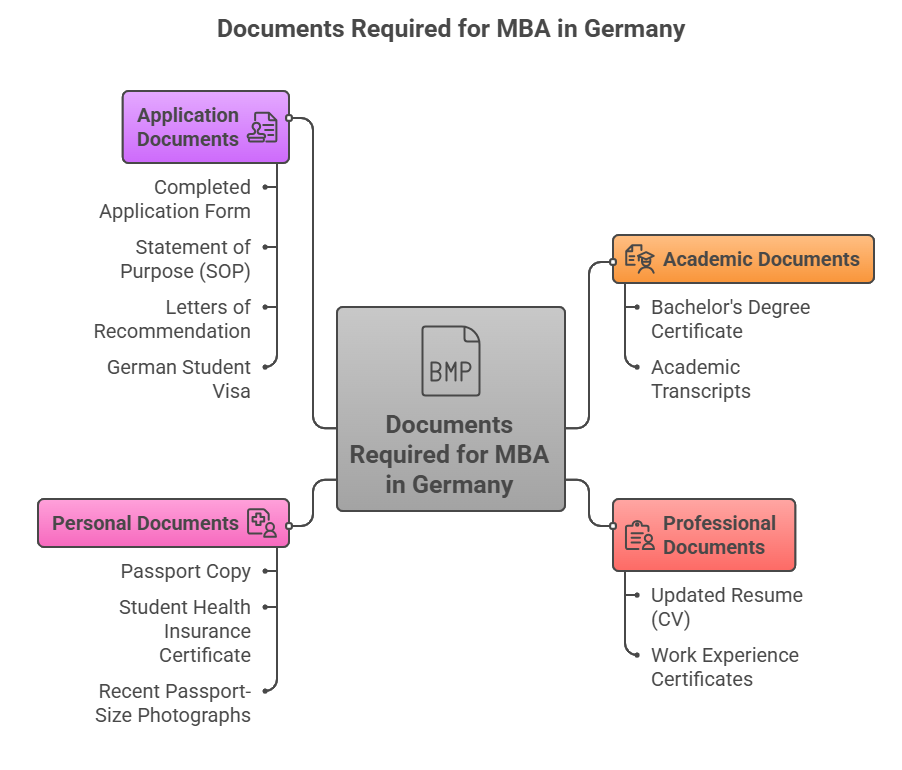
Documents Required for MBA in Germany
To apply for an MBA program in Germany, Indian students generally need the following documents:
- Completed application form
- Bachelor’s degree certificate
- Academic transcripts
- Updated resume (CV)
- Work experience certificates
- Statement of Purpose (SOP)
- Letters of Recommendation
- Passport copy
- Student health insurance certificate
- Recent passport-size photographs
- German student visa
MBA in Germany Without GMAT
Not every student has a GMAT score, and the good news is that several reputable universities in Germany offer MBA programs without making GMAT mandatory. Many institutions evaluate applicants based on work experience, academic performance, and interviews instead. This opens the door for working professionals and career changers who may not want to invest time preparing for the GMAT exam.
Below is a list of universities that waive the GMAT requirement, along with the alternative they accept:
|
University |
MBA Program Name |
Alternative Requirement |
|
Pforzheim University |
International MBA |
Strong academic record + work experience interview |
|
EU Business School – Munich |
MBA (various specializations) |
Personal interview + 2 years work experience |
|
SRH Berlin University of Applied Sciences |
MBA International Management |
Bachelor’s degree + relevant work experience |
|
Hochschule Bremen (IGC) |
MBA International Business |
Interview + motivation letter + work experience proof |
|
IU International University of Applied Sciences |
MBA General Management |
Degree certificate + 1–2 years work experience |
|
Arden University Berlin |
MBA Business Administration |
Application + professional references |
|
CBS International Business School |
MBA International Management |
2 years work experience + personal interview |
|
Technical University of Munich (Executive MBA) |
Executive MBA |
5+ years work experience + leadership interview |
|
University of Applied Sciences Koblenz |
MBA Business Management |
Academic transcripts + relevant professional experience |
Application Process to Study MBA in Germany
Applying for an MBA in Germany involves several important steps. Students must plan early and follow each step carefully to ensure a smooth admission process.
Below is a clear step-by-step guide for Indian students:
Step 1: Research and Choose the MBA Program
Begin by researching MBA programs that match your career goals, budget, and work experience. Compare universities based on tuition fees, duration, specializations, and language of instruction before shortlisting the right options.
Step 2: Check Eligibility Requirements
Carefully review the admission criteria of each university. Make sure you meet the academic qualifications, required work experience, and language proficiency standards. Some universities may also ask for GMAT or GRE scores.
Step 3: Prepare Required Documents
Collect and organize all necessary documents such as your bachelor’s degree certificate, academic transcripts, resume, statement of purpose, letters of recommendation, work experience certificates, and passport copy. Ensure all documents are scanned properly for online submission.
Step 4: Arrange Financial Resources
Plan your finances in advance by calculating tuition fees and living expenses. Open a blocked account as required for the student visa and explore scholarships or education loan options if needed.
Step 5: Submit the Online Application
Apply through the university’s official website or through platforms like uni-assist, depending on the university’s process. Upload all documents and pay the application fee if required. After submission, you will receive a confirmation email.
Step 6: Receive Admission Offer
If your application is successful, the university will send you an admission letter. You may need to confirm your acceptance and pay a deposit to secure your seat.
Step 7: Apply for German Student Visa
After receiving the admission letter, apply for a German student visa. Arrange health insurance, proof of financial funds, and attend the visa appointment at the German Embassy or Consulate.
Step 8: Arrange Accommodation and Travel
Once the visa is approved, arrange accommodation near your university and plan your travel to Germany.
Step 9: Complete Enrolment in Germany
After arriving in Germany, register your address, complete the enrolment process at the university, and begin your MBA program.
Work Permit After MBA in Germany for Indian Students
Germany offers good opportunities for international students to stay and work after completing their MBA. Indian students can move from a student visa to a work permit and later even apply for permanent residency.
Post-Study Work Visa
After finishing your MBA, you can apply for an 18-month residence permit to search for a job related to your field of study. During this period, you are allowed to work in any job to support yourself while looking for a full-time position in your profession.
Work Permit or EU Blue Card
Once you get a job that matches your qualifications, you can apply for a German work permit or an EU Blue Card. The EU Blue Card is usually given to highly skilled professionals who earn above a minimum salary level. The salary requirement is approximately €43,760 per year, though it may change slightly each year. The EU Blue Card offers better benefits, including faster permanent residency options and easier mobility within the European Union.
Permanent Residency in Germany
After working in Germany for 21 to 33 months with an EU Blue Card, you can apply for permanent residency. If you hold a regular work permit, the time required may be slightly longer. This pathway makes Germany a strong option for MBA graduates who want to build a long-term career and settle in Europe.
Are MBA Programs in Germany Available in English?
Yes, many MBA programs in Germany are taught completely in English. This makes it easier for international students, including Indian students, to study without needing strong German language skills. In fact, most MBA classes have students from different countries. Because of this, English is commonly used as the main language for teaching, assignments, and exams. However, if you are planning to stay and work in Germany after completing your MBA, it is a good idea to learn German. Even if your course is in English, knowing German will help you:
- Find better job opportunities
- Communicate easily at the workplace
- Adjust to daily life in Germany
- Improve your chances of long-term settlement
So, while German is not always required to study an MBA in Germany, learning it can give you better career growth after graduation.
MBA in Germany vs UK vs USA: Which Country is Best for Indian Students?
Germany has become a top choice for Indian students who want an affordable MBA with strong career opportunities. Compared to the USA and the UK, Germany offers lower study costs, competitive salaries, and easier post-study work options. Many universities have lower tuition fees, helping students recover their investment faster after graduation.
|
Factor |
Germany |
UK |
USA |
|
Total MBA Cost |
₹25–55 lakh (€28K–€62K) |
₹60 lakh–1.4 crore |
₹1.1–1.7 crore |
|
Average Salary After MBA |
€65K–€89K (₹58–80 lakh/year) |
£55K–£80K (₹58–84 lakh/year) |
$90K–$130K (₹83 lakh–1.2 crore/year) |
|
Course Duration |
12–18 months |
12–15 months |
18–24 months |
|
Post-Study Work Options |
18-month job-seeker visa with pathway to EU Blue Card |
Graduate Route visa |
OPT work permit and H-1B lottery |
|
GMAT Requirement |
Optional at many universities |
Required by many universities |
Required by most top universities |
|
Return on Investment (ROI) |
2–4 years |
3–5 years |
4–7 years |
|
Long-Term Settlement Options |
EU Blue Card leading to Permanent Residency |
Skilled Worker Visa pathway |
H-1B to Green Card process |
For Indian students looking for a balance of affordability, quality education, career growth, and long-term settlement opportunities, Germany offers one of the strongest MBA options. Its lower education costs and faster return on investment make it an attractive alternative to both the UK and the USA.
How Much Do MBA Graduates Earn in Germany?
One of the biggest reasons students choose Germany for an MBA is the strong salary potential after graduation. Germany’s economy is among the largest in the world, and MBA graduates are in high demand across industries like finance, consulting, technology, and manufacturing. Salaries vary based on your specialization, level of experience, and the city where you work. Cities like Munich, Frankfurt, and Hamburg tend to offer higher packages due to the concentration of multinational companies.
On average, MBA graduates in Germany can expect an entry-level salary of EUR 50,000 to EUR 65,000 per year. With five or more years of experience, this can grow significantly depending on your field and company. Below is a specialization-wise salary breakdown to help you plan your career:
|
MBA Specialization |
Entry-Level Salary (EUR/year) |
Salary After 5 Years (EUR/year) |
|
Finance |
€55,000 – €70,000 |
€85,000 – €110,000 |
|
Marketing |
€48,000 – €60,000 |
€70,000 – €90,000 |
|
Consulting |
€60,000 – €75,000 |
€95,000 – €130,000 |
|
Technology |
€58,000 – €72,000 |
€90,000 – €120,000 |
|
Engineering Management |
€55,000 – €68,000 |
€80,000 – €105,000 |
|
Supply Chain Management |
€50,000 – €65,000 |
€75,000 – €95,000 |
Return on Investment of MBA in Germany
Return on Investment (ROI) is one of the most important factors when deciding where to pursue an MBA. Germany offers one of the best ROI for MBA programs compared to many other popular destinations. The combination of relatively lower tuition fees, high post-MBA salaries, and strong employment opportunities makes it a financially smart choice for international students.
Total Investment for an MBA in Germany
The total cost for a full MBA in Germany includes tuition fees and living expenses. Here is a realistic estimate based on the type of university:
|
Cost Component |
Public University (EUR) |
Private University (EUR) |
Approx. INR |
|
Tuition Fees (full program) |
€1,000 – €15,000 |
€35,000 – €55,000 |
INR 3L – 50L |
|
Living Expenses (1.5 years) |
€16,000 – €18,000 |
€16,000 – €18,000 |
INR 14L – 16L |
|
Total Estimated Investment |
€17,000 – €33,000 |
~€51,000 – €73,000 |
INR 17L – 66L |
Payback Period Calculation
- Here is a simple example to understand the payback period for an MBA in Germany:
- Total MBA Investment (private university): €65,000 (approx. INR 58 lakh)
- Average post-MBA annual salary: €60,000 (approx. INR 54 lakh)
- Estimated payback period: 1.5 to 2.5 years
This means within just 1.5 to 2.5 years of working after graduation, you can recover your full MBA investment. In comparison, a top IIM in India charges INR 20 to 25 lakh in tuition, but post-MBA salaries in India for IIM graduates average INR 20 to 30 lakh per year, resulting in a similar payback period – but with far less global exposure and earning potential in EUR. Germany-based MBAs also open doors to the EU job market, which can significantly accelerate long-term career growth. For students who choose public universities in Germany, the payback period can be as short as 12 to 18 months, making it one of the best ROI destinations globally for MBA education.
Student Life During MBA in Germany
Life as an MBA student in Germany is exciting, enriching, and relatively relaxed compared to the high-pressure environment often linked with business schools. Germany offers a great balance of study, work, and travel, and many students enjoy the experience beyond academics.
Housing
Finding accommodation is manageable with planning. Universities offer student dormitories (Studentenwohnheim), with rents usually between EUR 250–400 per month. Many students also choose shared apartments (WG), where rent ranges from EUR 400–650, depending on the city. Cities like Munich and Frankfurt are more expensive, while Leipzig and Bremen are more affordable.
Transportation
Germany has a strong public transport system. Students usually receive a semester ticket, which allows unlimited travel on local transport and is included in the semester fee. Cycling is also popular due to dedicated bike lanes. For longer travel, trains and budget airlines are convenient and affordable.
Social Life and Student Organisations
MBA life is social and engaging. Business schools have active student clubs in areas like consulting, finance, and entrepreneurship. These clubs organise events, competitions, and networking sessions. International student groups also help newcomers settle in. Students can enjoy cultural activities like festivals, markets, and travel across Europe. Cities like Berlin, Munich, Hamburg, and Frankfurt offer vibrant food and arts scenes.
Part-Time Work Culture
International students can work up to 20 hours per week during studies. Many take part-time roles in retail, hospitality, or as university assistants. Wages typically range from EUR 12–15 per hour, helping cover living expenses. Part-time work also improves language skills and gives valuable local work experience.
Build Your Management Career in Germany
Doing an MBA in Germany is a great choice for students who want international career growth. Germany offers strong business education, practical learning, and good job opportunities in one of Europe’s leading economies. MBA programs in Germany are globally recognized and often more affordable compared to other popular countries. After graduation, students can use post-study work options to find a suitable job and grow professionally. With proper planning, the right university choice, and timely application, an MBA in Germany can help you gain global exposure, strong management skills, and a successful long-term career.
How Can Y-Axis Help You?
Y-Axis provides complete support for students who want to study in Germany. We offer clear, step-by-step guidance and personalized assistance throughout your study abroad journey.
Our services include:
Don't know what to do ?
Get Free Counseling
Looking for Inspiration
Explore what Global Indians have to say about Y-Axis in shaping their future