

Don't know what to do ?
Get Free Counseling
Masters in Germany: Top Universities, Courses, Fees, Eligibility & More
Germany has become a top choice for students who want to study an MS or a master’s degree. One big reason is that more than 60% of study programs have no tuition fees because most universities in Germany are public universities. Germany is known for high-quality and affordable education. Many universities charge very low or no tuition fees, especially for courses in engineering, technology, and business. This makes Germany a popular choice for international students.
Students who plan to study an MS in Germany must check the admission requirements carefully, as they can be different for each university and course. Germany’s top universities are especially strong in STEM fields and offer good job opportunities after graduation. After completing a master’s degree in Germany, students can stay back for up to 18 months to look for a job. The overall cost of studying in Germany is lower compared to many other European countries, making it one of the most affordable options.
According to the Indian Express, more than 49,000 Indian students are currently studying in Germany, and this number is expected to grow a lot by 2030. A master’s degree from Germany can give students strong career opportunities, especially in fields where skilled professionals are in high demand.
*Are you looking to study in Germany? Y-Axis is here to guide through the entire process!
Why pursue a Masters in Germany?
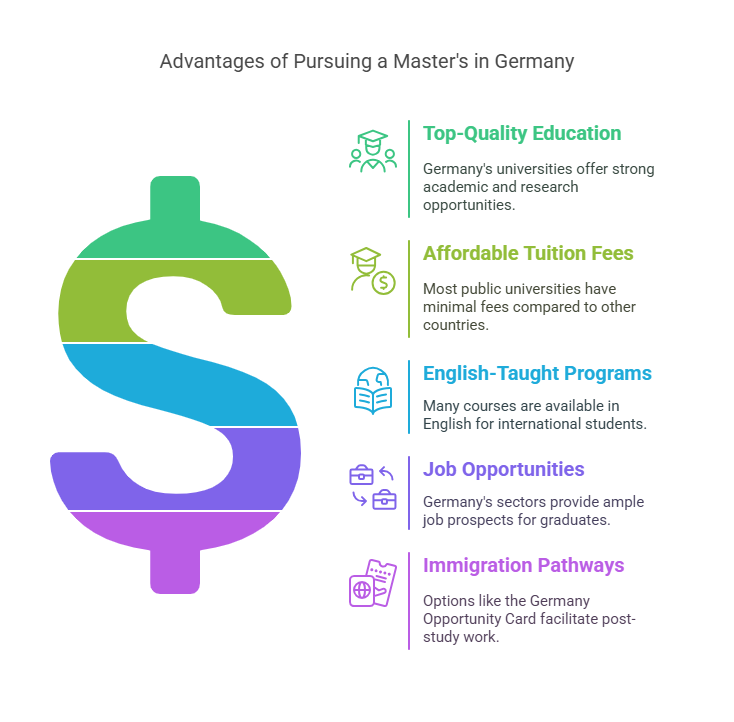
- Top-Quality Education: Germany is home to top-class universities with strong academic reputation and research opportunities. Germany offers a wide range of courses in various fields, including engineering, sciences, arts and humanities.
- Affordable Tuition Fee: Germany offers the most affordable universities in the whole of Europe. Most of the public universities don’t charge tuition fee, only requiring a small semester fee for administration and other costs.
- English-Taught Programs: Most of the German universities offer courses in English, making it convenient for international students to study in Germany.
- World-Class Universities: 40+ Universities in Germany are ranked among the top 1000 global QS Rankings.
- Job Opportunities and Career Growth: Germany’s thriving manufacturing sector along with healthcare, IT and renewable energy sectors offer plenty of job prospects for students who completed their masters in Germany.
- Immigration Pathways: There are several pathways for international students to stay and work after completing their masters in Germany. The Germany opportunity card allows you to seek employment for up to 18 months if you have sufficient funds to support yourself during your job search. Also, students can apply for an EU Blue Card if they find a job from a recognized German employer.
Top Universities in Study MS in Germany
Germany has many top universities that are well known around the world for their high-quality education. These universities offer excellent master’s programs, especially in engineering, technology, business, management, medicine, and arts and humanities. Many of them are ranked among the best universities globally in the QS World Rankings 2026.
One of the biggest advantages of studying in Germany is the affordable cost. Several public universities do not charge tuition fees, while others charge only a small annual fee compared to countries like the USA or the UK. This makes Germany a great choice for international students who want a world-class education at a lower cost.
Below is a list of the top universities in Germany for master’s programs, along with their QS rankings and average yearly fees.
|
Top Universities for Masters Program (Name) |
Universities QS World Rankings 2026 |
Average fee per year |
|
22 |
€8,000 - €12,000 |
|
|
58 |
No tution Fee |
|
|
80 |
€3300 |
|
|
88 |
€9000 |
|
|
98 |
€3400 |
|
|
105 |
€4000 |
|
|
130 |
No tuition fee |
|
|
145 |
€600 - €800 |
|
|
Rheinische Friedrich-Wilhelms-Universität Bonn |
207 |
€600 |
|
201 |
€3000 |
Top 10 Universities for Engineering and Technology in Germany
The table below lists the top 10 universities for masters in engineering in Germany, their QS world rankings, and average fee per year:
|
Universities in Germany |
QS World Rankings 2026 |
Average fee per year |
|
Technical University of Munich (TUM) |
22 |
€8,000 - €12,000 |
|
Technical University Berlin |
145 |
€600 - €800 |
|
Karlsruhe Institute of Technology |
98 |
€3400 |
|
RWTH Aachen University |
105 |
€4000 |
|
Dresden University of Technology |
218 |
€600 |
|
University of Stuttgart |
310 |
€3000 |
|
Technical University of Darmstadt |
253 |
€662 to €722 |
|
Humboldt University |
130 |
No tuition fee |
|
Ludwig Maximilian University of Munich (LMU) |
58 |
No tuition fee |
|
University of Erlangen-Nuremberg |
232 |
No tuition fee |
Top 10 Universities for Business and Management in Germany
The table below lists the top 10 universities for masters in business and management in Germany, their QS world rankings, and average fee per year:
|
Universities in Germany |
QS World Rankings 2026 |
Average fee per year |
|
Technical University of Munich (TUM) |
22 |
€16,000 |
|
University of Mannheim |
416 |
€39,500 |
|
WHU – Otto Beisheim School of Management |
NA |
€49,500 |
|
Ludwig Maximilian University of Munich (LMU) |
59 |
No tuition fee |
|
Humboldt University |
126 |
No tuition fee |
|
RWTH Aachen University |
99 |
€30,000 |
|
Freie University of Berlin |
97 |
No tuition fee |
|
Goethe University Frankfurt |
316 |
€29000 |
|
University of Hamburg |
193 |
€15,000 to €22,000 |
|
University of Cologne |
272 |
€44,500 |
Read more....
Why should you Study MBA in Germany?
Top 10 Universities for Medicine in Germany
The table below lists the top 10 universities for masters in medicine in Germany, their QS world rankings, and average fee per year:
|
Universities in Germany |
QS World Rankings 2026 |
Average fee per year |
|
Heidelberg University |
84 |
€3300 |
|
Ludwig Maximilian University of Munich (LMU) |
59 |
No tuition fee |
|
Technical University of Munich (TUM) |
22 |
€14,400 |
|
Charité – Universitätsmedizin Berlin |
NA |
No tution fee |
|
University of Hamburg |
191 |
No tuition fee |
|
Eberhard Karls University of Tübingen |
222 |
€3000 |
|
University of Freiburg |
212 |
€3400 |
|
Medizinische Hochschule Hannover |
NA |
No tuition fee |
|
University of Erlangen-Nuremberg |
224 |
No tuition fee |
|
University of Cologne |
285 |
No tuition fee |
Top 10 Universities for Arts and Humanities in Germany
The table below lists the top 10 universities for masters in arts and humanities in Germany, their QS world rankings, and average fee per year:
|
Universities in Germany |
QS World Rankings 2026 |
Average fee per year |
|
Humboldt University |
126 |
No tuition fee |
|
Free University of Berlin |
97 |
No tuition fee |
|
Ludwig Maximilian University of Munich (LMU) |
59 |
No tuition fee |
|
Heidelberg University |
84 |
€3000 |
|
Eberhard Karls University of Tübingen |
222 |
€3400 |
|
Goethe University Frankfurt |
309 |
No tuition fee |
|
University of Hamburg |
191 |
No tuition fee |
|
University of Freiburg |
212 |
€3000 |
|
University of Cologne |
285 |
No tuition fee |
|
University of Gottingen |
252 |
No tuition fee |
Top MS Specializations in Germany
Germany is well known for its strong engineering, technology, and research-based education system. Many students choose Germany for their MS because the country offers industry-focused programs, practical training, and strong job opportunities after graduation. Most master’s programs in Germany are 2 years long and are designed to match current industry needs. Today, fields like Artificial Intelligence, Data Science, Robotics, Renewable Energy, and Cybersecurity are highly in demand. Germany has a strong job market in automotive, manufacturing, IT, clean energy, and advanced technology sectors. Choosing the right specialization can improve your chances of getting a good job after completing your MS.
Below is a list of the top and latest in-demand MS specializations in Germany, along with popular universities, course duration, and approximate tuition fees.
|
MS Specialization |
Universities Offering the Course |
Duration |
Tuition Fee (EUR per year) |
|
Artificial Intelligence & Machine Learning |
Technical University of Munich (TUM), RWTH Aachen University, TU Berlin |
2 years |
0 – 20,000 |
|
Data Science & Big Data Analytics |
TUM, University of Freiburg, RWTH Aachen University |
2 years |
0 – 15,000 |
|
Computer Science |
TUM, RWTH Aachen University, TU Berlin, University of Freiburg |
2 years |
0 – 20,000 |
|
Mechanical Engineering |
RWTH Aachen University, TUM, Karlsruhe Institute of Technology (KIT) |
2 years |
0 – 15,000 |
|
Automotive Engineering |
TUM, University of Stuttgart, RWTH Aachen University |
2 years |
0 – 13,000 |
|
Robotics & Automation |
TUM, RWTH Aachen University, University of Stuttgart |
2 years |
0 – 15,000 |
|
Electrical & Electronics Engineering |
TUM, KIT, University of Stuttgart |
2 years |
0 – 12,000 |
|
Renewable Energy & Environmental Engineering |
TU Berlin, University of Stuttgart, RWTH Aachen University |
2 years |
0 – 12,000 |
|
Cybersecurity |
TUM, Ruhr University Bochum, TU Darmstadt |
2 years |
0 – 18,000 |
|
Industrial Engineering & Management |
RWTH Aachen University, TUM, University of Stuttgart |
2 years |
0 – 13,000 |
*Confused to choose which course to pursue? Avail Y-Axis course recommendation services to choose the best.
Cost of Studying in Germany for MS
Germany is one of the most affordable countries in the world to study a master’s degree. Most public universities do not charge tuition fees, so students only need to pay a small semester fee of about €150–€350. Because of this, the total cost of doing a master’s in Germany is much lower compared to many other countries. On average, the total yearly cost ranges between ₹11 lakhs and ₹36 lakhs, depending on whether you choose a public or private university. Private universities usually charge between €7,000 and €25,000 per year. In addition to tuition fees, students should plan for living expenses, which usually cost around €900–€1,200 per month. The overall cost can be higher in cities like Munich, Frankfurt, and Hamburg because rent and living costs are more expensive there.
Tuition fees for International Students
Tuition fees in Germany depend on whether you choose a public or private university.
- Most public universities in Germany do not charge tuition fees for master’s programs.
- Students only need to pay a semester contribution fee, which usually ranges from €150 to €350 per semester. This semester fee covers administration costs, student union services, and sometimes public transportation.
- Some special programs at public universities (such as non-consecutive master’s programs) may charge tuition fees ranging from €3,000 to €6,000 per year.
- Private universities charge full tuition fees, which usually range between €7,000 and €25,000 per year, depending on the course and university.
- Public universities remain the most affordable option for international students in Germany.
Living costs in major cities in Germany
The cost of living in German cities varies depending on where you reside. Cities like Munich, Berlin, Dortmund, and Frankfurt have different living expenses. Here is a look at the living expenses in major German cities:
Berlin
- It is one of the most affordable cities in Germany for students.
- Average monthly rent of €400 - €600
- Average monthly food expense of €150 - €250
- Transportation charges will be covered under the semester contribution.
- Estimated monthly living cost of €1000 - €1200
Munich
- Relatively expensive compared to Berlin
- Immense part-time job opportunities for students
- Average monthly rent of €600 - €1000
- Average monthly food expense of €250 - €400
- Estimated monthly living cost of €1600 - €2000
Frankfurt
- Relatively expensive since it’s the financial hub of Germany
- Average monthly rent of €500 - €700
- Average monthly food expense of €150 - €250
- Estimated monthly living cost of €1200 - €1400
Total Cost of Studying a Master’s in Germany
It is important for students to understand the full cost before planning to study in Germany. Even though public universities usually do not charge tuition fees, students still need to budget for living expenses, accommodation, health insurance, and other academic costs. These expenses make up most of the total budget for international students.
Estimated Yearly Cost for a Master’s in Germany:
- Tuition Fees (Public/Private): €0–€25,000 per year (₹0–₹25.8 lakh)
- Living Expenses: €10,800–€14,400 per year (₹11.1–₹14.8 lakh)
- Health Insurance: €1,320–€1,440 per year (₹1.36–₹1.49 lakh)
For Indian students, the overall yearly cost of studying a master’s in Germany generally falls within:
- €11,000–€16,000 per year (₹11.4–₹16.5 lakh) at public universities
- €20,000–€35,000 per year (₹20.6–₹36.1 lakh) at private universities
The final cost depends on the city you live in, your lifestyle, and your accommodation choice. Planning your budget carefully will help cover tuition, rent, food, transport, insurance, and other study-related expenses, making your academic journey in Germany smooth and stress-free.
*Read more....
Scholarships for Studying Masters in Germany Universities
Germany is one of the best countries to study a master’s degree because it offers high-quality education at an affordable cost. Along with low or no tuition fees at public universities, students can also apply for different scholarships to reduce their financial burden. These scholarships help cover tuition fees, living expenses, travel costs, health insurance, and research expenses.
Many scholarships are funded by the German government, private organizations, foundations, and universities. They are offered based on academic performance, financial need, research goals, or social involvement. Students planning to study an MS in Germany should carefully check the eligibility criteria, required documents, and deadlines before applying.
Below are some of the most popular scholarships for international students who want to pursue masters in Germany:
- DAAD Scholarship (Germany): The DAAD (German Academic Exchange Service) is one of the largest scholarship providers in the world. It supports international students pursuing master’s and doctoral degrees in Germany. The scholarship usually covers monthly living expenses, health insurance, travel allowance, and sometimes tuition fees.
- Erasmus+ Scholarship Programs: Erasmus+ is a European Union program that supports students studying in Europe. It offers financial support for tuition fees and living expenses. Some master’s programs under Erasmus allow students to study in multiple European countries, including Germany.
- Heinrich Böll Foundation Scholarships: This scholarship is offered to international students who show strong academic performance and social or political involvement. It provides financial support for master’s and doctoral students studying in Germany.
- Bayer Foundation Scholarships: The Bayer Foundation offers scholarships mainly for students in science-related fields such as biology, chemistry, medicine, and engineering. It supports research and academic development.
- Konrad-Adenauer-Stiftung (KAS) Scholarships: KAS scholarships are provided to talented international students who show leadership qualities and social commitment. The scholarship offers monthly financial support and networking opportunities.
- Friedrich Ebert Stiftung Scholarship: This scholarship supports academically strong students who believe in social justice and democracy. It provides financial assistance for living expenses and other study-related costs.
- Mawista Scholarship: The Mawista Scholarship mainly supports international students who plan to study abroad with family responsibilities. It helps reduce financial stress during studies in Germany.
*Read more....
Top Scholarships in Germany for Indian students
Eligibility Criteria for Indian Students to Apply for Master’s in Germany
- A 3-year Bachelor’s degree is required to apply for a master’s program.
- Students must submit their 10+2 certificate as proof of previous education.
- A Statement of Purpose (SOP) is mandatory for admission.
- A Letter of Recommendation (LOR) is optional but recommended.
- Most universities offer programs in English, so IELTS or TOEFL scores are required.
- Students usually need 6.5–7.0 in IELTS or 90–100 in TOEFL.
- If the course is taught in German, students must have C1 level German proficiency.
- For top universities, a minimum 8.0 CGPA is generally expected.
Documents Required for Indian Students to Study a Master’s in Germany
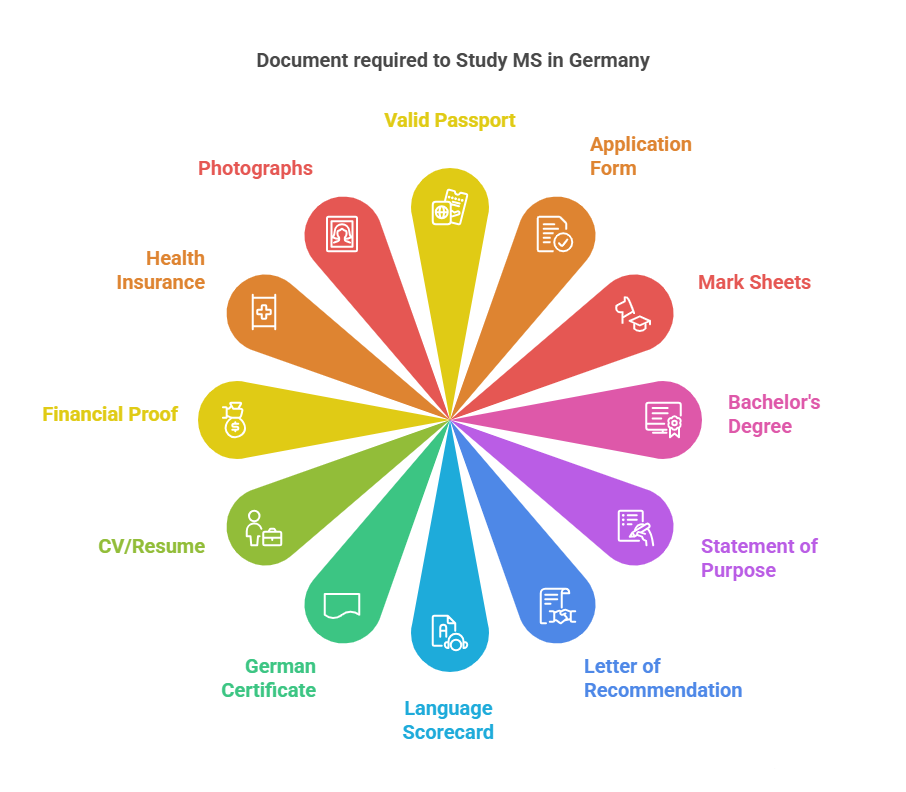
Indian students must prepare the following documents while applying for a master’s program in Germany:
- Valid passport
- Completed university application form
- 10th and 12th mark sheets and certificates
- Bachelor’s degree certificate and transcripts
- Statement of Purpose (SOP)
- Letter(s) of Recommendation (LOR)
- IELTS or TOEFL scorecard for English-taught programs
- German language certificate C1 level, if the course is in German
- Updated CV/Resume
- Proof of financial resources
- Health insurance proof
- Passport-size photographs
*Get expert coaching services from Y-Axis professionals to ace your scores.
Steps to Apply for Master’s in Germany
Step 1: Choose the master’s program and university you want to apply to.
Step 2: Check the eligibility requirements, such as degree, CGPA, and language scores.
Step 3: Take the required language test, IELTS/TOEFL or German test if needed.
Step 4: Prepare all necessary documents like transcripts, degree certificate, SOP, LORs, CV, and passport copy.
Step 5: Arrange proof of financial support.
Step 6: Fill out the online application form on the university website or through Uni-Assist.
Step 7: Pay the application fee if required and submit your application.
Step 8: Wait for the admission offer letter from the university. Once selected, proceed with the student visa process.
Student Visa Requirements for Master’s in Germany
Indian students who receive admission to a German university must apply for a German student visa before travelling. The student visa allows you to stay in Germany legally for the duration of your master’s program. To get the visa, you must prove that you have secured admission, have enough financial support, and meet all academic and language requirements. It is important to apply early because visa processing can take several weeks.
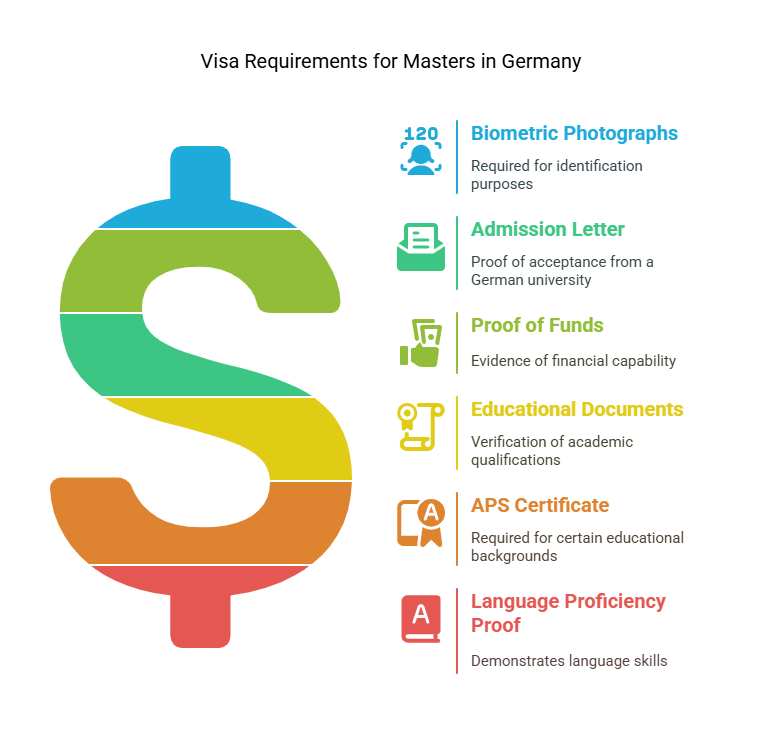
Below are the main requirements for a Germany student visa for Indian students:
- Latest biometric passport-size photographs
- Letter of admission from a recognized German university
- Proof of financial resources
- Educational qualification documents
- APS certificate which is mandatory for Indian students
- Proof of language proficiency, IELTS/TOEFL for English-taught programs or German certificate if applicable
Students should also check the official German Embassy or VFS website for any updated requirements before applying.
*Want to apply for Germany student visa? Contact Y-Axis for end-to-end guidance
Job Opportunities after Masters in Germany
There is a massive demand for skilled labor in Germany, especially in the STEM fields. Key industries that offer job opportunities are automotive, healthcare, engineering, and technology, with an average annual salary range from €46,000 to €110,000, depending on the job role and experience. After you secure an employment in Germany, you may be eligible for PR after completing two years of employment.
The table below has the list of high-paying jobs in Germany along with the average annual salary range:
|
Occupation |
Average Annual Salary |
|
IT and Software |
€36,000 - €65,000 |
|
Healthcare |
€37,300 - €100,000 |
|
Sales and Marketing |
€35,000 - €85,800 |
|
Engineering |
€58,500 - €312,000 |
|
Accounting and Finance |
€41,600 - €249,600 |
|
Human Resource |
€31,200 - €61,500 |
|
Teaching |
€39,000 - €208,000 |
|
Hospitality and Travel |
€24,000 - €134,500 |
|
Construction and Maintenance |
€34,200 - €91,000 |
|
STEM |
€44,200 - €156,000 |
*Also, read…
Germany Job Market in 2026-30
How can Y-Axis help you study in Germany?
Y-Axis provides complete support for students who want to pursue their Master’s in Germany. We guide you at every step of the process to make your study abroad journey smooth and successful.
At Y-Axis, we offer:
- Y-Path to help you choose the right course and university based on your profile
- Y-Axis Coaching Centre to improve your scores in IELTS, TOEFL, GRE, and GMAT
- Complete guidance for the Germany student visa process
- Expert support in writing strong and genuine SOPs and LORs
Our team ensures you receive the right advice and assistance from course selection to visa approval.
Don't know what to do ?
Get Free Counseling
Looking for Inspiration
Explore what Global Indians have to say about Y-Axis in shaping their future
Frequently Asked Questions