

Study in Germany

Don't know what to do?
Get Free Counseling
Study in Germany: Universities, Courses, Visa, Scholarships & Cost
Germany is one of the most popular non-English speaking study destinations in the world. It is currently ranked among the top 4 global destinations for international students. In recent years, India has become the largest source of international students in Germany. The number has grown to around 59,000 Indian students, showing an increase of nearly 20% compared to the previous year. Germany is a popular study destination because of its affordable education and high academic quality. It is known for its strong academic system and practical learning approach. Universities focus not only on theory but also on research, innovation, and real-world skills. Students learn through modern laboratories, industry projects, and internships that prepare them for global careers. The country has over 400 higher education institutions offering thousands of programs, including with more than 1,500 programs taught in English. German universities are especially strong in fields like engineering, technology, science, and management. Many institutions work closely with leading global companies, giving students exposure to international industry standards.
Germany is also one of the leading countries in research and development. Students get the opportunity to work on advanced research projects and use world-class facilities. The education system encourages critical thinking, independent learning, and problem-solving skills qualities that are highly valued worldwide. For Indian students who want internationally respected degrees, practical experience, and strong career growth, Germany offers a balanced combination of academic excellence and global exposure.
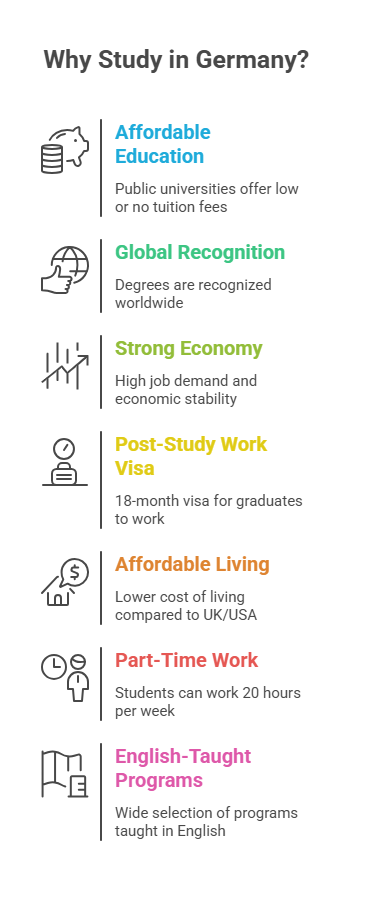
Why Study in Germany?
- Public universities offer little to no tuition fees
- Degrees are globally recognized
- Strong economy with high job demand
- 18-month post-study work visa
- Affordable living compared to UK/USA
- Students can work 20 hours per week during studies
- Wide range of English-taught programs available
Why Indian Students Choose Germany for Higher Education?
Affordable Education & No Tuition Fees
One of the biggest benefits of studying in Germany is its affordable education system. Free education in Germany for Indian students is possible at most public universities, as they do not charge tuition fees, even for international students, including Indians. This makes Germany much cheaper compared to countries like the USA, UK, or Australia.
Students only need to pay a semester contribution of €150–€350, which usually covers:
- Administration fees
- Student support services
- Public transport pass (Semesterticket)
In the state of Baden-Württemberg, non-EU students must pay €1,500 per semester at public universities. Private universities are more expensive and may charge between €5,000 – €20,000 per year, depending on the course and institution.
Read more....
How Indian Students Can Get Free Education in Germany
Globally Recognized Degrees
German degrees are respected and valued all over the world. They are especially strong in fields like engineering, technology, management, and science. The Association of Indian Universities (AIU) also recognizes German degrees, which is helpful for students who plan to return to India for higher studies or job opportunities.
Germany is well known for its excellent research facilities and strong connections between universities and industries. The education system focuses on practical and hands-on learning. Students do not just study theory in classrooms; they also work on real projects, internships, and research activities. This helps them develop real-world skills and prepares them for global careers.
Strong Job Market & Skilled Worker Demand
Germany has one of the strongest economies in Europe and needs around 400,000 skilled workers every year. This creates good job opportunities for international graduates, including Indian students, especially in fields like engineering, IT, healthcare, and data science. After completing their degree, Indian students can stay in Germany for 18 months to search for a job related to their course. During this time, they can work and attend interviews without restrictions. Once they get a full-time job and work for two years, they can apply for Permanent Residency (PR). This makes Germany a good choice for Indian students who want stable career growth and long-term settlement opportunities in abroad.
Higher Education System in Germany
Germany has a strong and well-developed higher education system:
- 400+ universities and higher education institutions across the country
- Around 13% of students are international, making campuses diverse and global
- Several universities are ranked among the top institutions in the world
- A unique grading system from 1.0 (Excellent) to 5.0 (Fail), where 1.0 is the highest score
This system ensures high academic standards while also offering an international learning environment.
Top Universities in Germany for Indian Students
Choosing the right university is very important for students who want to study in Germany. The country has 400+ higher education institutions across different cities. These include public universities, private universities, and universities of applied sciences. Germany is home to nearly 59,000 Indian students in recent years, showing its growing popularity.
Most universities in Germany are public institutions funded by the government. Around 240 public universities offer almost 90% of all study programs in the country. These universities are known for strong academic standards, research quality, and global rankings. Private universities are fewer in number but often offer specialized and career-focused programs, especially in business and management.
The main differences between public and private universities are explained below:
|
Aspect |
Public Universities |
Private Universities |
|
Tuition Fees |
Mostly tuition-free for international students. Students only pay a semester contribution of €150–€350. In Baden-Württemberg, non-EU students pay €1,500 per semester. |
Tuition fees range from €10,000–€15,000 per year for undergraduate programs and €10,000–€40,000 per year for graduate programs, depending on the course and institution. |
|
Class Size |
Larger class sizes because public universities admit many students each year. |
Smaller class sizes, allowing more personal attention and interaction with professors. |
|
Language |
Most programs are taught in German, but there are over 1,500 English-taught programs available, especially at the master’s level. |
Many programs are offered in English, especially business, management, and international courses. |
|
Admission Process |
More competitive due to high demand and limited seats, especially in popular courses like engineering and computer science. |
Less competitive in many cases and often more flexible with admission requirements. |
|
Research Focus |
Strong focus on academic research, innovation, and collaboration with industries and global institutions. |
More career-oriented and practice-focused, with emphasis on industry skills and professional training. |
*Read more.....
Top 10 best Public Universities to study in Germany
Top 10 QS Ranking Universities in Germany
Germany is home to some of the world’s top-ranked universities known for academic excellence, strong research output, and global reputation. Many of these institutions consistently appear in the QS World University Rankings. These universities are especially popular among Indian students for engineering, technology, management, medicine, and science programs. Below is the updated list of top-ranked universities in Germany along with their approximate semester administrative fees:
|
Name of the University |
QS World Ranking |
Semester Fee / Administrative Charge |
|
22 |
€100–€300 |
|
|
58 |
€100–€300 |
|
|
80 |
€150–€300 |
|
|
88 |
€100–€300 |
|
|
105 |
€250–€350 |
|
|
98 |
€150–€300 |
|
|
130 |
€300 |
|
|
145 |
€300–€600 |
|
|
193 |
€300 |
|
|
201 |
€150–€200 |
Popular Courses to Study in Germany
Germany offers a wide range of programs for international students. Most public universities do not charge tuition fees for many courses, especially at the undergraduate and regular master’s level. However, some specialized programs (like MBA or private university courses) may have tuition fees.
Below table show the popular courses, with with annual tution fee:
|
Name of the Programme |
Duration |
Popular Courses / Specializations |
|
3–4 years (Bachelor’s), 2 years (Master’s) |
Mechanical Engineering, Automotive Engineering, Electrical Engineering, Civil Engineering, Mechatronics, Robotics |
|
|
1–2 years |
International Business, Finance, Marketing, Human Resource Management, Supply Chain Management, MBA |
|
|
Humanities and Arts |
3 years |
Psychology, History, Philosophy, Literature, Media Studies, Fine Arts |
|
Computer Science & IT |
2 years |
Computer Science, Artificial Intelligence, Data Science, Cybersecurity, Software Engineering, Information Systems |
|
Social Sciences |
2–3 years |
Political Science, Sociology, International Relations, Public Policy, Social Work |
|
Law |
1–3 years (LLM), 4–5 years (State Exam) |
International Law, European Law, Business Law, Intellectual Property Law |
|
Natural Sciences |
2–3 years |
Physics, Chemistry, Biology, Environmental Science, Biotechnology |
|
Medicine (MBBS equivalent) |
6 years |
General Medicine, Dentistry, Pharmacy, Medical Research |
Cost of Studying in Germany
The cost of studying in Germany is one of the main reasons why Indian students choose this country. Compared to countries like the USA or UK, Germany is much more affordable. Below is a simple breakdown of the main expenses you should plan for.
Tuition Fees at Public and Private Universities
There is a big difference between public and private universities in Germany. Most public universities in Germany do not charge tuition fees. Students only need to pay a semester contribution. However, in the state of Baden-Württemberg, non-EU students must pay €1,500 per semester. Some universities have introduced new tuition fees for specific programs. For example, certain programs at the Technical University of Munich may charge tuition fees for non-EU students. Fees can range from €2,000–€6,000 per semester, depending on the level and course. Private universities charge tuition fees, which usually range between ₹4 lakh to ₹8 lakh per year approximately €5,000–€20,000. MBA programs are generally more expensive.
|
University Type |
Tuition Fee Range |
Notes |
|
Public Universities |
Mostly free |
Non-EU students pay €1,500 per semester in Baden-Württemberg |
|
Private Universities |
€5,000–€20,000 per year |
Higher fees for specialized or English-taught programs |
|
MBA Programs |
Up to €65,000 (total) |
Fees vary depending on the institution |
Semester Fees and Administrative Charges
Even if tuition is free, students must pay a semester contribution every semester.
This fee usually includes:
- Administrative charges
- Student services
- Public transport pass (Semesterticket)
The semester fee is usually between €150–€350 (approximately ₹14,000–₹34,000).
Cost of Living in Germany
Living costs in Germany depend on the city. Big cities like Munich, Berlin, and Frankfurt are more expensive than smaller cities.
Average Monthly Expenses:
- Accommodation: ₹25,000 – ₹50,000
- Food: ₹12,000 – ₹15,000
- Health Insurance: ₹4,000 – ₹6,000
- Miscellaneous (mobile, leisure, study materials): ₹8,000 – ₹12,000
- Estimated monthly cost: ₹60,000 – ₹1.07 lakh
- Estimated annual living cost: ₹8.9 lakh – ₹13.4 lakh
Students must also show proof of financial support through a Blocked Account (Sperrkonto) of €11,904 per year for visa approval.
Scholarships for Indian Students to Study in Germany
Germany offers many scholarship opportunities for international students, including Indians. These scholarships are provided by the German government, private foundations, research organizations, and universities. Since most public universities in Germany do not charge tuition fees, scholarships mainly help students cover living expenses, research costs, travel, and other study-related expenses.
Some scholarships are available for Bachelor’s and Master’s students, while many are specially designed for PhD and research scholars. Below table shows the main scholarships, the amount they provide, and who can apply.
|
Scholarship Name |
Scholarship Amount |
Eligibility |
|
Varies by program; usually covers monthly living expenses (approx. €850–€1,300+ per month depending on level) |
Open to international students with strong academic record; mainly for Master’s and PhD students |
|
|
Covers tuition, travel, and living expenses (amount varies by program) |
Open to students enrolled in Erasmus partner programs; selection based on academic merit |
|
|
Heinrich Böll Foundation Scholarship |
€750 per month (Master’s) €1,000 per month (PhD) |
Open to international students with good academic performance and social involvement |
|
Humboldt Research Fellowship |
€2,650 per month |
Open to international postdoctoral researchers who have completed a PhD |
|
Konrad-Adenauer-Stiftung (KAS) |
€850 per month (Postgraduate) |
Open to postgraduate and PhD students under 30 with excellent academic record |
|
Bayer Foundation Scholarship |
Approx. €6,400 per year (up to 2 years) |
Open to students with outstanding academic performance in science-related fields |
|
DKFZ PhD Scholarship |
Fully funded PhD (covers full program cost) |
Open to students with a Master’s degree in biomedical or related fields |
|
Einstein International Postdoctoral Fellowship |
Up to €20,000 per year |
Open to PhD holders for postdoctoral research in Berlin |
|
Marie Skłodowska-Curie Actions (MSCA) |
€3,000 per month + €600 transport allowance |
Open to researchers from all nationalities |
|
€300 per month |
Open to talented students of all nationalities studying at participating German universities |
*Read more....
Top Scholarships in Germany for Indian students
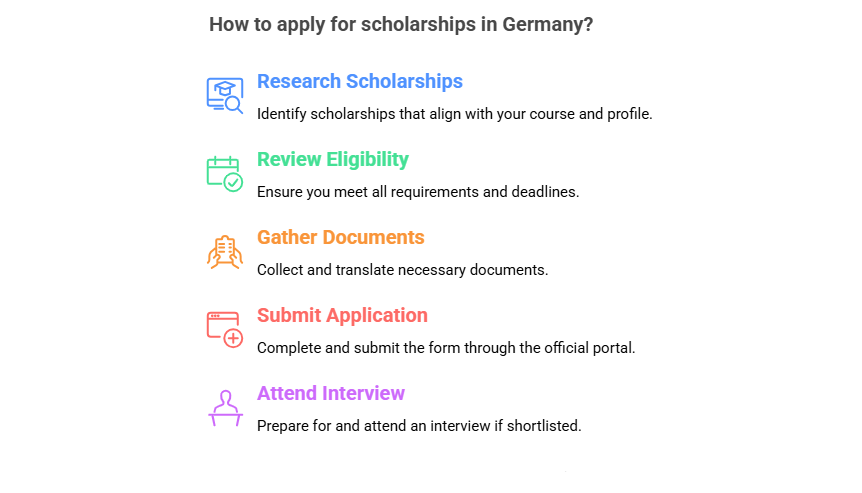
Steps to Apply for Scholarships in Germany
Step 1: Research and select the scholarship that matches your course and profile.
Step 2: Carefully review the eligibility requirements and application deadline.
Step 3: Gather all required documents and arrange translations if necessary.
Step 4: Complete and submit the application form through the official portal.
Step 5: Wait for the selection result and attend an interview if shortlisted.
MS in Germany for Indian Students
Many Indian students are choosing to study MS in Germany because of its high-quality education and good job opportunities. Most master’s programs take two years (four semesters) to complete, though some courses may be shorter or longer depending on the field. There are two types of programs: consecutive programs, which continue from a related bachelor’s degree, and non-consecutive programs, which may require work experience.
To apply, students must have a recognized bachelor’s degree and meet language requirements. For English-taught programs, IELTS (minimum 6.5) or TOEFL is usually required. For German-taught programs, exams like TestDaF or DSH are needed. Students can apply directly to universities or through uni-assist. Required documents generally include academic transcripts, language scores, passport copy, and an application fee. Germany offers more than 11,000 English-taught master’s programs, and most public universities do not charge tuition fees, except for some courses like MBA.
*Also Read....
Pursue Bachelor’s in Germany for a Bright Future
Admission Process and Eligibility Criteria to Study in Germany
Understanding the admission process is very important before applying to a German university. Below is a simple and clear explanation of the intakes, academic requirements, language requirements, and application deadlines.
1. Choose a University
After deciding to study in Germany, the first step is to choose the right course and university. Germany has more than 400 higher education institutions offering thousands of programs. You can search for courses through the DAAD (German Academic Exchange Service) database, which lists many programs, including a large number taught in English.
At the undergraduate level, most programs are taught in German. However, some courses are offered in both English and German. In such cases, students may start in English and later continue in German. Many universities also provide German language classes to help international students improve their skills.
While selecting a university, students should check:
- Course content and specialization
- University rankings
- Location and living costs
- Language of instruction
2. Check the Admission Requirements
Before applying to a German university, you must make sure that your academic qualifications are recognized. Students need a valid higher education entrance qualification (HZB) to study in Germany. For bachelor’s programs, this usually means having a valid 12th-grade certificate. In some cases, students may also need to complete one year of university study in India. Some applicants may be required to attend a foundation course called Studienkolleg and pass the Feststellungsprüfung exam before starting their degree.
Language requirements are also important. For German-taught programs, students must provide proof of German language skills through exams like DSH or TestDaF. For English-taught programs, IELTS or TOEFL scores are required. Each university clearly mentions the required scores and eligibility criteria on its official website.
3. Prepare Your Financial Documents
To apply for a student visa, you must show proof that you can support yourself financially. Students are required to open a Blocked Account (Sperrkonto) and deposit the required yearly amount (currently €11,904 per year).
4. Complete the Application Process
You can apply directly to the university’s international office or through uni-assist, which processes applications for many German universities.
Germany has two main intakes:
- Winter Semester (applications usually close around July 15)
- Summer Semester (applications usually close around January 15)
Deadlines may vary by university and course, so always check the official website. It is recommended to apply at least six weeks before the deadline.
5. Apply for Student Health Insurance
Health insurance is mandatory for all students in Germany. You must show proof of health insurance before enrolling at the university and applying for a visa. International students usually pay between €80–€160 per month for student health insurance. Students over 30 may need private insurance, which can cost more.
6. Get a German Student Visa
Most non-EU students, including Indian students, must apply for a German Student Visa before travelling to Germany for higher studies. This visa allows you to enter Germany legally and stay for the purpose of education.
7. Find Accommodation and Finish Anmeldung Process
German universities usually do not provide guaranteed accommodation for students, so it is important to start searching early. Students can choose between student dormitories, shared apartments, or private apartments. The type of housing you choose will depend on your budget and the city you live in. Rent is usually the biggest monthly expense. Major cities like Munich and Frankfurt are more expensive compared to smaller cities. After securing accommodation, students must register their address at the local registration office (Bürgeramt or Einwohnermeldeamt). This registration (Anmeldung) is mandatory and required for many official processes in Germany.
8. Complete Your Enrollment
Once you receive admission and arrive in Germany, you must complete enrollment at the university. Enrollment allows you to attend classes and use university facilities. After enrollment, you receive a student ID and registration certificate.
9. Settle Into Student Life in Germany
After completing all formalities, you can begin your studies. Some important steps include:
- Registering your address officially
- Opening a student bank account
- Applying for your residence permit
- Exploring part-time job opportunities
Germany offers a safe and international environment, making it easier for students to adjust and focus on their education.
Germany Student Visa Requirements for Indians
The Germany student visa process serves as a crucial milestone in your educational experience. Students from India must meet specific requirements to transform their study aspirations into reality.
Documents required for Germany Student Visa application
A complete application needs two similar sets of these documents:
- Valid passport issued within the last 10 years with at least two empty pages
- Completed and signed application form with declaration
- Three biometric passport photos (not older than 6 months)
- Letter of admission from a German university
- APS certificate from Academic Evaluation Center (exceptions exist for PhD/PostDoc students and scholarship recipients)
- Proof of financial means through a blocked account (Sperrkonto)
- Health insurance coverage
- Academic certificates and transcripts
- Language proficiency certificates (IELTS/TOEFL for English; TestDaF/DSH for German)
- Statement of purpose and curriculum vitae
Germany Student Visa Fee and Processing Time
The Germany student visa has a fixed application fee and a specific processing time. Students must pay the visa fee when submitting their application at the German Embassy or Consulate.
- The standard visa fee is €75 (approximately ₹6,700–₹7,000).
- For applicants under 18 years of age, the visa fee is €37.50.
For Indian students, the visa processing time is usually around 8 to 12 weeks. In some cases, it may take longer depending on the number of applications and document verification.
Since the process can take several weeks, students are advised to apply for the visa immediately after receiving their university admission letter. Applying early helps avoid delays and ensures you reach Germany before your course begins.
Part-Time Jobs in Germany for Indian Students
Part-time jobs help Indian students in Germany manage their living expenses and gain practical work experience. International students are allowed to work 140 full days or 280 half days per year, which usually means up to 20 hours per week during the semester. During semester breaks, students can work full-time within the allowed yearly limit.
Students can find part-time jobs through university notice boards, career centers, online job portals, supermarkets, restaurants, or company websites. Many universities also offer student assistant (HiWi) jobs. Knowing basic German can increase job opportunities, especially in customer-facing roles. Before starting work, students must ensure they follow visa rules and sign a proper work contract.
Types of Part-Time Jobs in Germany
The minimum wage in Germany is around €12 per hour, so most part-time jobs pay at least this amount. Earnings depend on the city, job type, and experience. Part-time work not only supports students financially but also helps them gain valuable international work experience.
|
Job Type |
Average Salary (Approx.) |
|
Restaurant / Café Staff |
€12–€14 per hour |
|
Supermarket / Retail Assistant |
€12–€15 per hour |
|
Delivery Jobs |
€12–€16 per hour |
|
Warehouse Assistant |
€12–€15 per hour |
|
Private Tutor |
€15–€25 per hour |
|
University Student Assistant (HiWi) |
€12–€17 per hour |
|
IT Support / Technical Assistant |
€15–€20 per hour |
Post-Study Work and Placement Opportunities
Germany offers strong career opportunities for international graduates, including Indian students. The country has a stable economy and a high demand for skilled professionals in fields like engineering, IT, healthcare, and business. This makes Germany a good place to build a long-term career after completing your studies.
Post-Study Work Visa in Germany
After completing an MS or any recognized degree in Germany, students can apply for an 18-month post-study residence permit. This permit allows graduates to stay in Germany and search for a full-time job related to their field of study. During these 18 months, students can work in any job to support themselves while looking for a permanent position. Once they find a job related to their qualification, they can switch to a work permit or EU Blue Card. This post-study period gives Indian students enough time to explore job opportunities, attend interviews, and start their professional career in Germany.
How to Get Placements After Graduation in Germany
Some of the steps that can help Indian students find a job in Germany after graduation are listed below:
Step 1: Use University Career Services
Many universities have career centers that help students with job search, resume writing, and interview preparation.
Step 2: Attend Career Fairs
Participate in job fairs and campus recruitment events to meet employers directly.
Step 3: Build a Strong LinkedIn Profile
Create a professional LinkedIn profile and connect with recruiters and industry professionals.
Step 4: Apply with Customized Resumes
Do not send the same resume to every company. Customize your CV and cover letter for each job role.
Step 5: Do Internships During Studies
Internships help you gain practical experience and increase your chances of getting a full-time job.
Step 6: Improve Your German Language Skills
Knowing German improves job opportunities, especially in roles that require communication with clients or teams.
Step 7: Apply Through Job Portals and Company Websites
Regularly check German job portals and apply directly through company websites for better opportunities.
Path to permanent residency (PR)
German university graduates can apply for a settlement permit (Permanent Residency – PR) after working in Germany for two years in a job related to their degree. This is faster compared to many other skilled workers.
To apply for PR, students must meet these requirements:
- Contribute to the pension system for at least 24 months
- Show German language skills at minimum B1 level.
- Have stable income and enough living space.
- Pass the “Life in Germany” test, which checks your basic knowledge of German laws, culture, and society.
Meeting these conditions allows graduates to stay in Germany permanently and continue building their career.
Build Your Future in Germany
Studying in Germany is a smart choice for Indian students who want good quality education at a lower cost. It offers strong career opportunities around the world and also gives students the chance to settle in Germany in the future. Compared to countries like the USA or the UK, Germany provides excellent education and job opportunities at a much more affordable price. If you plan properly, choose the right university, manage your money carefully, apply for scholarships early, and prepare your visa documents correctly, your dream of studying in Germany can become true. Germany is not just a place to study, it is a place where you can build a successful career and a better future.
How can Y-Axis help you?
Y-Axis offers complete support for students planning to study in Germany, with transparent and personalized guidance.
Our services include:
Looking for inspiration
Explore what Global Indians have to say about Y-Axis in shaping their future
Frequently Asked Questions