

Posted on November 23 2026
Life in Spain for Immigrants: Jobs, Visas, Cost of Living & Residency

By , Editor & Director
Updated November 23 2026
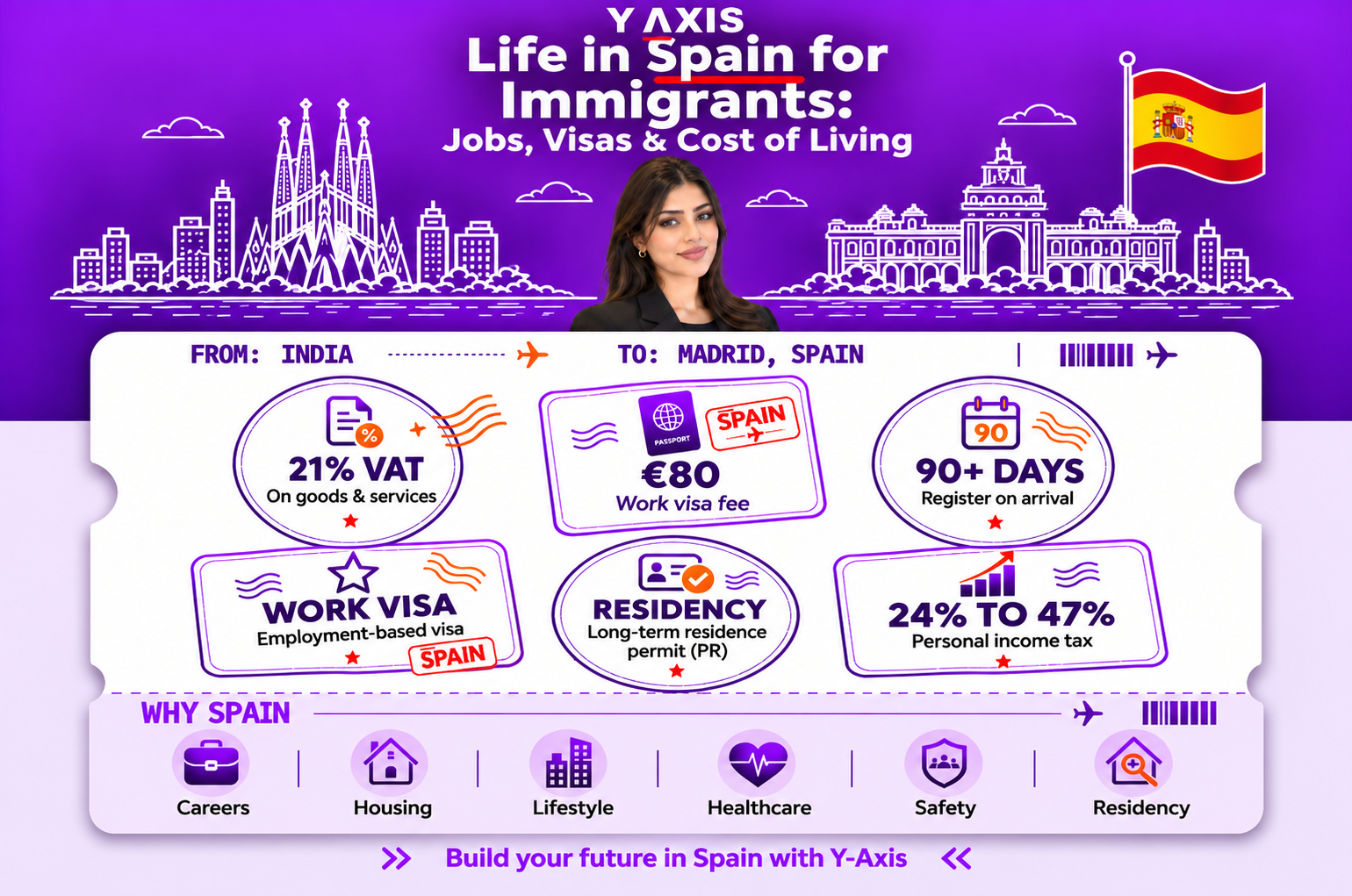
Life for immigrants in Spain offers a warm climate, public healthcare and a good work-life balance. Jobs are in demand in IT, engineering, healthcare, tourism and renewable energy. Most Indian professionals move with a job offer. Common routes are the Highly Qualified Professional permit, the EU Blue Card and employer-sponsored work permits. Remote workers can apply for the Digital Nomad Visa. Highly qualified roles need a salary of at least €41,356 a year. After five years of legal residence, you can apply for long-term residence. Indian citizens can usually apply for Spanish citizenship after 10 years. Madrid, Barcelona, Valencia, Málaga and Seville are popular cities for expats.
Some quick facts about Spain are as follows:
|
Population |
Approximately 49.9 million residents |
|
Capital |
Madrid (also the largest city) |
|
Official Languages |
Spanish; Catalan, Galician and Basque are also official in their regions |
|
Currency |
Euro (EUR) |
|
Popular Immigrant Hubs |
Madrid, Barcelona, Valencia, Málaga, Seville |
|
Economy |
Strong tourism, services, automotive, renewable energy and technology sectors; growing demand for IT, engineering, healthcare and hospitality professionals |
|
Typical Route to Long Stay |
Highly Qualified Professional permit, EU Blue Card, employer-sponsored work permit or Digital Nomad Visa |
|
Long-Term Residency |
Long-term residence after 5 years of legal stay; citizenship after 10 years for most Indian nationals |
*Want to settle in Spain? Sign up with Y-Axis for end-to-end assistance.
Why Choose Spain to Migrate Abroad?
Spain offers fast-track permits for skilled workers and employer-sponsored work permits for shortage roles. It also offers a Digital Nomad Visa for remote workers and work rights for students.
Here is why you should choose a life in Spain:
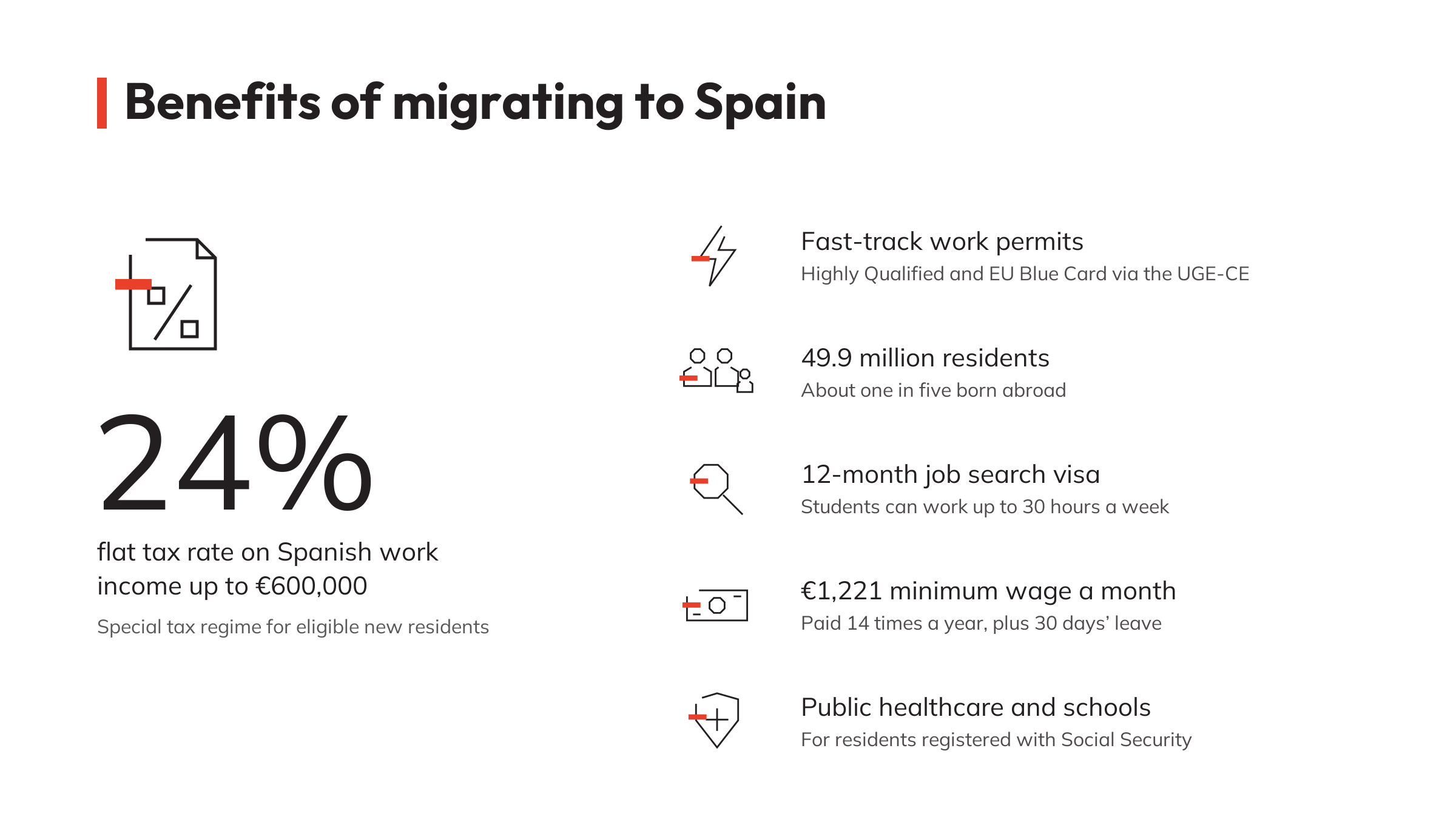
- Highly Qualified Professional and EU Blue Card applications go through a fast-track unit called the UGE-CE.
- Spain’s population reached a record 49.9 million, and about one in five residents was born abroad.
- The job search visa now lasts up to 12 months, and students can work up to 30 hours a week.
- The national minimum wage is €1,221 a month, paid 14 times a year, and workers get 30 calendar days of paid leave.
- Eligible new residents can choose a special tax regime with a flat 24% rate on Spanish work income up to €600,000.
- Residents registered with Social Security get public healthcare, and children can study free in public schools.
Note: Indian passport holders need a Schengen Visa to visit Spain. You cannot work on a Schengen Visa. Anyone with a job offer must get the correct work permit and national visa before starting work.
*Want to work in Spain? Let Y-Axis assist you with the process.
Can I Move to Spain as an Indian Immigrant?
Most Indians move to Spain with a job offer. The main routes are the Highly Qualified Professional permit, the EU Blue Card and employer-sponsored work permits. Remote workers can use the Digital Nomad Visa. Indian students can also study in Spain and later switch to a work permit.
The steps to migrate to Spain as an Indian professional are as follows:
Step 1: Choose the right route and check the official requirements on the Spanish Ministry of Inclusion website
Step 2: Secure a Spanish job offer, meet the Digital Nomad Visa income rule, or get university admission
Step 3: For a job offer, your employer applies for your work authorisation. Highly qualified roles go through the UGE-CE
Step 4: Prepare your documents, such as your passport, apostilled degree, police clearance certificate and medical certificate
Step 5: Apply for a national visa (Type D) through the Spanish visa application centre in India
Step 6: Travel to Spain within your visa validity and register your address at the local town hall (empadronamiento)
Step 7: Apply for your TIE residence card within one month of arrival. Then get a Social Security number, a bank account and a local SIM
Also, read…
Best Visa Options to Live in Spain
Spain offers several routes depending on your job offer, salary, skills and study plans. The table below shows the main options and their route to long-term residence.
|
Visa Type |
Best For |
Duration |
Long-Term Pathway |
|
Highly Qualified Professional (HQP) Permit |
Graduates and specialists with a job offer paying at least €41,356 a year |
Up to 3 years, renewable |
Long-term residence after 5 years; family can join and work |
|
EU Blue Card |
Highly qualified workers with a contract of at least 6 months and a salary of at least €41,356 (€33,085 for some shortage roles and recent graduates) |
Up to 3 years, renewable |
Long-term residence after 5 years; easier mobility within the EU |
|
Employer-Sponsored Work Permit |
Workers with a job offer, often in a shortage occupation |
1 year at first, then 4-year renewals |
Long-term residence after 5 years of legal stay |
|
Digital Nomad Visa |
Remote workers for companies or clients mainly outside Spain, with income of at least €2,849 a month |
Up to 3 years, renewable for 2 years |
Long-term residence after 5 years |
|
Student Visa |
International students at recognised Spanish institutions; can work up to 30 hours a week |
Length of the course |
Job search visa for up to 12 months, then a work permit |
Also, read…
Best Areas to Live in Spain
Spain’s job market and living costs vary by city. Choosing the right area can influence your commute, cost of living, housing expenses and overall quality of life.
The table below highlights the major Spanish cities and their best qualities for settlement abroad:
|
Area |
Best For |
Sightseeing |
Average Rent |
Job Market |
How Much You Can Save |
|
Madrid |
Corporate professionals & expats |
Prado Museum, Retiro Park, Royal Palace |
€1,100-1,600/mo (1BR flat) |
Very strong, finance, consulting & IT |
Moderate, high rents |
|
Barcelona |
Tech & startup professionals |
Sagrada Família, Park Güell, Gothic Quarter |
€1,100-1,500/mo (1BR flat) |
Strong, tech, startups, tourism & manufacturing |
Moderate savings potential |
|
Valencia |
Families & young professionals |
City of Arts and Sciences, Turia Gardens, Malvarrosa Beach |
€950-1,300/mo (1BR flat) |
Good, logistics, port, tech & tourism |
Good savings potential |
|
Málaga |
Tech workers & remote workers |
Alcazaba, Picasso Museum, Malagueta Beach |
€1,000-1,350/mo (1BR flat) |
Growing, tech hub, tourism & services |
Good savings potential |
|
Seville |
Budget-conscious families |
Royal Alcázar, Plaza de España, Seville Cathedral |
€800-1,100/mo (1BR flat) |
Good, aerospace, tourism & public services |
Strong savings potential |
Note: Rents in Spain are usually advertised per month. The legal deposit for a home rental is one month’s rent. Landlords can ask for up to two more months as an extra guarantee. Agency fees are paid by the landlord. Figures vary by neighbourhood, size and distance from transit. Confirm current listings before budgeting.
Also, read…
Visa Sponsorship Jobs in Spain
Cost of Living in Spain
Spain’s cost of living changes by location. Madrid and Barcelona cost the most, while Valencia, Málaga, Seville and smaller cities are more affordable.
Below is a breakdown of average monthly expenses for a single adult living outside the most premium areas:
|
Rent (1BR flat, outside prime areas) |
€800-1,200/month |
|
Utilities (electricity, water, gas & heating) |
€100-180/month |
|
Groceries |
€250-400/month |
|
Public Transport (metro, bus & local trains) |
€20-60/month for a monthly pass, depending on the city and discounts |
|
Healthcare |
Public healthcare through Social Security for registered workers; private insurance usually costs €50-120/month for a single person |
|
Dining Out (per meal) |
€12-16 (menu of the day), €30-50 (mid-range restaurant) |
|
Mobile & Internet |
€30-60/month |
|
Entertainment & Leisure |
€80-200/month |
Is Spain Expensive Compared to the UK or Germany?
Spain is generally more affordable than the UK and Germany, especially outside Madrid and Barcelona. Groceries, dining out and public transport cost less in most Spanish cities.
Salaries in Spain are lower than in northern Europe. Rents in Madrid and Barcelona are high compared with local salaries. Many immigrants save more in Valencia, Málaga and Seville.
Madrid and Barcelona are the priciest cities. However, these cities also offer the most jobs in multinational companies, IT, finance and consulting.
Also, read…
Can a Spanish Digital Nomad Visa Lead to Permanent Residency?
Work in Spain
Spain’s job market is led by IT, engineering, healthcare, tourism and renewable energy. Leading employers include Santander, BBVA, Telefónica, Inditex, Iberdrola and Amadeus.
The table below shows some of the most in-demand jobs in Spain for immigrants.
|
Occupation |
Average Monthly Salary (Gross) |
Demand Level |
Average Savings |
|
IT & Software Development |
€3,000-5,500 |
High |
€600-1,500/month |
|
Nursing & Healthcare |
€2,200-3,200 |
High |
€300-800/month |
|
Civil, Mechanical & Electrical Engineering |
€2,700-4,500 |
High |
€500-1,200/month |
|
Accounting & Finance |
€2,200-3,800 |
Moderate |
€300-900/month |
|
Renewable Energy & Skilled Trades |
€1,800-3,000 |
High |
€200-700/month |
|
Hospitality & Tourism |
€1,500-2,300 |
High |
€150-500/month |
Note: Monthly salaries are shown on a 12-payment basis. Many Spanish employers pay salaries in 14 instalments, with two extra payments in summer and December.
Also, read…
Most In-Demand Jobs in Spain for the Next 10 Years
Settling in Spain
Once you arrive, register your address, get your TIE residence card and open a bank account. Then set up your day-to-day essentials.
Here is a quick overview of what to expect during your first weeks in the country:
|
Housing |
Healthcare |
Education for Children |
Banking & Financial Essentials |
|
Search on portals such as Idealista, Fotocasa and Habitaclia; viewings are common before you apply |
Register with Social Security and your local health centre to get a health card (tarjeta sanitaria) |
Public schools are free for resident children and teach in Spanish and, in some regions, a regional language |
Open an account with Santander, BBVA, CaixaBank, Sabadell or ING |
|
Landlords often ask for an employment contract, payslips and a deposit |
Some visas, such as the Digital Nomad Visa, need private health insurance |
Register children at your local school after you register your address |
You need your NIE (foreigner identity number) for most banking and contracts |
|
Allow 2-6 weeks to find a rental; tenants can usually renew a lease for up to 5 years |
Many people use private health insurance for faster specialist access |
International schools are available in major cities, but fees can be high |
Many banks offer accounts for newcomers, and some let you start the process online |
|
Register your address at the town hall (empadronamiento) once you have a lease |
Pharmacies are widely available and offer advice on minor health issues |
Children aged 6 to 16 must attend school |
Get your Social Security number before starting work |
Permanent Residency and Long-Term Residency in Spain
Long-term residency in Spain is mainly available after five years of legal stay.
|
Highly Qualified Professional Permit / EU Blue Card |
Fast-track permits for skilled workers; family members can join and work; time counts towards long-term residence |
|
Employer-Sponsored Work Permit |
1-year initial permit, then 4-year renewals; leads to long-term residence after 5 years |
|
Digital Nomad Visa |
Up to 3 years when you apply in Spain, renewable for 2 years; leads to long-term residence after 5 years |
|
Student Visa to Work Permit |
Students can work up to 30 hours a week and use a job search visa for up to 12 months after graduation |
|
Long-Term Residence |
Needs 5 years of continuous legal residence; absences of up to 6 months at a time, with no more than 10 months in total |
|
Spanish Citizenship |
Usually needs 10 years of legal residence for Indian nationals, plus the DELE A2 Spanish exam and the CCSE culture test |
Important note: Long-term residents can live and work in Spain on largely the same terms as citizens. The long-term residence card is usually renewed every 5 years. You can lose long-term residence if you live outside the EU for more than 12 months in a row. Spain does not allow dual citizenship for Indian nationals, and India does not allow it either. Indians who become Spanish citizens can apply for an OCI card.
Dependent Benefits for Immigrants in Spain
Spain allows most skilled workers and long-term residents to bring their partner and children.
Here are the benefits of securing a Spain dependent visa:
- Family members of Highly Qualified Professional and EU Blue Card holders can apply at the same time
- Spouses and partners who join through these routes can work in Spain
- Other residents can usually apply for family reunification after one year of legal residence
- Children of residents study free in Spanish public schools
- Family members registered as beneficiaries can access public healthcare
Practical Settlement Checklist for Indians Moving to Spain
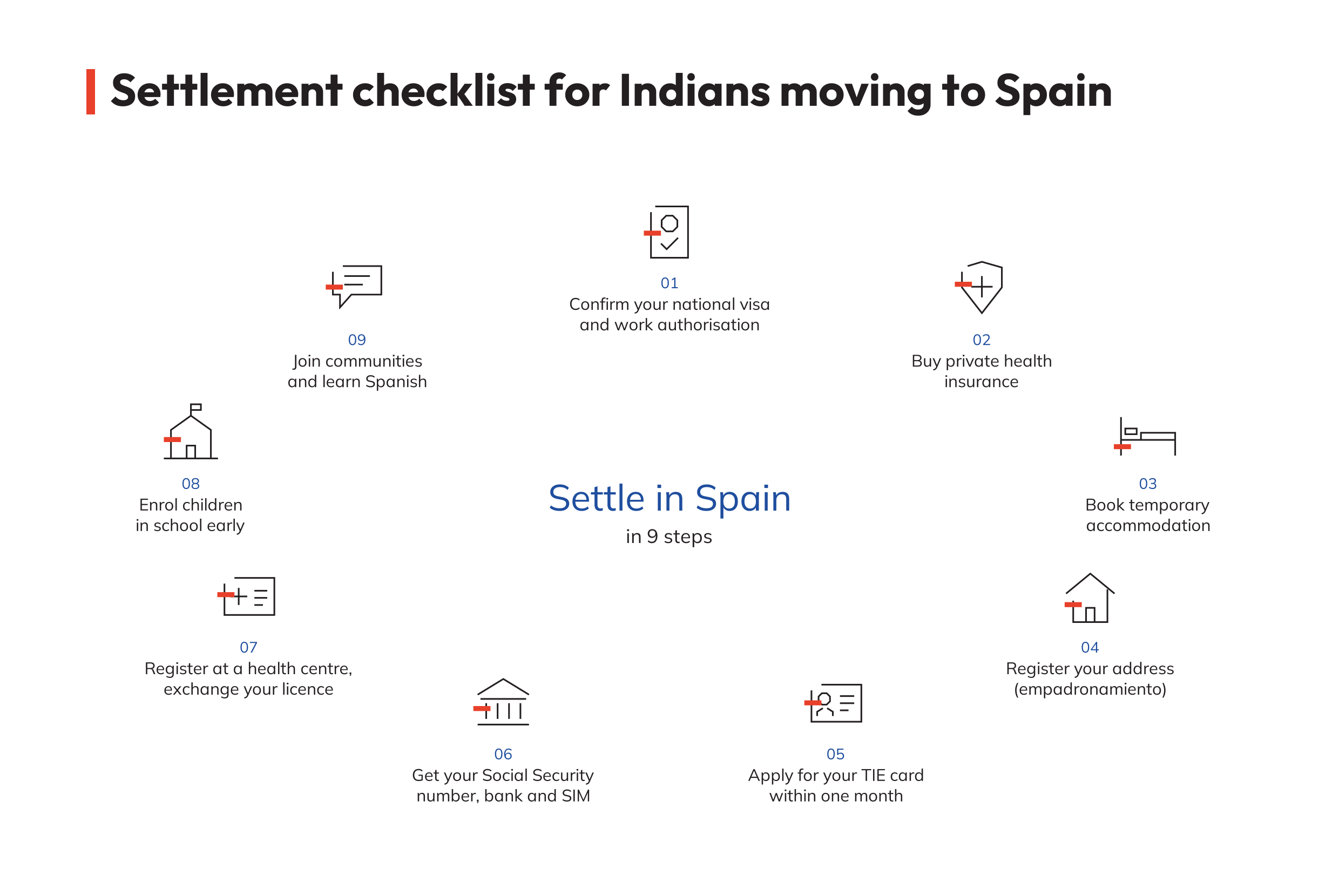
The steps for smooth transition to Spain for Indians are as follows:
Step 1: Confirm your national visa and work authorisation before you travel. Do not use a Schengen Visa to start work
Step 2: Buy private health insurance before arrival if your visa requires it or until Social Security cover starts
Step 3: Book temporary accommodation, such as a serviced apartment, for your first few weeks
Step 4: Register your address at the town hall (empadronamiento) as soon as you have a lease
Step 5: Book your fingerprint appointment and apply for your TIE residence card within one month of arrival
Step 6: Get your Social Security number, open a bank account and buy a local SIM
Step 7: Register with your local health centre and check the rules to exchange your Indian driving licence
Step 8: Enrol children in school early through your local school or education office
Step 9: Join Indian community associations and start Spanish classes to settle in faster
*Are you looking for step-by-step assistance with Spain immigration? Contact Y-Axis, the world’s No. 1 overseas immigration consultancy!
FAQs
Is Spain a good country for Indian immigrants?
Yes. Spain offers a warm climate, public healthcare, free public schools and a strong work-life balance. Jobs are in demand in IT, engineering, healthcare, tourism and renewable energy. Salaries are lower than in Germany or the UK, but living costs are also lower outside Madrid and Barcelona. Skilled workers can apply for long-term residence after five years of legal stay in Spain.
How can I move to Spain from India?
Most Indian professionals move to Spain with a job offer. Highly skilled workers can use the Highly Qualified Professional permit or the EU Blue Card. Other workers can get an employer-sponsored work permit, often for shortage occupations. Remote workers can apply for the Digital Nomad Visa. Students can study in Spain and later switch to a work permit after graduation.
What is the minimum salary for a Spain EU Blue Card?
The EU Blue Card in Spain needs a gross annual salary of at least €41,356.36. A reduced threshold of €33,085.09 applies to some shortage occupations and recent graduates. The national Highly Qualified Professional permit uses the same €41,356.36 threshold, with no reduced rate. Thresholds are updated regularly, so check the latest figure before you apply. Your employer must also confirm the salary in your job contract.
What is the income requirement for the Spain Digital Nomad Visa?
The Spain Digital Nomad Visa needs a minimum income of about €2,849 a month for a single applicant. This equals 200% of Spain's national minimum wage. Applicants must work remotely for companies or clients mainly based outside Spain. Extra income is needed for each family member. The permit can be granted for up to three years when you apply inside Spain.
What is the cost of living in Spain for a single person?
A single person in Spain usually spends €1,400 to €2,200 a month, including rent. A one-bedroom flat outside prime areas often costs €800 to €1,200 a month. Groceries cost about €250 to €400 a month. Madrid and Barcelona are the most expensive cities. Valencia, Málaga and Seville are more affordable for most immigrants. Utilities and public transport add about €120 to €240 a month.
Which Spanish cities are best for immigrants?
Madrid is best for finance, consulting and IT jobs. Barcelona suits tech and startup professionals. Valencia offers lower rents, a growing tech scene and good savings potential. Málaga has a fast-growing tech hub and a large expat community. Seville is the most affordable of these cities, with jobs in aerospace, tourism and public services. Choose a city based on your job and budget.
Can international students work in Spain?
Yes. International students in Spain can work up to 30 hours a week. The work must fit around their study schedule. After graduation, they can stay in Spain to look for a job or start a business. They can then switch to a work permit once they find a suitable job. Students must keep valid health insurance during their stay.
When can I get permanent residency in Spain?
You can apply for long-term residence in Spain after five years of continuous legal residence. Absences of up to six months at a time are allowed, if they total no more than 10 months. Long-term residents can live and work in Spain on the same terms as Spanish citizens in most areas. The long-term residence card is usually renewed every five years.
How long does it take Indians to get Spanish citizenship?
Indian citizens usually need 10 years of legal and continuous residence in Spain to apply for citizenship. Applicants must pass the DELE A2 Spanish language exam and the CCSE test on Spanish culture and society. Spain does not allow dual citizenship for Indian nationals, so Indian citizenship must be given up. Indians who become Spanish citizens can apply for an Overseas Citizen of India (OCI) card.
Can I bring my family to Spain?
Yes. Family members of Highly Qualified Professional permit and EU Blue Card holders can apply at the same time. They can also work in Spain. Other residents can usually apply for family reunification after one year of legal residence. Spouses, registered partners and dependent children are eligible. The sponsor must show enough income and suitable housing for the family. Family members can access public schools and, once registered, public healthcare.
Tags:
Life in Spain for immigrants
Move to Spain from India
Spain work visa
cost of living in Spain
Share
Y - Axis services

Get it on your mobile

Get News Alerts

Contact Y-Axis
Latest Article
Popular Post
Trending Article
Posted On November 23 2026
Life in Spain for Immigrants: Jobs, Visas, Cost of Living & Residency