

Posted on August 13 2026
Visa Sponsorship Jobs in Spain: In-Demand Jobs, Top Employers & How to Apply

By , Editor & Director
Updated August 18 2026
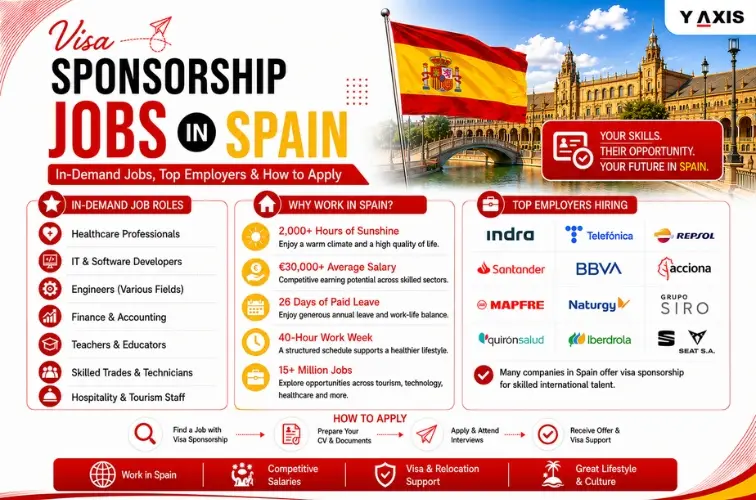
Spain is becoming an important job market in Europe. Employment reached a record 22.78 million people in 2026, while the unemployment rate fell to 9.87% in the second quarter, the first time it went below 10% since 2008. Spanish companies are also finding it difficult to hire skilled workers. According to the Hays Labour Market Guide 2026, around 93% of employers have difficulty finding qualified workers, and 81% plan to hire more employees this year.
The demand for workers is high in areas such as technology, healthcare, engineering, construction, hospitality, transport and elderly care. Spain also has an ageing population, which is increasing the need for nurses, doctors, carers and technicians. To address worker shortages, Spain introduced new immigration rules under Royal Decree 1155/2024, which came into effect on 20 May 2025. The new rules made some work permit processes easier, increased the job-seeker visa period to 12 months, and gave foreign graduates more options to stay and work in Spain.
For Indian professionals, this means that finding an employer is an important part of getting a Spanish work visa. In most cases, the Spanish employer starts the work permit process on behalf of the foreign worker. This is what is generally meant by a visa sponsorship job.
*Want to work in Spain? Contact Y-Axis for complete guidance
Why Apply for Jobs in Spain with Visa Sponsorship?
- Work and live in Spain: A Spanish work and residence permit lets you live and work legally in Spain. You can also travel to other Schengen countries for short visits without applying for a separate visa.
- 14 salary payments in many jobs: Many Spanish employment contracts pay salaries in 14 instalments. Employees usually receive 12 regular monthly salaries plus two extra payments, often in summer and around Christmas.
- Good work-life balance: Spain generally has a standard working week of around 40 hours. Employees are also entitled to paid annual leave and public holidays.
- Access to public healthcare: Employees who are registered with Spanish Social Security can use Spain's public healthcare system, subject to the applicable rules. Eligible family members may also receive healthcare coverage.
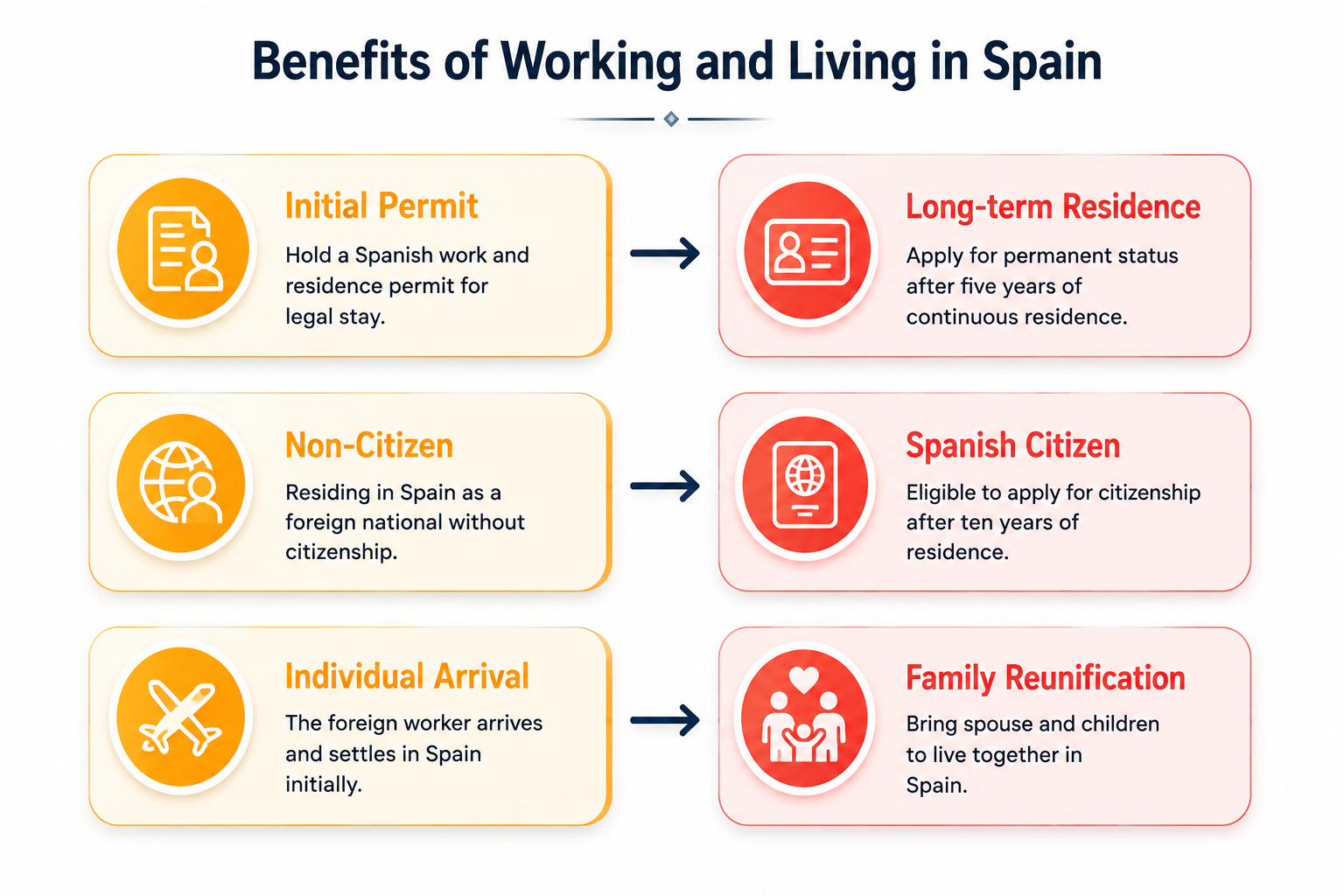
- Path to long-term residence: After five years of legal and continuous residence, eligible foreign nationals may apply for long-term residence in Spain.
- Path to Spanish citizenship: In general, Indian nationals can apply for Spanish citizenship after 10 years of legal and continuous residence, if they meet all other requirements.
- Family reunification: Eligible foreign workers may be able to bring their spouse and children to Spain. The rules and timing depend on the type of residence permit and the applicant's circumstances.
- Reasonable living costs: Some Spanish cities can have lower living costs than major cities in countries such as Germany, the Netherlands and the Nordic countries. However, costs vary widely between cities.
- Growing technology sector: Madrid, Barcelona, Valencia and Málaga have growing technology and business sectors. Some international companies also offer jobs where English is used.
- Job opportunities in shortage sectors: Spain has a shortage of workers in areas such as technology, healthcare, engineering, construction, hospitality and transport. This can create more opportunities for skilled foreign workers.
- Growing EU-India cooperation: The EU and India are working together on legal migration and mobility for skilled professionals, students, researchers and other groups. Applicants should check the latest official updates before relying on any new agreement.
- Indian community in Spain: Spain has an established Indian community, especially in cities such as Barcelona, Madrid and Valencia. Indian communities, shops, places of worship and restaurants can help new arrivals settle in.
What are Visa Sponsorship Jobs in Spain?
A visa sponsorship job in Spain is a job where a Spanish employer hires a worker from outside the EU and supports their work and residence permit application. The employer usually starts the work permit process before the worker applies for a visa.
How does the process work?
- A company in Spain offers you a job and agrees to support your work permit application.
- The employer applies for a residence and work authorisation through the Spanish Immigration Office. For highly qualified jobs, the application may be handled by the UGE-CE unit.
- For many jobs, the employer may need to show that the position could not be filled by a local worker. This is known as the labour market test. Some jobs do not require this test, such as jobs on Spain's Shortage Occupation List or jobs for eligible highly qualified professionals.
- After the work authorisation is approved, you apply for a Spanish work visa at the Spanish consulate in India.
- Once you receive the visa, you can travel to Spain and complete the required registration with Social Security.
- You then apply for your TIE residence card, where required, within the specified time after arriving in Spain.
The first work and residence permit is generally issued for a limited period and can be renewed if you continue to meet the requirements. Eligibility depends on factors such as your job offer, qualifications, work experience, occupation and the type of work permit you are applying for.
*Read more.....
In-demand Jobs in Spain
The table below groups the main in-demand sectors in Spain and lists the common job roles and their typical annual gross salary ranges.
| In-Demand Sector | In-Demand Roles | Average Annual Salary (EUR) |
|---|---|---|
| IT & Software | Software Developer; Cybersecurity Analyst / Engineer; Data Scientist / AI Engineer; Cloud / DevOps / SRE Engineer | €30,000 – €60,000 |
| Healthcare | Registered Nurse; Doctor / General Practitioner; Physiotherapist | €21,000 – €54,000 |
| Construction & Infrastructure | Civil Engineer; Electrician / Electrical Installer | €22,000 – €37,500 |
| Manufacturing & Industry | Mechanical Engineer; Welder | €22,500 – €35,500 |
| Transport & Logistics | Truck Driver (HGV) | €22,000 – €36,000 |
| Hospitality & Tourism | Chef / Cook; Hotel Receptionist / Hospitality Staff | €17,000 – €28,000 |
| Social & Elderly Care | Elderly Care Worker | €15,400 – €19,000 |
| Agriculture | Agricultural Worker | €16,000 – €22,000 |
| Marketing & Digital | Digital Marketing Specialist | €22,000 – €32,000 |
| Finance & Accounting | Accountant | €23,400 – €27,500 |
| Education | English / Language Teacher | €17,000 – €26,400 |
*Read more....
What are the most in-demand jobs in Spain for the next 10 years?
Highest Paying Job Opportunities in Spain
Spain's biggest salaries sit in banking and investment, senior technology leadership, pharmaceuticals, law, specialist medicine and aviation. Director-level pay is usually quoted as fixed salary, with bonuses adding anywhere from 20% to 100% on top in finance.
| Job Title | Average Annual Salary (EUR) | Average Annual Salary (INR) |
|---|---|---|
| Investment Banking Managing Director | €250,000 | ₹2.75 crore |
| Private Banking / Wealth Management Director | €200,000 | ₹2.20 crore |
| IT & Technology Director (CIO / CDO) | €155,000 | ₹1.71 crore |
| Banking Risk Director | €150,000 | ₹1.65 crore |
| Pharmaceutical / Medical Director | €135,000 | ₹1.49 crore |
| Cybersecurity Manager / CISO | €130,000 | ₹1.43 crore |
| Legal Director / In-House Counsel | €130,000 | ₹1.43 crore |
| Sales & Marketing Director | €120,000 | ₹1.32 crore |
| Air Traffic Controller (Senior) | €120,000 | ₹1.32 crore |
| Specialist Doctor / Surgeon (Private) | €110,000 | ₹1.21 crore |
| CFO / Finance Director | €105,000 | ₹1.16 crore |
| Airline Pilot (Captain) | €95,000 | ₹1.05 crore |
| HR Director | €85,000 | ₹93.5 lakh |
| Engineering Manager / CTO | €75,000 | ₹82.5 lakh |
| Data Scientist / AI Specialist | €55,000 | ₹60.5 lakh |
*Read more....
Top Companies Offering Visa Sponsorship Jobs in Spain
| In-Demand Sector | Companies | Common Roles |
|---|---|---|
| IT, Software & Technology | Google Spain; Amazon Web Services (AWS); Accenture Spain; EPAM Spain; Indra / Minsait | Software Engineers, Software Developers, Cloud Engineers, DevOps Engineers, Data Engineers, AI Specialists, Cybersecurity Specialists, Systems Engineers |
| Telecom & Digital Services | Telefónica / Telefónica Tech; Vodafone Spain; Orange Spain; Cellnex Telecom; MasOrange | Network Engineers, 5G/6G Engineers, Cloud Engineers, Cybersecurity Specialists, Data Specialists, AI Engineers, Telecom Engineers |
| Fintech & Financial Technology | N26; Stripe; BBVA; Santander; Revolut | Software Engineers, Backend Engineers, Data Analysts, Data Scientists, Risk & Compliance Specialists, Cybersecurity Specialists, Product Managers |
| Travel, E-commerce & Digital Platforms | Glovo; TravelPerk; Amadeus IT Group; Wallapop; Cabify | Software Engineers, Full-Stack Developers, Data Analysts, Data Scientists, Product Managers, UX Designers, DevOps Engineers |
| Engineering & Construction | ACS Group; Ferrovial; Sacyr; Acciona; Técnicas Reunidas | Civil Engineers, Mechanical Engineers, Electrical Engineers, Project Managers, Site Engineers, Construction Managers, Environmental Engineers |
| Healthcare & Medical Services | Quirónsalud; HM Hospitales; Sanitas; Vithas; Hospital Clínic de Barcelona | Doctors, Registered Nurses, Physiotherapists, Pharmacists, Healthcare Assistants, Medical Specialists |
| Manufacturing & Industrial Engineering | Siemens Spain; SEAT; Gestamp; CAF; Schneider Electric Spain | Mechanical Engineers, Electrical Engineers, Automation Engineers, Production Engineers, Industrial Engineers, Maintenance Technicians |
| Energy & Renewable Energy | Iberdrola; Endesa; Repsol; Naturgy; Acciona Energía | Renewable Energy Engineers, Electrical Engineers, Energy Analysts, Project Engineers, Maintenance Engineers, Environmental Specialists |
| Logistics & Transport | DHL Spain; DB Schenker Spain; XPO Logistics; Correos; SEUR | Logistics Managers, Supply Chain Specialists, Warehouse Managers, Truck Drivers, Transport Coordinators, Operations Managers |
| Hospitality & Tourism | Meliá Hotels International; Barceló Hotel Group; NH Hotel Group; Iberostar; RIU Hotels & Resorts | Chefs, Cooks, Hotel Managers, Receptionists, Restaurant Staff, Housekeeping Staff, Hospitality Supervisors |
| Customer Service & Business Services | Concentrix Spain; Teleperformance Spain; Foundever; Webhelp; Majorel | Multilingual Customer Support, Technical Support, Customer Success Specialists, Team Leaders, Sales Representatives |
| Education & Language Services | International House; British Council Spain; Cambridge School; Kids&Us; Language School Group | English Teachers, Language Teachers, Academic Coordinators, Education Managers, Trainers |
Eligibility Requirements for Visa Sponsorship Jobs in Spain for Indians
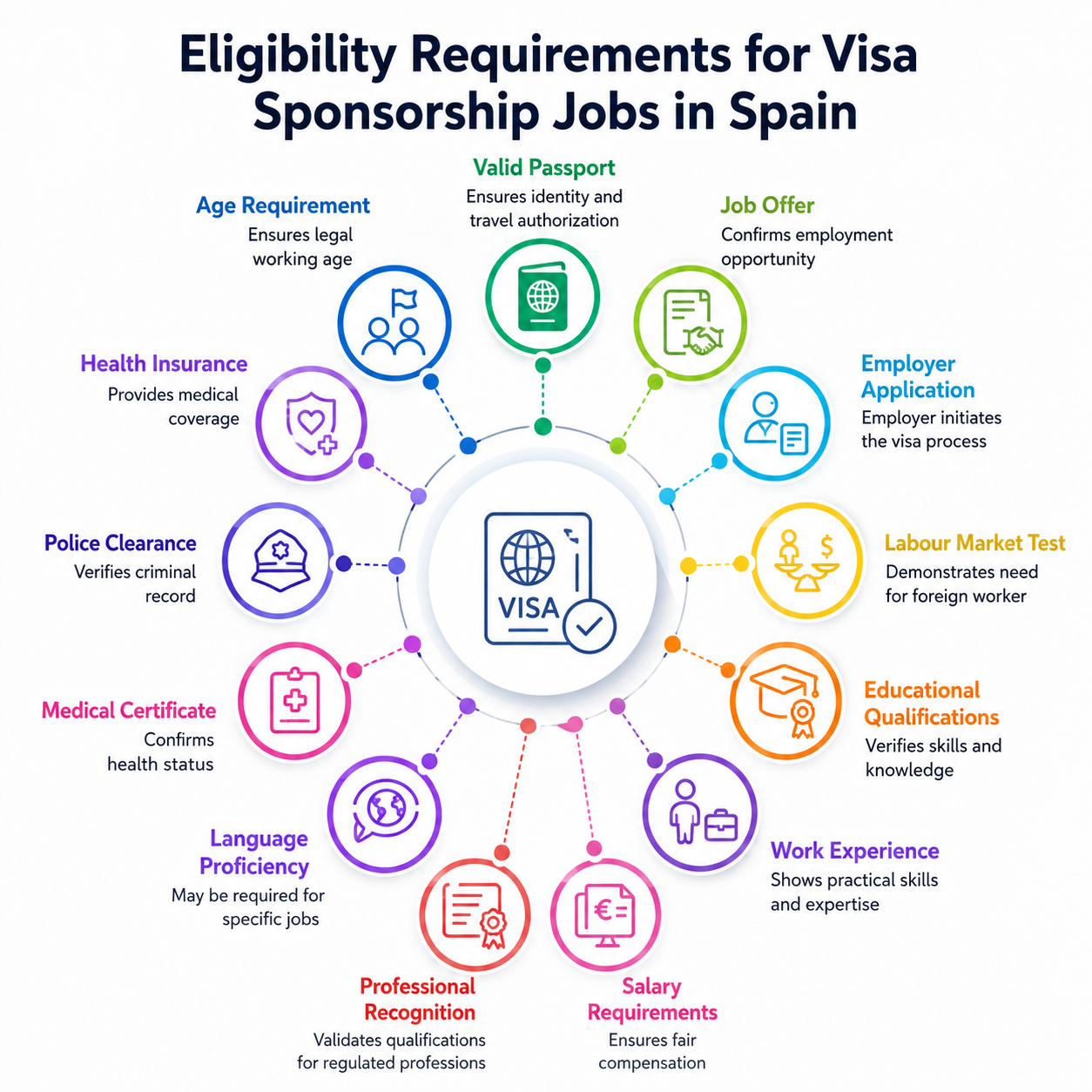
- You must have a valid Indian passport with enough validity and at least two blank pages.
- You need a valid job offer or signed employment contract from a company registered in Spain.
- The Spanish employer must apply for your residence and work authorization.
- For many jobs, the employer must show that the position could not be filled by a local worker.
- This labour market test may not apply to jobs on Spain's Shortage Occupation List or eligible highly qualified professional roles.
- You should have a relevant degree, diploma or recognized vocational qualification for the job.
- Some highly qualified roles require a university or postgraduate degree or equivalent professional experience.
- Work experience depends on the job. Many professional jobs ask for 2–5 years of experience.
- Your salary must meet the applicable Spanish minimum wage and the salary rules for your job and sector.
- Regulated professions such as medicine, nursing, pharmacy, engineering, architecture and law may require official recognition of your qualification in Spain.
- IELTS or a Spanish language test is generally not required for the work visa.
- Spanish may be required for healthcare, care, hospitality and other customer-facing jobs.
- You may need a medical certificate showing that you do not have a disease that could pose a public health risk.
- You may need police clearance certificates from India and other countries where you have lived for the required period.
- Health insurance may be required depending on the type of work permit and your circumstances.
- You generally need to be at least 18 years old to work in Spain.
Documents Required for a Sponsored Work Visa in Spain
- Valid passport and copies of the required pages.
- Recent passport-size photographs.
- Completed and signed Spanish national visa application form.
- Approved residence and work authorisation issued after the employer's application.
- Signed employment contract showing your job, salary, working hours and employment period.
- Documents from the employer showing company registration and compliance with tax and Social Security rules.
- Degree, diploma or vocational certificates related to the job, where required.
- Official qualification recognition documents for regulated professions, where required.
- Work experience letters to support your professional experience.
- Police clearance certificate covering the required period.
- Medical certificate from an approved doctor.
- Proof of payment of the required government and visa fees.
- Health insurance documents, if required for your visa category.
- Marriage and birth certificates if eligible family members are applying with you.
- Documents issued in India may need to be apostilled and officially translated into Spanish, depending on the document and visa requirement.
*Want to know about Spain Digital Nomad visa? Talk to Y-Axis for complete guidance.
How to Get a Visa Sponsorship Job in Spain?
Step 1: Check whether your occupation has a shortage route
Look at Spain's Shortage Occupation List, published quarterly by the public employment service SEPE. If your job is listed, your employer skips the labour market test a big advantage.
Step 2: Decide which permit route fits you
If your salary will exceed roughly €41,400 a year and you hold a degree, the Highly Qualified Professional permit or EU Blue Card is faster and easier. Below that level, you need the standard employed-worker permit.
Step 3: Prepare a Spanish-style CV
Keep it to one or two pages. Add a photo (common in Spain), your nationality, languages with proficiency levels, and any EU-recognised certifications. Mention clearly that you need visa sponsorship.
Step 4: Search for sponsorship jobs
Use InfoJobs, LinkedIn, EURES, the EU Talent Pool, Tecnoempleo, Manfred and company career pages. Target the tech hubs — Madrid, Barcelona, Valencia and Málaga and international companies with English-language teams.
Step 5: Apply and interview
Most first interviews are online. Expect technical tests for IT roles and a language check for customer-facing jobs. Employers will ask whether you already have EU work rights, so be upfront.
Step 6: Get the offer and check the details
Confirm your gross annual salary, the number of payments (12 or 14), the applicable collective agreement, holiday entitlement, probation period and whether relocation help is included.
Step 7: Employer applies for the authorisation
Your employer files the residence and work application. Highly qualified applications go to the UGE-CE and take around 20 working days. Standard applications go through the provincial Immigration Office and take longer.
Step 8: Apply for the work visa in India
Once approved, book an appointment at the Spanish consulate in New Delhi, Mumbai or a BLS visa centre. Submit your documents and pay the fee. Visa issuance usually takes around 10 working days for highly qualified cases and up to a month otherwise.
Step 9: Travel, register and collect your TIE
You must enter Spain within the visa validity, start work within three months, get your NIE and social security number, and apply for your TIE residence card within 30 days of arrival at a police station or immigration office.
Work Visa Options for Foreign Workers in Spain
| Visa / Permit Type | Purpose | Validity |
|---|---|---|
| Employed Worker Permit | The standard sponsored work permit for a specific employer and job | 1 year initially, then renewed for 4 years |
| Highly Qualified Professional (HQP) Permit | Fast-track route for degree-holders in well-paid roles, processed by UGE-CE | Up to 3 years, renewable for 2 years |
| EU Blue Card | EU-wide highly skilled permit with mobility rights across member states | Up to 4 years, renewable |
| Intra-Company Transfer (ICT) Permit | Transfers within the same corporate group, common for Indian IT companies | 3 years for managers and specialists |
| Seasonal Work Permit | Temporary agriculture and tourism work, often through bilateral schemes | Up to 9 months in a 12-month period |
| Job Seeker Visa | Lets recent graduates of Spanish institutions (aged 18–40) stay and look for work | 12 months |
| Self-Employed Work Visa | For entrepreneurs and freelancers running their own business in Spain | 1 year initially, renewable |
| Digital Nomad Visa | For remote workers employed by companies outside Spain | 1 year (visa) or 3 years (permit), renewable |
| Student Visa with Work Rights | Study in Spain with permission to work, then convert to a work permit | Duration of the course |
| Long-Term Residence | Independent status after 5 years of legal residence — no sponsor needed | 5 years, renewable |
Highly Qualified Professional permit and EU Blue Card thresholds
These are the fastest routes into Spain for skilled Indian professionals, but they carry salary conditions. Following the INE's publication of Spain's 2024 average salary of €29,540.26 on 28 May 2026, the thresholds are:
- General threshold: €41,356.36 per year (1.4 times the national average salary).
- Reduced threshold: €33,085.09 per year, available in specific cases such as recent graduates who obtained their qualification within the last three years.
- Director and manager-level roles: under the national highly qualified route can be held to a higher figure, in the region of €54,000 a year.
Cost of a Spain Work Visa
| Item | Fee | Paid By |
|---|---|---|
| Residence and Work Authorisation (Modelo 790 Code 052/062) | €203.84 – €407.71 depending on salary level and route | Employer (mostly) |
| National Work Visa Fee at the Consulate | Around €80 | Applicant |
| TIE Residence Card Issuance (Modelo 790 Code 012) | Around €16 – €22 | Applicant |
| Document Apostille, Translation and Legalisation | €150 – €500 depending on volume | Applicant |
| Medical Certificate | €50 – €100 in India | Applicant |
| Police Clearance Certificate | Nominal fee in India | Applicant |
| Typical Total | €280 – €500+ excluding translations | Shared |
Processing time: Highly qualified applications take roughly 20 working days for the authorisation plus about 10 working days for the visa — around 30 working days in total. Standard employed-worker applications usually take longer, often two to three months for the authorisation plus up to a month for the visa.
*Looking for assistance for overseas immigration? Contact Y-Axis, the world’s #1 overseas career consultancy for job search support and visa assistance.
FAQs
What are visa sponsorship jobs in Spain?
Visa sponsorship jobs in Spain are positions where a Spanish employer applies to the immigration authorities for permission to hire you as a non-EU worker. The company files for a combined residence and work authorisation, and only after that approval can you apply for your work visa at the Spanish consulate in India. You cannot apply for a Spanish work permit on your own.
Can Indians get visa sponsorship jobs in Spain?
Yes. Around 56,000 Indian nationals are registered as residents in Spain, concentrated in Barcelona, Madrid and Valencia. Indian professionals are recruited in IT, engineering, healthcare, hospitality, logistics and business services. You need a genuine job offer, relevant qualifications, and an employer willing to sponsor. Degree recognition is also required for regulated professions such as medicine and nursing.
Which companies sponsor foreign workers in Spain?
Companies known to recruit international talent include Google Spain, Amazon and AWS, Vodafone's Málaga R&D hub, Accenture Spain, Telefónica Tech, Indra/Minsait, EPAM, Amadeus IT Group, Concentrix, N26, Stripe, Glovo, TravelPerk, Typeform, Factorial, Wallapop and Cabify. Always confirm sponsorship for the specific role.
Which jobs are easiest to get sponsorship for in Spain?
Technology roles are the most realistic: software development, cloud and DevOps, cybersecurity and data science, because salaries clear the highly qualified threshold. Occupations on the official Shortage Occupation List, marine engineers and officers, refrigeration technicians, metal and PVC carpenters, electrical installers and crane operators, are also easier because the labour market test is waived.
What are the highest-paying sponsorship jobs in Spain?
Investment banking managing directors top the list at around €250,000 a year (about ₹2.75 crore), followed by private banking directors near €200,000, IT and technology directors around €155,000, and banking risk directors near €150,000. Cybersecurity managers, legal directors and pharmaceutical medical directors earn €130,000–135,000. Data scientists and AI specialists average about €55,000.
What qualifications are required for visa sponsorship jobs in Spain?
You generally need a degree, diploma or recognised vocational qualification matching the job. The Highly Qualified Professional permit requires a university or postgraduate degree, or at least three years of equivalent professional experience. Regulated professions — medicine, nursing, pharmacy, engineering, architecture, teaching and law — additionally require formal degree recognition (homologación) in Spain.
Do I need to speak Spanish to work in Spain?
No Spanish exam is required for the work visa. However, Spanish is essential in practice for healthcare, elderly care, hospitality, construction, retail and most customer-facing work. Technology teams in Madrid, Barcelona, Valencia and Málaga often operate in English. Learning Spanish to at least B1 level will significantly widen your options and help with daily life.
Is IELTS required for a Spain work visa?
No. Spain does not require IELTS or any English language test for a work visa. Employers may assess your English during interviews if the workplace language is English. For Spanish nationality later on, you will need to pass the DELE A2 Spanish language exam and the CCSE constitutional and sociocultural knowledge test, unless you are exempt.
What is the minimum salary for a work visa in Spain?
For standard sponsored jobs, your salary must be at least Spain's statutory minimum wage — €1,221 per month across 14 payments, or about €17,094 a year in 2026 — and must also meet the applicable collective agreement rate. For the Highly Qualified Professional permit and EU Blue Card, the general threshold is €41,356.36 per year, with a reduced threshold of €33,085.09 in certain cases.
How long does a Spain work visa take?
Highly qualified applications are processed by the UGE-CE in about 20 working days, plus roughly 10 working days for the visa — around 30 working days in total. Standard employed-worker applications take longer, commonly two to three months for the authorisation and up to a month for the visa. Add time for apostille, translation and consulate appointments.
How much does a Spain work visa cost?
Expect €280 to €500 or more in total. The residence and work authorisation fee is €203.84 to €407.71 through Modelo 790 codes 052 or 062, mostly paid by the employer. The consular visa fee is around €80, and the TIE residence card costs about €16 to €22. Translation, apostille and medical certificate costs are extra.
Can my family come with me to Spain?
Yes. Highly qualified professionals can include their spouse and children in the same application, so the family travels together. Under the general regime you must have lived in Spain for a year and obtained your first renewal before applying for family reunification, and show income of at least 150% of the IPREM, plus 50% more for each additional relative.
Can visa sponsorship in Spain lead to permanent residency?
Yes. After five years of continuous legal residence you can apply for long-term residence (residencia de larga duración), which lets you live and work in Spain without employer sponsorship and is renewable every five years. Time spent on a work permit, highly qualified permit or EU Blue Card all counts towards the five years.
Can I get Spanish citizenship?
Indian nationals can apply for Spanish nationality after 10 years of legal, continuous residence. You must pass the DELE A2 Spanish exam and the CCSE test, show good civic conduct and demonstrate integration. Spain does not generally permit dual nationality with India, so you would normally have to renounce Indian citizenship and can consider OCI status instead.
What is Spain's Shortage Occupation List and why does it matter?
The Catálogo de Ocupaciones de Difícil Cobertura is published quarterly by SEPE and lists jobs Spain cannot fill locally. If your occupation is on it, your employer does not need to run the labour market test, which shortens the process considerably. The current list is dominated by maritime, industrial and skilled trade roles rather than IT, and some entries apply only in specific provinces.
Are IT jobs available in Spain for foreigners?
Yes, and this is the strongest route. Spain's tech sector grew about 8% in 2025, and Málaga TechPark alone hosts around 715 companies and nearly 28,000 employees, anchored by Google's cybersecurity centre, Vodafone's R&D hub and Accenture. Barcelona's 22@ district employs roughly 90,000 people. Cloud, cybersecurity, data and AI skills are the most in demand.
Are nursing and healthcare jobs available in Spain?
Demand is high because of Spain's ageing population, but the process is slower than in the UK or Germany. Non-EU nurses and doctors must get their degree recognised through homologación, register with the relevant professional college, and demonstrate solid Spanish, usually B2. Madrid has removed the Spanish nationality requirement for non-EU doctors, which helps.
Can fresh graduates get sponsorship in Spain?
Directly from India it is difficult, because employers must justify hiring a fresher over local and EU candidates. The realistic path is to study in Spain first: graduates of Spanish institutions aged 18 to 40 can apply for a 12-month job seeker visa, and students who finish courses lasting over a year can receive up to four years of work authorisation.
Can I look for a job while in Spain on a tourist visa?
You can attend interviews, but you cannot work, and you cannot convert a Schengen tourist visa into a work permit from inside Spain in the normal course. The correct routes are the job seeker visa if you studied in Spain, or securing an offer from India and letting your employer sponsor you before you travel.
How can Y-Axis help me get a sponsorship job in Spain?
Y-Axis offers Europe-format resume writing, LinkedIn profile optimisation, job search assistance, and access to employer and vacancy databases for Spain and the EU. Our team also provides interview preparation, documentation, apostille and degree recognition guidance, visa application support, and one-to-one counselling so you know which roles suit your profile and what a realistic timeline looks like.
Tags:
Visa Sponsorship Jobs in Spain 2026
Spain Work Visa Sponsorship for Indians
Spain Work Visa Jobs
Spain Work Visa for Foreign Workers
In-Demand Jobs in Spain with Visa Sponsorship
Spain Employer-Sponsored Jobs
Spain Jobs for Foreign Workers
Share
Options for you by Y-Axis

Get it on your mobile

Get News alerts

Contact Y-Axis
Latest Article
Popular Post
Trending Article
Posted On September 28 2026
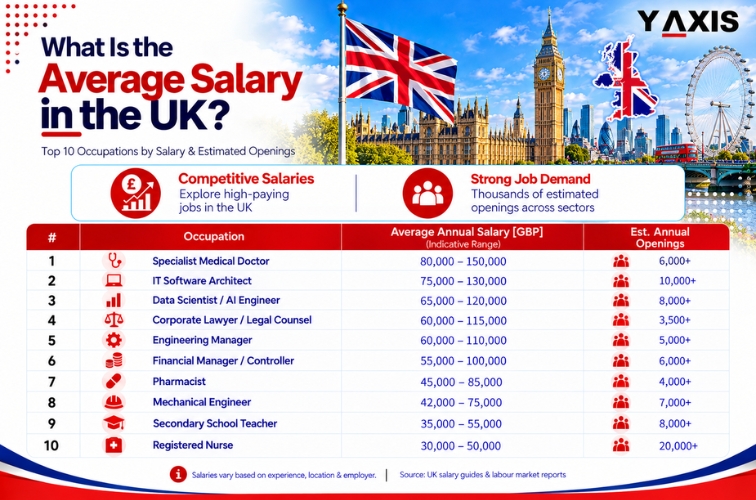
What Is the Average Salary in the UK?