

Posted on November 16 2026
Life in the Netherlands for Immigrants: Jobs, Visas, Cost of Living & Residency

By , Editor & Director
Updated November 16 2026
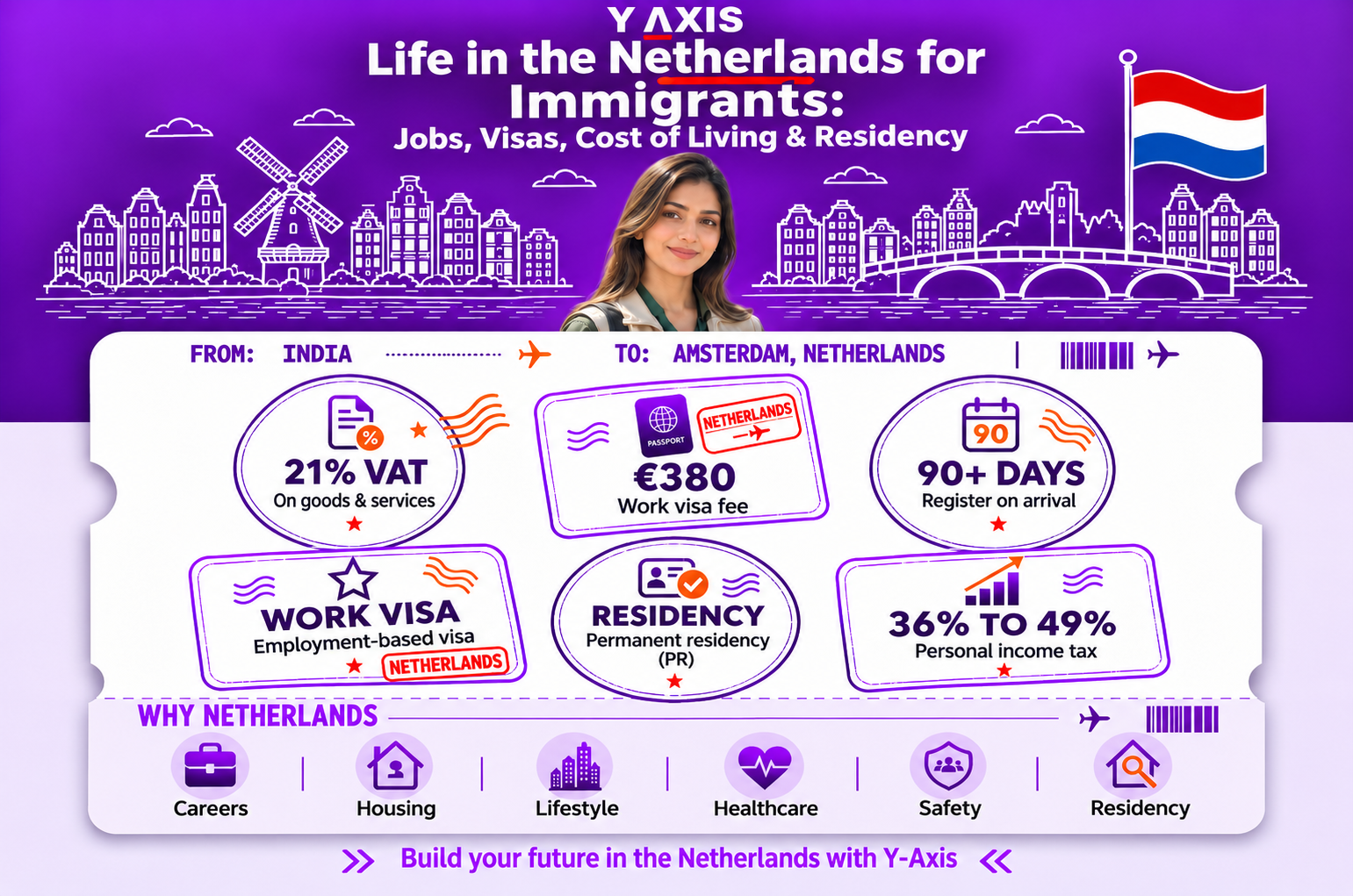
Life for immigrants in the Netherlands offers high salaries, widely spoken English, and a strong job market in IT, engineering, and logistics. Most Indian professionals move on the Highly Skilled Migrant permit, which needs a job offer from an IND-recognised sponsor. The salary must be at least EUR 5,942 a month if you are 30 or over, or EUR 4,357 if you are under 30. Highly qualified graduates can apply for the EU Blue Card as an alternate immigration pathway to Netherlands. Recent foreign graduates of top universities can use the Orientation Year to look for work for 12 months. Permanent residency in Netherlands is possible after 5 years with A2-level Dutch. Amsterdam, Rotterdam, The Hague, Utrecht, and Eindhoven are popular cities for expats to work and settle in the country.
Some quick facts about the Netherlands are as follows:
|
Population |
Approximately 18 million residents |
|
Capital |
Amsterdam (the government sits in The Hague) |
|
Official Language |
Dutch (English is widely spoken at work and in cities) |
|
Currency |
Euro (EUR) |
|
Popular Immigrant Hubs |
Amsterdam, Rotterdam, The Hague, Utrecht, Eindhoven |
|
Economy |
Strong tech, semiconductor, logistics, finance, and agri-food sectors; high demand for IT, engineering, and healthcare professionals |
|
Typical Route to Long Stay |
Highly Skilled Migrant permit with a job offer, or the EU Blue Card for highly qualified graduates |
|
Long-Term Residency |
Permanent residency after 5 years with A2 Dutch; citizenship usually after 5 years |
*Want to settle in the Netherlands? Sign up with Y-Axis for end-to-end assistance.
Why Choose the Netherlands to Migrate Abroad?
The Netherlands runs an employer-led work permit system for skilled workers from outside the EU. It also offers the EU Blue Card and an Orientation Year for recent graduates.
Here is why you should choose a life in the Netherlands:
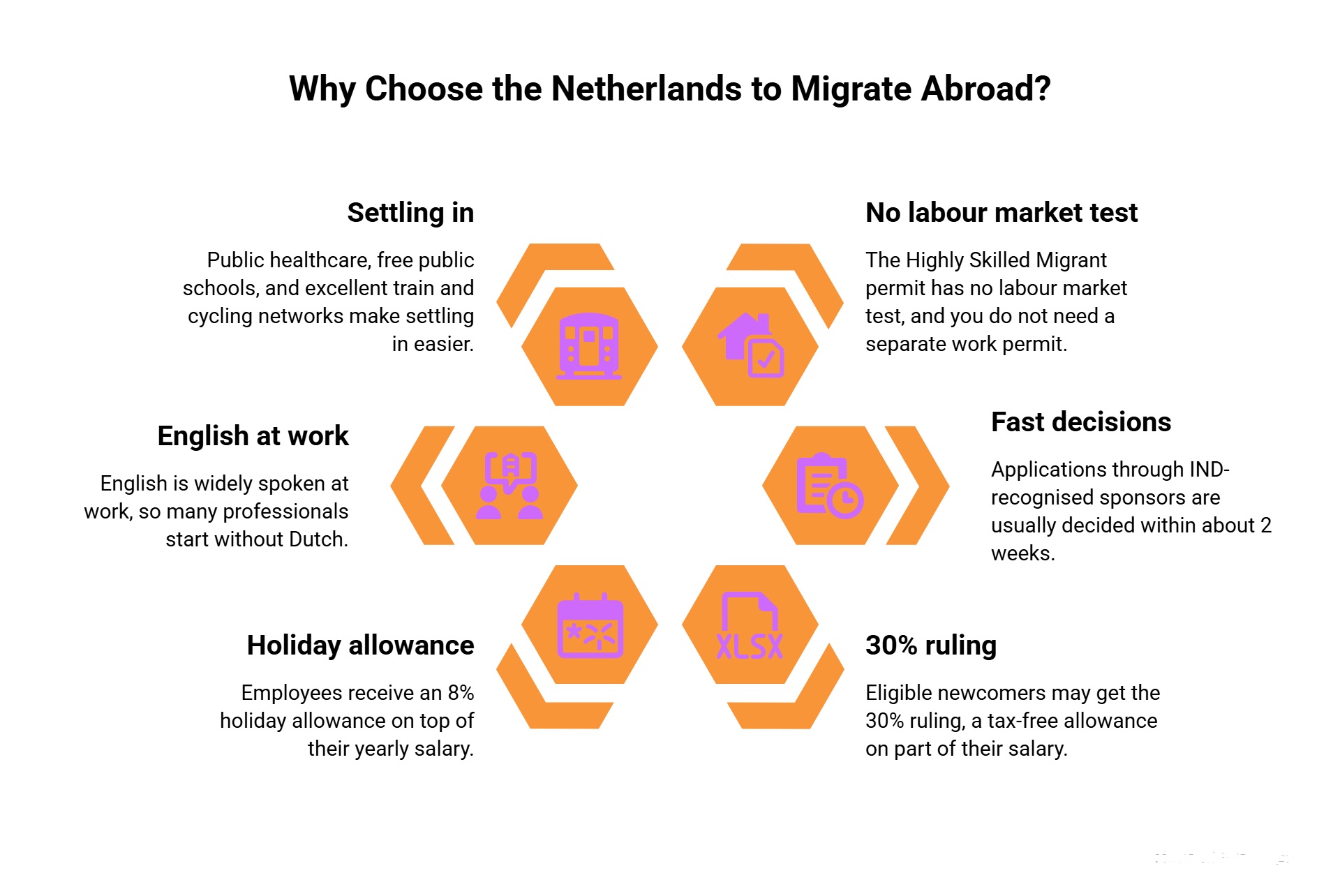
- The Highly Skilled Migrant permit has no labour market test, and you do not need a separate work permit.
- Applications through IND-recognised sponsors are usually decided within about 2 weeks.
- Eligible newcomers may get the 30% ruling, a tax-free allowance on part of their salary.
- Employees receive an 8% holiday allowance on top of their yearly salary.
- English is widely spoken at work, so many professionals start without Dutch.
- Public healthcare, free public schools, and excellent train and cycling networks make settling in easier.
Note: Indian passport holders need a Schengen visa to visit the Netherlands. You cannot work on a Schengen visit visa. For stays longer than 90 days, you usually need an MVV entry visa and a residence permit, such as the Highly Skilled Migrant permit, before starting work.
*Want to work in the Netherlands? Let Y-Axis assist you with the process.
Can I Move to the Netherlands as an Indian Immigrant?
Most Indians move to the Netherlands on a Highly Skilled Migrant permit. To apply for a Highly Skilled Migrant permit, you need a job offer from an IND-recognised sponsor and a salary above the threshold. Highly qualified graduates can apply for the EU Blue Card as an alternate route to immigrate to Netherlands.
The steps to migrate to the Netherlands as an Indian professional are as follows:
Step 1: Check the current salary thresholds on the official IND website (ind.nl) for your age and route
Step 2: Secure a job offer from an IND-recognised sponsor that meets the salary threshold
Step 3: Select a suitable pathway, such as the Highly Skilled Migrant permit, the EU Blue Card, or the Orientation Year
Step 4: Your employer applies to the IND for your MVV entry visa and residence permit together
Step 5: The IND checks your application, which usually takes about 2 weeks for recognised sponsors
Step 6: Collect your MVV at the Netherlands Embassy or a consulate in India, and travel within its 90-day validity
Step 7: Register your address at your municipality within 5 days to get your BSN, then collect your residence permit from the IND
Also, read...
Highest Paying Job Opportunities in the Netherlands
Best Visa Options to Live in the Netherlands
The Netherlands offers several routes depending on your job offer, salary, education, and business plans. The table below shows the main options and their route to long-term residence in the country.
|
Visa Type |
Best For |
Duration |
Long-Term Pathway |
|
Highly Skilled Migrant Permit (Kennismigrant) |
Skilled workers with a job offer from an IND-recognised sponsor (EUR 5,942/month if 30+, EUR 4,357/month if under 30) |
Up to 5 years, based on your contract |
Can lead to permanent residency after 5 years |
|
Graduates with a job offer of at least 6 months paying at least EUR 5,942 a month (EUR 4,754 for recent graduates) |
Up to 4 years, renewable |
Can lead to permanent residency after 5 years; easier moves within the EU |
|
|
Orientation Year (Zoekjaar) |
Recent graduates of Dutch universities or top-ranked universities abroad, within 3 years of graduating |
12 months |
Switch to a Highly Skilled Migrant permit at the reduced threshold of EUR 3,122/month |
|
Start-up Visa and Self-Employed Permit |
Entrepreneurs with an innovative business plan; start-ups need a recognised facilitator |
1 year (start-up); 2 years (self-employed) |
Can lead to permanent residency after 5 years |
Note: Salary thresholds are gross monthly amounts, excluding the 8% holiday allowance. The IND updates them every January.
Also, read...
The Netherlands Job Market Outlook
Best Areas to Live in the Netherlands
The Dutch job market and living costs vary by city. Choosing the right area can influence your commute, cost of living, housing expenses, and overall quality of life.
The table below highlights the major Dutch cities and their best qualities for settlement abroad:
|
Area |
Best For |
Sightseeing |
Average Rent |
Job Market |
How Much You Can Save |
|
Amsterdam (Central) |
Corporate professionals & expats |
Rijksmuseum, Anne Frank House, Canal Ring |
EUR 1,800-2,500/mo (1BR flat) |
Strong, tech, finance & international HQs |
Moderate, very high rents |
|
Amstelveen |
Families & the Indian community |
Amsterdamse Bos, Cobra Museum |
EUR 1,500-2,000/mo (1BR flat) |
Strong, close to Amsterdam & Schiphol |
Moderate, higher rents |
|
Rotterdam |
Logistics & engineering professionals |
Markthal, Cube Houses, Erasmus Bridge |
EUR 1,300-1,800/mo (1BR flat) |
Good, port, logistics & maritime |
Good savings potential |
|
The Hague |
Legal, government & international organisation staff |
Binnenhof, Mauritshuis, Scheveningen Beach |
EUR 1,200-1,700/mo (1BR flat) |
Good, international bodies, IT & energy |
Good savings potential |
|
Utrecht |
Young professionals & researchers |
Dom Tower, Oudegracht canal, Utrecht University |
EUR 1,300-1,800/mo (1BR flat) |
Good, IT, consulting & research |
Moderate, higher rents |
|
Eindhoven |
Engineers & tech professionals |
Philips Museum, Van Abbemuseum, Strijp-S |
EUR 1,000-1,500/mo (1BR flat) |
Strong, semiconductors & high-tech |
Good savings potential |
Note: Most landlords ask for a deposit of up to 2 months' basic rent, which is the legal maximum for most leases. Tenants usually do not pay agency fees. Housing is in short supply, so start your search early. Figures vary by neighbourhood, size, and distance from train or tram stops. Confirm current listings before budgeting.
*Start your Europe job search today with Job Portal Registration at just ₹2,500 (50% off). Your profile goes live on the top 10 international job portals.
View all packages: https://www.y-axis.com/lp/europe-work-indians/
Cost of Living in the Netherlands
The cost of living in the Netherlands changes by location. Amsterdam and Utrecht cost the most, while Rotterdam, The Hague, and Eindhoven are more affordable.
Below is a breakdown of average monthly expenses for a single adult living outside the most premium areas:
|
Rent (1BR flat, outside prime area, e.g. Rotterdam/Eindhoven) |
EUR 1,000-1,500/month |
|
Utilities (energy, water & internet) |
EUR 180-280/month |
|
Groceries |
EUR 275-450/month |
|
Public Transport (trains, trams & buses) |
EUR 50-110/month (many people cycle to save costs) |
|
Healthcare |
Basic health insurance is mandatory; about EUR 157-159/month per adult, plus a EUR 385 yearly deductible |
|
Dining Out (per meal) |
EUR 15-25 (casual restaurant), EUR 40-70 (mid-range restaurant) |
|
Mobile & Internet |
EUR 10-50/month |
|
Entertainment & Leisure |
EUR 100-250/month |
Also, read...
What are the Eligibility Requirements for a Netherlands Work Visa?
Is the Netherlands Expensive Compared to Germany or Belgium?
The Netherlands is generally more expensive than Germany and Belgium, mainly because of rent. Living costs in Amsterdam are similar to Munich, while Rotterdam, The Hague, and Eindhoven are noticeably cheaper.
Salaries for skilled professionals are high, and you receive an 8% holiday allowance. Eligible newcomers can also use the 30% ruling to lower their tax bill.
Amsterdam and Utrecht are the priciest cities. However, Amsterdam also offers the most jobs in tech, finance, and international headquarters.
Also, read...
Can Indians apply for the Netherlands Orientation Permit?
Work in the Netherlands
The Dutch job market is led by tech, semiconductors, logistics, finance, and agri-food. Leading employers include ASML, Philips, Booking.com, ING, Shell, Heineken, and Adyen.
The table below shows some of the most in-demand jobs in the Netherlands for immigrants.
|
Occupation |
Average Monthly Salary |
Demand Level |
Average Savings |
|
IT & Software Development |
EUR 4,500-7,000 |
High |
EUR 1,000-2,000/month |
|
Data Science & AI |
EUR 4,800-7,500 |
High |
EUR 1,100-2,200/month |
|
Mechanical, Electrical & Semiconductor Engineering |
EUR 4,200-6,500 |
High |
EUR 900-1,800/month |
|
Nursing & Healthcare |
EUR 3,000-4,800 |
High |
EUR 400-1,000/month |
|
Finance & Accounting |
EUR 4,000-6,500 |
Moderate |
EUR 800-1,600/month |
|
Logistics & Supply Chain |
EUR 3,200-5,000 |
High |
EUR 500-1,200/month |
Note: Salaries are gross monthly estimates. For the Highly Skilled Migrant permit, your offer must meet the IND salary threshold for your age. Healthcare roles usually need Dutch registration and Dutch language skills.
Also, read...
Visa Sponsorship Jobs in Netherlands: In-Demand Jobs, Top Employers & How to Apply
Settling in the Netherlands
Once you arrive in the Netherlands, you need to register your address, collect your residence permit, take out health insurance, and set up your day-to-day essentials.
Here is a quick overview of what to expect during your first weeks in the country:
|
Housing |
Healthcare |
Education for Children |
Banking & Financial Essentials |
|
Search via portals like Funda, Pararius, and Kamernet, or English-speaking agents; flats near train and tram stops are in high demand |
Take out Dutch basic health insurance within 4 months of registering; cover is backdated to your arrival |
Public schools are free and teach in Dutch; international schools offer English, British, and IB options |
Open an account with ING, ABN AMRO, Rabobank, or bunq |
|
Landlords usually ask for a deposit of up to 2 months' basic rent; register your address at the municipality within 5 days |
Register with a local GP (huisarts), who is your first point of contact for care |
Subsidised Dutch international schools charge lower fees than private international schools |
Banks usually ask for your passport, residence permit, and BSN |
|
Allow 1-3 months to find a rental, as the housing market is tight |
Children under 18 are insured for free under a parent's policy |
International school fees range from around EUR 4,000 to EUR 25,000+ a year |
Apply for a DigiD to access tax, benefits, and government services online |
|
Book temporary accommodation for your first weeks while you search |
Many expats add supplementary cover for dental care and physiotherapy |
Apply for school places early; popular international schools have waitlists |
Online banks such as bunq allow quick account opening |
Also, read...
What are the most in-demand jobs in the Netherlands for the next 10 years?
Permanent Residency and Long-Term Residency in the Netherlands
Long-term residency in the Netherlands is mainly available through the permanent residence permit and EU long-term resident status.
|
Highly Skilled Migrant Permit |
Valid for up to 5 years and tied to a recognised sponsor; you can switch to another recognised sponsor; counts towards permanent residency |
|
EU Blue Card |
Valid for up to 4 years; you can move to another EU country after 12 months; counts towards permanent residency |
|
Orientation Year |
Valid for 12 months; lets you switch to a Highly Skilled Migrant permit at a reduced salary threshold |
|
Permanent Residency |
Needs 5 years of continuous legal stay, the A2 civic integration exam, a stable income, and health insurance |
|
Dutch Citizenship (Naturalisation) |
Usually needs 5 years of legal residence, the A2 civic integration exam, good conduct, and giving up your current nationality |
Important note: To apply for Dutch permanent residency, you usually need 5 years of continuous legal stay on a permit for a non-temporary purpose, such as the Highly Skilled Migrant permit or EU Blue Card. Time on a student permit or the Orientation Year usually does not count fully. You must also pass the A2 civic integration exam, show a stable income, and have health insurance. Citizenship usually needs 5 years of residence. The government has proposed a higher B1 language level and a longer residence period, so check the latest rules before you apply. The Netherlands generally requires you to give up your old citizenship, and India does not allow dual citizenship.
Also, read...
Why Apply for a Netherlands Orientation Permit?
Dependent Benefits for Immigrants in the Netherlands
The Netherlands allows Highly Skilled Migrant permit and EU Blue Card holders to bring their spouse or partner and children through family reunification.
Here are the benefits of securing a Netherlands dependent permit:
- Spouses, partners, and children can often apply at the same time as you
- Partners can work for any employer, or be self-employed, without a separate work permit
- Children can study for free in Dutch public schools
- Children under 18 are insured for free under a parent's health insurance
- Parents can claim child benefit (kinderbijslag) every quarter for children under 18
Practical Settlement Checklist for Indians Moving to the Netherlands
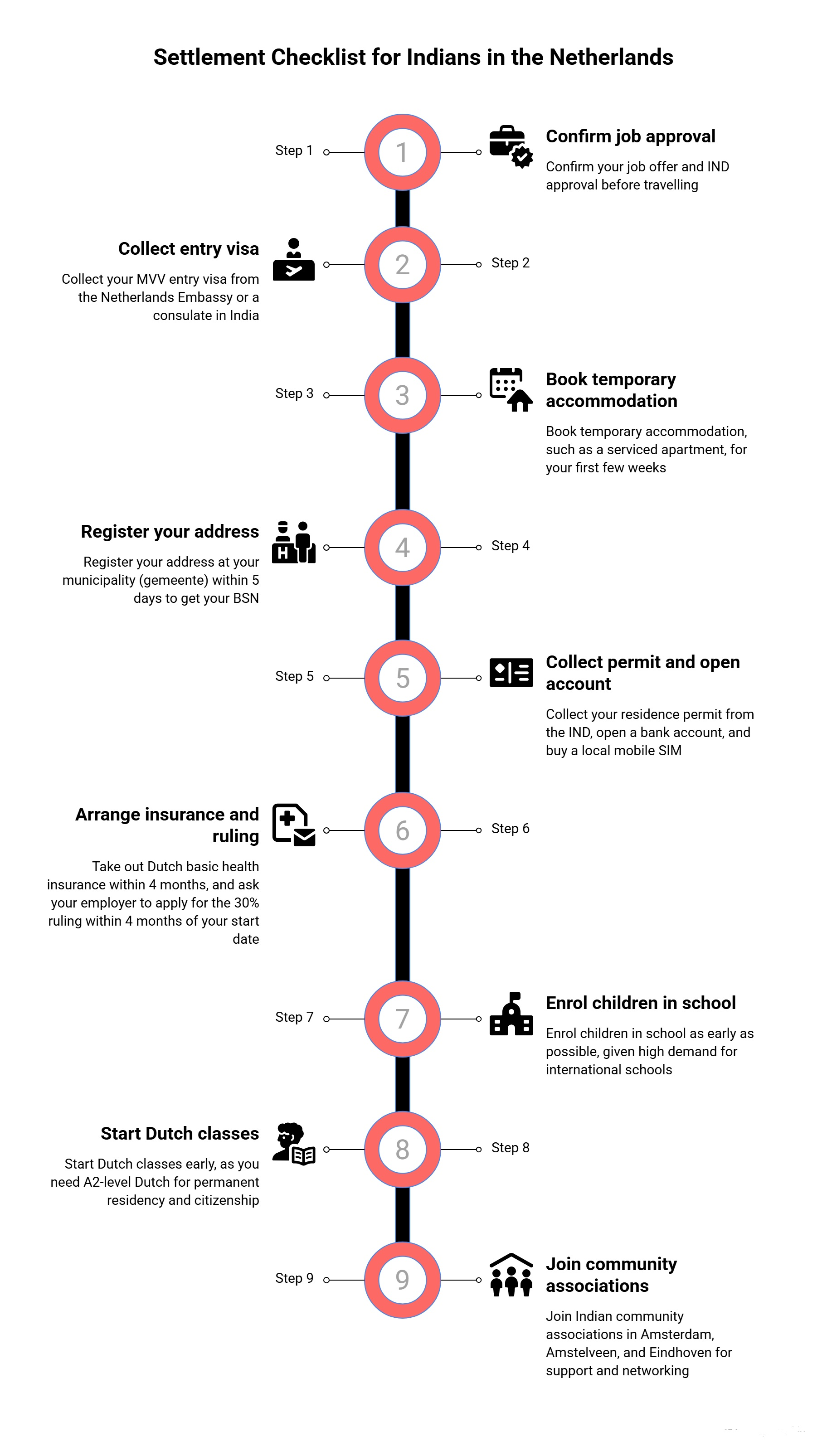
The steps for a smooth transition to the Netherlands for Indians are as follows:
Step 1: Confirm your job offer and IND approval before travelling, and do not use a Schengen visit visa to start work
Step 2: Collect your MVV entry visa from the Netherlands Embassy or a consulate in India so you can travel and collect your residence permit
Step 3: Book temporary accommodation, such as a serviced apartment, for your first few weeks
Step 4: Register your address at your municipality (gemeente) within 5 days to get your BSN
Step 5: Collect your residence permit from the IND, open a bank account, and buy a local mobile SIM
Step 6: Take out Dutch basic health insurance within 4 months, and ask your employer to apply for the 30% ruling within 4 months of your start date
Step 7: Enrol children in school as early as possible, given high demand for international schools
Step 8: Start Dutch classes early, as you need A2-level Dutch for permanent residency and citizenship
Step 9: Join Indian community associations in Amsterdam, Amstelveen, and Eindhoven for support and networking
*Are you looking for step-by-step assistance with Netherlands immigration? Contact Y-Axis, the world's No. 1 overseas immigration consultancy!
FAQs
1. Can Indians move to the Netherlands for work?
Yes. Indian professionals can move to the Netherlands for work, most often on the Highly Skilled Migrant permit. You need a job offer from an employer recognised as a sponsor by the IND, and your salary must meet the current threshold for your age. Highly qualified graduates can also apply for the EU Blue Card. Your employer usually applies for your entry visa and residence permit together. Once approved, you collect your entry visa in India, travel to the Netherlands, register your address, and start work. You cannot start working on a Schengen visit visa.
2. What is the Highly Skilled Migrant permit in the Netherlands?
The Highly Skilled Migrant permit, also called the kennismigrant permit, is the main work and residence permit for skilled non-EU professionals. It is employer-led, so an IND-recognised sponsor must hire you and apply on your behalf. There is no labour market test, and you do not need a separate work permit. The permit is usually valid for the length of your contract, up to 5 years. You can change employers, but your new employer must also be a recognised sponsor. Time on this permit counts towards permanent residency and citizenship.
3. What salary do I need for the Highly Skilled Migrant permit?
The IND sets gross monthly salary thresholds, excluding the 8% holiday allowance. If you are 30 or older, you need at least EUR 5,942 a month. If you are under 30, the minimum is EUR 4,357 a month. A reduced threshold of EUR 3,122 a month applies to eligible recent graduates, including those switching from the Orientation Year. The IND updates these amounts every January. Your salary must meet the threshold that applies on the date your employer submits the application, so always check the latest figures on the IND website.
4. What is an IND-recognised sponsor?
An IND-recognised sponsor is an employer, university, or organisation that the Dutch Immigration and Naturalisation Service has approved to sponsor foreign workers. Only recognised sponsors can apply for a Highly Skilled Migrant permit. They must check your documents, pay a market-level salary, keep records, and report changes to the IND. In return, they use a faster application process. The IND publishes a public register of recognised sponsors. Checking this register before you accept a job offer helps you confirm the employer can support your permit.
5. What is the difference between the Highly Skilled Migrant permit and the EU Blue Card?
Both routes need a job offer and a minimum salary, but they work differently. The Highly Skilled Migrant permit needs an IND-recognised sponsor and has age-based salary thresholds. The EU Blue Card needs a recognised higher education qualification or qualifying experience, and a contract of at least 6 months. Its standard threshold is EUR 5,942 a month, or EUR 4,754 for recent graduates. The Blue Card makes it easier to move to another EU country later. Both permits count towards Dutch permanent residency after 5 years.
6. What is the Orientation Year in the Netherlands?
The Orientation Year, or zoekjaar, is a 12-month residence permit for recent graduates. It lets you live in the Netherlands and look for work, or start a business, without a job offer. You can apply if you graduated from a Dutch university or from a top-ranked university abroad, usually within 3 years of graduating. You can work freely during this year. If you find a job, you can switch to a Highly Skilled Migrant permit at the reduced salary threshold of EUR 3,122 a month.
7. Do I need to speak Dutch to work in the Netherlands?
No. Most international companies, tech firms, and research institutes use English at work. Many Indian professionals start their jobs without speaking any Dutch. Highly Skilled Migrant permit holders also do not have to take a civic integration exam on arrival. However, learning Dutch helps with daily life, healthcare visits, and building friendships. You will also need to pass the civic integration exam at A2 level to get permanent residency or Dutch citizenship. Starting Dutch classes early makes this step much easier later.
8. How long does the IND take to process a work permit?
Applications made through an IND-recognised sponsor are usually decided within about 2 weeks, if all documents are complete. The legal maximum decision period is 90 days. Delays usually happen when documents are missing, when the salary does not meet the threshold, or when the IND asks for more information. After approval, you collect your entry visa in India and travel to the Netherlands. You then collect your residence permit card from an IND desk after registering your address.
9. What is an MVV visa?
An MVV is a long-stay entry visa that lets you travel to the Netherlands to collect your residence permit. Indian citizens usually need an MVV for stays longer than 90 days. For work routes, your employer typically applies for the MVV and the residence permit together in one procedure. Once the IND approves it, you collect the MVV sticker from the Netherlands Embassy or a consulate in India. The MVV is valid for 90 days, so plan your travel and housing within that period.
10. What is a BSN and how do I get one?
A BSN, or burgerservicenummer, is your Dutch citizen service number. You need it to get paid, open a bank account, take out health insurance, and access government services. You receive your BSN when you register your address at your local municipality, or gemeente. You must register within 5 days of arriving if you plan to stay longer than 4 months. Book your municipality appointment as early as possible. You will need your passport, residence permit details, and proof of your address.
11. What is the 30% ruling in the Netherlands?
The 30% ruling is a tax benefit for eligible skilled workers recruited from abroad. It lets your employer pay part of your salary as a tax-free allowance, which can significantly increase your take-home pay. You usually need to meet a minimum salary and have lived more than 150 km from the Dutch border before starting work. The benefit lasts up to 5 years and is set to reduce to 27% for new applicants. Your employer must apply, ideally within 4 months of your start date.
12. Is health insurance mandatory in the Netherlands?
Yes. Everyone who lives or works in the Netherlands must take out Dutch basic health insurance, called basisverzekering. You must arrange it within 4 months of registering, and the cover is backdated to your arrival. The average basic premium is about EUR 157 to EUR 159 a month per adult. You also pay a compulsory yearly deductible of EUR 385 before most care is covered. Children under 18 are insured for free under a parent's policy. Many expats add supplementary cover for dental care and physiotherapy.
13. What is the cost of living in the Netherlands for a single person?
A single person living outside central Amsterdam usually spends about EUR 2,000 to EUR 2,800 a month. Rent is the biggest expense, at about EUR 1,000 to EUR 1,500 for a one-bedroom flat in cities like Rotterdam or Eindhoven. Central Amsterdam rents often run from EUR 1,800 to EUR 2,500. Add about EUR 157 for basic health insurance, EUR 275 to EUR 450 for groceries, and EUR 180 to EUR 280 for utilities and internet. Many people cycle, which keeps transport costs low.
14. Which are the best cities in the Netherlands for Indian professionals?
Amsterdam offers the most jobs in tech, finance, and international headquarters, but rents are high. Amstelveen, next to Amsterdam, has a large Indian community and good international schools. Eindhoven suits engineers, thanks to the high-tech and semiconductor sector around ASML and Philips. Rotterdam is strong for logistics, maritime, and engineering roles, with lower rents. The Hague attracts professionals in law, government, and international organisations. Utrecht is popular with young professionals and researchers because of its central location and university.
15. Can my spouse work in the Netherlands?
Yes. If you hold a Highly Skilled Migrant permit or an EU Blue Card, your spouse or partner can join you through family reunification. Partners of these permit holders can work for any employer, or be self-employed, without a separate work permit. You can often apply for your family members at the same time as your own permit. Your children can join you too. They can study for free in Dutch public schools and are covered free under a parent's health insurance.
16. How can I get permanent residency in the Netherlands?
You can usually apply for permanent residency after 5 years of continuous legal stay on a residence permit for a non-temporary purpose, such as the Highly Skilled Migrant permit or EU Blue Card. You must pass the civic integration exam at A2 level, show a stable income, and have valid health insurance. Time on a student permit or the Orientation Year usually does not count fully. The IND first checks whether you qualify for EU long-term resident status. If not, it considers the national permanent residence permit.
17. How long does it take to become a Dutch citizen?
You can usually apply for Dutch citizenship through naturalisation after 5 years of continuous legal residence. You must pass the civic integration exam at A2 level, have no serious criminal record, and make a declaration of solidarity at a ceremony. The Netherlands generally requires adults to give up their previous nationality. India also does not allow dual citizenship. The government has proposed a higher B1 language level and a longer residence period, so check the latest rules before you plan your application.
18. What are the most in-demand jobs in the Netherlands?
The Netherlands has strong demand for IT and software developers, data scientists, and AI specialists. Mechanical, electrical, and semiconductor engineers are also in high demand, especially around Eindhoven. Healthcare, including nursing, faces ongoing shortages. Logistics and supply chain professionals find many roles in Rotterdam and around Schiphol. Finance and accounting roles are concentrated in Amsterdam. Leading employers include ASML, Philips, Booking.com, ING, Shell, Heineken, and Adyen. Healthcare roles usually require Dutch registration and Dutch language skills.
19. Is it hard to find housing in the Netherlands?
Yes, housing is one of the biggest challenges for newcomers. Demand is high, especially in Amsterdam, Utrecht, and The Hague. Allow 1 to 3 months to find a rental, and book temporary accommodation for your first weeks. Popular portals include Funda, Pararius, and Kamernet. Landlords usually ask for a deposit of up to 2 months' basic rent, and tenants usually do not pay agency fees. Always view the property or verify the landlord before paying anything, as rental scams do occur.
20. Can I start a business in the Netherlands as an Indian?
Yes. The Netherlands offers a start-up visa and a self-employed residence permit. The start-up visa is valid for 1 year and needs an innovative business idea and support from a recognised facilitator. After that year, you can apply for the self-employed permit. The self-employed permit is assessed on points for your experience, business plan, and value to the Dutch economy. Graduates on the Orientation Year can also start a business. Time on these permits can count towards permanent residency.
Tags:
Life in Netherlands for Immigrants
Settle in Netherlands
Share
Y - Axis services

Get it on your mobile

Get News Alerts

Contact Y-Axis
Latest Article
Popular Post
Trending Article
Posted On November 17 2026
Life in Canada for Immigrants: Jobs, Visas, Cost of Living & Residency