

Posted on July 10 2026
What are the Eligibility Requirements for a Netherlands Work Visa?

By , Editor & Director
Updated July 10 2026
To apply for a Netherlands work visa from India, you need to secure a confirmed job offer from a Dutch employer that is registered with the Immigration and Naturalisation Service (IND) as a recognised sponsor. Most Indian professionals apply through the Highly Skilled Migrant (HSM) permit, which uses a salary threshold instead of a points system provided your offer meets the required gross monthly salary for your age group, and qualification. The EU Blue Card is a parallel route for highly qualified applicants with a recognised degree. Both routes offer fast processing, family inclusion, and a clear path to permanent residence in Netherlands.
*Interested to work in the Netherlands? Let Y-Axis assist you with the process.
Eligibility Criteria to Apply for a Netherlands Work Visa from India
Applying for a Netherlands work visa from India generally requires a confirmed job offer from an IND-recognised sponsor employer. Unlike some European systems, the Netherlands does not use a points-based assessment. Additionally, the IND does not evaluate your skills or experience directly hence meeting the salary threshold for your visa category is the primary test. Most Highly Skilled Migrant applications submitted through a recognised sponsor are processed within about 2 weeks.
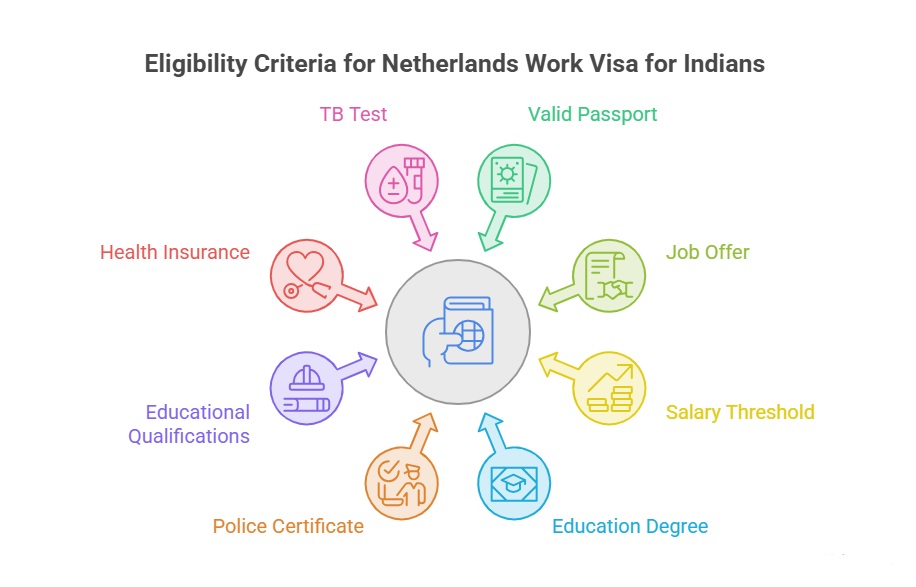
The eligibility criteria for a Netherlands work visa are as follows:
- Valid Indian passport
- Confirmed job offer/signed employment contract from a Dutch employer that holds IND recognised sponsor status
- Salary meeting the applicable threshold for your age group (for the Highly Skilled Migrant permit)
- A recognised higher education degree and a job offer meeting the EU Blue Card salary threshold (for the EU Blue Card)
- Police/antecedents certificate confirming no criminal record
- Recognised educational qualifications — diplomas may need verification through Nuffic if not automatically recognised
- Valid health insurance coverage
- A tuberculosis (TB) test certificate, required for Indian nationals within 3 months of arrival
*Interested to apply for a Netherlands work visa? Sign up with Y-Axis for end-to-end assistance.
Eligibility Requirements by Visa and Permit Type
The Netherlands offers several permit categories depending on your qualifications, salary, and career stage. The table below outlines the main routes relevant to Indian professionals.
|
Visa / Permit Type |
Who Can Apply |
Fee |
Validity |
Key Benefit |
|
Highly Skilled Migrant (HSM) Permit |
Skilled professionals with a job offer from an IND-recognised sponsor meeting the age-based salary threshold |
Approx. EUR 423 (2026) |
Up to 5 years, tied to employment contract |
No labour market test; fastest and most common route for Indian professionals |
|
EU Blue Card |
Highly qualified applicants with a recognised higher education degree meeting the salary threshold |
Approx. EUR 423 |
Up to 4 years, renewable |
No points system; strong EU mobility rights after 12 months |
|
Reduced-Salary HSM (Orientation Year Graduates) |
Recent graduates of a Dutch or top-200 global university transitioning from the Orientation Year permit |
Approx. EUR 423 |
Up to 5 years |
Lower salary threshold — EUR 3,122/month gross (2026) |
|
Intra-Corporate Transferee (ICT) Permit |
Employees transferred within the same multinational group to a Dutch branch |
Approx. EUR 423 |
Up to 3 years |
Same age-based salary thresholds as HSM; simplified transfer process |
|
Orientation Year Permit (Zoekjaar) |
Recent graduates of a Dutch university or a top-200 ranked global university |
Approx. EUR 210 |
12 months |
Work without a separate work permit while job hunting |
|
Self-Employed / Start-up Visa |
Entrepreneurs starting an innovative business, assessed via a points-based scheme |
Approx. EUR 423 |
1 year (start-up), 2 years (self-employed) |
Pathway for founders outside employer sponsorship |
Also, read...
Netherlands Job Market: Trends and Opportunities
What are the Employer Requirements for Sponsoring Indian Professionals in the Netherlands?
Dutch employers sponsoring most Netherlands work visa categories must first register with the IND as a recognised sponsor (erkend referent) — this status, not a labour market test, is the gatekeeping mechanism for the Highly Skilled Migrant and EU Blue Card routes.
- Must hold valid IND recognised sponsor status before filing any Highly Skilled Migrant or ICT applications
- Must offer a salary meeting the applicable 2026 threshold for the employee's age and category — this figure is a hard floor with no discretion or waiver
- Salary and any allowances counted toward the threshold must be fixed, guaranteed, and paid directly to the employee's personal bank account
- Recognised sponsors can file combined applications for the residence permit and the MVV entry visa in a single procedure (the TEV procedure).
- Employers without recognised sponsor status can use an Employer of Record or immigration service provider to sponsor an employee compliantly
Also, read...
Highest paying Jobs in Netherlands
The Netherlands Salary Threshold System (No Points, No Labour Market Test)
The Netherlands does not use a points system like some other European countries. Instead, the IND relies on a single, transparent salary threshold to determine Highly Skilled Migrant eligibility — a structure designed to keep processing fast and predictable.
- The IND does not directly assess your skills, qualifications, or work experience for the Highly Skilled Migrant permit — meeting the salary threshold is the entire test
- Salary thresholds are reviewed and adjusted every January 1 based on wage indexation
- The threshold that applies is the one in effect on the date your application is submitted, not the date your offer was made
- If you change employers, the threshold in effect on your new contract's start date applies
- Reduced thresholds exist only for orientation-year graduates (HSM) and recognised-degree graduates (EU Blue Card) — there is no general discount for younger applicants beyond the standard under-30 rate
- Because there is no labour market test for the HSM or EU Blue Card, employers do not need to prove that no Dutch or EU candidate was available for the role
Also, read...
Salary Standards and Tax Considerations for Indian Professionals
The Netherlands reviews its work visa salary thresholds every January, and 2026 brought a further increase across all categories. Beyond the visa threshold itself, the Netherlands also offers a notable tax benefit for incoming skilled migrants.
- Highly Skilled Migrant (age 30 and older): minimum EUR 5,942/month gross (2026), approximately ₹5.6–5.7 lakh/month
- Highly Skilled Migrant (under age 30): minimum EUR 4,357/month gross (2026), approximately ₹4.1–4.2 lakh/month
- Reduced HSM threshold for orientation-year graduates: EUR 3,122/month gross (2026)
- EU Blue Card: minimum EUR 5,942/month gross (2026); reduced rate of EUR 4,754/month for recognised-degree graduates
- These figures exclude the mandatory 8% holiday allowance (vakantiegeld), which is paid on top of the base salary
- Eligible skilled migrants can apply for the 30% ruling, which allows a portion of gross salary to be paid tax-free for up to 5 years, subject to a 2026 income cap of EUR 262,000
- India and the Netherlands have a Double Taxation Avoidance Agreement (DTAA), which helps prevent Indian professionals from being taxed twice on the same income
Watch To Know More: Netherlands Work Visa | Jobs, Salary & Requirements Explained
Discover everything you need to know about working in the Netherlands. Learn about in-demand jobs, salary expectations, work visa requirements, eligibility criteria, and the steps to start your career in the Netherlands.
Job Mobility and Family Sponsorship on a Netherlands Work Visa
The Highly Skilled Migrant permit is tied to your employer, but the Netherlands offers a straightforward process for switching jobs and a strong family sponsorship framework.
- If you change employers, your new employer must also hold IND recognised sponsor status, and your permit is updated to reflect the new employment relationship
- The salary threshold that applies after a job change is the one in effect on your new contract's start date, not your original approval date
- Partners and minor children can generally join immediately as dependents, without waiting for the primary applicant's permit to be finalised first
- Partners of Highly Skilled Migrant holders can usually work in the Netherlands without needing a separate work permit
- Partners may need to meet basic civic integration requirements later if applying for long-term residence or citizenship
Also, read...
Netherlands Work Dependent Visa
What Sector-Specific Requirements Apply for Netherlands Work Visas?
Certain professions in the Netherlands are subject to additional recognition steps or naturally fall under a specific visa category. The table below outlines sector-specific considerations for Indian professionals.
|
Sector |
Additional Requirements |
|
Information Technology & Software |
Amsterdam, Eindhoven, and The Hague host major tech employers and a dense startup ecosystem. Software engineers, data scientists, and cybersecurity specialists are among the most sponsored HSM profiles, as salaries comfortably clear the threshold. |
|
Engineering & Semiconductors |
Eindhoven's High Tech Campus, anchored by ASML and NXP Semiconductors, drives strong demand for electrical, mechanical, and process engineers, particularly in semiconductor manufacturing. |
|
Life Sciences & Pharmaceuticals |
Leiden Bio Science Park and the wider Randstad life sciences cluster create demand for biotechnologists, clinical researchers, and regulatory affairs specialists; some roles require Nuffic diploma recognition. |
|
Finance & Banking |
Amsterdam is a major European financial centre. Roles in banking, fintech, and risk and compliance generally require salary levels that are comfortably met by senior finance hires. |
|
Logistics & Supply Chain |
The Port of Rotterdam and Schiphol's cargo operations drive demand for supply chain managers and logistics engineers — an often under-recognised sponsorship route for Indian professionals. |
|
Academic & Research Roles |
Researchers and PhD holders may qualify under a separate scientific researcher category with its own conditions, distinct from the standard Highly Skilled Migrant route. |
How to Apply for a Netherlands Work Visa from India?
The Netherlands work visa process is largely employer-led. If your employer holds IND recognised sponsor status, the residence permit and MVV entry visa (where required) are usually filed together in a single combined procedure.
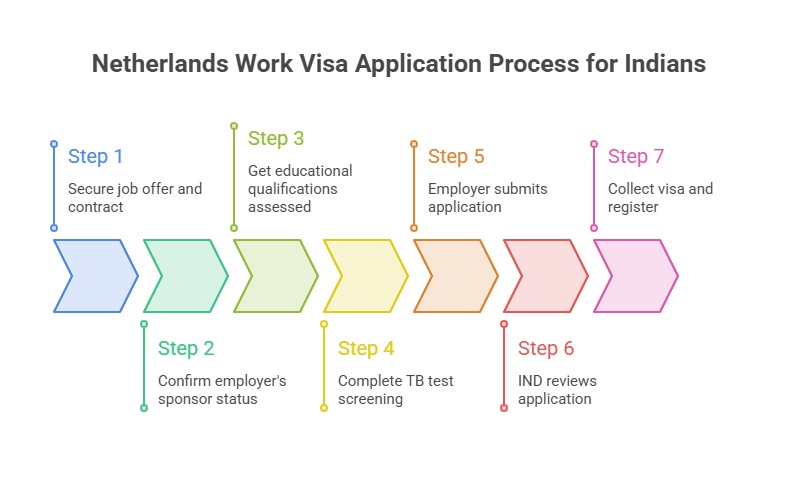
The steps to apply for a Netherlands work visa for Indians are as follows:
Step 1: Secure a confirmed job offer and signed employment contract from a Dutch employer meeting the applicable 2026 salary threshold for your category.
Step 2: Confirm that your employer holds IND recognised sponsor status — this determines whether you can use the fast-track combined procedure.
Step 3: Get your educational qualifications assessed or recognised through Nuffic where required, and arrange certified translations of key documents.
Step 4: Complete a tuberculosis (TB) test screening, required for Indian nationals within 3 months of arrival in the Netherlands.
Step 5: Your employer submits the combined residence permit and MVV application (TEV procedure) directly to the IND on your behalf.
Step 6: The IND reviews your salary, sponsor status, and documentation — most recognised-sponsor applications are decided within about 2 weeks.
Step 7: Once approved, collect your MVV entry visa (if required) from the Dutch embassy or consulate in India, travel to the Netherlands, and register with your local municipality to receive your residence permit card.
*Are you looking for step-by-step assistance with overseas immigration? Contact Y-Axis, the world's No. 1 overseas immigration consultancy!
FAQs
What is the Highly Skilled Migrant permit and who can apply for it?
The Highly Skilled Migrant (HSM) permit is the Netherlands' main work and residence permit for skilled non-EU professionals. Unlike points-based systems elsewhere, it relies purely on a salary threshold — if your job offer from an IND-recognised sponsor meets the required gross monthly salary for your age group, you qualify. There is no labour market test and no direct assessment of your qualifications or experience. Most Indian IT, engineering, and finance professionals use this route to work in the Netherlands.
How does the Netherlands salary threshold system work?
Instead of a points system, the IND uses a single salary threshold to determine eligibility. The threshold depends on your age and visa category, and is reviewed every January 1 based on wage indexation. The amount that applies is the one in effect when your application is submitted, not when your offer was made. If your salary meets the threshold, you qualify — there is no discretion, appeal, or waiver on this requirement.
What is the minimum salary for a Netherlands work visa in 2026?
For the Highly Skilled Migrant permit, the 2026 threshold is EUR 5,942 gross per month for applicants aged 30 and older, and EUR 4,357 for those under 30. A reduced threshold of EUR 3,122 applies to orientation-year graduates. The EU Blue Card generally requires EUR 5,942/month, with a reduced rate of EUR 4,754 for recognised-degree graduates. These figures exclude the mandatory 8% holiday allowance.
What is the EU Blue Card and how is it different from the Highly Skilled Migrant permit?
The EU Blue Card is a parallel work permit for highly qualified non-EU professionals holding a recognised higher education degree and meeting the EU Blue Card salary threshold. Like the HSM permit, it does not use a points system. Its main advantage is stronger EU mobility rights after 12 months of residence, making it attractive for professionals who may want to work across other EU countries later in their career.
What is an IND recognised sponsor and why does it matter?
An IND recognised sponsor (erkend referent) is a Dutch employer registered with the Immigration and Naturalisation Service to hire Highly Skilled Migrants and EU Blue Card holders. This status allows the employer to use a faster, combined application procedure for the residence permit and entry visa. If your prospective employer isn't a recognised sponsor, your application may take longer or require an Employer of Record to sponsor you compliantly.
What documents are required for a Netherlands work visa application?
Required documents typically include a valid passport, a signed employment contract, proof your salary meets the applicable threshold, a police or antecedents certificate, educational qualification documents (with Nuffic recognition where needed), valid health insurance, and a tuberculosis (TB) test certificate, which is mandatory for Indian nationals within 3 months of arrival. Your employer separately handles the recognised sponsor documentation as part of the combined application.
How long does the Netherlands work visa process take?
Applications filed by an IND-recognised sponsor through the combined TEV procedure are typically decided within about 2 weeks, making this one of the fastest work visa routes in Europe. Processing can take longer if your employer isn't a recognised sponsor, or if additional document verification is needed. It's advisable to begin your TB test and qualification recognition steps early so they don't delay an otherwise fast process.
Can I change employers on a Netherlands work visa?
Yes. If you change jobs, your new employer must also hold IND recognised sponsor status, and your permit is updated to reflect the new employment relationship. The salary threshold that applies is the one in effect on your new contract's start date, not your original approval date. This means a job change could require meeting a higher threshold if thresholds have increased since your last application.
Can I bring my family to the Netherlands on a work visa?
Yes. Partners and minor children can generally join Highly Skilled Migrant and EU Blue Card holders immediately as dependents, without waiting for the primary applicant's permit to be finalised first. Partners can usually work in the Netherlands without needing a separate work permit of their own. They may later need to meet basic civic integration requirements if applying for long-term residence or Dutch citizenship.
Can a Netherlands work visa lead to permanent residency?
Yes. After 5 years of continuous legal residence on a Highly Skilled Migrant permit, EU Blue Card, or a combination of qualifying permits, you become eligible to apply for permanent residency in the Netherlands. Dutch citizenship is possible after 3 to 7 years, depending on your integration progress and Dutch language proficiency, though this requires giving up Indian citizenship, as India does not permit dual nationality.
Tags:
Work in Netherlands
Netherlands work visa
migrate to Netherlands
Netherlands immigration
eligibility requirements for Netherlands work visa
Netherlands Highly Skilled Migrant visa for Indians
Netherlands EU Blue Card
Netherlands work permit
Share
Options for you by Y-Axis

Get it on your mobile

Get News alerts

Contact Y-Axis
Latest Article
Popular Post
Trending Article
Posted On October 09 2026
Canada’s Immigration Reset: Why the Next Move May Be About Fit, Not Volume