

Don't know what to do ?
Get Free Counseling
Last Updated 25 May 2026
About the Netherlands Work Dependent Visa
The Netherlands Work Dependent Visa allows the spouse and dependent children under 18 of skilled workers living in the Netherlands to join them and build a life together. It is formally a family reunification residence permit (verblijfsvergunning regulier voor verblijf bij familie) issued under the Dutch Aliens Act (Vreemdelingenwet 2000) and administered by the IND (Immigratie- en Naturalisatiedienst).
If your spouse holds a Highly Skilled Migrant Visa, a European Blue Card, an Intra-corporate Transfer (ICT) Permit, or a Researcher's Permit in the Netherlands, the Netherlands Work Dependent Visa is the legal pathway to bring your family to the Netherlands.
You do not need to be separated from your family for years. The Netherlands is one of the most family-friendly destinations in Europe for dependent visa holders. Spouses of Highly Skilled Migrants and EU Blue Card holders receive full and unrestricted work rights with no separate work permit needed. For Indian professionals moving to the Netherlands in IT, engineering, data science, finance, and life sciences, this makes the Netherlands a highly attractive choice for long-term family immigration.
India is among the fastest-growing source countries for skilled workers choosing the Netherlands. Thousands of Indian professionals work at leading Dutch companies including ASML, Philips, Shell, ING, KPMG, NXP, Heineken, and many others. As the Indian professional community in the Netherlands grows, demand for the Netherlands Work Dependent Visa from Indian families has increased significantly.
Netherlands Work Dependent Visa: Key Facts at a Glance
| Category | Details |
|---|---|
| Visa Type | Family Reunification — Regular Temporary Residence Permit (Type I) |
| Applicable For | Spouse/registered partner and dependent children under 18 of Highly Skilled Migrant, EU Blue Card, ICT, Researcher, and other employment-based permit holders in the Netherlands |
| Governing Authority | IND (Immigratie- en Naturalisatiedienst) — Netherlands Immigration and Naturalisation Service |
| Governing Law | Dutch Aliens Act (Vreemdelingenwet 2000) |
| Who Can Apply (Dependants) | Legally married spouse; registered civil partner; unmarried partner (documented long-term relationship); dependent children under 18 |
| Work Rights (Spouse — HSM / Blue Card / ICT / Researcher) | FULL — unrestricted work rights; no TWV (work permit) required |
| Work Rights (Spouse — Regular Employee GVVA) | Same work rights as sponsor — TWV required if sponsor needs TWV |
| Work Rights (Children) | Not automatically permitted — subject to Dutch labour law; vocational training (BBL) possible from age 15/16 |
| Study Rights | Full — all dependants may study at any Dutch educational institution; children have free compulsory schooling (Leerplicht) |
| Language Requirement (Before Arrival) | EXEMPT — partners of Highly Skilled Migrants and EU Blue Card holders are exempt from the Civic Integration Exam Abroad (Basisexamen inburgering buitenland) |
| Language Requirement (After Arrival) | Integration obligation (inburgeringsplicht) applies — Dutch language course required (B1 level within 3 years) |
| Visa Fee — Child under 18 | EUR 85 per child (approx. INR 7,900) — first application, change in purpose, and extension |
| Visa Fee — Adult Partner | Check ind.nl/en/fees-costs-of-an-application for current confirmed amount |
| Processing Time | 90 days standard IND decision period from submission |
| Income Requirement (Sponsor — Couple) | Approx. EUR 2,294.40/month gross SV salary — Jan to Jun 2026 rate. HSM (30+): EUR 5,942/month; Blue Card: EUR 5,942/month — both comfortably exceed threshold. |
| Validity | Tied to primary applicant's residence permit — typically 1 to 3 years, extendable |
| Health Insurance | Mandatory Dutch basic health insurance (Basisverzekering) for all residents after arrival — approx. EUR 150–200/month per adult |
| TB Test | Required — GGD appointment within 3 months of receiving residence permit |
| PR Pathway (General) | 5 years lawful residence. EU Blue Card holders may qualify earlier via EU long-term residency rules — see PR section. |
| Application Method | TEV procedure (combined MVV + residence permit) via IND + VFS Global India / Dutch Embassy India |
| VFS Global Centres in India | New Delhi, Mumbai, Bengaluru, Chennai, Hyderabad, Kolkata, Pune, Chandigarh, Ahmedabad, Kochi, Jalandhar, Lucknow |
*Want to apply for a Netherlands work dependent visa? Sign up with Y-Axis for end-to-end assistance.
Netherlands Work Dependent Visa: Overview
The Netherlands Work Dependent Visa is issued as a regular temporary residence permit under the Dutch Aliens Act. It allows the spouse and dependent children of a skilled worker in the Netherlands to live in the country for the duration of the sponsor's work permit.
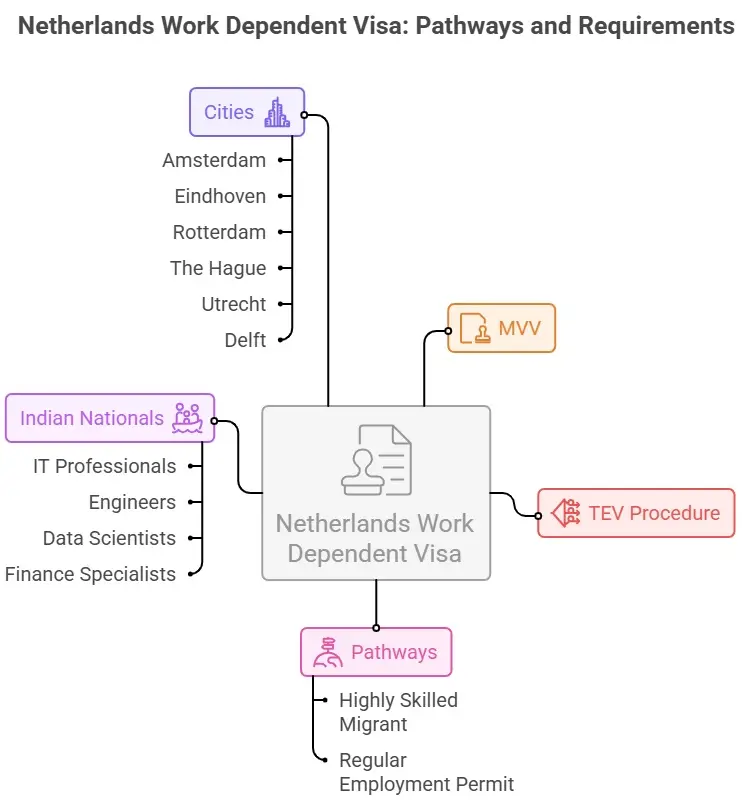
Indian nationals travelling to the Netherlands for a long-term stay need an MVV (Machtiging tot Voorlopig Verblijf) a provisional residence permit before travelling. The MVV and the residence permit are applied together through the TEV procedure (Toelating en Verblijf — Entry and Residence).
There are two main pathways under the Netherlands Work Dependent Visa:
- Joining a Highly Skilled Migrant (HSM) or EU Blue Card holder: The spouse receives full and unrestricted work rights with no TWV (work permit) needed. The spouse is also exempt from the Dutch Civic Integration Exam Abroad before the visa application.
- Joining a holder of a regular employment permit (GVVA or similar): The spouse generally receives the same employment rights as the primary applicant. If the sponsor requires a TWV to work, the spouse will also need one.
India is one of the fastest-growing source countries for Highly Skilled Migrants in the Netherlands. Indian IT professionals, engineers, data scientists, and finance specialists are among the most common categories sponsoring family members. The Netherlands particularly Amsterdam, Eindhoven, Rotterdam, The Hague, Utrecht, and Delft has a rapidly growing and well-established Indian professional community.
Benefits of the Netherlands Work Dependent Visa for Indian Families
The Netherlands Work Dependent Visa gives Indian families one of the most comprehensive dependent visa packages in Europe. Key benefits include:
- Spouses of Highly Skilled Migrants, EU Blue Card holders, ICT permit holders, and Researchers can work for any Dutch employer in any sector without a separate work permit (TWV).
- Partners of Highly Skilled Migrants and EU Blue Card holders do not need to pass a Dutch civic integration exam before applying for the visa.
- Dependent children receive free compulsory education at Dutch state schools.
- The family can join the skilled worker in the Netherlands from the time their work permit is granted.
- Dependants accumulate legal permanent residence years alongside the primary applicant.
- After 5 years of lawful residence, dependants may independently apply for a permanent residence permit.
- The Netherlands' 30% Ruling (30% regeling) is a major tax advantage with qualifying highly skilled migrants receiving 30% of their gross salary tax-free.
- All residents in the Netherlands including dependants are entitled to basic Dutch health insurance (Basisverzekering).
- Amsterdam, Rotterdam, Eindhoven, The Hague, Delft, and Utrecht offer excellent infrastructure, safety, international schooling options, and growing Indian communities.
- The Netherlands is home to top global employers across tech, engineering, life sciences, financial services, and energy — giving working spouses strong career opportunities.
Also, read...
Highest paying Jobs in Netherlands
Who is Eligible for the Netherlands Work Dependent Visa?
Eligible Dependants
The following family members of a primary work visa holder in the Netherlands may apply:
- Legally married spouse in a valid marriage recognised under Dutch law
- Registered civil partner
- Unmarried partner in a long-term, and documented relationship
- Dependent children under 18 — biological, adopted, or step-children
Note: Parents, siblings, and adult independent children of the primary visa holder are generally not eligible under this visa route.
Primary Applicant (Sponsor) Requirements
| Requirement | Details |
|---|---|
| Visa / Permit Type | Must hold a valid Netherlands residence permit for employment — Highly Skilled Migrant (HSM), European Blue Card, Intra-corporate Transfer (ICT), Researcher (Directive EU 2016/801), Essential Start-up Personnel, or other employment-based permit |
| Residence in Netherlands | Must be legally residing and registered in Netherlands with a valid residence permit at the time of the dependant's application |
| Financial Capacity | Must demonstrate sufficient income to support the family — approx. EUR 2,294.40/month gross SV salary for a couple (Jan–Jun 2026 rate). HSM (30+) and Blue Card salary of EUR 5,942/month comfortably exceeds this. |
| Accommodation | Adequate housing in Netherlands for all family members — proved via rental contract or ownership documents |
| Health Insurance for Dependants | Must confirm Dutch health insurance (Basisverzekering) is in place for all family members joining in the Netherlands |
| Registration in Netherlands | Must be registered at a Dutch address — BRP extract (Uittreksel basisregistratie personen) required, not older than 3 months |
| Cannot Sponsor Family (Excluded Permit Types) | Sponsors on Au pair, Working Holiday, Cultural Exchange, Seasonal Work, Seafaring Service, or Work Experience permits cannot bring a partner under this route |
Can Netherlands Work Dependent Visa Holders Work in the Netherlands?
Yes. Dependent spouses in the Netherlands on a family reunification residence permit generally have the right to work. For spouses of Highly Skilled Migrants, EU Blue Card holders, ICT permit holders, and Researchers, work rights are full and unrestricted from the day the residence permit is issued.
If the sponsor holds a Highly Skilled Migrant or EU Blue Card permit, the partner is free to work.
| Type of Work / Activity | Permitted for Dependent Spouse? |
|---|---|
| Full-time employment (any sector) | YES — unrestricted for spouses of HSM, EU Blue Card, ICT, Researcher, Essential Start-up Personnel from day one |
| Part-time employment | YES — unrestricted |
| Self-employment / freelance work | YES — after registering with the Chamber of Commerce (KvK) and paying Dutch taxes; health insurance obligations apply |
| Work for any employer (not tied to sponsor's employer) | YES — no requirement to work for the same employer as the primary applicant |
| Change employer freely | YES — no restriction on changing employers |
| Work in a different Dutch city from primary applicant | YES — no geographic restriction |
| Remote work for an Indian employer (from within Netherlands) | Permitted in most cases — Dutch tax and social security obligations apply; confirm with a qualified tax adviser |
| Work rights for spouses of regular employment (GVVA) holders | Depends on sponsor's permit — spouse has same rights as sponsor. TWV required if sponsor needs TWV. |
| Separate work permit (TWV) required? | NO — for HSM/Blue Card/ICT/Researcher spouses. Work rights are included in the family reunification residence permit. |
Note: Dependent children under 18 do not hold independent employment rights but may undertake vocational training (BBL — Beroepsbegeleidende Leerweg) from approximately age 15/16 in line with Dutch education and labour laws.
*Want to apply for Netherlands work visa? Let Y-Axis guide you with the process.
Study Rights for Netherlands Work Dependent Visa Holders
All dependants on a Netherlands Work Dependent Visa residence permit can study at any registered Dutch educational institution — universities, HBO (higher professional education) colleges, MBO (vocational) institutions, language schools, or civic integration course providers.
| Study Aspect | Details for Dependants |
|---|---|
| Spouse / Partner | Can study full-time or part-time at any Dutch university, HBO, MBO, or language institute. No restriction; no separate study permit required. |
| Children (school age) | Must attend Dutch state primary and secondary school — education is compulsory (Leerplicht from age 5 to 16) and free for all children residing in the Netherlands |
| Integration courses (Inburgeringscursus) | Adult dependants are required to complete a Dutch civic integration programme (inburgeringsplicht) after arrival. Covers Dutch language to B1 CEFR and civic knowledge. Often subsidised through the municipality. |
| Vocational Training (MBO/BBL) | Dependants can enrol in Dutch vocational education and apprenticeship programmes |
| University education | No restriction — dependants may apply to Dutch public universities, which have modest tuition fees compared to many other European countries |
| International schooling for children | Many Dutch cities have international schools — particularly suitable for families who plan a shorter stay or whose children do not yet speak Dutch |
*Want to apply for Netherlands student visa? Let Y-Axis guide you with the process.
Netherlands Work Dependent Visa Fees
| Fee Type | Amount (EUR) | Amount (INR approx.) |
|---|---|---|
| Residence permit — dependent child under 18 (first application, change in purpose, extension) | EUR 85 | INR 7,900 approx. |
| Residence permit — adult partner (first application) | Check ind.nl/en/fees-costs-of-an-application | Subject to official confirmation |
| MVV (Provisional Residence Permit) — included in TEV application | Included in residence permit fee | Included |
| TB test with GGD (Netherlands) — within 3 months of permit | Confirm with GGD on appointment | Approx. INR 3,000–5,000 subject to confirmation |
| Dutch health insurance (Basisverzekering) per adult per year | EUR 1,500–2,400 approx. | INR 1,39,500–2,23,200 approx. |
| Document Apostille (MEA India, per document) | — | INR 500–3,000 approx. |
| Certified Translation (per document, Dutch or English) | — | INR 800–2,500 approx. |
| VFS Global Service Fee (India) | — | INR 2,000–3,000 approx. |
| Y-Axis Professional Consultancy Fee | As per service package | As per service package |
Note: The IND fee is paid at the time of application. IND fees are updated on 1 January every year. The health insurance premium is an ongoing monthly cost once the dependant is registered in the Netherlands. The residence permit fee in the Netherlands is paid at the local Gemeente (municipality) or through the IND portal after arrival for some processes.
Netherlands Work Dependent Visa Processing Time
| Stage | Estimated Time |
|---|---|
| Document apostille — MEA India (e-Apostille) | 3–7 business days |
| Document apostille — MEA India (offline) | 2–4 weeks |
| Certified Translation of Documents | 3–7 business days |
| VFS Global / Dutch Consulate Appointment Booking (India) | 2–6 weeks (varies by city; Delhi and Mumbai can be longer — book early) |
| IND standard decision period (after submission) | 90 days from submission date — approx. 3 months |
| TB test after arrival in Netherlands (GGD) | Must be booked within 3 months of receiving residence permit |
| Total Estimated Timeline (preparation to visa grant) | Approximately 3–5 months for a complete, well-prepared application |
Note: Processing times are indicative. Submitting a complete, correctly apostilled, and translated document set at the time of application significantly reduces the risk of delays or requests for additional documents.
Documents Required for the Netherlands Work Dependent Visa
Documents for Spouse / Registered Partner
- Valid passport
- Recent passport-size photographs
- Completed visa / MVV application form Marriage certificate — with MEA India apostille and certified Dutch or English translation
- Proof of sponsor's valid Netherlands work residence permit (HSM, Blue Card, ICT, Researcher, etc.)
- BRP extract (Uittreksel basisregistratie personen) — sponsor's certificate of registration at Dutch municipality (not older than 3 months)
- Proof of adequate accommodation in Netherlands — rental contract or property ownership documents
- Proof of sufficient income — last 3 months' payslips from Dutch employer, current employment contract, last 3 months' Dutch bank statements
- Appendix Antecedents Certificate (IND form 7601) for all persons over 12 years old
- Cover letter explaining the application and family situation (recommended)
Documents for Dependent Children
- Valid passport for each child
- Recent biometric passport-size photographs
- Birth certificate — with MEA India apostille and certified Dutch or English translation
- Proof of sponsor parent's valid Netherlands residence permit
- School records or current school enrolment certificate (if applicable)
- Custody documents if only one parent is listed or accompanying
- Notarised and apostilled consent of the non-travelling parent (if child travels with one parent only)
Financial and Supporting Documents
- Sponsor's last 3 months' payslips from Dutch employer
- Sponsor's current employment contract with salary details (showing gross SV salary)
- Sponsor's last 3 months' Dutch bank statements
- Copy of sponsor's HSM / Blue Card / ICT / Researcher residence permit
- Proof of enrolment / employment with IND-recognised sponsor employer (if applicable)
Note: All documents not in Dutch or English must be translated by a certified or sworn translator. MEA India apostille is required for all Indian official documents — marriage certificates, birth certificates, and other relevant certificates. Always confirm the final document checklist with the Dutch Embassy India or VFS Global Netherlands before your appointment.
How to Apply for the Netherlands Work Dependent Visa from India
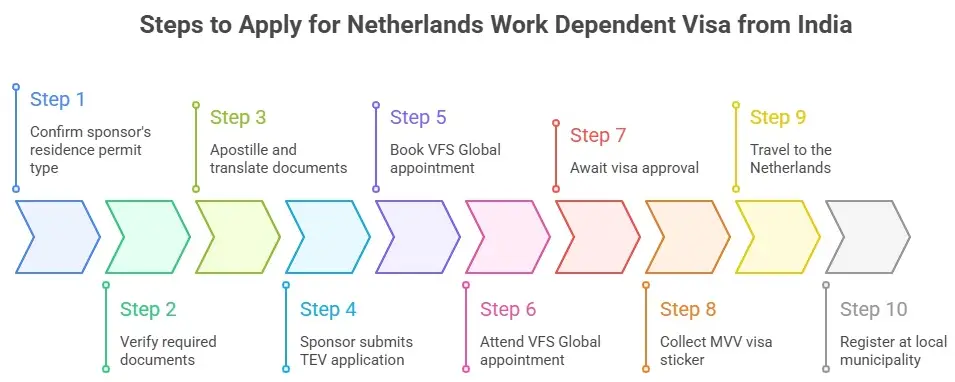
Follow these steps to apply for the Netherlands Work Dependent Visa for Indians:
Step 1: Confirm the sponsor's residence permit type in Netherlands (HSM, Blue Card, ICT, Researcher, etc.).
Step 2: Verify all required documents such as marriage certificate, birth certificates, proof of accommodation, and employer/income documents.
Step 3: Get all Indian official documents apostilled through MEA India (e-apostille preferred) and arrange certified Dutch or English translations.
Step 4: The sponsor in Netherlands submits the TEV application via the IND My IND online portal (DigiD required) on behalf of the family member.
Step 5: Book an appointment at the nearest VFS Global Netherlands India.
Step 6: The family member in India attends the VFS Global appointment in person and submits documents along wirh biometrics.
Step 7: Await visa approval to migrate abroad on dependent visa.
Step 8: On approval, the family member collects the MVV visa sticker at the Dutch Embassy or Consulate in India.
Step 9: Upon dependent visa approval, travel to the Netherlands.
Step 10: Register at the local municipality (BRP — Basisregistratie Personen) within 5 days of arrival.
Financial Requirements for the Netherlands Work Dependent Visa
The sponsor in Netherlands must prove sufficient and independent income to support all family members without relying on Dutch public funds (bijstand or equivalent). This is a key requirement under Dutch immigration law. The IND requires SV salary — social security salary from employment — which is the gross salary on which wage tax and national insurance contributions are calculated.
| Financial Requirement | Details |
|---|---|
| Minimum income for sponsor + spouse (couple) | Approx. EUR 2,294.40/month gross SV salary without holiday allowance — Jan to Jun 2026 rate (updated by IND every 6 months) |
| Minimum income (with holiday allowance) | Approx. EUR 2,477.95/month gross SV salary |
| Minimum income — single parent | Approx. EUR 1,606.08/month gross SV salary without holiday allowance |
| Highly Skilled Migrant salary (under 30) | EUR 4,357/month gross — well above the family income threshold |
| Highly Skilled Migrant salary (30 and over) | EUR 5,942/month gross — well above the family income threshold |
| EU Blue Card salary | EUR 5,942/month gross — well above the family income threshold |
| Documents required | Last 3 months' payslips, current employment contract with salary details, last 3 months' Dutch bank statements |
| Public funds restriction | Application may be refused if the family's income depends on Dutch public benefits (bijstand or equivalent) |
| Salary update note | IND income threshold amounts are updated on 1 January and 1 July each year — always confirm at ind.nl/en/required-amounts-income-requirements |
Accommodation Requirements for the Netherlands Work Dependent Visa
The sponsor must prove adequate housing in the Netherlands for all family members who will join. The accommodation must be safe, legal, and sufficient for the family.
| Accommodation Requirement | Details |
|---|---|
| Proof required | Rental contract (huurcontract) or property ownership documents confirming the address and size of the accommodation |
| Private rental or owned property | Standard proof for most applicants — a rental contract in the sponsor's name clearly showing the property address and rental terms |
| Temporary accommodation | A confirmed hotel booking or temporary accommodation address may be accepted at the visa application stage if permanent accommodation is not yet secured |
| Adequacy assessment | The accommodation must be suitable for the whole family. Overcrowded or substandard accommodation is a common reason for delays or refusals. |
| Employer-arranged housing | Some Dutch employers provide housing for highly skilled migrant employees. A letter from the employer confirming the housing arrangement may be accepted alongside the accommodation documents. |
Language Requirements for the Netherlands Work Dependent Visa
Before Arrival: EXEMPT for Most Applicants
Partners joining a Highly Skilled Migrant or EU Blue Card holder in the Netherlands are EXEMPT from the Civic Integration Exam Abroad (Basisexamen inburgering buitenland).
| Scenario | Language Requirement |
|---|---|
| Spouse joining a Highly Skilled Migrant (HSM) | EXEMPT — HSM permit is a temporary purpose; partner does not need to pass Civic Integration Exam Abroad before applying |
| Spouse joining an EU Blue Card holder | EXEMPT — EU Blue Card is a temporary purpose; partner does not need to pass Civic Integration Exam Abroad |
| Spouse joining an ICT or Researcher permit holder | EXEMPT — both are temporary purposes; confirm with IND at time of application |
| Spouse joining other employment category workers | Confirm exemption status with IND or Y-Axis — exemption typically applies to most employment-based temporary permits |
| Level required (where applicable) | A2 level (Civic Integration Exam Abroad) — only if not exempt |
| Integration after arrival (all partners) | Inburgeringscursus (Dutch language + civic integration) required — Dutch B1 level within 3 years of receiving the residence permit; subsidised courses available |
Note: Always confirm the specific language requirement with the Dutch Embassy India or Y-Axis immigration advisers before applying, as policy interpretations can vary.
Netherlands Work Dependent Visa: Validity and Extension
The Netherlands Work Dependent Visa (residence permit) is tied to the primary applicant's work permit end date. When the sponsor's permit ends, the dependant's permit also ends.
| Situation | Validity Rule |
|---|---|
| Initial Permit Grant | Same end date as primary applicant's residence permit — typically 1 to 3 years, extendable |
| Primary Applicant Renews Work Permit | Dependant must also apply for renewal of their residence permit at the IND after the sponsor's renewal is granted |
| Primary Applicant Changes Employer | Dependant's residence permit conditions generally unaffected — work rights continue |
| Primary Applicant Transitions to Permanent Residency | Dependant applies for permanent residence permit at the same time — must independently meet the conditions |
| Relationship Ends (Separation / Divorce) | Dependant's right of residence may be affected. Seek immigration legal advice immediately. Domestic violence provisions may apply under Dutch law. |
| Child Turns 18 | Must apply for their own independent residence permit. Conditions depend on individual circumstances and years of residence in the Netherlands. |
| Sponsor Leaves Netherlands Permanently | Dependant's right of residence may be affected — seek urgent immigration legal advice |
Pathway to Netherlands Permanent Residency for Work Dependent Visa Holders
Dependants on a Netherlands Work Dependent Visa build up years of legal residence in the Netherlands alongside the primary applicant. The pathway to permanent residency depends on the primary applicant's visa category.
| Route | Details |
|---|---|
| General pathway — all dependants | After 5 years of continuous lawful residence in the Netherlands, dependants may apply for a permanent residence permit (verblijfsvergunning voor onbepaalde tijd) — subject to sufficient income, B1 Dutch language, civic integration, and no criminal record |
| EU Blue Card — accelerated long-term EU residency | EU Blue Card holders can apply for long-term EU residency after 2 consecutive years with a Blue Card in Netherlands + at least 12 months in another EU country with a Blue Card + 5 total years in EU with qualifying permits — see ind.nl/en/exceptions-to-5-year-term-for-permanent-residency. Family members are included. |
| Highly Skilled Migrant route | PR after 5 years of continuous legal residence. The HSM pathway is one of the most common routes for Indian professionals settling long-term in the Netherlands. |
| Dutch language requirement for PR | B1 Dutch language (CEFR) — passing the inburgeringsexamen in the Netherlands |
| Dutch citizenship timeline | After 5 years of legal residence with a valid permit — subject to language, integration, and other conditions |
| Dual citizenship — India & Netherlands | The Netherlands generally does not permit dual nationality. Indian nationals applying for Dutch citizenship would normally need to renounce their Indian citizenship. Confirm current exceptions with IND or Y-Axis. |
Practical pathway for Indian families (Highly Skilled Migrant route):
Work Dependent Visa (Year 0) → Permanent Residence Permit (Year 5) → Dutch Citizenship (Year 5 onwards, subject to all conditions)
Market Trends: Netherlands Work Dependent Visa
- India is among the fastest-growing source countries for Highly Skilled Migrants choosing the Netherlands. The number of Indian professionals on HSM permits has grown sharply in recent years, driven by demand from major Dutch technology, semiconductor, engineering, financial services, and life sciences companies.
- ASML — the global leader in semiconductor lithography equipment, headquartered in Eindhoven — is one of the largest employers of Indian engineers and technical professionals in Europe. The demand for Netherlands Work Dependent Visas from families of Indian ASML employees has been notable.
- Amsterdam, Rotterdam, Eindhoven, The Hague, Utrecht, and Delft have seen strong growth in their Indian professional communities. Indian restaurants, cultural associations, Bollywood events, and Indian grocery stores are now well-established across these cities.
- The Netherlands Knowledge Migrants programme (Kennismigrantenregeling) is widely regarded as one of the most efficient skilled worker visa routes in Europe. The employer-sponsored model means that most HSM applications are processed quickly, and family members can join within a few months.
- The 30% tax ruling continues to make the Netherlands financially attractive for highly paid Indian professionals. With a gross salary of EUR 5,942/month or more (Blue Card threshold), the take-home benefit of the 30% ruling is substantial for families planning a long stay.
- The Netherlands' post-study Orientation Year Permit (Zoekjaar Hoogopgeleiden) is increasingly used by Indian graduates of Dutch universities as a pathway to HSM employment — and their families can join as dependants once the HSM permit is issued.
Also, read...
Netherlands Job Market in 2026-30
How Can Y-Axis Help with Your Netherlands Work Dependent Visa?
As the world's No. 1 overseas immigration consultancy, Y-Axis has been providing reliable, personalised immigration services for 25+ years with over 10 lakh clients assisted.
Our Netherlands immigration experts provide complete, end-to-end assistance including:
- Free eligibility assessment — confirm whether your family qualifies based on the sponsor's permit type
- Personalised document checklist for HSM, Blue Card, ICT, and other permit category dependants
- Income assessment and salary documentation review to confirm the sponsor meets IND family income thresholds
- Document apostille guidance through MEA India — both e-apostille and offline apostille process
- Certified translation referrals for marriage certificates, birth certificates, and other documents
- VFS Global Netherlands India appointment booking assistance
- Visa application form preparation, review, and submission support
- Accommodation documentation review to meet IND adequacy standards
- Dutch health insurance guidance — selecting the right Basisverzekering plan for the whole family
- Dutch language and civic integration course guidance — preparation for the inburgeringsplicht after arrival
- Post-arrival support — BRP municipality registration and IND residence permit collection
- Long-term Netherlands immigration roadmap — work dependent visa to permanent residency to Dutch citizenship
- Resume writing and Dutch job search assistance for working dependants
- Guidance on EU Blue Card long-term residency pathway and comparison with Highly Skilled Migrant route
- 30% Ruling (30% regeling) information and referral to qualified Dutch tax advisers
- Guidance on dual citizenship position for Indian nationals and Dutch citizenship application process
Y-Axis — the world's No. 1 immigration consultancy. Sign up at www.y-axis.com or call +91-7670800000.
Y-Axis snapshot
1M
Successful applicants
1500+
Experienced counselors
25Y+
Expertise
50+
Offices
Don't know what to do ?
Get Free Counseling
Looking for Inspiration
Explore what Global Indians have to say about Y-Axis in shaping their future