

Posted on August 20 2026
Visa Sponsorship Jobs in Netherlands: In-Demand Jobs, Top Employers & How to Apply

By , Editor & Director
Updated August 23 2026
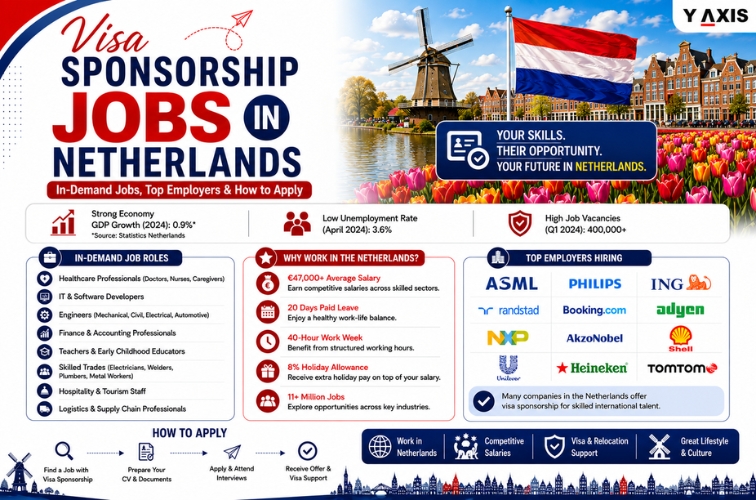
The Netherlands is a strong job market for international professionals, especially in IT, engineering, healthcare, technology, finance, logistics and business services. Labour shortages in several skilled occupations are creating opportunities for workers from outside the EU. For non-EU professionals, getting a job with an employer that can sponsor a work permit is an important step. Under the Highly Skilled Migrant route, the employer must be recognised by the Dutch Immigration and Naturalisation Service (IND). The IND’s public register currently includes around 10,000 recognised sponsors.
Salary is also an important requirement. In 2026, the minimum monthly salary for the Highly Skilled Migrant route is €4,357 for workers under 30 and €5,942 for workers aged 30 or above. A reduced salary requirement of €3,122 per month may apply in certain cases, such as eligible graduates using the orientation-year route. With the right skills, qualifications, work experience and a job offer from a recognised sponsor, skilled professionals can explore visa sponsorship jobs in the Netherlands.
*Want to work in Netherlands? Sign-up to Y-Axis for complete guidance
Why Apply for Visa Sponsorship Jobs in the Netherlands?
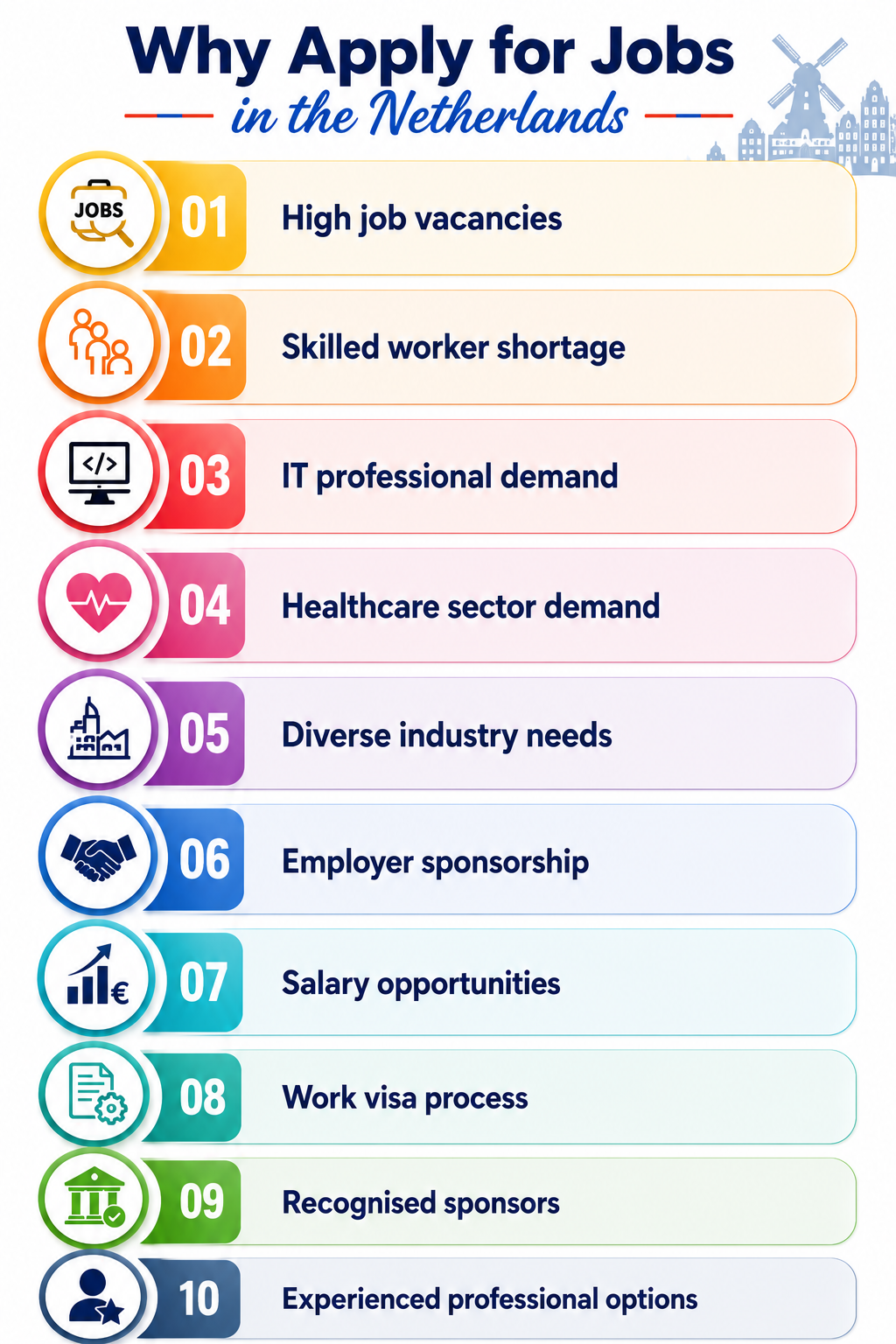
- High number of job vacancies: The Netherlands had around 375,000 job vacancies in Q2 2026, showing strong demand for workers.
- Shortage of skilled workers: Around 64% of Dutch companies reported staff shortages in 2026, creating more opportunities for skilled professionals.
- Strong demand for IT professionals: About 589,000 people were working in ICT jobs in Q2 2026, making IT one of the key fields for international workers.
- High demand in healthcare: The healthcare sector had around 68,500 open jobs in Q2 2026, creating opportunities for qualified healthcare workers.
- Many industries need skilled workers: There are job opportunities in IT, engineering, healthcare, finance, construction, logistics, technology and business services.
- Employer sponsorship is available: Skilled workers from outside the EU can get sponsorship from employers approved to hire international workers.
- Good salary opportunities: The Netherlands has minimum salary rules for sponsored workers, which can help skilled professionals target well-paid jobs.
- Clear work visa process: The Highly Skilled Migrant route provides a structured way for eligible foreign professionals to work in the Netherlands.
- Many recognised sponsors: The Netherlands has thousands of employers recognised by the Dutch immigration authorities to sponsor skilled foreign workers.
- Good option for experienced professionals: Workers with relevant skills, qualifications and work experience can apply for jobs with Dutch employers that offer visa sponsorship.
What Are Visa Sponsorship Job Opportunites in the Netherlands?
Visa sponsorship jobs are jobs where a Dutch employer helps a foreign worker get permission to live and work in the Netherlands. For highly skilled workers, the employer usually needs to be a recognised sponsor registered with the Dutch Immigration and Naturalisation Service (IND). The employer applies for the required residence permit for the worker. The worker must meet certain conditions, such as the required salary, job requirements and other immigration rules. The Netherlands does not have one single visa called a “visa sponsorship visa.” The type of work permit you need depends on your job, skills, qualifications, salary and employment situation.
*Also, read...
Netherlands Job Market: Trends & Job Opportunities
In-Demand Visa Sponsorship Jobs in the Netherlands
The Netherlands has a strong demand for skilled workers in several industries. IT, engineering, healthcare, technology, finance, logistics and renewable energy are some of the key areas where employers look for qualified professionals. International workers with the right skills, qualifications and work experience can apply for jobs with Dutch employers that are able to sponsor foreign workers.
The table below shows some of the in-demand visa sponsorship jobs in the Netherlands, along with common job roles and estimated annual salaries.
|
In-Demand Job Sector |
Roles |
Average Annual Salary (EUR) |
|
IT & Technology |
Software Developer, Data Engineer, Data Scientist, AI Engineer, Cybersecurity Specialist, Cloud Engineer, DevOps Engineer, IT Architect |
€55,000 – €90,000 |
|
Healthcare |
Registered Nurse, Medical Doctor, Specialist Doctor, Physiotherapist, Healthcare Specialist |
€40,000 – €150,000+ |
|
Engineering |
Mechanical Engineer, Electrical Engineer, Civil Engineer, Industrial Engineer, Automation Engineer |
€48,000 – €75,000 |
|
Semiconductors & Electronics |
Semiconductor Engineer, Chip Designer, Hardware Engineer, Electronics Engineer, Research Engineer |
€55,000 – €85,000 |
|
Energy & Renewable Energy |
Energy Engineer, Electrical Engineer, Sustainability Engineer, Renewable Energy Specialist |
€50,000 – €80,000 |
|
Construction & Technical Trades |
Electrical Technician, HVAC Technician, Maintenance Technician, Construction Engineer, Technical Specialist |
€35,000 – €60,000 |
|
Logistics & Supply Chain |
Supply Chain Specialist, Logistics Coordinator, Transport Planner, Operations Manager, Warehouse Manager |
€35,000 – €65,000 |
|
Finance & Accounting |
Financial Analyst, Accountant, Controller, Risk Specialist, Financial Advisor |
€45,000 – €75,000 |
|
Business & Consulting |
Business Consultant, Management Consultant, Project Manager, Business Analyst |
€50,000 – €85,000 |
|
Pharma & Life Sciences |
Clinical Researcher, QA Specialist, Regulatory Affairs Specialist, Biomedical Scientist |
€45,000 – €80,000 |
|
Manufacturing & Industry |
Process Engineer, Production Engineer, Industrial Automation Specialist, Maintenance Engineer |
€45,000 – €75,000 |
|
Education & Research |
University Researcher, Lecturer, Technical Teacher, Research Scientist |
€40,000 – €75,000 |
*Also, read...
What are the most in-demand jobs in the Netherlands for the next 10 years?
Highest Paying Careers in the Netherlands
The Netherlands offers high salaries in medicine, technology, finance, engineering, management and specialised professional roles.
|
Job Title |
Average Annual Salary (EUR) |
Approx. Annual Salary (INR) |
|
Medical Specialist / Surgeon |
€150,000 |
₹1.50 crore |
|
IT Director / CIO |
€130,000 |
₹1.30 crore |
|
Finance Director / CFO |
€125,000 |
₹1.25 crore |
|
Specialist Doctor |
€120,000 |
₹1.20 crore |
|
Senior Technology Manager |
€110,000 |
₹1.10 crore |
|
Engineering Manager |
€100,000 |
₹1.00 crore |
|
Corporate Lawyer / Legal Counsel |
€95,000 |
₹95 lakh |
|
Data Science / AI Lead |
€90,000 |
₹90 lakh |
|
Cybersecurity Architect |
€90,000 |
₹90 lakh |
|
Cloud Solutions Architect |
€85,000 |
₹85 lakh |
|
Senior Software Engineer |
€80,000 |
₹80 lakh |
|
Product Manager – Technology |
€78,000 |
₹78 lakh |
|
Clinical Research Manager |
€75,000 |
₹75 lakh |
|
Supply Chain Manager |
€70,000 |
₹70 lakh |
|
Senior Process Engineer |
€68,000 |
₹68 lakh |
*Also read
Highest paying Jobs in Netherlands
Top Companies Offering Jobs in the Netherlands with Visa Sponsorship
The following companies have major operations in the Netherlands and regularly hire professionals across technology, engineering, finance, healthcare, logistics and other sectors. Sponsorship depends on the job and the employer's hiring requirements.
|
Sector |
Company Names |
Common Sponsored Roles |
|
Technology & IT |
ASML, Booking.com, Adyen, TomTom, Philips, NXP Semiconductors |
Software Engineers, Data Scientists, Cloud Engineers, AI Specialists, Cybersecurity Specialists |
|
Semiconductors & Electronics |
ASML, NXP Semiconductors, ASM International, BE Semiconductor Industries (Besi) |
Semiconductor Engineers, Chip Designers, Hardware Engineers, Research Engineers |
|
Healthcare & Medical Technology |
Philips, Johnson & Johnson, Siemens Healthineers, Medtronic |
Medical Researchers, Biomedical Engineers, Healthcare Specialists, Software Engineers |
|
Pharmaceuticals & Biotechnology |
Janssen, MSD, AstraZeneca, AbbVie |
Scientists, Clinical Researchers, QA Specialists, Regulatory Affairs Specialists |
|
Engineering & Industry |
Shell, AkzoNobel, DSM-Firmenich, Tata Steel Netherlands |
Process Engineers, Mechanical Engineers, Chemical Engineers, R&D Engineers |
|
Energy & Utilities |
Shell, Vattenfall, TenneT, Eneco |
Energy Engineers, Electrical Engineers, Sustainability Specialists, Project Managers |
|
Automotive |
Stellantis, DAF Trucks, VDL Groep, Toyota Motor Europe |
Automotive Engineers, Software Engineers, Data Analysts, Supply Chain Specialists |
|
Banking & Financial Services |
ING, ABN AMRO, Rabobank, de Volksbank |
Financial Analysts, Risk Specialists, Data Analysts, IT Specialists |
|
Financial Technology |
Adyen, Mollie, bunq |
Software Engineers, Data Engineers, Security Specialists, Product Managers |
|
Professional Services & Consulting |
Accenture, Deloitte, EY, KPMG, PwC |
Technology Consultants, SAP Consultants, Cloud Consultants, Data Specialists |
|
Logistics & Transport |
DHL, Maersk, Kuehne+Nagel, UPS |
Supply Chain Specialists, Logistics Planners, Operations Managers, Data Analysts |
|
E-commerce & Retail |
bol, Amazon Netherlands, IKEA Netherlands |
Software Engineers, Data Analysts, Product Managers, Supply Chain Specialists |
|
Food & Consumer Goods |
Unilever, Heineken, FrieslandCampina |
Supply Chain Specialists, Data Analysts, Engineers, Marketing Specialists |
|
Telecommunications |
KPN, VodafoneZiggo, Odido |
Network Engineers, Software Engineers, Cybersecurity Specialists, IT Architects |
|
Research & Higher Education |
TU Delft, Eindhoven University of Technology, University of Amsterdam, Erasmus University Rotterdam |
Researchers, PhD Researchers, Research Engineers, Data Scientists |
|
Construction & Infrastructure |
Royal BAM Group, Arcadis, Heijmans |
Civil Engineers, Project Managers, Structural Engineers, Construction Specialists |
Important: A company may be able to sponsor foreign workers, but this does not mean that every job vacancy offers visa sponsorship. Applicants should check the sponsorship details for each vacancy before applying.
Eligibility Requirements for Visa Sponsorship Jobs in the Netherlands
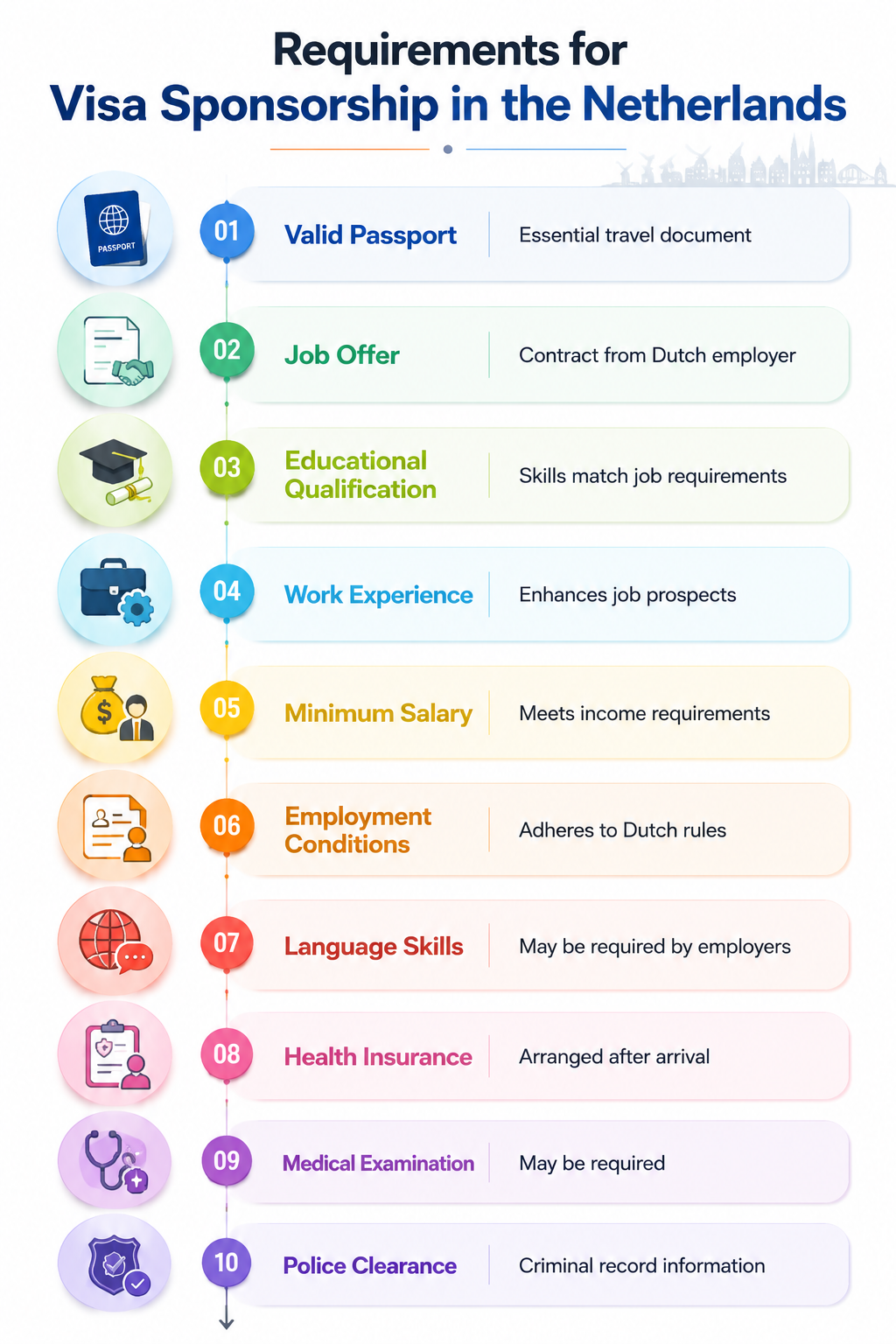
- Valid Passport: You must have a valid passport or travel document.
- Job Offer: You generally need a job offer or employment contract from a Dutch employer. For the Highly Skilled Migrant route, the employer must be a recognised sponsor.
- Educational Qualification: Your education and skills should match the requirements of the job. Some jobs may require a specific degree or professional qualification.
- Work Experience: Work experience is not always compulsory, but relevant experience can improve your chances of getting a job.
- Minimum Salary: Your salary must meet the minimum income requirement for the type of work permit you are applying for. The amount can vary based on your age, permit type and situation.
- Employment Conditions: Your job and employment contract must meet Dutch employment and immigration rules.
- Language Skills: There is no general Dutch language test for most work permits. However, some employers and professions may require Dutch or English language skills.
- Health Insurance: You must arrange Dutch health insurance after arriving in the Netherlands. You may also need to meet health-related requirements depending on your situation.
- Medical Examination: Some applicants may need to complete a medical examination, depending on their nationality and residence situation.
- Police Clearance: You may need to provide information about your criminal record or complete an antecedents declaration as part of the residence application.
- Qualification Recognition: Regulated professions such as doctors, nurses and teachers may need their qualifications to be recognised in the Netherlands before they can work.
- Recognised Sponsor: For the Highly Skilled Migrant route, the Dutch employer must be listed as a recognised sponsor by the Dutch Immigration and Naturalisation Service (IND).
*Read about: Is job offer mandatory to apply for Jobs in Netherlands
Documents Required for Visa Sponsorship Jobs in the Netherlands
- Valid passport
- Signed employment contract or job offer
- Updated CV
- Educational certificates and transcripts
- Work experience certificates, if applicable
- Proof of salary and employment conditions
- Employer sponsorship documents
- Antecedents declaration, if required
- Medical documents, if required
- Qualification recognition documents, if required
- Professional registration documents, if required
- Residence permit application documents
- Passport-size photographs, if required
- Proof of health insurance, where applicable
- Additional documents requested by the Dutch immigration authorities
Types of Work Permits and Visas in the Netherlands
|
Permit / Visa |
Who It Is For |
Key Points |
|
Highly Skilled Migrant Permit |
Skilled professionals with a job offer from a recognised Dutch sponsor |
One of the main routes for skilled foreign workers; employer applies for the residence permit; salary requirements apply |
|
EU Blue Card |
Highly qualified non-EU workers with the required education, employment contract and salary |
Designed for highly qualified workers; can provide better mobility options within the EU |
|
GVVA – Single Permit |
Non-EU workers who want to work in the Netherlands for more than 90 days in jobs that do not fall under another special route |
Combines the work permit and residence permit into one application |
|
TWV – Work Permit |
Certain non-EU workers employed in the Netherlands, particularly for shorter or specific types of employment |
Usually arranged by the employer; generally used for work that does not require a GVVA |
|
Intra-Corporate Transferee (ICT) Permit |
Managers, specialists and trainee employees transferred from a company outside the EU to its Dutch branch |
Employer must meet specific requirements; permit is linked to the international company transfer |
|
Researcher Residence Permit |
Researchers working with an approved Dutch research organisation |
Requires a recognised research institution and a hosting agreement or employment arrangement |
|
Orientation Year Permit |
Eligible graduates and researchers who completed qualifying studies or research in the Netherlands or certain recognised foreign institutions |
Allows eligible graduates to stay in the Netherlands for up to one year to look for work |
|
Seasonal Work Permit |
Non-EU workers employed in seasonal agricultural work |
Mainly used for seasonal work in agriculture; specific conditions and time limits apply |
|
Self-Employed Residence Permit |
Foreign nationals who want to start or operate a business in the Netherlands |
Business must meet Dutch requirements and show sufficient economic value |
|
European ICT Mobility Permit |
Certain ICT employees who already hold an ICT permit in another EU country and are transferred to the Netherlands |
Allows eligible ICT workers to work temporarily in the Netherlands under EU mobility rules |
Important: The correct permit depends on your job, salary, employer, qualifications, length of stay and type of employment. For most skilled professionals, the Highly Skilled Migrant permit is one of the main routes when the employer is a recognised sponsor.
*Want to apply for a Netherlands work visa? Let Y-Axis guide you with the steps.
How to Find Visa Sponsorship Jobs in the Netherlands?
Follow these steps to improve your chances of finding a sponsored job:
Step 1: Identify jobs that match your qualifications, experience and skills.
Step 2: Focus on occupations with strong demand, such as IT, engineering, healthcare and technical roles.
Step 3: Search for employers that are recognised sponsors in the Netherlands.
Step 4: Check whether the advertised salary meets the relevant 2026 salary requirement.
Step 5: Prepare a Netherlands-style CV highlighting your skills, qualifications and work experience.
Step 6: Apply directly through company career pages and trusted job portals.
Step 7: Mention your international work status clearly when appropriate.
Step 8: If you receive a job offer, confirm whether the employer will sponsor your residence permit.
Step 9: The recognised employer submits the required application to the IND.
Step 10: After approval, complete the required entry and residence formalities and move to the Netherlands.
*Want to apply for jobs in Netherlands? Avail Y-Axis services to find the right one.
Tips to Get a Sponsored Job in the Netherlands
- Apply for jobs that match your skills and experience.
- Focus on shortage occupations.
- Check whether the employer is an IND-recognised sponsor.
- Make sure the offered salary meets the required threshold.
- Use a clear and professional CV.
- Highlight international experience and specialist skills.
- Apply directly to multinational companies.
- Learn basic Dutch to improve your job options.
- Check professional registration requirements for regulated occupations.
- Do not pay an employer for a job or sponsorship.
Conclusion
The Netherlands offers good opportunities for skilled professionals from outside Europe. IT, engineering, healthcare, finance, business and logistics are among the areas where international professionals can find opportunities.
The Highly Skilled Migrant route is one of the main pathways for professionals who receive a qualifying job offer from an IND-recognised sponsor. In 2026, the minimum salary is €5,942 per month for highly skilled migrants aged 30 or above and €4,357 for those under 30, while a reduced salary criterion of €3,122 may apply in certain cases.
If you are planning to work in the Netherlands, start by identifying your target occupation, checking recognised sponsors and applying for jobs that match both your skills and the visa requirements.
*Looking for assistance for overseas immigration? Contact Y-Axis, the world’s #1 overseas career consultancy for job search support and visa assistance.
FAQs
What are visa sponsorship jobs in the Netherlands?
Visa sponsorship jobs are jobs where a Dutch employer helps a foreign worker get permission to live and work in the Netherlands. For the Highly Skilled Migrant route, the employer usually needs to be a recognised sponsor. The employer applies for the required residence permit. The worker must also meet conditions related to salary, employment, qualifications and other immigration rules. The type of permit depends on the job and situation.
Can Indians get visa sponsorship jobs in the Netherlands?
Yes, Indian professionals can apply for jobs with Dutch employers that sponsor foreign workers. You normally need a suitable job offer, the required salary and the right qualifications or work experience. For the Highly Skilled Migrant route, the employer must generally be a recognised sponsor. Indian applicants may also need an entry visa before travelling to the Netherlands, depending on their circumstances and the type of residence permit.
Which jobs are in demand in the Netherlands?
The Netherlands has opportunities for skilled workers in areas such as IT, engineering, healthcare, technology, finance, logistics, energy and life sciences. Common roles include software developers, data professionals, engineers, healthcare workers, cybersecurity specialists, cloud engineers and technical specialists. Demand can change based on the labour market and location. Applicants should check current vacancies and make sure their skills and qualifications match the employer's requirements before applying.
What is the Highly Skilled Migrant visa in the Netherlands?
The Highly Skilled Migrant residence permit is a work route for qualified professionals from outside the European Union, European Economic Area and Switzerland. The employee must have an employment contract with a Dutch employer that is a recognised sponsor. The applicant must meet the required income level, and the salary should meet the rules for the job. This route is mainly designed for professionals with specialised skills and suitable employment.
What is the minimum salary for a Highly Skilled Migrant in 2026?
In 2026, the minimum gross monthly salary for a Highly Skilled Migrant aged 30 or above is €5,942. For workers under 30, the minimum is €4,357 per month. A reduced salary requirement of €3,122 per month can apply in certain cases, including eligible applicants who qualify under the orientation-year route. These amounts can change each year, so applicants should check the latest salary requirement before applying.
Does the employer have to be a recognised sponsor?
For the Highly Skilled Migrant route, the employer must generally be a recognised sponsor. Recognised sponsors are employers approved by the Dutch immigration authorities to hire certain foreign workers. The employer submits the residence permit application and handles important parts of the immigration process. However, recognition is not required for every type of Dutch work permit. The requirement depends on the job, employment situation and residence route being used.
Do I need a job offer to get a Netherlands work visa?
For most employer-sponsored work routes, you need a job or employment arrangement before your employer can apply for your work permit. For the Highly Skilled Migrant route, you need an employment contract with a recognised Dutch sponsor. Some other routes may have different requirements. Eligible graduates and highly educated people may also qualify for an orientation-year permit, which allows them to stay in the Netherlands while looking for suitable employment.
Can I get a Netherlands work visa without a job offer?
In most cases, you cannot get an employer-sponsored work permit without a job or employment arrangement. However, some eligible graduates and highly educated people may qualify for an orientation-year residence permit. This allows them to stay in the Netherlands for up to one year while looking for suitable work. If they find a qualifying job, they may be able to move to another work residence route under the applicable conditions.
Is IELTS required for visa sponsorship jobs in the Netherlands?
There is no general IELTS requirement for the Highly Skilled Migrant residence permit. However, an employer may ask for English or Dutch language skills depending on the job. Some professions may also have specific language requirements. Before applying, check the job description carefully to see which language skills are required. Good communication skills can also improve your chances of finding employment and working successfully in the Netherlands.
What documents are required for Netherlands visa sponsorship jobs?
Common documents include:
- A valid passport
- Employment contract
- Educational certificates
- Work experience documents
- Residence application documents
- Employer sponsorship documents, where required
- Entry visa application, where applicable
- Professional qualification documents, where required
The exact document list depends on the type of work and residence permit you apply for.
Do I need work experience to get a sponsored job in the Netherlands?
Work experience requirements depend on the job, employer and visa route. There is no single work experience requirement for all sponsored jobs. Employers usually look for candidates whose skills and experience match their vacancies. Some highly qualified work routes have specific education or professional experience requirements. Relevant experience can improve your chances, especially for senior positions. Fresh graduates may also find opportunities if they have suitable qualifications and strong job-related skills.
Can freshers get visa sponsorship jobs in the Netherlands?
Fresh graduates can find sponsored jobs, but getting sponsorship without work experience can be difficult because employers often look for candidates with skills that match their job requirements. Graduates with strong technical skills, relevant qualifications, internships or project experience may have better opportunities. Eligible graduates may also qualify for an orientation-year permit to look for work in the Netherlands. Finding a suitable job can then help them move to another work permit route.
What companies in the Netherlands offer visa sponsorship?
Several large international companies in the Netherlands hire professionals from different countries. These include companies such as ASML, Philips, Booking.com, ING, Adyen, Shell and Unilever, as well as international consulting firms. They recruit workers in areas such as technology, engineering, finance, healthcare and business services. However, sponsorship is not guaranteed for every vacancy. Applicants should check whether the employer is recognised to sponsor foreign workers and whether the specific job accepts international applicants.
How can I find visa sponsorship jobs in the Netherlands?
You can search for suitable jobs through Dutch company career pages, job websites and professional networking platforms. Look for vacancies that mention visa sponsorship, relocation support or international applicants. You can also check whether the employer is a recognised sponsor before applying. Focus on jobs that match your qualifications, skills and experience. Before applying, check the salary, job requirements, location, employment conditions and sponsorship details carefully.
How does the Netherlands visa sponsorship process work?
First, you need to find a suitable job with an employer that can sponsor foreign workers. After receiving a job offer, you sign the employment contract and provide the required documents. For the Highly Skilled Migrant route, the recognised employer submits the residence permit application to the Dutch immigration authorities. If the application is approved, you complete any required entry visa steps and travel to the Netherlands. You then complete the required registration procedures after arrival.
Do Indians need an MVV to work in the Netherlands?
Indian citizens generally need an MVV, or long-stay entry visa, when they plan to stay in the Netherlands for more than 90 days, unless they qualify for an exemption. The MVV allows the applicant to travel to the Netherlands and collect the residence permit. For many work routes, the employer can apply for the MVV and residence permit together. The exact process depends on the applicant's nationality, residence route and personal circumstances.
Can my family join me if I get a sponsored job?
In many cases, family members can apply to live in the Netherlands with a foreign worker who has a valid residence permit. The rules depend on the worker's residence permit and the relationship with the family member. Spouses, partners and children may be eligible under certain conditions. Separate applications and supporting documents may be required. Applicants should check the family residence requirements before travelling to ensure all necessary documents are prepared.
Can I change employers after getting a sponsored job?
Yes, changing employers can be possible, but the process depends on your residence permit. For Highly Skilled Migrants, the new employer generally needs to meet the applicable sponsorship requirements. Your new salary must also meet the required income conditions. You should complete the necessary immigration steps before starting the new job. Changing employers without following the required process could affect your residence status, so it is important to follow the applicable rules.
Can visa sponsorship jobs in the Netherlands lead to permanent residence?
A sponsored job can be part of a long-term route to permanent residence, but getting a sponsored job does not automatically provide permanent residence. Applicants generally need to meet requirements related to legal residence, income, integration and other conditions. In many cases, five years of continuous legal residence is an important requirement. The exact rules can vary depending on the residence permit and individual situation, so applicants should check the requirements before applying.
What is the best way to increase my chances of getting a sponsored job?
Focus on jobs that match your qualifications, skills and work experience. Create a clear CV and highlight your main achievements and technical skills. Learn skills that are in demand, especially in areas such as IT, engineering, data, healthcare and technology. Check whether the employer can sponsor foreign workers and whether the salary meets the required level. Apply for suitable vacancies with customised applications instead of sending the same CV to every employer.
Tags:
Visa Sponsorship Jobs in Netherlands 2026
Netherlands Work Visa Sponsorship for Indians
Netherlands Work Visa Jobs
Netherlands Work Visa for Foreign Workers
In-Demand Jobs in Netherlands with Visa Sponsorship
Netherlands Employer-Sponsored Jobs
Share
Options for you by Y-Axis

Get it on your mobile

Get News alerts

Contact Y-Axis
Latest Article
Popular Post
Trending Article
Posted On October 09 2026
Canada’s Immigration Reset: Why the Next Move May Be About Fit, Not Volume