

Posted on October 29 2026
Life in Austria for Immigrants: Jobs, Visas, Cost of Living & Residency

By , Editor & Director
Updated October 29 2026
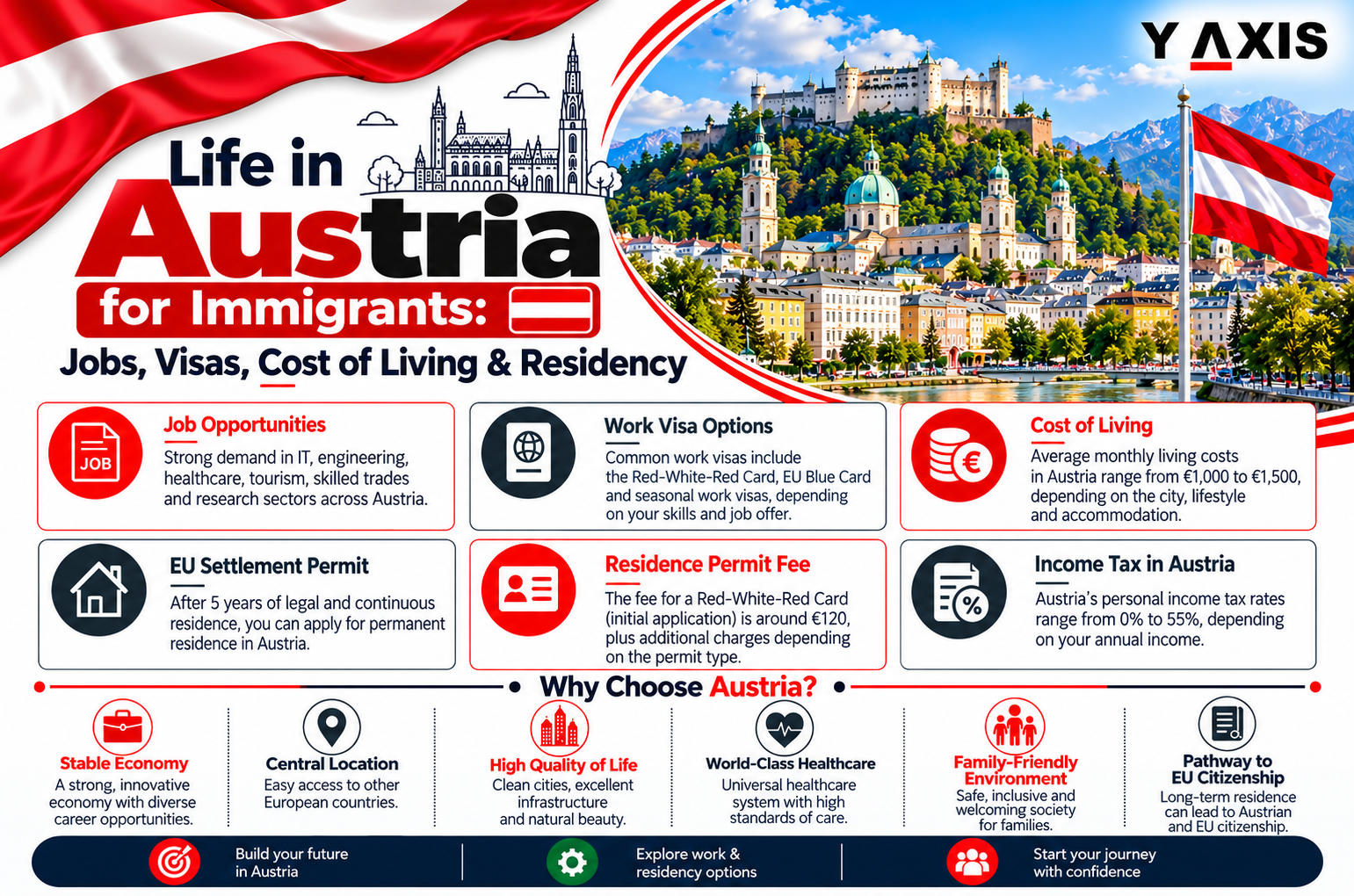
Life for immigrants in Austria offers high salaries, excellent public services, and a strong job market in engineering, IT, and healthcare. Most Indian professionals move on the Red-White-Red Card, a points-based work and residence permit linked to a job offer. Highly qualified graduates with a salary of at least EUR 55,678 a year can apply for the EU Blue Card instead. Very highly qualified professionals can use the Job Seeker Visa to look for work in Austria for 6 months. Permanent residency (Daueraufenthalt – EU) is possible after 5 years of continuous stay with B1 German. Vienna, Graz, Linz, Salzburg, and Innsbruck are popular cities for expats.
Some quick facts about Austria are as follows:
|
Population |
Approximately 9.2 million residents |
|
Capital |
Vienna (Austria's capital and largest city) |
|
Official Language |
German (English is widely used in international companies, research, and IT) |
|
Currency |
Euro (EUR) |
|
Popular Immigrant Hubs |
Vienna, Graz, Linz, Salzburg, Innsbruck |
|
Economy |
Strong engineering, manufacturing, tourism, and research sectors; growing demand for IT, engineering, and healthcare professionals |
|
Typical Route to Long Stay |
Red-White-Red Card with a job offer, or the EU Blue Card for highly qualified graduates |
|
Long-Term Residency |
Permanent residency (Daueraufenthalt – EU) after 5 years with B1 German; citizenship usually after 10 years |
*Want to settle in Austria? Sign up with Y-Axis for end-to-end assistance.
Why Choose Austria to Migrate Abroad?
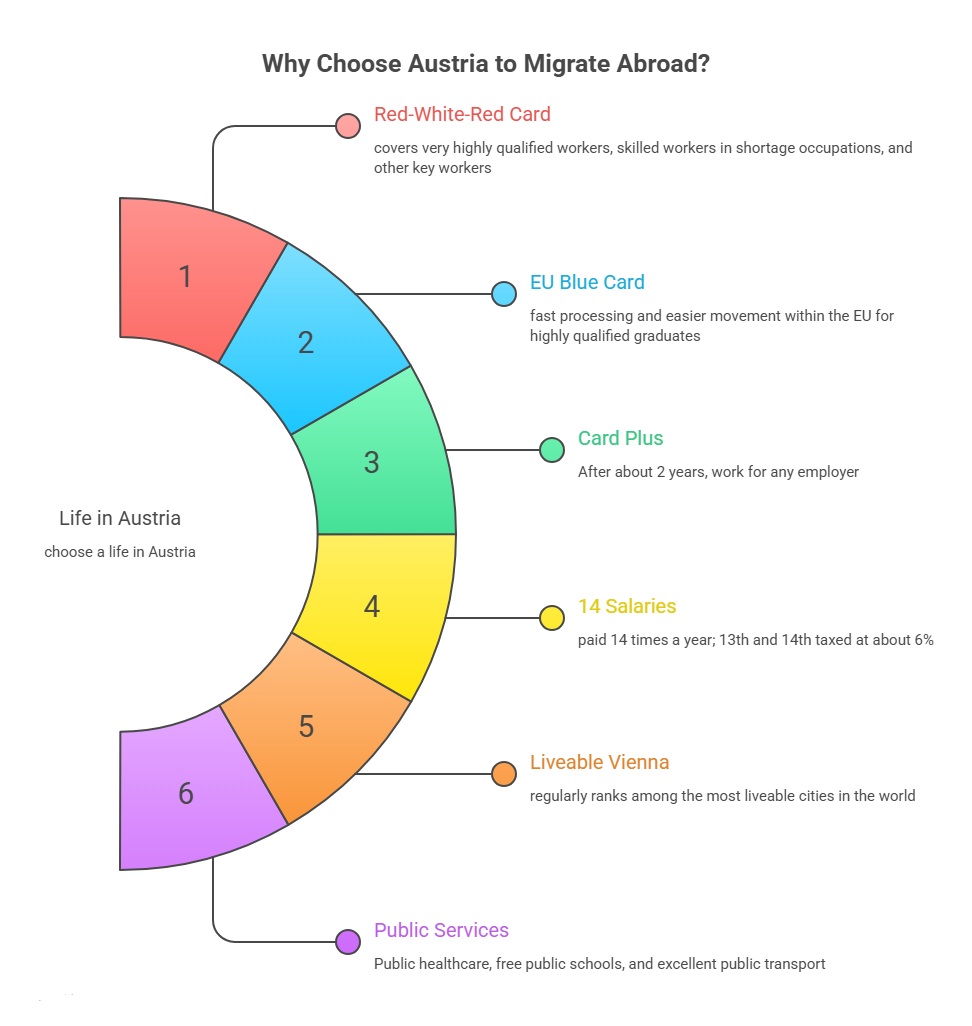
Austria runs a points-based work permit system for skilled workers from outside the EU. It also offers the EU Blue Card and a Job Seeker Visa for highly qualified professionals.
Here is why you should choose a life in Austria:
- The Red-White-Red Card covers very highly qualified workers, skilled workers in shortage occupations, and other key workers.
- The EU Blue Card offers fast processing and easier movement within the EU for highly qualified graduates.
- After about 2 years, you can switch to the Red-White-Red Card Plus and work for any employer.
- Salaries are paid 14 times a year, and the 13th and 14th salaries are taxed at a low flat rate of about 6%.
- Vienna regularly ranks among the most liveable cities in the world.
- Public healthcare, free public schools, and excellent public transport make settling in easier.
Note: Indian passport holders need a Schengen visa to visit Austria. You cannot work on a Schengen visit visa. Anyone with a job offer must get the correct residence permit, such as the Red-White-Red Card, before starting work.
*Want to work in Austria? Let Y-Axis assist you with the process.
Can I Move to Austria as an Indian Immigrant?
Most Indians move to Austria on a Red-White-Red Card, which needs a job offer and enough points. Highly qualified graduates with a strong salary can apply for the EU Blue Card instead.
The steps to migrate to Austria as an Indian professional are as follows:
Step 1: Check your points on the official Austrian immigration portal (migration.gv.at) for the Red-White-Red Card
Step 2: Secure a job offer from an Austrian employer that meets the minimum salary for your category
Step 3: Select a suitable pathway, such as the Red-White-Red Card, the EU Blue Card, or the Job Seeker Visa
Step 4: Apply at the Austrian Embassy in New Delhi, or your employer applies for you at the local residence authority in Austria
Step 5: The Public Employment Service (AMS) checks your points and job offer, which usually takes about 8 weeks
Step 6: Travel to Austria on a D visa once approved, and collect your residence card from the local authority
Step 7: Register your address (Meldezettel) within 3 days, open a bank account, and get an Austrian mobile number
Also, read...
Highest Paying Job Opportunities in Austria
Best Visa Options to Live in Austria
Austria offers several routes depending on your job offer, salary, skills, and business plans. The table below shows the main options and their route to long-term residence.
|
Visa Type |
Best For |
Duration |
Long-Term Pathway |
|
Red-White-Red Card |
Skilled workers with a job offer who score enough points (55-70 points, depending on category) |
24 months |
Can lead to the Red-White-Red Card Plus after 21 months, then permanent residency after 5 years |
|
EU Blue Card |
University graduates with a job offer paying at least EUR 55,678 a year |
Up to 24 months, renewable |
Can lead to the Red-White-Red Card Plus and permanent residency after 5 years |
|
Job Seeker Visa |
Very highly qualified professionals with at least 70 points who want to look for work |
6 months |
Switch to a Red-White-Red Card once you find a suitable job |
|
Red-White-Red Card for Self-Employed Key Workers and Start-up Founders |
Entrepreneurs and founders with a business plan and investment that benefit Austria |
24 months |
Can lead to the Red-White-Red Card Plus and permanent residency |
Also, read...
The Austria Job Market Outlook
Best Areas to Live in Austria
Austria's job market and living costs vary by city. Choosing the right area can influence your commute, cost of living, housing expenses, and overall quality of life.
The table below highlights the major Austrian cities and their best qualities for settlement abroad:
|
Area |
Best For |
Sightseeing |
Average Rent |
Job Market |
How Much You Can Save |
|
Vienna (Inner Districts) |
Corporate professionals & expats |
St. Stephen's Cathedral, Hofburg Palace, MuseumsQuartier |
EUR 1,100-1,700/mo (1BR flat) |
Strong, MNCs, IT, finance & UN agencies |
Moderate, higher rents |
|
Vienna (Outer Districts) |
Families & young professionals |
Danube Island, Schönbrunn Palace, Prater |
EUR 750-1,100/mo (1BR flat) |
Strong, IT, services & healthcare |
Good savings potential |
|
Graz |
Engineers, researchers & students |
Schlossberg, Old Town, Kunsthaus Graz |
EUR 700-1,000/mo (1BR flat) |
Good, automotive, engineering & universities |
Good savings potential |
|
Linz |
Manufacturing & engineering professionals |
Ars Electronica Center, Pöstlingberg |
EUR 750-1,200/mo (1BR flat) |
Good, steel, chemicals & industrial firms |
Good savings potential |
|
Salzburg & Innsbruck |
Tourism & hospitality professionals |
Hohensalzburg Fortress, Golden Roof, Nordkette |
EUR 900-1,500/mo (1BR flat) |
Good, tourism, hotels & research |
Moderate, higher rents |
Note: Most Austrian rentals need a security deposit of up to 3 months' rent. Since July 2023, the landlord pays the agent's fee in most cases. Figures vary by district, size, and distance from U-Bahn or tram stops. Confirm current listings before budgeting.
Also, read...
Cost of Living in Austria
Austria's cost of living changes by location. Vienna's inner districts, Salzburg, and Innsbruck cost the most, while Graz and smaller cities are more affordable.
Below is a breakdown of average monthly expenses for a single adult living outside the most premium areas:
|
Rent (1BR flat, outside prime area, e.g. Graz/outer Vienna) |
EUR 750-1,100/month |
|
Utilities (electricity, heating, water & internet) |
EUR 150-250/month |
|
Groceries |
EUR 300-450/month |
|
Public Transport (Vienna U-Bahn / trams / buses) |
EUR 39-75/month (Vienna annual pass EUR 467, or EUR 75 monthly ticket) |
|
Healthcare |
Employees join public health insurance (ÖGK) through their employer; total employee social insurance is about 18% of gross salary |
|
Dining Out (per meal) |
EUR 12-18 (casual restaurant), EUR 35-60 (mid-range restaurant) |
|
Mobile & Internet |
EUR 15-40/month |
|
Entertainment & Leisure |
EUR 100-250/month |
Also, read...
What are the Eligibility Requirements for an Austria Work Visa?
Is Austria Expensive Compared to Germany or Switzerland?
Austria is much cheaper than Switzerland, especially for rent, food, and healthcare. Living costs in Vienna are broadly similar to Munich or Berlin.
Salaries for skilled professionals are high, and are paid 14 times a year. Many immigrants can save well, especially outside central Vienna and Salzburg.
Vienna's inner districts, Salzburg, and Innsbruck are the priciest areas. However, Vienna also offers the most jobs in multinational companies, IT, and research.
Also, read...
Austria Working Holiday Visa for Indians
Work in Austria
Austria's job market is led by engineering, manufacturing, tourism, and research. Leading employers include Siemens Austria, voestalpine, Red Bull, OMV, Erste Group, and Infineon Austria.
The table below shows some of the most in-demand jobs in Austria for immigrants.
|
Occupation |
Average Monthly Salary |
Demand Level |
Average Savings |
|
IT & Software Development |
EUR 4,000-6,500 |
High |
EUR 800-1,800/month |
|
Mechanical & Electrical Engineering |
EUR 3,800-6,000 |
High |
EUR 700-1,600/month |
|
Nursing & Healthcare |
EUR 3,000-4,500 |
High |
EUR 500-1,100/month |
|
Finance & Accounting |
EUR 3,800-6,000 |
Moderate |
EUR 700-1,500/month |
|
Hospitality & Tourism Management |
EUR 2,500-3,800 |
High |
EUR 300-800/month |
|
Construction & Skilled Trades |
EUR 2,800-4,200 |
High |
EUR 400-1,000/month |
Also, read...
What Are the Different Types of Austria Visas to Migrate?
Settling in Austria
Once you arrive in Austria, you need to register your address, collect your residence card, join social insurance, and set up your day-to-day essentials.
Here is a quick overview of what to expect during your first weeks in the country:
|
Housing |
Healthcare |
Education for Children |
Banking & Financial Essentials |
|
Search via portals like willhaben and ImmoScout24, or English-speaking agents; flats near U-Bahn and tram stops are in high demand |
Employees are covered by public health insurance (ÖGK) and receive an e-card for doctor visits |
Public schools are free and teach in German; international schools offer English, British, American, and IB options |
Open an account with Erste Bank, Raiffeisen, Bank Austria, or BAWAG |
|
Landlords usually ask for a deposit of up to 3 months' rent; you must register your address (Meldezettel) within 3 days of moving in |
Spouses and children are usually co-insured at no extra cost under the public scheme |
International school fees range from around EUR 10,000 to EUR 25,000+ a year |
Banks usually ask for your passport, residence card, and Meldezettel |
|
Allow 3-6 weeks to find a rental; many private leases run for a fixed term of 3 years |
Many expats take private supplementary insurance for faster appointments and private rooms |
Apply for school places early; popular international schools in Vienna have waitlists |
Online banks such as N26 and George by Erste allow quick account opening |
Also, read...
What are the fast-track hiring options in Austria for Skilled Professionals?
Permanent Residency and Long-Term Residency in Austria
Long-term residency in Austria is mainly available through the Red-White-Red Card Plus and the Daueraufenthalt – EU permit.
|
Red-White-Red Card |
Valid for 24 months and tied to your employer; counts towards permanent residency |
|
Red-White-Red Card Plus |
Available after 21 months of qualifying work within 24 months; valid for 3 years with free access to the job market |
|
EU Blue Card |
Valid for up to 24 months; after 21 months of qualifying work, you can switch to the Red-White-Red Card Plus |
|
Permanent Residency (Daueraufenthalt – EU) |
Needs 5 years of continuous legal stay, B1 German (Integration Agreement Module 2), stable income, and health insurance |
|
Austrian Citizenship (Naturalisation) |
Usually needs 10 years of legal residence, B1 German, a citizenship test, stable income, and good conduct |
Important note: To apply for Austrian permanent residency, you usually need 5 years of continuous legal stay on a Red-White-Red Card, Red-White-Red Card Plus, or EU Blue Card. Time spent on a student permit does not count. You must also pass the B1 German integration exam (Module 2), show a stable income, and have health insurance. Citizenship usually needs 10 years of residence, or 6 years in some cases with B2 German. Austria generally requires you to give up your old citizenship, and India does not allow dual citizenship.
Also, read...
How Can I Get Permanent Residency in Austria?
Dependent Benefits for Immigrants in Austria
Austria allows Red-White-Red Card and EU Blue Card holders to bring their spouse and children through family reunification.
Here are the benefits of securing an Austria dependent permit:
- Spouses and children can join you on a Red-White-Red Card Plus
- Family members get free access to the job market and can work for any employer
- Children can study for free in Austrian public schools
- Spouses and children are usually co-insured under public health insurance at no extra cost
- Parents can claim the Familienbonus Plus tax credit of up to EUR 2,000 a year per child
Also, read...
Austria Work Dependent Visa: Requirements, Application Process, Cost and Eligibility
Practical Settlement Checklist for Indians Moving to Austria
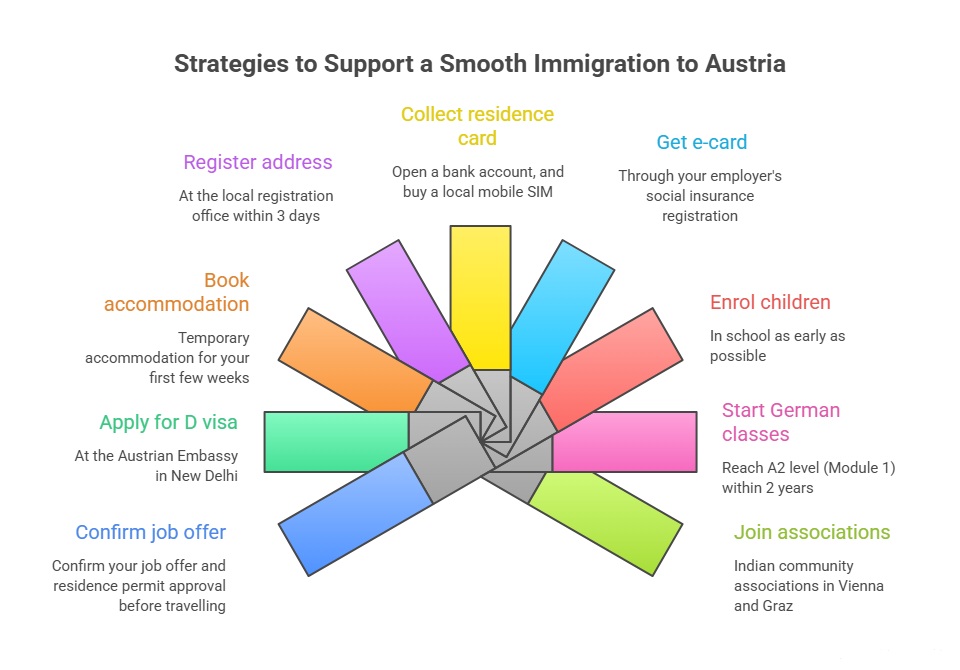
The steps for smooth transition to Austria for Indians are as follows:
Step 1: Confirm your job offer and residence permit approval before travelling, and do not use a Schengen visit visa to start work
Step 2: Apply for a D visa at the Austrian Embassy in New Delhi so you can travel and collect your residence card
Step 3: Book temporary accommodation, such as a serviced apartment, for your first few weeks
Step 4: Register your address (Meldezettel) at the local registration office within 3 days of moving in
Step 5: Collect your residence card, open a bank account, and buy a local mobile SIM
Step 6: Get your e-card through your employer's social insurance registration and arrange private supplementary insurance if needed
Step 7: Enrol children in school as early as possible, given high demand for international schools
Step 8: Start German classes early, as you must reach A2 level (Module 1) within 2 years for most permits
Step 9: Join Indian community associations in Vienna and Graz for support and networking
*Are you looking for step-by-step assistance with Austria immigration? Contact Y-Axis, the world's No. 1 overseas immigration consultancy!
FAQs
What is the easiest way for Indians to move to Austria?
Most Indians move on a Red-White-Red Card, which needs a job offer and enough points. Highly qualified graduates earning at least EUR 55,678 a year can apply for the EU Blue Card. Very highly qualified professionals can use the 6-month Job Seeker Visa to look for work first.
What is the Red-White-Red Card in Austria?
The Red-White-Red Card is a points-based work and residence permit for skilled workers from outside the EU. It is valid for 24 months and is linked to your employer. After 21 months of qualifying work, you can switch to the Red-White-Red Card Plus and work for any employer.
Can I move to Austria without a job offer?
Yes, but only in limited cases. Very highly qualified professionals with at least 70 points can apply for the Job Seeker Visa, which allows a 6-month stay to look for work. Start-up founders and self-employed key workers have their own routes. Most other workers need a job offer first.
Is healthcare free for immigrants in Austria?
Not fully free, but it is low-cost. Employees join public health insurance (ÖGK) through their employer, and total employee social insurance is about 18% of gross salary. This covers doctor visits and hospital care. Spouses and children are usually co-insured at no extra cost.
What is the average salary for skilled workers in Austria?
Salaries vary by sector and experience. IT professionals typically earn EUR 4,000-6,500 a month, and engineers earn EUR 3,800-6,000 a month, paid 14 times a year. Austria's income tax is progressive, from 0% to 55%, with the first EUR 13,539 tax-free in 2026.
Can I bring my family to Austria on a work visa?
Yes. Red-White-Red Card and EU Blue Card holders can bring their spouse and children through family reunification. Family members usually receive a Red-White-Red Card Plus, which lets them work for any employer. Children can study for free in public schools.
Which area in Austria is best for Indian immigrants?
Vienna offers the most jobs and expat-friendly living, though its inner districts cost more. Outer Vienna districts suit families looking for lower rents. Graz and Linz suit engineers working in automotive, steel, and industrial firms.
How much does it cost to live in Austria?
Austria's cost of living varies by city. In inner Vienna, a one-bedroom flat costs around EUR 1,100-1,700 a month. In Graz or outer Vienna, similar housing costs about EUR 750-1,100. Groceries, utilities, and transport add around EUR 500-800 a month.
How do I get permanent residency in Austria?
You usually need 5 years of continuous legal stay on a Red-White-Red Card, Red-White-Red Card Plus, or EU Blue Card. You must also pass the B1 German integration exam, show a stable income, and have health insurance. Time on a student permit does not count.
How can I get Austrian citizenship?
Austrian citizenship usually needs 10 years of legal residence, or 6 years in some cases with B2 German. You must pass B1 German and a citizenship test, and show stable income and good conduct. Austria and India both generally do not allow dual citizenship, so you would need to give up your Indian citizenship.
Tags:
Austria immigration
Austria work visa
Red-White-Red Card
Living in Austria
Cost of living in Austria
Best areas in Vienna
Jobs in Austria for Indians
Healthcare in Austria
Housing in Austria
Settle in Austria
Share
Y - Axis services

Get it on your mobile

Get News Alerts

Contact Y-Axis
Latest Article
Popular Post
Trending Article
Posted On October 29 2026
Life in Austria for Immigrants: Jobs, Visas, Cost of Living & Residency