

Posted on October 08 2026
Austria eases immigration rules for foreign workers with faster processing and greater flexibility. Check Your Eligibility!

By , Editor & Director
Updated October 08 2026
Highlights: Austria Reduces Immigration Processing Time to 90 days for Foreign Workers
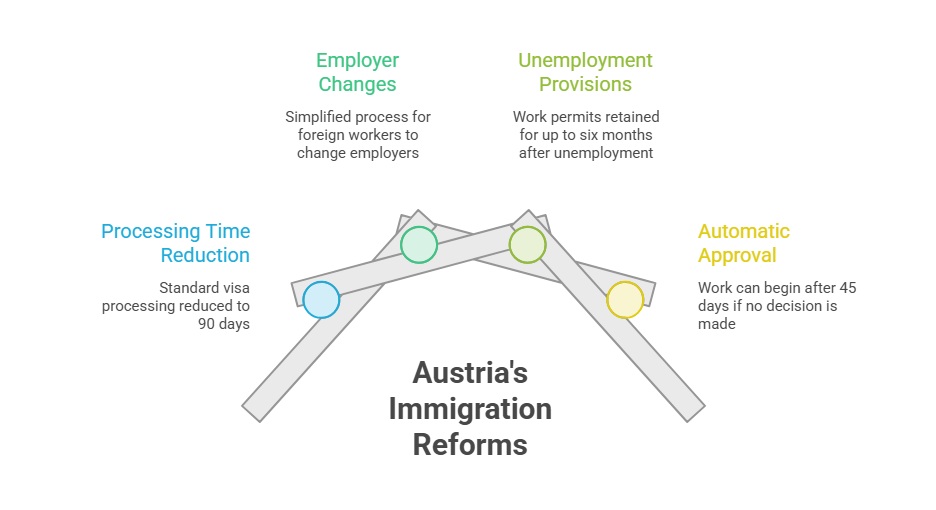
- Austria eases immigration rules for foreign workers from August 7, 2026, simplifying employer changes and unemployment provisions.
- The country has reduced standard immigration processing times to 90 days for visa applications.
- Foreign workers with single permits can change employers after receiving approval from Austrian authorities.
- Applicants can start working for a new employer if no decision is issued within 45 days of a complete application.
- Eligible foreign workers can now retain their work permits for up to six months after becoming unemployed.
*Want to work in Austria? Let Y-Axis guide you with the steps.
Austria Eases Immigration Rules for Foreign Workers From August 2026
Austria has introduced several changes to its immigration rules for foreign workers, effective August 7, 2026. The reforms cover employer changes, unemployment protection and processing times for immigration applications.
The changes also bring parts of Austria’s national immigration legislation in line with the revised EU Single Permit Directive. This is set to provide foreign workers with greater flexibility when their employment circumstances change.
Under the revised rules, holders of eligible single permits can change employers after obtaining approval from the relevant authorities. A major change is that if authorities do not issue a decision within 45 days of receiving the application, the worker can begin employment with the new employer.
The existing rules governing employer changes for EU Blue Card holders will remain unchanged.
However, Austria has also expanded protection for foreign nationals who lose their jobs. Eligible workers can now retain their work permits for up to six months after becoming unemployed, whereas the earlier provision was generally available only to EU Blue Card holders.
The table below summarises the Austria immigration policy changes introduced in August, 2026:
|
Immigration change |
New provision |
|
Employer change |
Eligible single permit holders can change employers with authority approval |
|
45-day provision |
Workers may start with the new employer if no decision is issued within 45 days |
|
Unemployment protection |
Eligible workers can retain permits for up to 6 months after job loss |
|
Unemployment notification |
Workers must inform authorities when employment ends |
|
Standard processing time |
Most complete applications must be processed within 90 days |
|
Red-White-Red Card |
Existing shorter processing deadline remains |
|
EU Blue Card |
Existing shorter processing deadline remains |
|
ICT permits |
Excluded from certain new employer-change and unemployment provisions |
|
Posted workers |
Continue to have different rules, including longer processing periods in applicable cases |
Also, read...
What are the Eligibility Requirements for an Austria Work Visa?
Austria Aligns Immigration Rules With Revised EU Single Permit Framework
The Austria immigration reforms are partly intended to align Austria’s national legislation with the revised EU Single Permit Directive. The changes address situations that can create uncertainty for foreign workers, particularly when they change jobs or become unemployed.
Additionally, Austria has also shortened the standard processing period for immigration applications. With certain exceptions, authorities must now process applications within 90 days from the submission of a complete application.
Also, read...
Austria Opens Doors for Indian Engineering Students with New Student Visa Partnership
How Do Austria’s New Immigration Rules Benefit Foreign Workers?
The revised rules could provide greater flexibility for foreign professionals already working or planning to work in Austria, particularly those holding eligible single permits. The changes can reduce uncertainty around changing employers, provide a longer period to find new employment after job loss and establish clearer expectations around application processing.
- Greater job mobility: Eligible Indian workers with single permits can change employers after receiving the required approval.
- 45-day employer-change provision: If authorities do not issue a decision within 45 days, eligible applicants can begin working for the new employer.
- More protection after job loss: Eligible foreign workers can retain their work permits for up to six months after becoming unemployed.
- More time to find another job: The six-month period can give Indian workers additional time to secure suitable employment without immediately losing their work status.
- Clearer processing timelines: Most complete immigration applications now have a standard processing period of up to 90 days.
- Better planning: More defined processing timelines can help Indian professionals plan employment, relocation and other arrangements more effectively.
- EU-aligned framework: Changes aligning Austrian rules with the revised EU Single Permit Directive may provide a more consistent framework for eligible foreign workers.
- Opportunity for skilled professionals: Indian professionals considering Austria can factor the new employer-change and unemployment provisions into their long-term career planning.
*Are you looking for step-by-step assistance with Overseas Immigration? Contact Y-Axis, the world’s No. 1 overseas immigration consultancy, for end-to-end support!
For recent immigration updates on Austria, check out Y-Axis Schengen News!
FAQs
What immigration changes has Austria introduced for foreign workers?
Austria introduced several immigration reforms from August 7, 2026, affecting foreign workers and residence permit holders. The changes include greater flexibility for eligible single permit holders who want to change employers, a new six-month period of work permit protection after unemployment and shorter standard processing times. The reforms also partly align Austria’s national immigration framework with the revised EU Single Permit Directive.
Can foreign workers in Austria change employers under the new rules?
Yes. Eligible single permit holders can change employers after receiving approval from the Austrian authorities. A new provision also allows eligible applicants to start working for the new employer if the authorities do not issue a decision within 45 days of receiving the application. However, the provision does not apply to intracompany transfer permit holders, while existing EU Blue Card rules remain unchanged.
What happens if an Austrian authority does not decide an employer-change application within 45 days?
Under the revised rules, eligible single permit holders may begin working for their new employer if the authorities have not issued a decision within 45 days of receiving the relevant application. This provides greater flexibility for workers waiting for approval. However, applicants should confirm that their permit category is covered because the 45-day provision does not apply to intracompany transfer permit holders.
How long can eligible foreign workers remain unemployed in Austria?
Eligible foreign workers can now retain their work permits for up to six months after becoming unemployed. This represents an expansion of protection that was previously available only to EU Blue Card holders under the earlier framework. Workers must notify the relevant authorities when their employment ends. In limited circumstances, the six-month period may also be extended according to the applicable rules.
Do all foreign workers qualify for Austria’s six-month unemployment provision?
No. The six-month unemployment provision does not apply to every foreign worker or permit category. Certain groups, including intracompany transferees and posted workers, are excluded from the provision. Therefore, foreign nationals should identify the specific residence or work permit they hold before relying on the new unemployment protection. The applicable conditions can vary depending on the worker’s immigration status.
Has Austria reduced immigration application processing times?
Yes. Austria has introduced a standard processing period of 90 days for most immigration applications, calculated from the submission of a complete application. However, some categories have different deadlines. Existing shorter processing periods for permits such as Red-White-Red Cards and EU Blue Cards remain unchanged, while certain categories, including posted workers and self-employed applicants, can continue to have longer processing periods.
How do Austria’s new immigration rules benefit Indian workers?
Indian workers who qualify under the revised provisions may benefit from greater employment flexibility and additional protection after job loss. Eligible single permit holders can change employers through the revised process, while eligible unemployed workers may retain their permits for up to six months. The 90-day standard processing timeframe can also provide greater clarity when planning immigration applications, employment and relocation to Austria.
Do the new Austria immigration rules apply to EU Blue Card holders?
The new employer-change provision does not replace the existing rules for EU Blue Card holders. Austria has specifically stated that the existing change-of-employer rules for EU Blue Card holders remain unchanged. Similarly, the new six-month unemployment provision represents an expansion beyond the previous framework, under which this protection was available to EU Blue Card holders. Applicants should therefore check the rules specific to their permit.
Do the new rules apply to intracompany transfer permit holders?
No, certain new provisions specifically exclude intracompany transfer permit holders. The new 45-day employer-change provision does not apply to ICT permit holders, and they are also excluded from the six-month unemployment provision. This means ICT workers cannot automatically rely on the new flexibility available to eligible single permit holders. They should follow the immigration rules applicable specifically to intracompany transfers when changing employment circumstances.
Why has Austria changed its immigration rules for foreign workers?
The reforms include measures intended to make Austria’s immigration framework more flexible while aligning parts of national legislation with the revised EU Single Permit Directive. The changes address employer mobility, unemployment protection and application processing times. For foreign workers, the revised provisions can provide greater clarity around employment changes and periods of unemployment, although eligibility continues to depend on the specific permit category.
Tags:
Foreign workers in Austria
Austria immigration
migrate to Austria
work in Austria
Austria work visa
Single permit holders in Austria
Austria immigration rules update
EU Blue Card
Austria work permit changes
Schengen visa
Share
Options for you by Y-Axis

Get it on your mobile

Get News alerts

Contact Y-Axis
Latest Article
Related Post
Trending Article
Posted On October 08 2026
Austria eases immigration rules for foreign workers with faster processing and greater flexibility. Check Your Eligibility!