

Posted on July 10 2026
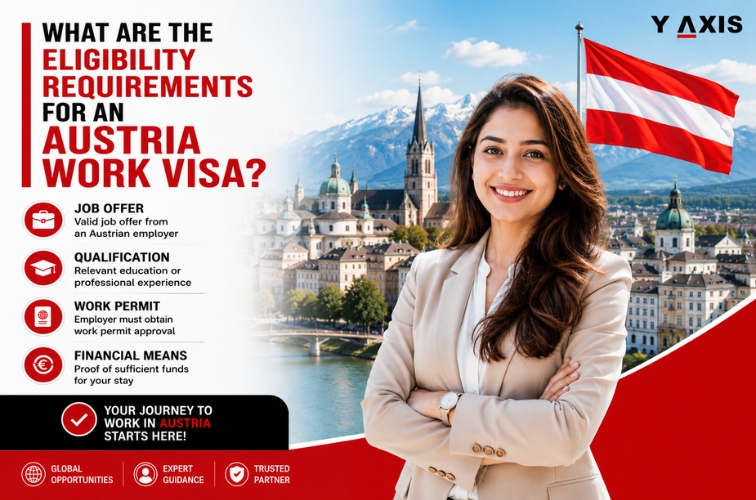
What are the Eligibility Requirements for an Austria Work Visa?

By , Editor & Director
Updated July 12 2026
To apply for an Austria work visa from India, you need to secure a confirmed job offer from an Austrian employer that meets either the points threshold for the Red-White-Red Card (RWR Card) or the salary requirement for the EU Blue Card. Austria's system is transparent and rules-based allowing applicants who meet the points or salary threshold to qualify for the visa. The Red-White-Red Card is the main route for skilled non-EU professionals and is tied to a specific employer, while the EU Blue Card suits highly qualified foreign professionals with a higher salary bar.
*Interested to work in Austria? Let Y-Axis assist you with the process.
Eligibility Criteria to Apply for an Austria Work Visa from India
Applying for an Austria work visa from India generally requires a confirmed job offer from an Austrian employer. Your income should meet either a points-based threshold for Red-White-Red Card or a salary threshold for EU Blue Card. Most applications are reviewed jointly by Austria's residence authority and the Arbeitsmarktservice (AMS), the Austrian Public Employment Service, which verifies points, salary.
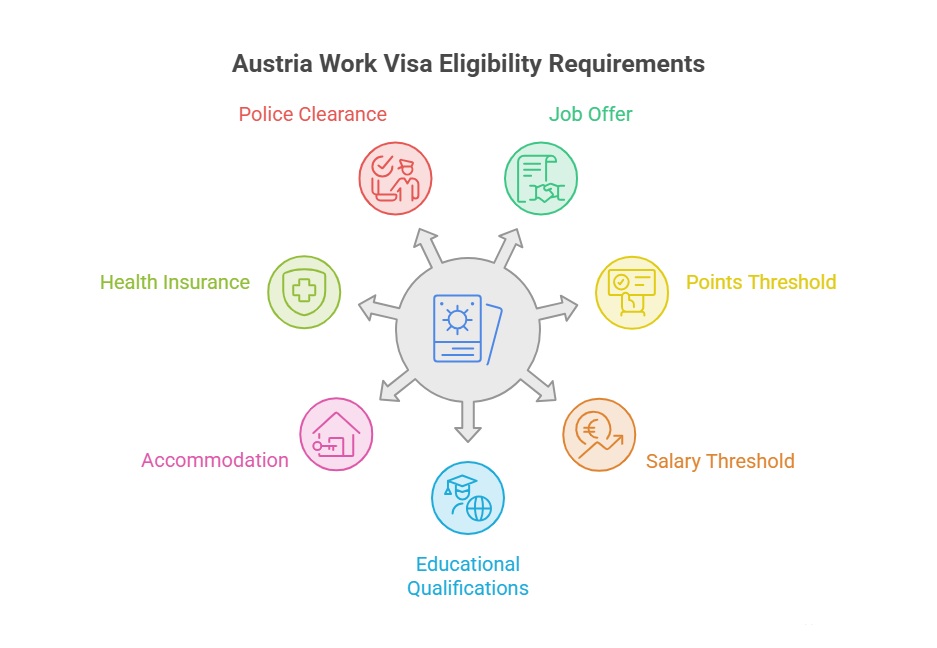
The eligibility criteria for an Austria work visa are as follows:
- Valid Indian passport
- Confirmed job offer/signed employment contract from an Austrian employer specifying salary, job title, and duration
- A minimum points score (typically 55 to 70 out of 100, depending on category) across qualifications, work experience, language skills, and age (for major Red-White-Red Card categories)
- A university degree of at least 3 years and a job offer meeting the 2026 salary threshold of EUR 55,678 gross per year (for the EU Blue Card)
- Salary meeting the applicable 2026 threshold for your category
- Police clearance certificate
- Recognised educational qualifications such as degree certificates may need verification through Austria's ENIC-NARIC recognition database
- Proof of accommodation in Austria
- Valid health insurance coverage
Interested to apply for an Austria work visa? Sign up with Y-Axis for end-to-end assistance.
Eligibility Requirements by Visa and Permit Type
Austria's work authorisation system offers several permit categories depending on your qualifications, salary, and career stage. The table below outlines the main routes relevant to Indian professionals.
| Visa / Permit Type | Who Can Apply | Fee | Validity | Key Benefit |
|---|---|---|---|---|
| RWR Card – Very Highly Qualified Workers | Senior professionals, researchers, and managers scoring 70+ out of 100 points; does not require a job offer to apply for the linked Job Seeker Visa. | Approx. EUR 120–160 application fee (varies by representation). | 24 months, employer-tied. | No labour market test; eligible to enter via a 6-month Job Seeker Visa if the required points are met without a job offer. |
| RWR Card – Skilled Workers in Shortage Occupations | Applicants with a confirmed job offer in one of the 64 nationwide or 66 regional shortage occupations for 2026. | Approx. EUR 120–160. | 24 months, employer-tied. | Lower points threshold and exemption from the standard labour market test. |
| RWR Card – Other Key Workers | Applicants with a job offer not on the shortage list; requires 55+ points and a gross monthly salary of EUR 3,465 (2026). | Approx. EUR 120–160. | 24 months, employer-tied. | Suitable for a wide range of specialised roles; subject to an AMS labour market check. |
| RWR Card – Graduates of Austrian Universities | Graduates of Austrian universities or universities of applied sciences with a job offer matching their qualification level. | Approx. EUR 120–160. | 24 months, employer-tied. | No points system and no separate minimum salary beyond applicable collective agreement rates. |
| EU Blue Card | University graduates (minimum 3-year degree) with a job offer meeting the EUR 55,678 annual salary threshold (2026). | Approx. EUR 120–160. | Up to 24 months, renewable. | No points system; offers enhanced EU mobility rights and is a preferred route for senior IT, engineering, and finance professionals. |
| RWR Card Plus | RWR Card holders after completing 21 months of qualifying employment. | Approx. EUR 120–160. | 3 years, renewable. | Provides unrestricted access to the Austrian labour market, allowing holders to change employers or become self-employed. |
Also, read...
Austria Job Market: Trends and Opportunities
What are the Employer Requirements for Sponsoring Indian Professionals in Austria?
Austrian employers sponsoring most Red-White-Red Card categories must offer a salary that meets the applicable threshold or collective agreement rate. Employers hiring professionals outside shortage occupations list may need to demonstrate that no equally qualified Austrian or EU jobseeker was available through the AMS labour market test.
- Must offer a salary meeting the applicable 2026 threshold or the relevant sector collective agreement (Kollektivvertrag)
- For Other Key Workers and most non-shortage categories, must cooperate with the AMS labour market test confirming no suitable local or EU candidate is registered
- Shortage occupation roles (64 nationwide, 66 regional for 2026) are exempt from the labour market test
- The employment contract must clearly state salary, working hours, and job duties matching Austrian labour standards
- Either the employer or the applicant can file the application — with the Austrian embassy/consulate abroad, or directly with the residence authority (MA 35 in Vienna, or the Bezirkshauptmannschaft in other federal states) if the applicant has visa-free entry.
Also, read...
What are the fast-track hiring options in Austria for Skilled Professionals?
Austria's Points System and Shortage Occupations List
Most Red-White-Red Card categories use a transparent points system rather than a discretionary employer-driven process.
- Points are awarded across five broad categories: qualifications, work experience, language skills (German and English), age, and — for some categories — salary in past roles
- German and English language points can be combined up to a capped maximum, though German skills are weighted more heavily given it is Austria's dominant business language
- ÖSD, Goethe-Institut, TELC, and Austrian Integration Fund (ÖIF) certificates are the recognised sources for German language proficiency points
- The 2026 Skilled Workers Ordinance lists 64 nationwide and 66 regional shortage occupations, spanning nursing, IT development, engineering, and skilled construction trades
- Shortage-listed roles benefit from a lower points threshold and bypass the AMS labour market test entirely
- Applicants who reach 70+ points under the Very Highly Qualified Workers category but lack a job offer can apply for a 6-month Job Seeker Visa (category D) to search for work inside Austria
Also, read...
Top In-Demand Jobs in Austria for Indians
Salary Standards and Tax Considerations for Indian Professionals
Austria reviews its work visa salary thresholds annually, and 2026 brought a significant increase across most categories. Austrian salaries are also structured differently from India's, which is worth understanding before you evaluate an offer.
- Red-White-Red Card — Other Key Workers: minimum EUR 3,465/month gross (2026), approximately ₹3.3 lakh/month
- EU Blue Card: minimum EUR 55,678/year gross (2026), approximately ₹53-54 lakh/year
- Super Key Employees and posting-exemption roles: EUR 8,316/month gross (2026), approximately ₹8 lakh/month
- Austrian salaries are typically paid across 14 instalments a year — 12 monthly payments plus two special payments (Weihnachtsgeld in November and Urlaubsgeld in June) — so always confirm whether a quoted monthly figure already reflects this structure
- Skilled Workers in Shortage Occupations have no separate fixed minimum salary, but the offer must match the applicable sector collective agreement (Kollektivvertrag) rate
- Austria applies a progressive income tax with rates from 0% to 55%, alongside mandatory health, accident, and pension insurance contributions once earnings exceed the statutory minimum insurance threshold (EUR 551.10/month in 2026)
- India and Austria have a Double Taxation Avoidance Agreement (DTAA), which helps prevent Indian professionals from being taxed twice on the same income
Watch To Know More: Why Work in Austria | Jobs, Salary & Visa Process
Learn why Austria is a top destination for skilled professionals. Explore high-demand jobs, salary expectations, work visa options, and the step-by-step process to start your career in Austria.
Job Mobility and Family Sponsorship on an Austria Work Visa
Austria's Red-White-Red Card is initially tied to a specific employer, but the system provides a clear route to full labour market flexibility, along with structured options for bringing family.
- The initial Red-White-Red Card is bound to the employer named in the application
- After 21 months of qualifying employment, RWR Card holders can upgrade to the RWR Card Plus, which grants unrestricted access to the Austrian labour market, including the ability to change employers or become self-employed
- Spouses and minor children of RWR Card and EU Blue Card holders can generally join through family reunification, receiving a permit that allows the spouse to access the labour market after a short waiting period
- Family income requirements apply
- Time spent in Austria on a Student Visa counts at 50% toward the 5-year permanent residence requirement — the remaining period must be completed on a Red-White-Red Card or RWR Card Plus
What Sector-Specific Requirements Apply for Austria Work Visas?
Certain professions in Austria are subject to additional recognition steps or naturally fall under a specific visa category. The table below outlines sector-specific considerations for Indian professionals.
| Sector | Additional Requirements |
|---|---|
| Information Technology & Software | Vienna is a major Central European technology hub, hosting regional offices of companies such as Google, Microsoft, AWS, and Siemens. Software developers, cloud architects, and data scientists are among the most sought-after professionals and often qualify under the shortage occupation category or for the EU Blue Card due to competitive salaries. |
| Engineering | Mechanical, electrical, and industrial engineers are consistently listed among Austria's shortage occupations, allowing eligible applicants to benefit from a lower points threshold and exemption from the AMS labour market test. |
| Healthcare & Nursing | Nursing remains on Austria's 2026 shortage occupation list. Foreign-qualified nurses and doctors generally need professional recognition from the relevant Austrian health authority before they can practise. |
| Pharmaceuticals & Life Sciences | Austria is home to leading pharmaceutical companies such as Boehringer Ingelheim and Sandoz (Novartis), with a growing biotechnology cluster in Vienna and Graz, creating strong demand for biochemists, clinical researchers, and life sciences professionals. |
| Skilled Trades & Construction | Several skilled trade occupations are included on Austria's regional shortage occupation lists. Applicants generally require recognised vocational qualifications or equivalent documented work experience. |
| Academic & Research Roles | Graduates of Austrian universities who secure employment matching their qualifications may apply under the dedicated RWR Card category for Austrian graduates, which does not require the points system or a separate minimum salary threshold. |
How to Apply for an Austria Work Visa from India?
The Austria work visa process can be filed by the applicant at the Austrian embassy or consulate in India, or in some cases directly by the employer with the Austrian residence authority. Either way, the AMS reviews points, salary, and labour market conditions before approval.
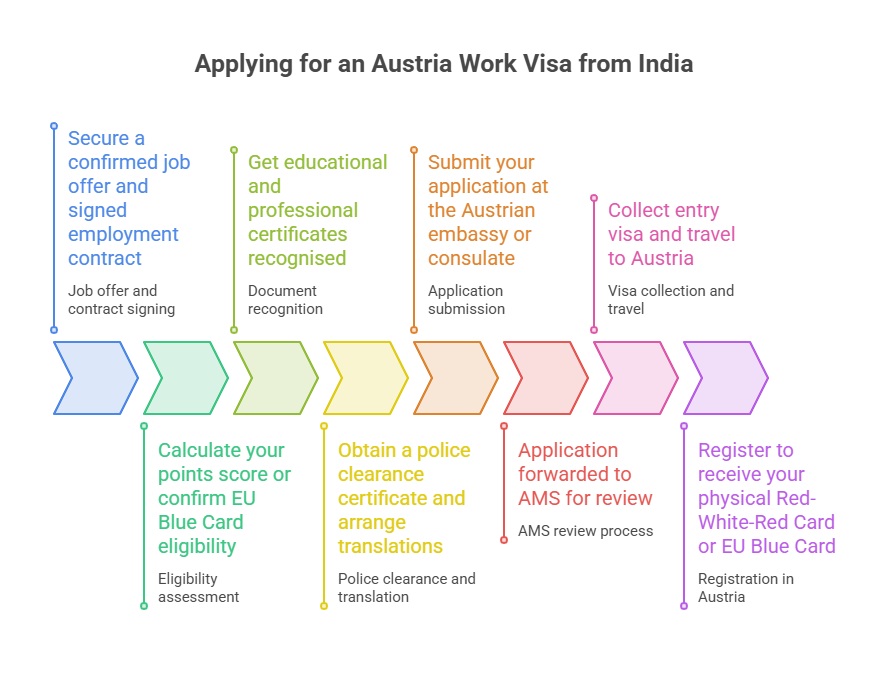
The steps to apply for an Austria work visa for Indians are as follows:
Step 1: Secure a confirmed job offer and signed employment contract from an Austrian employer meeting category-based income threshold.
Step 2: Calculate your points score if applying under a Red-White-Red Card category, or confirm your EU Blue Card salary eligibility.
Step 3: Get your educational and professional certificates recognised where required, and arrange German or English language certification (ÖSD, Goethe-Institut, TELC, or ÖIF for German).
Step 4: Obtain a police clearance certificate and arrange certified translations for any non-German documents.
Step 5: Submit your application at the Austrian embassy or consulate in India with the necessary documents.
Step 6: The application is forwarded to the AMS, which verifies your points score, salary and conducts the labour market test.
Step 7: Once approved, collect your category D entry visa, travel to Austria, and register to receive your physical Red-White-Red Card or EU Blue Card.
Are you looking for step-by-step assistance with Austria immigration? Contact Y-Axis, the world's No. 1 overseas immigration consultancy!
FAQs
What is the Red-White-Red Card and who can apply for it?
The Red-White-Red Card (RWR Card) is Austria's main points-based work and residence permit for skilled non-EU professionals. It covers several categories — Very Highly Qualified Workers, Skilled Workers in Shortage Occupations, Other Key Workers, and Graduates of Austrian Universities — each with different points thresholds and requirements. Most categories require a confirmed job offer from an Austrian employer, though the Very Highly Qualified Workers category allows entry via a Job Seeker Visa if you score 70+ points without a job offer yet secured.
How does Austria's points system work for the Red-White-Red Card?
Points are awarded across five categories: qualifications, work experience, language skills (German and English), age, and — for certain categories — salary in past roles. The minimum required score is typically 55 points for Other Key Workers or 70 points for Very Highly Qualified Workers. German language certificates carry more weight than English given Austria's business language, and applicants can combine both up to a capped maximum. Reaching the threshold guarantees eligibility — there is no quota or lottery.
What is the minimum salary for an Austria work visa in 2026?
The threshold depends on your visa category. The Red-White-Red Card for Other Key Workers requires a minimum of EUR 3,465 gross per month (2026), approximately ₹3.3 lakh. The EU Blue Card requires EUR 55,678 gross per year, approximately ₹53-54 lakh. Skilled Workers in Shortage Occupations have no separate fixed minimum but must be paid according to the applicable sector collective agreement. Super Key Employees must earn EUR 8,316/month.
What is the EU Blue Card and how is it different from the Red-White-Red Card?
The EU Blue Card is a separate residence permit for highly qualified non-EU professionals with a university degree of at least 3 years and a job offer meeting the EUR 55,678/year threshold (2026). Unlike the Red-White-Red Card, it does not use a points system — eligibility is based purely on qualification and salary. It also offers stronger EU mobility rights, making it a cleaner route for senior IT, engineering, and finance professionals who comfortably exceed the salary threshold.
What are Austria's shortage occupations and how do they help Indian applicants?
Austria's Ministry of Social Affairs publishes an annual Skilled Workers Ordinance listing shortage occupations — for 2026, this includes 64 nationwide and 66 regional roles spanning nursing, IT development, engineering, and skilled construction trades. Applicants with a job offer in a shortage-listed occupation benefit from a lower points threshold and are exempt from the AMS labour market test, which otherwise requires employers to prove no equally qualified Austrian or EU candidate is available.
What documents are required for an Austria work visa application?
Required documents typically include a valid passport, a signed employment contract, a police clearance certificate no older than 3 months, degree certificates (with ENIC-NARIC recognition where needed), German or English language certificates (ÖSD, Goethe-Institut, TELC, or ÖIF for German), proof of accommodation in Austria, valid health insurance, and a recent passport photo. Non-German documents generally require certified translation by a sworn translator recognised by Austrian authorities.
How long does the Austria work visa process take?
Processing typically takes 6 to 8 weeks from a complete application, covering both the residence authority's review and the AMS's verification of points, salary, and labour market conditions. If additional documents are requested, this can extend to around 12 weeks. Applicants are advised to begin the process at least 3 months before their intended start date in Austria to account for potential delays.
Can I change employers on an Austria work visa?
The initial Red-White-Red Card is tied to the employer named in your application, so changing jobs during this period generally requires a fresh application. However, after 21 months of qualifying employment, you can upgrade to the RWR Card Plus, which grants unrestricted access to the Austrian labour market — allowing you to change employers, work multiple jobs, or become self-employed without needing a new permit each time.
Can I bring my family to Austria on a work visa?
Yes. Spouses and minor children of Red-White-Red Card and EU Blue Card holders can generally join through family reunification. The household must demonstrate sufficient combined income to support all family members. Once in Austria, spouses typically gain access to the labour market after a short waiting period, allowing them to work without needing to separately qualify under the points system themselves.
Can an Austria work visa lead to permanent residency?
Yes. After 5 years of continuous legal residence — accumulated through the Red-White-Red Card and RWR Card Plus — you become eligible for the Daueraufenthalt-EU, Austria's EU long-term residence permit. Time spent on a Student Visa counts at 50% toward this requirement. Austrian citizenship becomes possible after 10 years of legal residence (or 6 years with exceptional integration), though this requires giving up Indian citizenship, as India does not permit dual nationality.
Tags:
Work in Austria
Austria work visa
migrate to Austria
Austria immigration
eligibility requirements for Austria work visa
Austria Red-White-Red Card for Indians
Austria EU Blue Card
Austria work permit for Indians
Austria points system
Austria PR
Share
Options for you by Y-Axis

Get it on your mobile

Get News alerts

Contact Y-Axis
Latest Article
Popular Post
Trending Article
Posted On October 09 2026
Canada’s Immigration Reset: Why the Next Move May Be About Fit, Not Volume