

Posted on September 28 2026
How Can I Get Permanent Residency in Austria?

By , Editor & Director
Updated October 02 2026
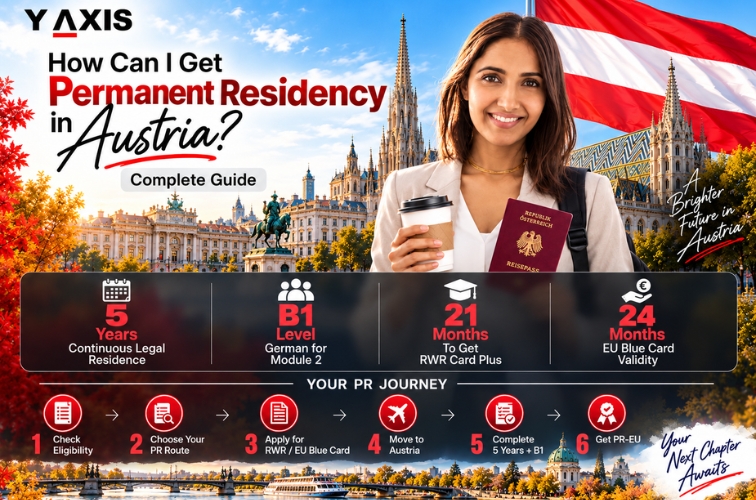
Austria offers several pathways for people who want to live and work there long term. For skilled workers, common options include the Red-White-Red Card, EU Blue Card, family reunification and other residence permits. Eligibility depends on your qualifications, occupation, work experience, job offer, German-language skills, salary and other requirements. For many skilled professionals, the Red-White-Red Card is an important route. It covers highly qualified workers, shortage-occupation workers, other key workers, graduates, self-employed key workers and start-up founders. The EU Blue Card is another option for eligible highly qualified professionals with a suitable Austrian job offer and the required salary. After five years of qualifying lawful residence, eligible third-country nationals may apply for Long-term Resident – EU, subject to requirements including the applicable integration and language requirements.
*Interested in Austria immigration? Let Y-Axis assist you with the steps.
What Are the Main Ways to Get Permanent Residency in Austria?
|
PR / Long-Term Residence Pathway |
Who It May Suit |
|
Red-White-Red Card – Very Highly Qualified Workers |
Highly qualified professionals who meet the required points and qualification criteria. |
|
Red-White-Red Card – Skilled Workers in Shortage Occupations |
Skilled workers with qualifications in an eligible shortage occupation and a suitable Austrian job offer. |
|
Red-White-Red Card – Other Key Workers |
Qualified professionals with an Austrian job offer who meet the salary and points requirements. |
|
Highly qualified professionals with a suitable Austrian job offer and the required salary and qualifications. |
|
|
Red-White-Red Card – Austrian Graduates |
Eligible graduates of Austrian universities and universities of applied sciences. |
|
Self-Employed Key Workers / Start-up Founders |
Entrepreneurs who meet Austria's economic and immigration requirements. |
|
Family Reunification |
Eligible family members of Austrian citizens or qualifying residents. |
|
Long-term Resident – EU |
Third-country nationals with five years of qualifying lawful residence who meet the required conditions. |
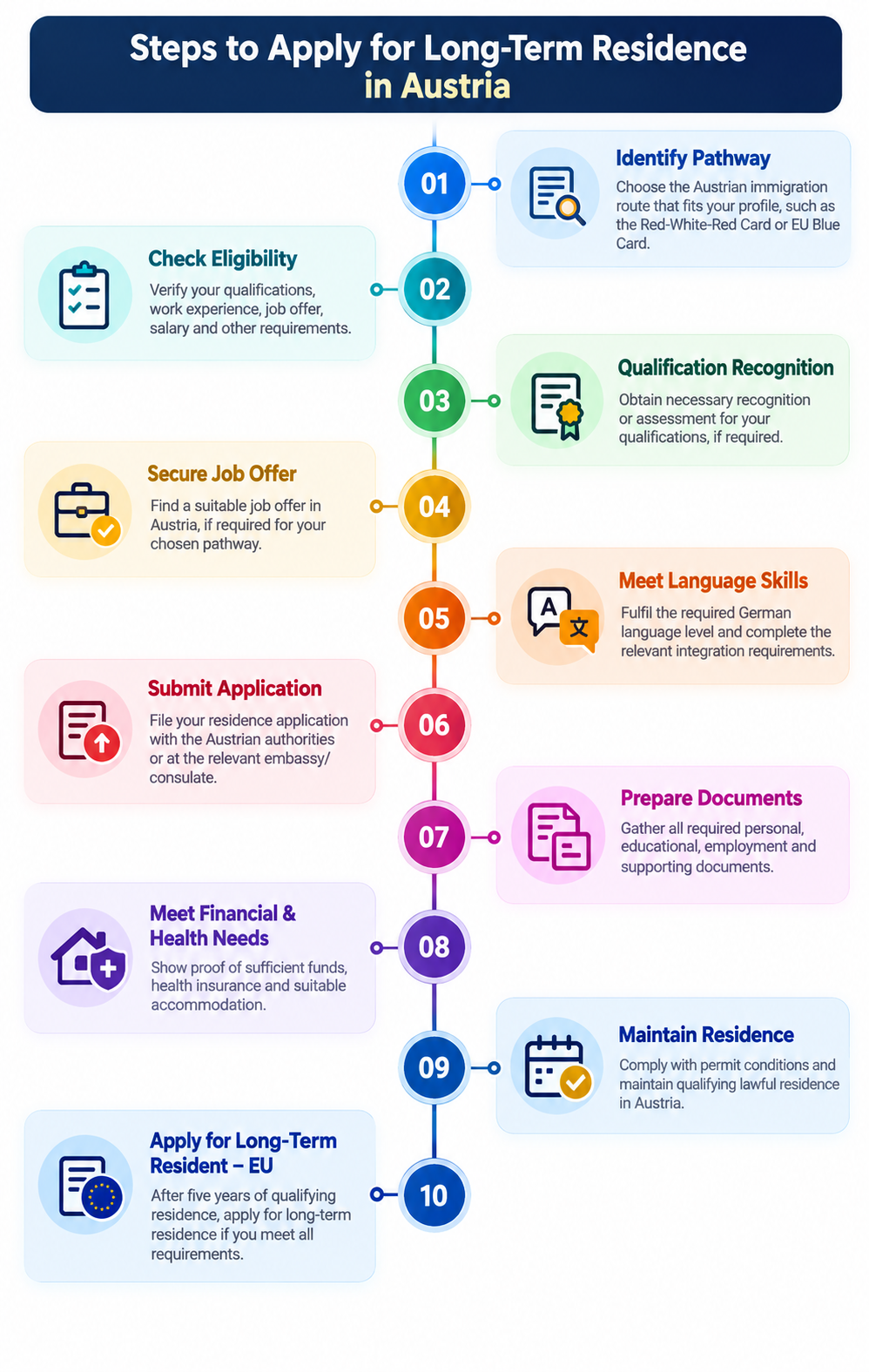
Steps to Apply for Long-Term Residence in Austria
Step 1: Identify the Austrian immigration pathway that suits your profile, such as the Red-White-Red Card or EU Blue Card.
Step 2: Check your eligibility based on your age, qualifications, occupation, work experience, job offer, salary and language skills.
Step 3: Complete any required qualification recognition or professional assessment for your occupation.
Step 4: Secure an eligible Austrian job offer if your chosen pathway requires one.
Step 5: Meet the applicable German-language requirements for your residence pathway and long-term settlement.
Step 6: Submit your residence application to the appropriate Austrian authority or representation.
Step 7: Prepare documents such as your passport, educational certificates, employment records, language certificate, health insurance and proof of sufficient funds.
Step 8: Meet applicable requirements for accommodation, financial resources and health insurance.
Step 9: Maintain your qualifying lawful residence and comply with the conditions of your residence permit.
Step 10: After five years of qualifying residence, apply for Long-term Resident – EU if you meet the applicable requirements.
Important Note for Indian Applicants
Indian citizens are generally treated as third-country nationals under Austrian immigration rules. Requirements vary by residence pathway and occupation. German-language skills can be particularly important for long-term settlement, even when the initial work-based residence pathway has different language requirements.
*Want to apply for Austria work visa? Let Y-Axis assist you with the process.
Austria PR Requirements
- You usually need to live legally in Austria for 5 years before applying for long-term permanent residence.
- You must have a valid residence permit during the required period.
- You need to show that you have enough money to support yourself and your family.
- You must have health insurance in Austria.
- You may need to show that you have suitable accommodation.
- You need to complete Module 2 of the Integration Agreement, which includes German at B1 level and basic knowledge about life and laws in Austria.
- Skilled workers can first move to Austria through options such as the Red-White-Red Card or EU Blue Card.
- Some Red-White-Red Card holders can later apply for the Red-White-Red Card Plus after meeting the required work conditions.
- You must meet Austria's health, security and other legal requirements.
- You need to provide documents such as your passport, residence documents, income proof, insurance and language certificate, where required.
- After meeting the requirements, you can apply for Long-term Resident – EU, which allows you to live and work in Austria on a long-term basis.
*Read about...
Austria PR Cost and Processing Time
The cost of Austrian permanent or long-term residence depends on the type of residence permit you apply for. The Long-term Resident – EU application fee is €275. You may also have extra costs for document translation, language tests, document certification and other requirements. Processing time depends on your application and the local immigration authority. Applications can generally take up to six months to process, although the actual time may be shorter or longer.
*Looking for help with overseas immigration? Contact Y-Axis, worlds’s number one immigration consultancy for guidance and visa assistance.
FAQs
How can I get permanent residency in Austria?
To get long-term permanent residence in Austria, you usually need to live legally in the country for five years. You must also have enough money to support yourself, health insurance, suitable accommodation and meet other residence conditions. You may need to complete the required German language and integration requirements before applying for Long-term Resident – EU status.
How many years do I need to live in Austria to get PR?
In most cases, you need to complete five years of legal and qualifying residence in Austria before applying for Long-term Resident – EU status. During this period, you must follow the conditions of your residence permit and maintain the required financial, insurance and accommodation conditions. You must also meet the required language and integration rules when applying for long-term residence.
Is German language required for Austria PR?
Yes, German language skills are important for long-term residence in Austria. Applicants generally need to complete Module 2 of the Integration Agreement, which includes German at B1 level. You may need to provide an approved language certificate or other accepted proof. Some initial work permits may have different language requirements, so the rules depend on your residence pathway.
What are the main ways to move to Austria?
Skilled workers can move to Austria through several options, including the Red-White-Red Card and EU Blue Card. Other options include family reunification, Austrian university graduate pathways, self-employment and start-up routes. Your best option depends on your education, job, work experience, salary, German language skills and personal situation. You should check the requirements before choosing a residence pathway.
Can Indian citizens apply for Austria PR?
Yes, Indian citizens can apply for Austrian long-term residence if they meet the requirements. Indian applicants usually need to first obtain a suitable Austrian residence permit, work and live legally in Austria for the required period, and meet financial, insurance, accommodation and language requirements. After meeting the conditions, they may apply for Long-term Resident – EU status.
How much does Austria PR cost?
The cost depends on the residence permit you are applying for. The application fee for Long-term Resident – EU is €275. You may also have other expenses for language tests, document translation, document certification, health checks and other required services. The total cost can therefore be higher than the basic application fee, depending on your personal situation.
Can I work in Austria after getting permanent residence?
Yes. Long-term Resident – EU status provides long-term settlement rights and free access to the Austrian labour market. This means you can generally work in Austria without being tied to the same employer or job conditions as some temporary residence permits. However, you must continue to follow Austrian laws and the conditions that apply to your long-term residence status.
Can my family join me in Austria?
Yes, eligible family members may be able to join you through family reunification. The exact rules depend on your residence permit and family relationship. Spouses, registered partners and children may qualify in certain situations. Applicants may need to show suitable accommodation, sufficient income, health insurance and other required conditions. Family members may also have separate language or residence requirements.
How long does Austria PR processing take?
Processing time can vary depending on the type of application, your documents and the responsible immigration authority. Applications for residence titles can generally take up to six months. The actual time may be shorter or longer. Providing complete and correct documents can help avoid delays. Immigration authorities may ask for additional documents or information during the application process.
What documents are needed for Austria PR?
Common documents can include your valid passport, current residence permit, proof of income, health insurance, accommodation documents and German language or integration certificates. You may also need employment records and other supporting documents. The exact document list depends on your residence pathway and personal situation. Documents from outside Austria may also need translation or certification before submission.
Tags:
How to Get Austria PR
Austria Permanent Residency
Austria PR Process
Austria Immigration
Austria Skilled Migration
Austria Red-White-Red Card
Austria PR Eligibility
Austria PR Requirements
Austria Immigration for Skilled Workers
Austria PR
Share
Options for you by Y-Axis

Get it on your mobile

Get News alerts

Contact Y-Axis
Latest Article
Popular Post
Trending Article
Posted On October 01 2026
The Borderless Indian