


Editors Pick
Latest Article
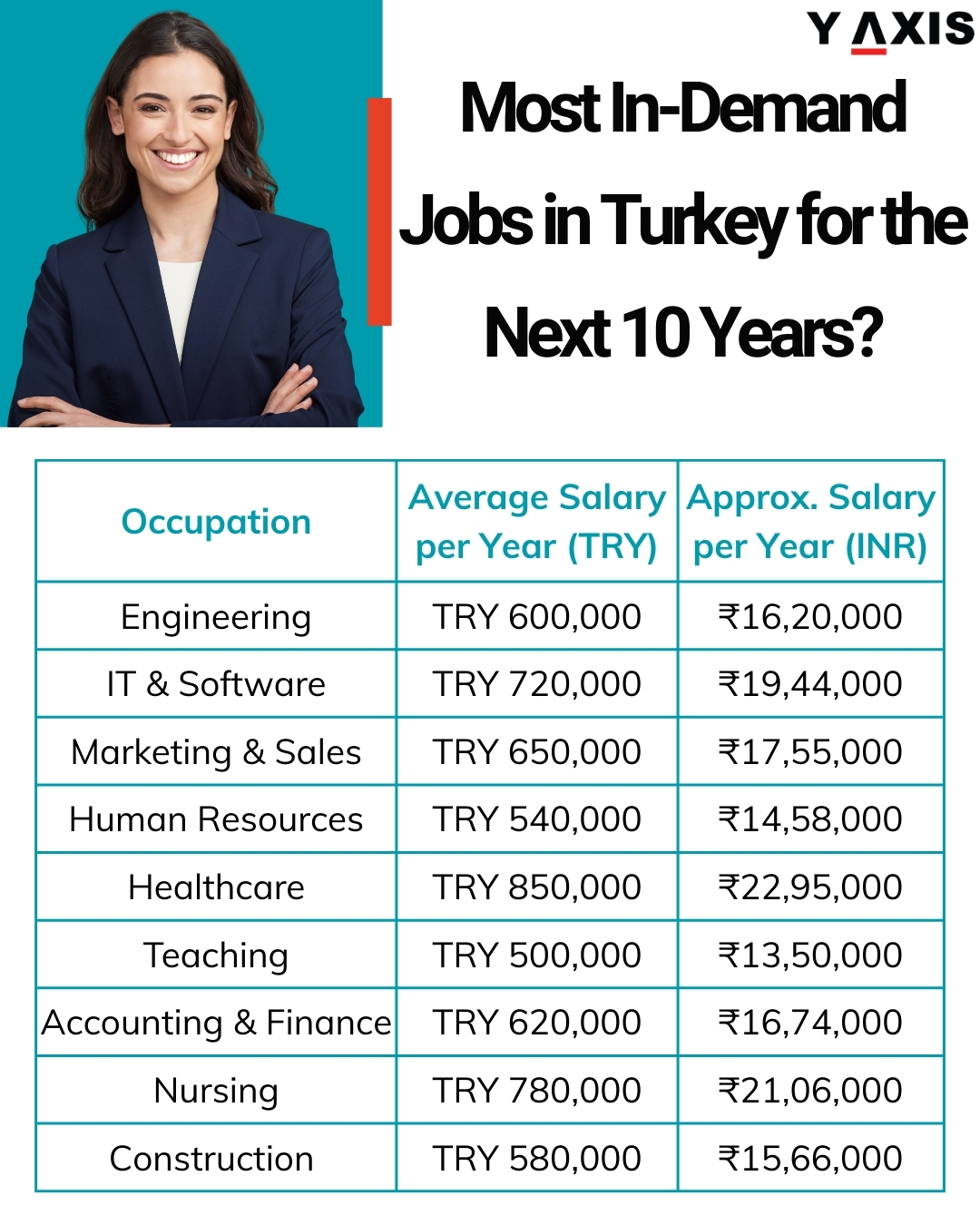
What Are the Most In-Demand Jobs in Turkey for the Next 10 Years?
What Are the Most In-Demand Jobs in Turkey for the Next 10 Years?
Turkey’s job market is expected to grow strongly over the next 10 years due to rapid digital development and infrastructure expansion. The highest demand will be in technology, renewable energy, healthcare, and specialized engineering sectors. As businesses adopt automation and digital systems, roles such as AI engineers, data scientists, cybersecurity specialists, and automation engineers will become more important. At the same time, growth in solar and wind energy projects will increase demand for renewable energy technicians and project managers. Healthcare, especially medical tourism, will continue to create opportunities for doctors and medical professionals. Overall, skilled professionals with technical and specialized knowledge will have better job opportunities in Turkey in the coming decade.
*Want to work in Turkey? Get expert guidance from Y-Axis
List of Top Job Opportunities in Turkey for the Next 10 Years
Turkey’s job market is expected to grow steadily over the next 10 years due to strong economic development, digital transformation, and expansion in key industries. As the country invests more in technology, renewable energy, healthcare, tourism, and manufacturing, the demand for skilled professionals will continue to increase.
Sectors such as IT, engineering, medical tourism, green energy, and export-based industries will offer better job opportunities for both local and foreign professionals. Below is a sector-wise list of the top job opportunities in Turkey for the coming decade:
|
Sector |
In-Demand Roles |
Key Focus Areas |
|
IT and Automation |
AI Engineers, Machine Learning Developers, Cloud Computing Experts, Data Scientists, Cybersecurity Specialists |
Automation, Digitalization, IT Infrastructure, Data Security |
|
Engineering & Manufacturing |
Automation & Robotics Engineers, Production Engineers, Chemical Engineers |
Defense, Aerospace, Automotive Manufacturing |
|
Healthcare & Nursing |
Aesthetic Doctors, Dentists, Ophthalmologists, Healthcare Technicians |
Medical Tourism, Specialized Treatments |
|
Renewable Energy & Sustainability |
Renewable Energy Technicians, Project Managers |
Green Energy Projects, Sustainability Initiatives |
|
Tourism & Hospitality |
Hotel Managers, Tourism Coordinators, Multilingual Staff |
Growing International Tourism and Hospitality Services |
|
Logistics & Finance |
Export Managers, Logistics Coordinators, Financial Analysts |
Export-Oriented Manufacturing, Trade & Financial Planning |
*Read more.....
Top In-Demand Skills for Turkey for Next 10 Years
Turkey’s job market in the next 10 years will focus strongly on skills rather than just degrees. Employers will look for professionals who have technical knowledge, practical abilities, and strong communication skills. Developing the right skills will improve job opportunities across technology, engineering, healthcare, energy, and business sectors.
|
Category |
Key Skills |
|
IT & Digital |
AI & Machine Learning, Cloud Computing, Cybersecurity, Data Analytics, Software Development, DevOps |
|
Engineering & Manufacturing |
Automation & Robotics, CAD Design, Industrial Engineering, Production Planning, Project Management |
|
Renewable Energy & Sustainability |
Solar & Wind Energy Systems, Energy Storage, Grid Integration, Sustainability Management |
|
Healthcare & Medical Tourism |
Clinical Skills, Aesthetic & Dental Expertise, Diagnostic Skills, Patient Care, Medical Technology |
|
Business & Finance |
Financial Analysis, Export-Import Knowledge, ERP Systems, Risk Management, Compliance |
|
Soft & Workplace Skills |
English Communication, Basic Turkish Language, Teamwork, Problem Solving, Adaptability |
|
Operations & Logistics |
Supply Chain Management, Logistics Coordination, Warehouse Automation, Health & Safety Compliance |
Turkey’s Job Outlook for the Next 10 Years
Turkey’s job market in the next 10 years will grow because of strong government plans, new investments, and support for important industries. The government is focusing on technology, energy, manufacturing, exports, and infrastructure to create more jobs.
- National Technology Initiative (Milli Teknoloji Hamlesi) supports the growth of local technology and innovation. This will create more jobs in AI, software, robotics, and advanced manufacturing.
- Digital Türkiye Strategy aims to improve digital systems in companies and government services. This will increase demand for IT professionals, cloud experts, and data specialists.
- Government support for renewable energy, like solar and wind power, will create more jobs for engineers, technicians, and project managers in green energy projects.
- Employment incentive programs give financial support and tax benefits to companies that hire new workers. This helps increase hiring in sectors like manufacturing, tourism, and services.
- Support for small businesses and startups through grants and funding programs will help new companies grow and create more job opportunities.
- Large development projects, including the Southeastern Anatolia Project (GAP), will create jobs in construction, agriculture, transportation, and public services.
- Export-focused economic policies and trade agreements will support industries like automotive, textiles, electronics, and defense, leading to more jobs in factories and logistics.
- Skilled and English-speaking professionals will continue to have good opportunities, especially in multinational companies and export-based businesses.
Overall, Turkey’s government policies and investments are expected to support steady job growth in the coming decade, especially for skilled and trained workers.
*Read more.....
Salary Trends in Turkey Over the Next Decade
- Salaries are expected to increase gradually in high-demand sectors such as IT, artificial intelligence, renewable energy, healthcare, and advanced engineering. Skilled professionals in these fields are likely to earn higher pay compared to other industries.
- Technology and AI-related jobs are expected to see the fastest salary growth, especially in major business cities like Istanbul, Ankara, and Izmir, where many tech companies and startups operate.
- Renewable energy and large engineering projects (solar, wind, infrastructure, defense, automotive) may offer competitive salaries, along with performance-based bonuses for project completion.
- Healthcare and medical tourism roles, such as specialized doctors, dentists, and surgeons, are likely to see steady salary growth due to strong international demand.
- Manufacturing and export-driven industries may offer stable salary growth, particularly for automation engineers, production managers, and logistics specialists.
- Major cities like Istanbul and Ankara usually offer higher salaries compared to smaller cities, but the cost of living, especially housing, should be considered when comparing pay.
- Foreign professionals with technical skills and English language ability may receive better salary packages, especially in multinational companies and export-focused firms.
Companies That Actively Hire Foreign Professionals in Turkey
Many well-known companies in Turkey hire foreign professionals, especially in sectors that are growing fast or need specialized skills. Employers usually look for candidates with technical knowledge, international experience, and strong English communication skills. Below is a table showing key sectors and major companies that actively recruit foreign talent in Turkey:
|
Sector |
Major Companies Hiring Foreign Professionals |
|
Tech & IT |
Turkcell, Türk Telekom, ASELSAN |
|
Defense & Manufacturing |
Turkish Aerospace Industries, Ford Otosan, TOGG |
|
Renewable Energy & Construction |
Enka İnşaat, Zorlu Energy, Limak Holding |
|
Finance & Banking |
Türkiye İş Bankası, Garanti BBVA, Akbank |
|
Healthcare & Pharmaceuticals |
Acıbadem Healthcare Group, Anadolu Medical Center, International pharma companies operating in Turkey |
|
Hospitality & Tourism |
Rixos Hotels, Divan Hotels, TUI Türkiye |
|
Logistics & E-commerce |
Turkish Cargo, Aras Kargo, Hepsiburada |
These companies operate in high-growth sectors such as technology, defense, renewable energy, healthcare, manufacturing, and tourism. Skilled foreign professionals, especially those with technical expertise and English language skills, may find good opportunities in these industries.
Building a Successful Career in Turkey
To increase your chances of getting a job in Turkey, follow these simple and practical steps:
- Prepare a professional CV and cover letter that match Turkish job market standards. Keep your CV clear, simple, and focused on skills and experience. Highlight technical expertise and international work experience if you have it.
- Learn basic Turkish language skills. While many multinational companies use English, knowing Turkish will improve your job opportunities and help in daily communication.
- Earn relevant certifications in your field. For example, cloud certifications (AWS, Azure), data analytics, cybersecurity, project management (PMP), renewable energy training, or medical licenses can improve your chances.
- Build your professional network on LinkedIn and connect with Turkish recruiters and hiring managers. Attend job fairs, industry events, and apply to companies that are open to hiring foreign professionals.
- Be prepared for online interviews and technical tests. Many companies conduct remote interviews, skill assessments, or practical evaluations before hiring.
- Understand Turkey’s work visa process. Most foreign professionals need an employer-sponsored work permit. Make sure your employer is ready to support your work permit application.
- Research salary expectations and cost of living in cities like Istanbul, Ankara, and Izmir before accepting an offer.
What to Expect in Turkey’s Job MarketTurkey’s job market over the next decade will be driven by technology, manufacturing, renewable energy, and export-led growth. Digital transformation and government-backed industrial development will play a major role in creating new opportunities. Professionals in IT, AI, cybersecurity, engineering, renewable energy, healthcare (especially medical tourism), logistics, and advanced manufacturing will find the best career prospects. Sectors connected to exports, infrastructure, and automation are expected to remain strong. Foreign professionals with strong technical skills, English communication ability, industry certifications, and practical experience will be more competitive. Knowing basic Turkish and understanding the local work permit process will further improve job opportunities in Turkey.
FAQs
What will be the most in-demand jobs in Turkey over the next 10 years?
Over the next 10 years, Turkey’s job market is expected to focus strongly on technology and specialized skills. Jobs such as AI engineers, data scientists, cybersecurity specialists, cloud computing experts, and automation engineers will see high demand due to digital growth. Renewable energy professionals will also be needed as Turkey expands solar and wind power projects. In addition, healthcare professionals like doctors, dentists, and medical technicians will remain important because of medical tourism growth. Skilled engineers in defense, aerospace, and manufacturing will also have strong long-term opportunities.
Which industries will grow the most in Turkey in the next 10 years?
In the coming decade, technology is expected to be the fastest-growing industry in Turkey. The country is investing in artificial intelligence, software development, and digital infrastructure. Renewable energy will also expand as Turkey increases solar and wind power production. Advanced manufacturing, including automotive and defense industries, will continue to grow due to export demand. Healthcare will expand because of medical tourism and specialized treatments. Logistics and e-commerce are also expected to grow as Turkey strengthens its trade connections with Europe, Asia, and the Middle East.
How will digital transformation impact jobs in Turkey over the next decade?
Digital transformation will significantly change Turkey’s job market over the next 10 years. Many companies are adopting automation, cloud systems, and data-driven decision-making. This will increase demand for IT professionals such as software developers, cybersecurity experts, AI specialists, and data analysts. Businesses will also need cloud engineers and DevOps professionals to manage digital systems. Traditional roles may require digital skills as well. Employees who understand technology and can work with digital tools will have better job security and higher salary potential in the future.
Will artificial intelligence create more job opportunities in Turkey in the future?
Yes, artificial intelligence is expected to create many new job opportunities in Turkey over the next decade. As companies use AI for automation, data analysis, customer service, and manufacturing, they will need skilled professionals to design, manage, and maintain these systems. Roles such as machine learning engineers, AI developers, robotics specialists, and data scientists will become more common. AI will also improve productivity in industries like healthcare, finance, and logistics. Professionals who learn AI-related skills will have strong career growth opportunities.
Is renewable energy a strong career option in Turkey for the next decade?
Renewable energy is expected to be a strong and stable career option in Turkey over the next 10 years. The government is investing heavily in solar and wind energy projects to reduce energy imports and support sustainability goals. This will increase demand for renewable energy engineers, technicians, project managers, and maintenance specialists. Energy storage and grid management roles will also grow. As global focus on clean energy increases, professionals with green energy skills and technical knowledge will have good long-term job opportunities in Turkey.
How will automation affect the job market in Turkey by 2035?
By 2035, automation is expected to play a major role in Turkey’s industries, especially manufacturing and logistics. Companies will use robotics and automated systems to improve productivity and reduce costs. This will increase demand for automation engineers, robotics specialists, and software developers. However, some low-skilled manual jobs may decrease due to machines replacing repetitive tasks. Workers who upgrade their skills in digital systems, robotics, and programming will benefit the most. Overall, automation will create more skilled technical jobs in the long term.
Will healthcare jobs continue to grow in Turkey over the next 10 years?
Yes, healthcare jobs are expected to grow steadily in Turkey over the next decade. The country is a popular destination for medical tourism, especially for dental care, cosmetic surgery, and specialized treatments. This increases demand for experienced doctors, dentists, surgeons, nurses, and medical technicians. Hospitals are also adopting advanced medical technology, which requires trained professionals. As the population grows and healthcare services improve, skilled medical professionals will continue to have stable and promising career opportunities in Turkey.
Which engineering careers have strong future prospects in Turkey?
Over the next 10 years, several engineering careers are expected to have strong growth in Turkey. Aerospace and defense engineering will grow due to government investment in national technology and manufacturing. Automotive engineering will remain important because Turkey is a major vehicle producer and exporter. Robotics and automation engineering will increase as factories adopt smart systems. Chemical and production engineers will also be needed in manufacturing and energy sectors. Engineers with digital skills and experience in modern technologies will have better career stability and long-term opportunities.
Are IT salaries expected to increase in Turkey over the next 10 years?
Yes, IT salaries are expected to increase steadily over the next decade. As companies continue digital transformation, the demand for AI engineers, cybersecurity experts, cloud professionals, and software developers will remain high. Skilled IT professionals are already in short supply, which pushes salaries higher. Technology startups and multinational companies in major cities will offer competitive pay packages. Professionals who upgrade their skills regularly and gain international certifications may earn even better salaries compared to other sectors in Turkey.
Which cities will offer the best job growth in Turkey in the future?
In the next 10 years, Istanbul, Ankara, and Izmir are expected to offer the best job growth in Turkey. Istanbul is the largest business and financial center with strong opportunities in technology, finance, and trade. Ankara, as the capital city, has many government, defense, and technology projects. Izmir is growing in manufacturing, renewable energy, and export industries. These cities attract investments, startups, and multinational companies. Professionals looking for high-paying and skilled jobs will find better opportunities in these major urban centers.
Will foreign professionals have better job opportunities in Turkey in the next decade?
Yes, foreign professionals with specialized skills are expected to have good opportunities in Turkey over the next 10 years. Multinational companies and export-focused businesses often look for candidates with international experience and strong English communication skills. Fields such as IT, engineering, renewable energy, healthcare, and finance are especially open to skilled foreign workers. However, having basic Turkish language skills can improve job chances. Professionals with technical expertise and certifications will be more competitive in the Turkish job market.
What future skills will be most valuable in Turkey’s job market?
In the next decade, skills related to technology and innovation will be highly valuable in Turkey. AI and machine learning, cybersecurity, cloud computing, and data analytics will be in strong demand. Automation and robotics knowledge will also be important in manufacturing industries. Renewable energy system expertise will grow as green projects expand. Project management and financial analysis skills will remain useful across industries. In addition, communication skills, adaptability, and basic Turkish language ability will help professionals succeed in the evolving job market.
How important will cybersecurity be in Turkey’s future job market?
Cybersecurity will be extremely important in Turkey’s job market over the next 10 years. As businesses and government services move to digital platforms, protecting data and online systems will become a top priority. Cyber threats and data breaches are increasing worldwide, and Turkey is no exception. Companies will need skilled cybersecurity professionals to protect networks, financial systems, and customer information. Roles such as cybersecurity analysts, ethical hackers, and security engineers will grow steadily. Professionals with strong technical knowledge in data protection will have stable career opportunities.
Will green jobs increase in Turkey over the next 10 years?
Yes, green jobs are expected to increase significantly in Turkey during the next decade. The country is investing in renewable energy projects like solar and wind power to reduce carbon emissions and energy imports. Sustainability goals and environmental regulations will create demand for renewable energy engineers, environmental consultants, and sustainability managers. Companies will also focus on energy efficiency and waste management. As global climate awareness grows, professionals with green skills and environmental expertise will have better job opportunities and long-term career stability.
How will government initiatives influence employment growth in Turkey?
Government initiatives will play a major role in employment growth over the next 10 years. Programs supporting digital transformation, renewable energy expansion, export growth, and infrastructure development will create new jobs across many industries. Technology-focused policies will increase demand for IT professionals and engineers. Investments in transportation, construction, and manufacturing projects will generate employment in both skilled and semi-skilled roles. Support for startups and small businesses will also create new opportunities. Overall, government plans are expected to support steady and long-term job growth.
Is logistics a future-proof career in Turkey?
Yes, logistics is expected to remain a strong and stable career option in Turkey over the next decade. As exports increase and e-commerce continues to grow, companies will need efficient supply chain systems. This will increase demand for logistics managers, warehouse supervisors, supply chain analysts, and transportation coordinators. Turkey’s strategic location between Europe and Asia also strengthens its role in international trade. Professionals with knowledge of global trade systems and digital logistics tools will have good long-term career opportunities.
Will tourism continue to create jobs in Turkey in the future?
Yes, tourism is expected to continue creating jobs in Turkey over the next 10 years. Turkey remains a popular destination for international travelers due to its history, culture, and natural attractions. Growth in tourism will increase demand for hotel managers, travel coordinators, tour guides, and multilingual staff. Medical tourism will also support healthcare-related hospitality roles. As tourism services become more digital, professionals with language skills and customer service experience will have better career prospects in this growing sector.
How will advanced manufacturing shape Turkey’s job market by 2035?
By 2035, advanced manufacturing will strongly influence Turkey’s job market. Industries will use automation, robotics, and smart factory technologies to improve productivity and quality. This will increase demand for skilled engineers, robotics technicians, automation specialists, and software professionals. Traditional factory roles may change, requiring workers to learn digital and technical skills. Advanced manufacturing will also support export growth and economic development. Professionals who adapt to new technologies and gain technical training will benefit from long-term career opportunities.
What are the long-term career prospects in Turkey’s defense and aerospace sector?
Turkey’s defense and aerospace sector is expected to grow steadily over the next decade. Government investment in national technology and manufacturing projects will create demand for aerospace engineers, mechanical engineers, electronics specialists, and research professionals. Export of defense products may also increase job opportunities. These sectors require highly skilled and technically trained workers. Professionals with expertise in advanced engineering, robotics, and systems design will have strong long-term career prospects in this field.
Will salaries in renewable energy increase in Turkey over the next decade?
Yes, salaries in renewable energy are expected to increase gradually over the next 10 years. As Turkey expands solar and wind energy projects, the demand for skilled engineers and technicians will rise. Experienced professionals with project management and technical expertise may receive competitive salary packages. Companies may also offer performance-based incentives for successful project completion. As the green energy sector grows and becomes more advanced, qualified professionals will likely see better income opportunities compared to traditional energy roles.
How can professionals prepare for Turkey’s future job market?
Professionals can prepare for Turkey’s future job market by developing strong technical skills and staying updated with industry trends. Learning AI, cybersecurity, renewable energy systems, automation, or data analytics can improve career opportunities. Gaining internationally recognized certifications will also increase employability. Improving English communication skills and learning basic Turkish can help in workplace integration. Building a professional network through LinkedIn and industry events is also important. Continuous learning and adaptability will be key for long-term career success.
Will small businesses and startups create more jobs in Turkey in the future?
Yes, small businesses and startups are expected to create more jobs in Turkey over the next decade. Government support programs, funding opportunities, and innovation initiatives will help new companies grow. Many startups focus on technology, e-commerce, fintech, and renewable energy. As these companies expand, they will hire skilled professionals in IT, marketing, finance, and operations. The startup ecosystem will encourage innovation and entrepreneurship, creating diverse employment opportunities for young and skilled professionals.
Is Turkey’s job market stable for the next 10 years?
Turkey’s job market is expected to remain stable and gradually grow over the next decade. Sectors linked to technology, exports, renewable energy, infrastructure, and healthcare are projected to expand. While economic changes may affect certain industries, skilled professionals in high-demand fields will continue to find opportunities. Government support and international trade partnerships will also strengthen employment growth. Professionals who continuously upgrade their skills will have better job security in the evolving market.
What is the overall job outlook for Turkey over the next decade?
The overall job outlook for Turkey over the next 10 years is positive. Growth in technology, engineering, renewable energy, healthcare, logistics, tourism, and export-based industries will create new opportunities. Digital transformation and automation will increase demand for skilled professionals with technical expertise. Major cities like Istanbul, Ankara, and Izmir will remain strong employment hubs. Professionals who adapt to new technologies and improve their skills will have promising long-term career prospects in Turkey.
Posted on February 17 2026

How can I migrate to the UK as a Financial Analyst?
How can I migrate to the UK as a Financial Analyst?
You can migrate to the UK as a financial analyst by demonstrating high educational qualifications, skills, and work experience through suitable immigration pathways. Financial analysts must secure a job offer with a Certificate of Sponsorship (CoS) from a licensed UK employer to migrate under the UK Skilled Worker Visa. Other UK immigration pathways for financial analysts include the Global Talent Visa and the High Potential Individual Visa, which require a high level of education and a recognised contribution to the global financial sector. Additionally, financial analysts should engage in extensive networking, hold relevant qualifications like AACA or CFA, and have relevant work experience before applying for a suitable work visa pathway to relocate to the UK.
*Want to apply for a UK work visa? Let Y-Axis guide you with the steps.
Immigration Pathways in the UK for a Financial Analyst
Financial analysts can migrate to the UK through immigration pathways such as the UK Skilled Worker Visa, Global Talent Visa, and High Potential Individual Visa. You will generally need a valid job offer from a licensed sponsor, along with a Certificate of Sponsorship (CoS), to apply for a UK Skilled Worker visa. UK visa applicants must also meet the minimum salary threshold of £41,700 or the going rate for that occupation, as well as English language requirements. The UK HPI visa is a great choice for recent graduates from universities on the UK’s Global Universities List, while a Global Talent Visa is ideal for individuals with an endorsement in a qualifying field (IT, Fintech, digital technology, etc)
The immigration pathways in the UK for financial analysts are as follows:
UK Skilled Worker Visa
The UK Skilled Worker Visa is one of the most common immigration pathways for financial analysts seeking to migrate to the UK. To qualify, you must have a job offer from a licensed UK employer. You can apply for job roles such as finance and Investment Analysts and Advisers (SOC 2422), provided they meet the minimum salary threshold of £41,700 per annum, and the English language requirements.
How it works: You need to secure a valid job offer, meet the minimum salary requirement, and have the required language proficiency, along with a Certificate of Sponsorship (CoS) from your UK employer, which is mandatory to apply for a Skilled Worker Visa.
Benefits: Financial analysts can find full-time employment at UK-based finance firms, giving them direct access to the UK job market. A Skilled Worker Visa permits dependents to accompany you to the country.
Pathway to PR: After working for 5 years in the UK on a Skilled Worker Visa, financial analysts can apply for Indefinite Leave to Remain (ILR), which allows them to work in the country without sponsorship, provided they meet the required criteria.
*Want to apply for a UK Skilled Worker Visa? Let the Y-Axis guide you with the process.
Global Talent Visa
The Global Talent Visa is a selective immigration pathway in the UK for highly skilled and accomplished professionals with internationally recognised qualifications. You must submit evidence of leadership in any of the qualifying fields, such as research, academia, and digital technology. It is a suitable pathway for senior financial analysts with a record of significant research and contributions in fintech and other related fields. You do not need to secure a job offer to migrate to the UK via the Global Talent Visa pathway as a financial analyst.
How it works: You need to secure an endorsement to verify your research and innovative contributions as a financial analyst, issued based on your achievements, leadership, or potential impact. Upon receiving a valid endorsement, you can independently apply for a Global Talent Visa, even without an employer sponsorship.
Benefits: Financial analysts do not require a job offer/employer sponsorship and can work for multiple organizations, switch roles, consult, or start their own venture through a Global Talent Visa pathway.
Pathway to PR: Global Talent Visa permits you to apply for ILR within 3 to 5 years and is the fastest route to PR.
*Want to apply for a Global Talent Visa? Let Y-Axis assist you with the process.
High Potential Individual (HPI) Visa
The UK High Potential Individual (HPI) Visa is an employer-independent pathway for early- to mid-career foreign financial analysts wanting to migrate to the UK. Financial analysts who graduated from top global universities in the last 5 years with a Bachelor's, Master's, or PhD degree and have a minimum English language proficiency score of B2 can apply for the UK HPI visa. The HPI Visa allows financial analysts to target sectors such as investment banking, consulting, fintech, or corporate finance through direct networking with employers.
How it works: Newly graduated financial analysts with a degree awarded within the last 5 years from a university listed on the UK’s Global Universities List, who meet the English proficiency test (B2 level), have the required funds, and get their qualifications verified through Ecctis, can apply for the HPI visa.
Benefits: You can gain UK work experience for up to 2 to 3 years as a financial analyst without requiring an initial job offer. HPI Visa has no occupation code restrictions and offers dependent benefits to the primary visa holder.
Pathway to PR: Financial analysts can switch to the Skilled Worker Visa or the Global Talent Visa while working in the UK to be eligible for an Indefinite Leave to Remain.
*Want to apply for a UK HPI Visa? Let Y-Axis assist you with the steps.
Eligibility Criteria to Migrate to the UK as a Financial Analyst
The eligibility requirements to migrate to the UK as a financial analyst depend on the type of visa you are applying for. However, here is a general list of eligibility criteria that you require to move to the UK as a financial analyst:
- Relevant educational qualifications (A Bachelor's, Master's, or PhD in economics, mathematics, business analytics, accounting, etc.)
- A valid job offer from a licensed UK employer (required for the UK Skilled workers visa)
- A Certificate of Sponsorship (CoS) issued by your employer in the UK
- Meet the minimum salary threshold in the UK (£41,700 per year) or the going rate for your occupation.
- Meet the English language proficiency requirements (CEFR B2 for HPI and B1 for UK Skilled worker visa)
- Have sufficient funds
- Maintain a clear criminal record.
- Complete the visa application fees and Immigration Health Surcharge (IHS)
Also, read…
How can I migrate to the UK as an Architect?
How to Migrate to the UK as a Financial Analyst?
Migrating to the UK as a financial analyst requires you to apply for a suitable immigration route, such as the UK Skilled Worker Visa, Global Talent Visa, or High Potential Individual Visa.
The steps to migrate to the UK as a financial analyst are as follows:
Step 1: Check if you are eligible for the different UK immigration pathways for financial analysts.
Step 2: Select the most suitable path to migrate to the UK as a financial analyst based on profile, including qualifications, education, a job offer, and skills.
Step 3: Secure a valid job offer from a registered UK employer if applying for a UK Skilled Worker Visa.
Step 4: Obtain a Certificate of Sponsorship (CoS) (only necessary for the UK Skilled Worker Visa).
Step 5: Apply for an endorsement in any of the qualifying fields (if applying for the UK Global Talent Visa)
Step 6: Arrange the required documents for the UK work visa (passport, proof of funds, proof of English language proficiency, CoS endorsement, etc.).
Step 7: Apply for a UK work visa with the necessary documents and pay the required fees.
Step 8: Schedule and attend the biometrics appointment
Step 9: Await a decision on your work visa
Step 10: Upon work visa approval, fly to the UK to work as a financial analyst.
*Are you looking for step-by-step assistance with UK immigration? Contact Y-Axis, the world’s No. 1 overseas immigration consultancy, for end-to-end assistance!
FAQs
Are financial analysts in demand in the UK?
Yes, financial analysts are in high demand in the UK, with rapid growth across sectors such as banking, insurance, and investment. As the UK's Fintech, legal finance, and corporate expansion grow, the country needs a large number of foreign financial analysts to sustain its workforce. The government offers competitive salaries, public services, and dependent immigration to financial analysts migrating to the UK.
How can I migrate to the UK as a financial analyst?
You can migrate to the UK through immigration pathways such as the UK Skilled Worker Visa, Global Talent Visa, and High Potential Individual Visa, which require a high educational background in finance and relevant work experience. Foreign financial analysts can target high-paying roles in financial hubs across the country, provided they meet the qualification requirements (CFA or ACCA standards).
Can I migrate to the UK as a financial analyst without a job offer?
Yes, it is possible to migrate to the UK as a financial analyst without a job offer through immigration pathways such as the Global Talent Visa and the High Potential Individual (HPI) Visa. Financial analysts must have a high degree and a research contribution to qualify for a Global Talent Visa, while freshly graduated financial analysts from top universities listed on the Global University List are eligible for a High Potential Individual Visa.
What is the average salary of a financial analyst working in the UK?
The average salary of a financial analyst working in the UK is around £40,000–£57,500 annually. The salary for entry-level financial analysts ranges from £23,000 to £30,000, while senior analysts can expect a salary exceeding £70,000. The overall salary of foreign financial analysts in the UK varies depending on work experience, location, company, and specific sector.
What is the cost of relocating to the UK as a financial analyst?
The cost of relocating to the UK as a financial analyst includes upfront expenses such as visa fees, the Immigration Health Surcharge (IHS), and initial settlement charges ranging from £5,000 to over £15,000. The total cost depends on whether you are migrating alone or with family, lifestyle expenses, and sponsorship from an employer supporting relocation.
Can I apply for a UK Skilled Worker visa as a financial analyst?
Yes, you can apply for a UK Skilled Worker visa as a financial analyst after securing a valid job offer with a Certificate of Sponsorship (CoS) from a UK-based employer. Financial analysts also need to have language proficiency, high educational qualifications, advanced skills, and meet the minimum salary requirement (£38,700) to qualify for a Skilled Worker Visa in the UK.
What documents are required to migrate to the UK as a financial analyst?
To migrate to the UK as a financial analyst, you need to arrange the following documents:
- Valid job offer with the minimum salary threshold (£38,700) (only for Skilled Worker Visa).
- Certificate of Sponsorship (CoS).
- Educational degree/diploma certificates.
- Work experience letter.
- Proof of English Proficiency.
- Proof of sufficient funds (at least £1,270 for HPI Visa).
- Police Clearance Certificate.
- Valid passport.
How do I register as a licensed financial analyst in the UK from India?
To register as a licensed financial analyst in the UK from India, you need to hold globally recognized certifications, such as those from the Chartered Financial Analyst (CFA) Institute, in compliance with Financial Conduct Authority (FCA) regulations. Financial analysts need to qualify for the CFA program, gain relevant work experience, and secure a job offer to be eligible for a visa, such as the Skilled Worker Visa.
How can I find work visa sponsorship jobs in the UK as a financial analyst?
You need to target companies licensed by the Home Office to secure a work visa sponsorship job in the UK as a financial analyst. To secure employment in the UK with visa sponsorship, you can search by key phrases like "Skilled Worker Visa jobs," "sponsor jobs," and "visa sponsorship" on official job platforms with UK-based offers.
Can I apply for permanent residence in the UK as a financial analyst?
Yes, you can apply for permanent residence in the UK as a financial analyst, granted through Indefinite Leave to Remain (ILR). Financial analysts need to have worked in the country for at least 5 consecutive years to apply for an ILR. Additionally, you must meet salary requirements, pass the "Life in the UK" test, and prove English proficiency to secure an ILR and transition to permanent residence in the UK.
Posted on February 13 2026

Can I get a Switzerland work visa without a job offer?
Can I get a Switzerland work visa without a job offer?
No, it is generally not possible to get a work visa in Switzerland without a job offer. To get a Switzerland work permit, you must secure a job with an employment contract and a labour market test showing that no local candidates are available to fill the position. However, exceptions are allowed for EU/EFTA citizens, entrepreneurs, and highly qualified specialists (in some cases).
*Want to apply for a Switzerland work visa? Let Y-Axis guide you with the process.
Requirements to Apply for a Switzerland Work Visa
To apply for a Switzerland work visa as a non-EU/EFTA national, you need to secure a valid job offer from a Swiss employer, along with a legal employment contract. The Swiss employer must prove that no suitable local worker is available to fill the vacant position.
The requirements to apply for a work visa in Switzerland are as follows:
- Valid job offer with a legal employment contract
- Proof of approved work authorisation.
- Educational degree certificates/diplomas.
- Proof of work experience
- Updated resume/CV.
- Proof of a clean criminal record (Police Clearance Certificate).
- Copies of your recent passport-sized photos.
- A passport valid for at least 6 months.
- Filled and signed visa application form.
Also, read…
What are the questions asked in a Switzerland Work Visa interview?
How to get a job in Switzerland from India?
Looking for jobs in Switzerland from India requires you to apply for roles on various job platforms, targeting sectors aligned with your educational background/skills, and work experience. You must focus on high-demand job sectors such as IT, engineering, life sciences, and finance.
The steps to apply for a job in Switzerland from India are as follows:
Step 1: Search for job opportunities aligned with your field across job portals, company career pages, and international recruitment websites.
Step 2: Apply for highly skilled job roles in Switzerland, where employers can hire non-EU/EFTA professionals based on your educational qualifications, skills, field of interest, and work experience, and the labour market needs.
Step 3: Create a well-structured, comprehensive resume that outlines your work experience, skills, and qualifications, in line with Swiss resume standards.
Step 4: Write a clear, concise cover letter tailored to field-specific work positions.
Step 5: Upon being shortlisted for an interview, prepare for the evaluation questions.
Step 6: Once selected, you will receive the job offer letter with an official employment contract.
Step 7: Secure the proof of authorisation from the Swiss employer confirming no regional worker was available to fill the position.
Step 8: Apply for the Switzerland long-stay work visa (National D-Visa) once you receive your work authorization.
Step 9: Fly to Switzerland once your work visa is approved, and complete registration with the local authorities to begin working legally in the country.
*Are you looking for step-by-step assistance with overseas immigration? Contact Y-Axis, the world’s No. 1 overseas immigration consultancy, for end-to-end assistance!
FAQs
Can I move to Switzerland without a job?
Yes, you can move to Switzerland without a job offer only through limited pathways such as self-employment or business ownership. Non-EU nationals must demonstrate strong financial stability, pay significant taxes, secure Swiss health insurance, and prove that their presence benefits the Swiss economy. For most applicants, a job offer remains the primary route.
Do I need a job offer to apply for a Switzerland work visa?
Yes. A valid job offer with an employment contract is mandatory to apply for a Switzerland work visa. The Swiss employer must also prove that no suitable local or EU/EFTA worker was available for the position and initiate the permit approval process on your behalf.
Who is eligible for a work visa in Switzerland?
To be eligible for a Switzerland work visa, applicants must meet the following criteria:
- High educational qualifications or specialised skills
- Valid job offer with an employment contract
- Employer sponsorship for the work visa
- Successful Labour Market Test (employer-led)
- Approval under the annual work permit quota
- Sufficient financial resources
- Passport valid for at least 3 months
What are the requirements for obtaining a Switzerland work visa?
- Mandatory job offer with a signed employment contract
- High educational qualification
- Advanced or specialised professional training
- Labour Market Test approval
- Qualification under annual permit quotas
- Proof of accommodation in Switzerland
- Clear criminal background
What documents are required to apply for a Switzerland work visa?
- Valid passport
- Proof of sufficient funds (bank statements)
- Job offer letter or employment contract
- Labour Market Test proof
- Educational certificates or diplomas
- Updated resume/CV
- Work experience letters
- Recent passport-sized photographs
- Proof of accommodation (lease or rental agreement)
- Completed and signed visa application form
How can I get a Switzerland work visa without a job offer?
Obtaining a Switzerland work visa without a job offer is challenging. However, it may be possible through self-employment, business establishment that benefits the Swiss economy, family reunification permits, or student-to-work transition routes after studying in Switzerland.
What is the cost of applying for a Switzerland work visa?
The approximate visa application costs are:
| Fee Type | Approximate Fee (INR) | Approximate Fee (€) |
| Visa Fee (Adults) | INR 9,400 | €90 |
| Visa Fee (Children 6–12) | INR 4,700 | €45 |
| VFS Service Charge | INR 1,850 | €20 |
| Courier/Form Assistance (Optional) | INR 5,500 | €50 |
How long does it take to get a Switzerland work visa?
The processing time for a Switzerland long-term (D-type) work visa typically ranges from 8 to 12 weeks. Delays may occur during peak application periods or due to incomplete documentation.
Is it difficult to get a Switzerland work visa?
Switzerland has one of the most selective work visa systems in Europe. Approval depends on factors such as educational background, professional experience, employer sponsorship, Labour Market Test results, and annual permit quotas.
Is it difficult to get a job in Switzerland?
Finding a job in Switzerland is easier if you:
- Target in-demand sectors such as IT, Engineering, Healthcare, Life Sciences, and Finance
- Have a strong, Swiss-style CV
- Hold a high educational qualification
- Possess relevant professional experience
- Speak local languages (German, French, or Italian)
- Network actively within Switzerland
Posted on February 06 2026

How can I migrate to Japan as a Software Engineer?
How can I migrate to Japan as a Software Engineer?
You can migrate to Japan as a software engineer by securing a job offer that includes a visa sponsorship. Software engineers can migrate to Japan through immigration pathways such as the "Engineer/Specialist in Humanities/International Services" visa, the HSP (Highly Skilled Professional), and the J-Skip Visa. You must have a relevant qualification (bachelor's/master's) in software engineering, with advanced certifications and Japanese language proficiency (N2-N1 level), which is not mandatory but preferred.
*Want to work in Japan? Let the Y-Axis guide you with the process.
Immigration Pathways in Japan for Software Engineers
Immigration pathways in Japan for software engineers include the "Engineer/Specialist in Humanities/International Services" visa, the HSP (Highly Skilled Professional) Visa, and the J-Skip Visa. Software engineers migrating to Japan should have a bachelor's/master's degree in a related field or at least 10 years of professional work experience, in the absence of a degree.
The following are the immigration pathways in Japan for software engineers:
Engineer/Specialist in Humanities/International Services Visa
The Engineer/Specialist in Humanities/International Services visa (Engineer visa) is the most common immigration pathway in Japan for software engineers. You can apply for an Engineer visa to work in the IT and engineering sectors of Japan, with long-term employment support and rapid career growth. Software engineers with prior work experience (10+ years) in technical or professional roles such as software development, system engineering, and IT consulting, or those with a valid Bachelors or Master’s degree can migrate to Japan through an Engineer visa. The visa is valid for up to 1-5 years, allowing you to work and stay in Japan, and can be renewed for future work requirements.
How it works: You need to secure a job offer with visa sponsorship from a Japanese company to initiate the visa application process and obtain a Certificate of Eligibility (CoE), which is an employer-mediated process.
Benefits: Software engineers from abroad can engage in full-time employment in software and IT roles with a renewable work permit and family reunification benefits.
Pathway to PR: Software engineers working in Japan on an Engineer/Specialist in Humanities/International Services visa can transition to PR status in 3 to 5 years through the Highly Skilled Professional points system.
Also, read…
Highly Skilled Professional (HSP) Visa
Software engineers with high educational qualifications, salary, and work experience can apply for a Highly Skilled Professional (HSP) Visa to migrate to Japan. An HSP Visa works on a point-based system, where a high score is granted to software engineers with an exceptional educational background (Master’s/PhD), prior work experience, and globally recognised achievements, high salaries and qualifications. Software engineers need to secure at least 70 points or more under Japan’s points system for HSP visa approval, valid for 5 years.
How it works: Points are calculated based on salary, work experience, education, age, and skills under Japan’s point-based system. You need at least 70 points and a valid job offer to qualify for an HSP visa, which is fast-tracked compared to standard work visas in Japan.
Benefits: Foreign software engineers receive preferential immigration treatment through an HSP visa, which also permits the spouses of visa holders to engage in full-time employment in the country.
Pathway to PR: Software engineers migrating to Japan on an HSP Visa can be eligible to apply for PR within 3 years, and within 1 year for candidates with 80+ points, provided they meet the required criteria.
Also, read…
What are the fast-track hiring options in Japan for Skilled Professionals?
J-Skip Visa (Special Highly Skilled Professional)
The J-Skip Visa is a fast-track immigration pathway for software engineers with top-tier educational qualifications and work experience. Highly paid and experienced software engineers can expedite entry into Japan for long-term work and residence with a simplified PR transition. A J-Skip Visa is issued for 5 years, but can be renewed if the work is extended.
How it works: Software engineers with advanced education/skills and a high salary threshold qualify for a fast-tracked J-Skip visa, provided they have a high-paying job offer in a Japanese organisation.
Benefits: The process of applying for a J-Skip visa as a software engineer is simplified to enable fast-track entry and work in Japan’s skilled-shortage sectors.
Pathway to PR: A J-Skip Visa makes you eligible for Japan PR after 1 year of continuous residence in Japan.
Also, read…
What are the most in-demand jobs in Japan for the next 10 years?
Eligibility Criteria for Software Engineers to Migrate to Japan
To migrate to Japan as a software engineer, you need to secure a job offer from a Japanese employer with valid visa sponsorship. Software engineers migrating to Japan must have a relevant educational qualification (Bachelor’s/Master's) and at least 10 years of professional work experience. The following are the eligibility criteria for software engineers to migrate to Japan:
- Standard university degree in engineering (Bachelor’s/Master’s).
- At least 10 years of professional work experience. (in the absence of a degree)
- IT examinations under the ITPEC (Information Technology Professional Examination Council) framework (if a university degree is absent).
- Valid job offer with visa sponsorship.
- Minimum salary requirement (must be higher than that of a Japanese national in an equivalent role).
- Certificate of Eligibility (COE).
- Japanese language proficiency (N2-N1 level). (optional)
- Police Clearance record.
- Valid passport.
*Interested in software engineer jobs abroad? Sign-up with Y-Axis for assistance in every step.
How to Apply for Japan Immigration as a Software Engineer?
Software engineers can migrate to Japan by securing a job from a Japanese company that is willing to offer visa sponsorship (for a Specialist in Humanities/International Services visa). You should have relevant educational qualifications, work experience, and proficiency in Japanese to migrate to Japan as a software engineer.
The steps to migrate to Japan as a software engineer are as follows:
Step 1: Check eligibility for different Japan immigration pathways for software engineers (Engineer/Specialist in Humanities/International Services or Highly Skilled Professional visa)
Step 2: Select a suitable immigration pathway in Japan for a software engineer based on educational qualification, work experience, language proficiency, and skills.
Step 3: Secure a valid job offer from a Japanese employer with visa sponsorship.
Step 4: The Japanese employer applies for a Certificate of Eligibility (CoE) on your behalf after job confirmation.
Step 5: Upon receiving the CoE, submit the visa application with the necessary documents, including the CoE, a work experience letter, educational documents, etc.
Step 6: Fly to Japan after visa approval.
Step 7: Receive a Residence Card upon arriving in Japan, confirming your Status of Residence (SOR).
*Are you looking for step-by-step assistance with overseas immigration? Contact Y-Axis, the world’s No. 1 overseas immigration consultancy, for end-to-end assistance!
FAQs
How can I migrate to Japan as a software engineer?
You can migrate to Japan as a software engineer by securing a job with visa sponsorship from a Japanese employer. Applicants should have relevant educational qualifications (Bachelor’s or Master’s degree in engineering or IT), typically 10+ years of work experience, and Japanese language proficiency (JLPT N2 or N1 preferred). Popular immigration pathways include the Engineer/Specialist in Humanities/International Services visa, the Highly Skilled Professional (HSP) visa, and the J-Skip Visa.
What are the immigration pathways in Japan for software engineers?
Japan offers several immigration pathways for software engineers, including the Engineer/Specialist in Humanities/International Services visa, the Highly Skilled Professional (HSP) visa, and the J-Skip Visa. These pathways generally require a relevant degree, professional experience (often 10 years or more), a minimum salary threshold, and adequate language proficiency.
Are software engineers in demand in Japan?
Yes, software engineers are in high demand in Japan due to labour shortages and an ageing population. The country is actively recruiting foreign IT professionals for roles in AI, cloud computing, cybersecurity, data science, and full-stack development, supported by fast-track visa options.
What documents are required to migrate to Japan as a software engineer?
The key documents required include:
- Certificate of Eligibility (CoE)
- Job offer letter from a Japanese employer
- Proof of employer visa sponsorship
- University degree or diploma in engineering or IT
- Work experience letters
- Japanese language proficiency certificates (JLPT, if applicable)
- Valid passport
Is a job offer mandatory to migrate to Japan as a software engineer?
Yes, a job offer is mandatory. A Japanese employer must sponsor your visa and apply for the Certificate of Eligibility (CoE) on your behalf. The CoE is a compulsory document for submitting your work visa application.
What is the average salary of software engineers in Japan?
The average annual salary of a software engineer in Japan ranges between ¥5 million and ¥12 million. Salaries vary based on experience, qualifications, company type, and location. Senior professionals in cities like Tokyo can earn around ¥10 million or more annually.
What is the relocation cost to move to Japan as a software engineer?
The total relocation cost typically ranges from ¥1 million to ¥2 million, covering travel, visa fees, and initial settlement expenses. Housing deposits in cities like Tokyo may range from ¥300,000 to ¥500,000, with an additional ¥200,000–¥500,000 required for furnishing.
How can I apply for permanent residency in Japan after working as a software engineer?
To apply for permanent residency (PR) in Japan, you generally need to live and work in the country for at least 10 years. Software engineers must complete a minimum of 5 years on a standard work visa, while those under the Highly Skilled Professional (HSP) points system may qualify within 1–3 years, subject to points, stable income, and good conduct.
Are there language proficiency requirements for software engineers migrating to Japan?
Japanese language proficiency is not mandatory, especially for international IT roles, but it greatly enhances job prospects and career growth. JLPT N2 or N1 level proficiency is strongly recommended for long-term employment and integration.
Can I apply for a Japanese work permit online as a software engineer?
Yes, the Certificate of Eligibility (CoE) application can be submitted online, but the process must be initiated by your Japanese employer. Once approved, you can apply for the work visa through the Japanese embassy or consulate in your home country.
Posted on January 31 2026

What are the fast-track hiring options in Italy for Skilled Professionals?
What are the fast-track hiring options in Italy for Skilled Professionals?
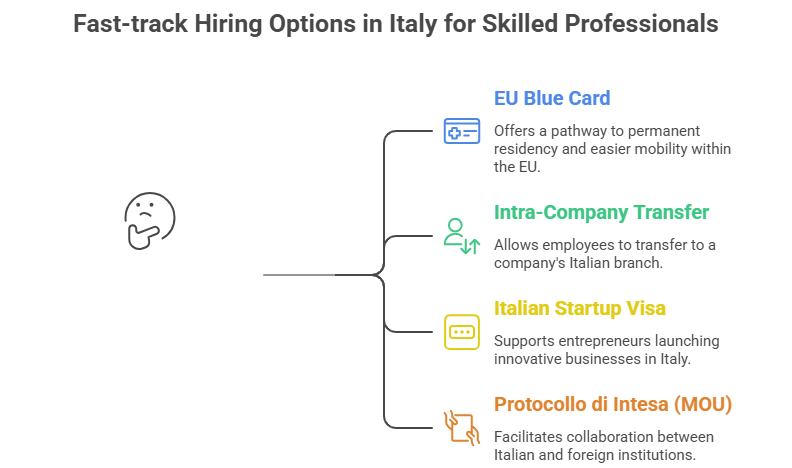
Fast-track hiring options in Italy for skilled professionals include the EU Blue Card, the ICT Permit, and the Italy Startup Visa. Companies in Italy can also sign the "Protocollo di Intesa" (Protocol Agreement) with the Ministry of the Interior to hire qualified foreign skilled workers through expedited pathways that eliminate time-consuming Local Labour Board procedures. Skilled professionals can apply for fast-track hiring options in Italy to work in sectors experiencing labour shortages, such as IT, engineering, operations, and healthcare. Accelerated visa processing enables foreign skilled professionals to bypass labour market checks for specific high-demand roles in the country.
*Want to work in Italy? Let Y-Axis guide you with the steps.
Fast-track Hiring Options in Italy for Skilled Workers
Foreign skilled professionals can apply for fast-track hiring options in Italy via expedited immigration pathways such as the EU Blue Card, Startup Visa, ICT (Intra-company transfer) Permit, and the Protocollo di Intesa (MOU). Italian companies with a Protocollo di Intesa (MOU) can hire skilled professionals from abroad through expedited pathways that do not require lengthy labour-market verifications.
The following are the fast-track hiring options in Italy for skilled professionals:
EU Blue Card
An EU Blue Card offers a fast-track work and residence permit in Italy, designed to attract highly qualified foreign workers. Professionals with high educational qualifications, work experience, and advanced skills can work in labour-shortage sectors of Italy through the EU Blue Card as an Italian immigration pathway. The EU Blue Card bypasses quota requirements and streamlines the visa approval process for skilled workers with specialised technical knowledge.
Eligibility requirements for the EU Blue Card:
- Valid job offer with an employment contract.
- Minimum salary threshold (approx. €35,000+ annually).
- Proof of work experience.
- Recognised university degree (Master’s/PhD).
- Declaration of Value (DOV) for validation of a foreign degree. (if required)
- Proof of accommodation.
- Health insurance.
- Valid passport.
*Want to apply for the EU Blue Card? Let Y-Axis guide you with the process.
Protocollo di Intesa (MOU)
A Protocollo di Intesa (MOU) is a special contract between an Italian company and the Ministry of the Interior that initiates fast-track hiring of skilled professionals abroad. This visa pathway is available only via Italian employers that have a pre-approved Protocollo di Intesa with the Ministry of the Interior. The agreement bypasses Local Labour Board procedures that can delay recruitment of qualified workers in shortage sectors. A Memorandum of Understanding (MOU) simplifies Italy's immigration processes for skilled professionals applying through pre-approved companies with a Protocollo di Intesa to work in skilled jobs.
Eligibility requirements for Protocollo di Intesa (MOU):
- Valid job offer from an Italian company with an MOU.
- Employer sponsorship.
- High educational qualification.
- Work experience letter.
- Minimum salary threshold.
- Health insurance.
- Proof of accommodation.
- Valid passport.
Also read…
Intra-Company Transfer (ICT)
An Intra-company transfer (ICT) permit allows multinational companies to transfer a skilled employee, such as a senior manager or executive, to their branch in Italy to conduct an urgent task. Skilled professionals from abroad can migrate to Italy on an ICT permit to temporarily live and work in the country. The process is fast-tracked for highly qualified employees, expediting labour market tests and quota restrictions.
Eligibility requirements for ICT:
- Managerial, specialist, executive, or trainee role.
- At least 3 consecutive months of work in the same company.
- Assignment/contract letter from the employer.
- Proof of company relationship (parent branch or subsidiary in Italy).
- High educational qualification.
- Authorization (Nulla Osta) to legally work in the Italy branch.
- Health insurance.
- Valid passport.
Also read…
Italy to grant 500,000 work visas in 2026-28. Apply now!
Italian Start-up Visa
The Italian Start-up Visa is a fast-track immigration pathway for skilled professionals in Italy, permitting innovative entrepreneurship. Foreign skilled professionals can enter Italy to establish a start-up venture or work in a start-up company. An Italian Start-up Visa is suitable for technically advanced, skilled workers to explore the country's technological and innovation sectors.
Eligibility requirements for the Italian Start-up visa:
- Proof of a comprehensive start-up business plan.
- Sufficient financial resources (minimum €50,000).
- Income Proof (at least €8,500).
- Start-up requirements (the company should not be more than 5 years old).
- Innovation requirements (at least 15% of investment in Research & Development (R&D), 1/3 of the team consists of PhD students/researchers, 2/3 of Master’s, ownership of a registered patent or software).
- Approval from the Italian Start-up Visa Committee.
- Certificate of no impediment (Nulla Osta).
- Proof of accommodation.
- Health insurance.
- Valid passport.
*Looking for jobs abroad? Sign-up with Y-Axis for end-to-end assistance.
Steps to Apply for Fast-track Hiring Options in Italy
The steps to apply for fast-track hiring options in Italy for skilled workers are as follows:
Step 1: Check eligibility for different fast-track hiring options in Italy for skilled professionals.
Step 2: Select a suitable fast-track hiring option based on educational qualification, work experience, job offer, and minimum salary requirements.
Step 3: Secure a valid job offer from an Italian employer (mandatory for the MOU and the EU Blue Card).
Step 4: The employer registers with the Italian Ministry of the Interior to bypass labour market tests.
Step 5: The employer submits a fast-track request for Nulla Osta (work authorization) on your behalf.
Step 6: Upon approval of the nulla osta, apply for an Italy work visa at the Italian Consulate/Embassy in your home country.
Step 7: Upon work visa approval, fly to Italy.
Step 8: Within one week of arrival, visit the local Immigration Office to sign a contract of stay and apply for the Residence Permit (permesso di soggiorno).
Step 9: Live and work legally in Italy as a skilled worker!
*Are you looking for step-by-step assistance with overseas immigration? Contact Y-Axis, the world’s No. 1 overseas immigration consultancy, for end-to-end assistance!
FAQs
What are fast-track hiring options in Italy for skilled professionals?
Fast-track hiring options in Italy for skilled workers include immigration pathways such as the EU Blue Card, the ICT permit, and the Italian Startup Visa. Foreign skilled professionals can also apply to Italian companies through a prioritized Protocollo d'Intesa (MOU) agreement for an expedited hiring process that eliminates lengthy labour market tests. These pathways permit highly qualified professionals to seek job opportunities in Italy's skill-shortage sectors, such as IT, healthcare, engineering, and construction.
Can Indian professionals apply for fast-track jobs in Italy?
Yes, Indian professionals can apply for fast-track jobs in Italy through expedited visa pathways and a Memorandum of Understanding (MOU). The Protocollo d'Intesa (MOU) is a special agreement between an Italy-based company and the Ministry of Interior that allows the company to hire foreign skilled professionals without having to follow labour market procedures, enabling faster recruitment for roles in skill shortage areas.
Who is eligible for fast-track work visa programs in Italy?
Fast-track visa programs in Italy are available for non-EU nationals with high educational qualifications, advanced training, and work experience. Foreign skilled workers are hired through an expedited immigration pathway to address Italy's labor shortages in sectors such as IT, engineering, AI, healthcare, nursing, operations, and construction.
What is Protocollo di Intesa (MOU) for fast-track hiring in Italy?
The Protocollo di Intesa, also known as the Memorandum of Understanding (MOU), is an agreement between Italy's Ministry of the Interior and a company seeking to hire foreign professionals through fast-tracked immigration pathways. Highly qualified professionals can migrate to Italy via fast-track pathways such as the ICT permit or the EU Blue Card, which exclude labour market tests and expedite the recruitment process.
What skills are currently in demand in Italy?
The most in-demand skills in Italy are digital transformation, engineering, and healthcare. There is also high demand for skilled professionals in AI, cybersecurity, and data analysis due to Italy's growing tech industry. Industries like manufacturing and specialized engineering face a serious talent shortage in the country, increasing the need for foreign skilled workers.
How long does fast-track visa processing take in Italy?
Fast-track visa processing in Italy generally takes about 5-7 working days for urgent recruitment of overseas skilled workers. The standard Italian work visa takes 15-30 days for approval, which can be accelerated through priority processing to address urgent labour gaps for certain skilled roles.
Which industries benefit most from fast-track hiring in Italy?
The industries in Italy that benefit most from fast-track hiring include IT, healthcare, engineering, construction, and tourism. Significant labour and skill shortages in these industries compel the country to offer expedited immigration pathways to hire skilled workers from abroad.
Do fast-track hiring options in Italy allow family members to join?
Yes, specific fast-track hiring options in Italy, such as an EU Blue Card or a specialized intra-company transfer (ICT) permit, allow family members/dependents to join the worker abroad. Family members, such as spouses, parents, and children, can apply for an Italian residence permit through the "accompanying family member" pathway to live with the worker in Italy.
What documents are required for a fast-track visa application in Italy?
Fast-track hiring options and priority processing of work visas in Italy require documents such as a job offer, employment contract, work authorisation, proof of accommodation, insurance, and a passport, among others.
The documents needed for fast-track hiring options in Italy for skilled professionals are as follows:
- Valid job offer with an employment contract.
- Work experience letter.
- Proof of minimum salary.
- Proof of Purpose/Invitation letter.
- Education degree certificate.
- Declaration of Value (DOV) for validation of a foreign degree.
- Certificate of no impediment (Nulla Osta).
- Proof of accommodation.
- Health insurance.
- Valid passport.
Can fast-tracking work visas in Italy lead to long-term residence?
Posted on January 24 2026
Trending Article
Posted On February 17 2026
What Are the Most In-Demand Jobs in Turkey for the Next 10 Years?