

Posted on February 17 2026
What Are the Most In-Demand Jobs in Turkey for the Next 10 Years?

By , Editor & Director
Updated May 30 2026
Turkey is one of the fastest-growing job markets in the world and Indian professionals are increasingly looking at it as a serious career destination. Positioned between Europe and Asia, Turkey offers access to both markets, a growing tech sector, and a strong demand for skilled foreign workers. The Turkey work permit process is employer-sponsored and highly streamlined. Salaries in IT, engineering, and healthcare compare well when converted to INR and the cost of living is significantly lower than European destinations.
Quick Facts — Turkey's Job Market at a Glance
| Fact | Detail |
|---|---|
| GDP Growth | Consistently among the fastest-growing OECD economies |
| Top Hiring Sectors | IT, Renewable Energy, Healthcare, Engineering, Tourism |
| Major Hiring Cities | Istanbul, Ankara, Izmir, Bursa, Antalya |
| Work Permit Type | Employer-sponsored work permit (most common for Indians) |
| Work Permit Processing Time | 30–90 days (employer applies on your behalf) |
| Language Requirement | English sufficient for multinationals; basic Turkish helps |
| Average IT Salary | USD 25,000–50,000/yr (approx. INR 21–42 lakhs) |
| Indian Professionals in Turkey | Growing presence in IT, healthcare, and hospitality sectors |
*Want to apply for a Turkey work visa? Get expert guidance from Y-Axis
Why Indian Professionals Are Considering Turkey?
Turkey's economy has gone through significant structural changes. The government's National Technology Initiative (Milli Teknoloji Hamlesi) is driving domestic growth in AI, robotics, and advanced manufacturing. The Digital Türkiye Strategy has pushed demand for cloud architects, data engineers, and cybersecurity specialists across both government and private sector organisations.
For Indian professionals, there are three specific advantages:
- Qualification recognition — Indian engineering, IT, and medical degrees are recognised by Turkish employers, particularly in multinationals. An evaluation through the Turkish Council of Higher Education (YÖK) confirms equivalency.
- Salary vs cost of living — Istanbul's cost of living is roughly 40–50% lower than comparable European cities. An IT professional earning USD 35,000 in Istanbul retains significantly more purchasing power than the same salary in Frankfurt.
- No language barrier for skilled roles — Most multinational employers in Istanbul and Ankara operate in English. Turkish language skills are an advantage but not a barrier for entry.
*Interested to find jobs in Turkey? Sign up with Y-Axis for end-to-end assistance.
Which Jobs Are Most In-Demand in Turkey Right Now?
Turkey’s job market is expected to grow steadily over the next 10 years due to strong economic development, digital transformation, and expansion in key industries. As the country invests more in technology, renewable energy, healthcare, tourism, and manufacturing, the demand for skilled professionals will continue to increase.
Sectors such as IT, engineering, medical tourism, green energy, and export-based industries will offer better job opportunities for both local and foreign professionals.
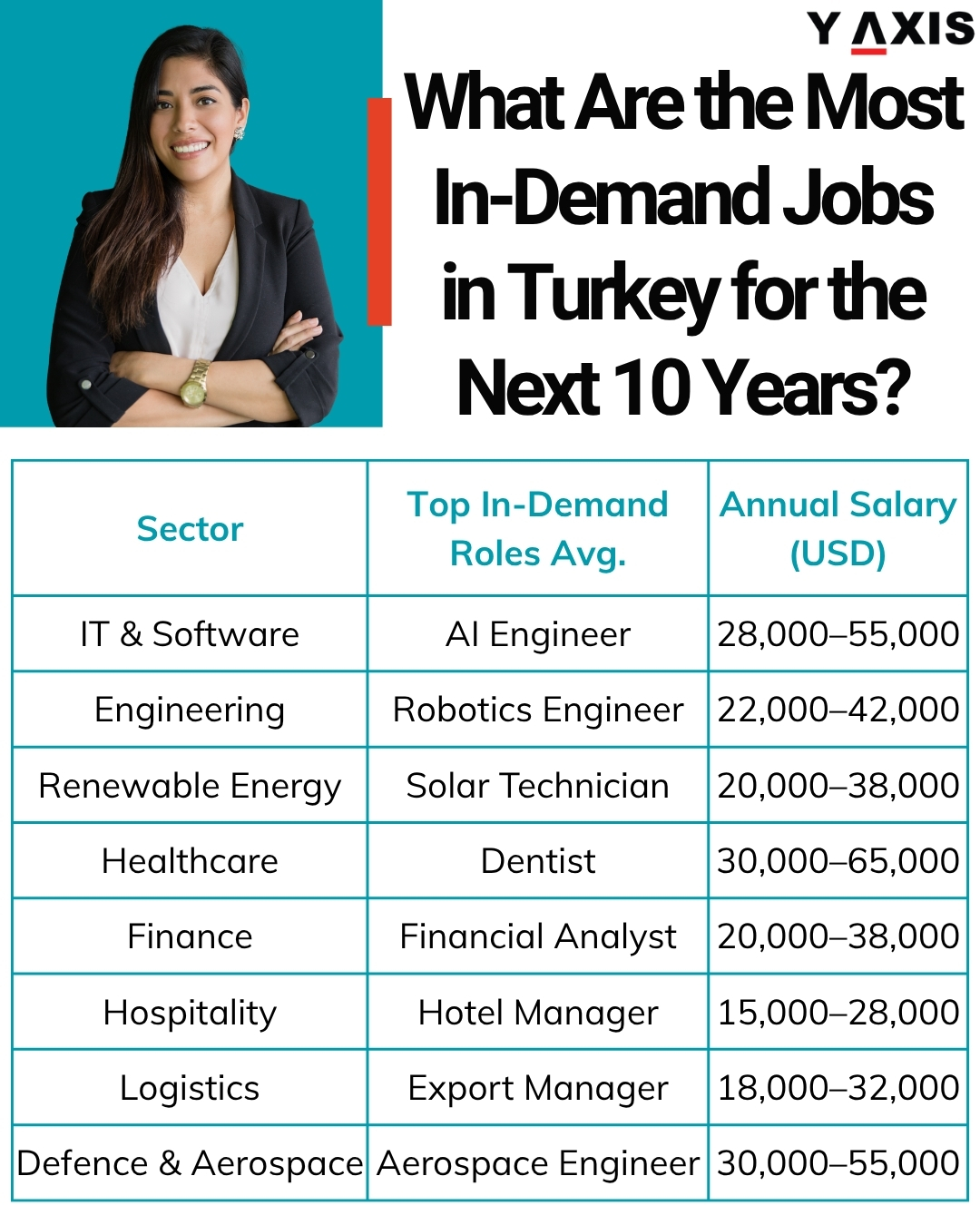
Below is a sector-wise list of the top job opportunities in Turkey for the coming decade:
| Sector | Top In-Demand Roles | Avg. Annual Salary (USD) | Approx. INR Equivalent | Key Hiring Cities |
|---|---|---|---|---|
| IT & Software | AI Engineer, ML Developer, Cloud Architect, Data Scientist, Cybersecurity Specialist | USD 28,000–55,000 | INR 23–46 lakhs | Istanbul, Ankara |
| Engineering & Manufacturing | Automation Engineer, Robotics Engineer, Production Engineer, Chemical Engineer | USD 22,000–42,000 | INR 18–35 lakhs | Bursa, Ankara, Istanbul |
| Renewable Energy | Solar/Wind Technician, Project Manager, Grid Integration Engineer | USD 20,000–38,000 | INR 17–32 lakhs | Konya, Ankara, Izmir |
| Healthcare & Medical Tourism | Aesthetic Doctor, Dentist, Ophthalmologist, Healthcare Technician | USD 30,000–65,000 | INR 25–54 lakhs | Istanbul, Antalya |
| Finance & Banking | Financial Analyst, Risk Manager, FinTech Developer | USD 20,000–38,000 | INR 17–32 lakhs | Istanbul |
| Tourism & Hospitality | Hotel Manager, Tourism Coordinator, Multilingual Guest Relations | USD 15,000–28,000 | INR 12–23 lakhs | Antalya, Istanbul, Bodrum |
| Logistics & Supply Chain | Export Manager, Logistics Coordinator, Warehouse Automation Specialist | USD 18,000–32,000 | INR 15–27 lakhs | Istanbul, Mersin |
| Defence & Aerospace | Aerospace Engineer, Defence Systems Analyst, R&D Engineer | USD 30,000–55,000 | INR 25–46 lakhs | Ankara |
Note: 1 USD ≈ INR 83.5 (indicative only; rates fluctuate daily). Gross salaries before Turkish income tax.
*Read more.....
In-demand Jobs in Turkey
Work in Turkey – Career Opportunities, Work Permits & PR Pathways
Discover why Turkey is becoming a top destination for skilled professionals in 2026. From high-demand jobs in IT, healthcare, engineering, tourism, and finance to affordable living and pathways to Turkish residency, this video covers everything you need to know about working and settling in Turkey. Learn about Turkey work permits, the Turquoise Card, salary expectations, visa processes, and career opportunities for Indians and international professionals.
🎥 Watch the full video here:
What Skills Does Turkey's Job Market Prioritise?
Turkey’s job market in the next 10 years will focus strongly on skills rather than just degrees. Employers will look for professionals who have technical knowledge, practical abilities, and strong communication skills. Developing the right skills will improve job opportunities across technology, engineering, healthcare, energy, and business sectors.
| Category | Key Skills |
|---|---|
| IT & Digital | AI & Machine Learning, Cloud Computing, Cybersecurity, Data Analytics, Software Development, DevOps |
| Engineering & Manufacturing | Automation & Robotics, CAD Design, Industrial Engineering, Production Planning, Project Management |
| Renewable Energy & Sustainability | Solar & Wind Energy Systems, Energy Storage, Grid Integration, Sustainability Management |
| Healthcare & Medical Tourism | Clinical Skills, Aesthetic & Dental Expertise, Diagnostic Skills, Patient Care, Medical Technology |
| Business & Finance | Financial Analysis, Export-Import Knowledge, ERP Systems, Risk Management, Compliance |
| Soft & Workplace Skills | English Communication, Basic Turkish Language, Teamwork, Problem Solving, Adaptability |
| Operations & Logistics | Supply Chain Management, Logistics Coordination, Warehouse Automation, Health & Safety Compliance |
What Is Driving Long-Term Job Growth in Turkey?
Turkey’s job market in the next 10 years will grow because of strong government plans, new investments, and support for important industries. The government is focusing on technology, energy, manufacturing, exports, and infrastructure to create more jobs.
- National Technology Initiative (Milli Teknoloji Hamlesi) supports the growth of local technology and innovation. This will create more jobs in AI, software, robotics, and advanced manufacturing.
- Digital Türkiye Strategy aims to improve digital systems in companies and government services. This will increase demand for IT professionals, cloud experts, and data specialists.
- Government support for renewable energy, like solar and wind power, will create more jobs for engineers, technicians, and project managers in green energy projects.
- Employment incentive programs give financial support and tax benefits to companies that hire new workers. This helps increase hiring in sectors like manufacturing, tourism, and services.
- Support for small businesses and startups through grants and funding programs will help new companies grow and create more job opportunities.
- Large development projects, including the Southeastern Anatolia Project (GAP), will create jobs in construction, agriculture, transportation, and public services.
- Export-focused economic policies and trade agreements will support industries like automotive, textiles, electronics, and defense, leading to more jobs in factories and logistics.
- Skilled and English-speaking professionals will continue to have good opportunities, especially in multinational companies and export-based businesses.
Overall, Turkey’s government policies and investments are expected to support steady job growth in the coming decade, especially for skilled and trained workers.
*Read more.....
Turkey Job Outlook
How Are Salaries Trending in Turkey's High-Demand Sectors?
- Salaries are expected to increase gradually in high-demand sectors such as IT, artificial intelligence, renewable energy, healthcare, and advanced engineering. Skilled professionals in these fields are likely to earn higher pay compared to other industries.
- Technology and AI-related jobs are expected to see the fastest salary growth, especially in major business cities like Istanbul, Ankara, and Izmir, where many tech companies and startups operate.
- Renewable energy and large engineering projects (solar, wind, infrastructure, defense, automotive) may offer competitive salaries, along with performance-based bonuses for project completion.
- Healthcare and medical tourism roles, such as specialized doctors, dentists, and surgeons, are likely to see steady salary growth due to strong international demand.
- Manufacturing and export-driven industries may offer stable salary growth, particularly for automation engineers, production managers, and logistics specialists.
- Major cities like Istanbul and Ankara usually offer higher salaries compared to smaller cities, but the cost of living, especially housing, should be considered when comparing pay.
- Foreign professionals with technical skills and English language ability may receive better salary packages, especially in multinational companies and export-focused firms.
Note: All salary references above are approximate. For INR-equivalent figures, refer to the sector salary table above. Currency conversion: 1 USD ≈ INR 83.5 (indicative; verify current rates before making decisions).
Which Major Companies in Turkey Hire Indian Professionals?
Many well-known companies in Turkey hire foreign professionals, especially in sectors that are growing fast or need specialized skills. Employers usually look for candidates with technical knowledge, international experience, and strong English communication skills.
Below is a table showing key sectors and major companies that actively recruit foreign talent in Turkey:
| Sector | Major Companies Hiring Foreign Professionals |
|---|---|
| Tech & IT | Turkcell, Türk Telekom, ASELSAN |
| Defense & Manufacturing | Turkish Aerospace Industries, Ford Otosan, TOGG |
| Renewable Energy & Construction | Enka İnşaat, Zorlu Energy, Limak Holding |
| Finance & Banking | Türkiye İş Bankası, Garanti BBVA, Akbank |
| Healthcare & Pharmaceuticals | Acıbadem Healthcare Group, Anadolu Medical Center, International pharma companies operating in Turkey |
| Hospitality & Tourism | Rixos Hotels, Divan Hotels, TUI Türkiye |
| Logistics & E-commerce | Turkish Cargo, Aras Kargo, Hepsiburada |
These companies operate in high-growth sectors such as technology, defense, renewable energy, healthcare, manufacturing, and tourism. Skilled foreign professionals, especially those with technical expertise and English language skills, may find good opportunities in these industries. Most of these employers have international HR teams and conduct interviews in English.
How Can Indian Professionals Get a Turkey Work Permit?
This is the most important section for Indian professionals considering Turkey — and it is missing from the current article entirely.
Turkey's work permit for foreign nationals is governed by the Law on Foreigners and International Protection. The employer submits the application on your behalf to the Ministry of Labour and Social Security (ÇSGB).
Who Is Eligible?
- You must have a valid job offer from a registered Turkish employer
- Your qualifications must match the role
- The employer must confirm no suitable local candidate was available — for skilled roles, this is routinely met
- Your passport must have at least 6 months' validity
Documents Indian Professionals Need
| Document | Details |
|---|---|
| Valid Indian Passport | Minimum 6 months validity beyond permit duration |
| Degree Certificates | Originals with apostille and certified Turkish translation |
| YÖK Equivalency Letter | Required for regulated professions — medicine, engineering, architecture |
| Signed Employment Contract | On Turkish company letterhead with agreed salary |
| Employer's Tax Registration | Provided by your employer — confirms they are a registered entity |
| Health Insurance | Mandatory for permit approval — employer typically covers this |
| Biometric Photographs | As per Turkish consulate specifications |
How Long Does It Take?
- Ministry of Labour review: 30–90 days from employer submission
- Work visa at Turkish Consulate India after approval: 7–15 working days
- Total timeline from job offer to arrival in Turkey: approximately 2–4 months
What Does It Cost?
- Work permit fee: approximately TRY 1,800–3,500 (most employers cover this)
- Work visa fee at Indian consulate: approximately USD 50–80
- Health insurance: approximately TRY 1,500–3,000 per year
How Do Indian Professionals Find and Secure Jobs in Turkey?
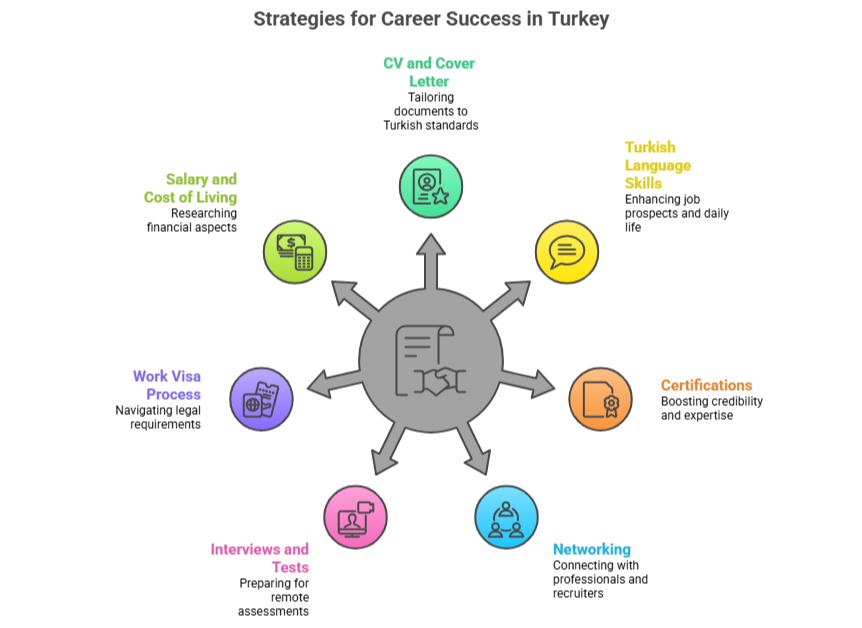
To increase your chances of getting a job in Turkey, follow these simple and practical steps:
- Prepare a professional CV and cover letter that match Turkish job market standards. Keep your CV clear, simple, and focused on skills and experience. Highlight technical expertise and international work experience if you have it.
- Learn basic Turkish language skills. While many multinational companies use English, knowing Turkish will improve your job opportunities and help in daily communication.
- Earn relevant certifications in your field. For example, cloud certifications (AWS, Azure), data analytics, cybersecurity, project management (PMP), renewable energy training, or medical licenses can improve your chances.
- Build your professional network on LinkedIn and connect with Turkish recruiters and hiring managers. Attend job fairs, industry events, and apply to companies that are open to hiring foreign professionals.
- Be prepared for online interviews and technical tests. Many companies conduct remote interviews, skill assessments, or practical evaluations before hiring.
- Understand Turkey’s work visa process. Most foreign professionals need an employer-sponsored work permit. Make sure your employer is ready to support your work permit application.
- Research salary expectations and cost of living in cities like Istanbul, Ankara, and Izmir before accepting an offer.
Turkey vs UAE vs Germany — Which Is Better for Indian Professionals?
| Factor | Turkey | UAE | Germany |
|---|---|---|---|
| Work Permit Process | Employer-sponsored; 30–90 days | Employer-sponsored; 2–4 weeks | Skilled Worker Visa; 4–12 weeks |
| Language Requirement | English (multinationals); Turkish helpful | English widely used | German B1 helpful; not mandatory in tech |
| Average IT Salary (USD/yr) | USD 28,000–50,000 | USD 50,000–90,000 | USD 60,000–95,000 |
| Approx. INR Equivalent | INR 23–42 lakhs | INR 42–75 lakhs | INR 50–79 lakhs |
| Income Tax | 15–40% progressive | 0% | 20–42% progressive |
| Cost of Living | Low–Moderate | High | High–Very High |
| PR / Long-Term Residency | Long-term permit after 8 years | Investor/retirement visa route | PR after 4 years; Blue Card after 33 months |
| Indian Community | Growing, smaller | Very large and established | Large and established |
| Best For | Mid-career professionals; healthcare and IT stepping stone | Tax-free income; fast processing | High salary; PR; European market access |
Currency: 1 USD ≈ INR 83.5 (indicative). Source: OECD, Numbeo Cost of Living Index, German Federal Employment Agency, UAE MOHRE.
Is Turkey the Right Career Move for You?
Turkey’s job market over the next decade will be driven by technology, manufacturing, renewable energy, and export-led growth. Digital transformation and government-backed industrial development will play a major role in creating new opportunities. Professionals in IT, AI, cybersecurity, engineering, renewable energy, healthcare (especially medical tourism), logistics, and advanced manufacturing will find the best career prospects. Sectors connected to exports, infrastructure, and automation are expected to remain strong. Foreign professionals with strong technical skills, English communication ability, industry certifications, and practical experience will be more competitive. Knowing basic Turkish and understanding the local work permit process will further improve job opportunities in Turkey.
*Are you looking for step-by-step assistance with overseas immigration? Contact Y-Axis, the world’s No. 1 overseas immigration consultancy
FAQs
Can Indian professionals work in Turkey?
Yes. Indian professionals can work in Turkey through an employer-sponsored work permit. The Turkish employer applies to the Ministry of Labour and Social Security on your behalf. Most multinational companies in Istanbul, Ankara, and Izmir regularly hire Indian professionals — particularly in IT, engineering, healthcare, and finance. The work permit process takes approximately 30 to 90 days from application. You do not need to speak Turkish for most skilled roles in international companies. Y-Axis helps Indian professionals navigate the full work permit process for Turkey. Call +91-7670800000 or visit www.y-axis.com for a free consultation.
Which jobs are most in demand in Turkey for foreigners?
The most in-demand jobs in Turkey for foreign professionals include software engineers, AI and machine learning developers, cloud architects, cybersecurity specialists, renewable energy engineers, healthcare professionals (particularly aesthetic doctors, dentists, and surgeons), financial analysts, and logistics coordinators. Istanbul and Ankara are the strongest hiring cities for technical and finance roles. Antalya leads in hospitality and tourism hiring. Multinational employers in Turkey actively recruit internationally for senior and specialist positions. Y-Axis can help identify which Turkish employers are currently hiring in your sector. Call +91-7670800000 or book a free assessment at www.y-axis.com/free-assessment/.
What is the average salary in Turkey for Indian professionals?
Salaries in Turkey vary significantly by sector. IT professionals typically earn USD 28,000 to USD 55,000 per year — approximately INR 23 to 46 lakhs. Healthcare specialists, particularly in medical tourism, earn USD 30,000 to USD 65,000 (INR 25 to 54 lakhs). Engineering roles range from USD 22,000 to USD 42,000 (INR 18 to 35 lakhs). The cost of living in Istanbul is 40 to 50 percent lower than comparable European cities, which means purchasing power is higher than the headline number suggests. Note: 1 USD ≈ INR 83.5 (indicative; rates fluctuate). Contact Y-Axis for current salary benchmarks: +91-7670800000.
How do I apply for a Turkey work permit from India?
The Turkey work permit application is employer-initiated. Your Turkish employer applies to the Ministry of Labour and Social Security on your behalf. You provide supporting documents including your passport, degree certificates with apostille, certified Turkish translations, and signed employment contract. Once the Ministry approves the permit, you apply for a work visa at the Turkish Embassy in New Delhi or the Consulate General in Mumbai. Total processing time from job offer to visa stamp is typically two to four months. Y-Axis manages the complete work permit documentation and visa application process for Indian professionals. Call +91-7670800000.
Does Turkey offer permanent residency for skilled workers?
Turkey does not have a fast-track permanent residency program for skilled workers equivalent to Canada's Express Entry or Germany's EU Blue Card. However, foreign professionals who have legally resided and worked in Turkey for a continuous period of eight years can apply for long-term residence status. After five years of legal residence, you may apply for Turkish citizenship under certain conditions, including financial investment or extraordinary contribution to Turkey. For Indian professionals seeking PR as a primary goal, Canada, Germany, or Australia offer faster and more structured pathways. Y-Axis can compare all options for your profile. Call +91-7670800000.
Is Turkish language required to work in Turkey?
Turkish language skills are not mandatory for most skilled professional roles in Turkey. Multinational companies, technology firms, and international healthcare groups in Istanbul and Ankara operate primarily in English. However, basic Turkish at A1 or A2 level significantly improves daily life, communication with local colleagues, and prospects in smaller companies. Customer-facing roles, government-adjacent positions, and teaching roles typically require working Turkish proficiency. For Indian IT, engineering, and healthcare professionals targeting international employers, English is sufficient. Y-Axis advises clients on language preparation based on their target sector and employer type. Call +91-7670800000.
Which Indian degrees are recognised in Turkey?
Indian university degrees are generally recognised in Turkey through the Council of Higher Education (YÖK). Engineering, IT, finance, and business degrees from Indian institutions are accepted by most private employers without formal equivalency paperwork. For regulated professions — medicine, dentistry, pharmacy, architecture, and law — formal YÖK equivalency recognition is mandatory before you can practice. The YÖK equivalency process takes approximately two to six months and must be initiated from Turkey by your employer or directly by you after arriving on a valid visa. Y-Axis guides clients through the degree recognition process. Call +91-7670800000.
What are the top cities in Turkey for Indian professionals?
Istanbul is the primary destination for Indian professionals in IT, finance, healthcare, and hospitality. It is Turkey's economic capital and houses the majority of multinational employers. Ankara, the political capital, is strong for defence, aerospace, and government-adjacent roles. Izmir offers opportunities in logistics, manufacturing, and renewable energy. Antalya and Bodrum are active for hospitality, tourism, and healthcare tourism roles. Bursa is a major automotive and manufacturing hub. Istanbul offers the largest English-speaking professional community and the highest concentration of international employers open to Indian professionals. Y-Axis helps you target the right city for your sector. Call +91-7670800000.
Is Turkey better than UAE for Indian professionals?
It depends on your priorities. The UAE offers zero income tax, a very large Indian community, faster work permit processing, and higher average salaries — particularly in finance and consulting. Turkey offers a lower cost of living, a more accessible work permit for mid-level professionals, strong growth in IT and renewable energy, and lower competition from other Indian applicants. If tax-free income is your priority, UAE wins. If you are in IT, engineering, or healthcare and want a growing market with strong purchasing power relative to cost of living, Turkey is a competitive option. Y-Axis compares both pathways for your profile. Call +91-7670800000.
Can I bring my family to Turkey on a work permit?
Yes. Once you hold a valid Turkish work permit and residence permit, your spouse and dependent children can apply for family reunion residence permits. Your spouse's residence permit allows them to live in Turkey but does not automatically grant work rights — they must apply separately for a work permit if they wish to be employed. Your children can attend Turkish state schools or international schools. Processing time for family residence permits is typically four to eight weeks. Y-Axis provides family relocation support for Turkey-bound Indian professionals. Call +91-7670800000 or visit www.y-axis.com.
What is the Turkey work permit fee for Indian professionals?
The Turkish work permit fee varies by category and duration. Short-term work permits (up to one year) cost approximately TRY 1,800 to TRY 3,500 depending on the applicant's nationality. Most employers cover this fee as part of the employment package — it is standard practice for international hires. Additionally, you will pay a visa application fee at the Turkish Consulate in India, typically USD 50 to USD 80. Health insurance — mandatory for the work permit application — costs approximately TRY 1,500 to TRY 3,000 per year. Y-Axis provides a full cost breakdown for Turkey work permit applications. Call +91-7670800000.
Which companies in Turkey hire Indian IT professionals?
Indian IT professionals are actively hired by Turkish technology firms and multinationals operating in Turkey. Key employers include Turkcell, Türk Telekom, ASELSAN, Logo Software, Etiya, Huawei Turkey, and SAP Turkey. Istanbul's startup ecosystem — one of the fastest-growing in Europe — also employs international developers. Multinational firms such as HSBC Turkey, Accenture Turkey, and Deloitte Turkey recruit for technology and consulting roles. LinkedIn is the most effective job portal for Indian IT professionals targeting Turkish employers. Most roles in this sector list English as the working language. Y-Axis helps clients identify and target the right employers. Call +91-7670800000.
Is healthcare a good sector for Indian professionals in Turkey?
Yes. Turkey is one of the world's top five medical tourism destinations, attracting over two million international patients annually. This drives sustained demand for specialist doctors — particularly aesthetic surgeons, dentists, ophthalmologists, and oncologists — as well as healthcare technicians and medical support staff. Indian medical graduates with MBBS, BDS, or specialist qualifications are eligible to work in private hospitals and clinics after completing YÖK degree recognition. Salaries for specialist doctors in Turkey's private sector range from USD 30,000 to USD 65,000 per year (INR 25 to 54 lakhs). Y-Axis assists Indian healthcare professionals with Turkey work permit applications. Call +91-7670800000.
What certifications improve job prospects in Turkey?
Internationally recognised certifications significantly improve your competitiveness in Turkey's job market. For IT professionals: AWS, Azure, or GCP cloud certifications; Certified Ethical Hacker (CEH) for cybersecurity; PMP for project management. For engineers: AutoCAD and CATIA proficiency; IOSH Managing Safely for health and safety compliance. For finance professionals: CFA, ACCA, or CPA. For healthcare: European Board specialty certifications improve credibility in medical tourism facilities. For energy professionals: IREC-certified renewable energy training. Basic Turkish language certification (A1 or A2 from Goethe Institut or TÖMER) is an added advantage across all sectors. Y-Axis advises on certification priorities by role. Call +91-7670800000.
How does Turkey's job market compare with Germany for Indian professionals?
Germany offers higher salaries (avg. IT salary: USD 60,000–95,000 vs Turkey's USD 28,000–55,000), a clear PR pathway through the EU Blue Card, and access to the wider European job market. Turkey offers a faster, simpler work permit process, significantly lower cost of living, and less competition for skilled roles. Germany requires B1 German for PR acceleration; Turkey requires no language qualification for most skilled roles. For Indian professionals prioritising high earnings and PR, Germany is stronger. For those seeking faster entry, lower living costs, and a growing market, Turkey is a viable first step. Y-Axis advises on both pathways. Call +91-7670800000.
What is the job outlook for AI and technology professionals in Turkey?
Turkey's National Technology Initiative (Milli Teknoloji Hamlesi) and Digital Türkiye Strategy are driving a sustained increase in demand for AI engineers, machine learning developers, data scientists, cloud architects, and cybersecurity specialists. Istanbul and Ankara are the primary tech hubs. The government has committed to increasing the technology sector's share of GDP, with direct investment in domestic AI development and smart manufacturing. Indian tech professionals with three or more years of experience in AI, cloud, or data engineering are competitive in Turkey's market. Salaries for senior AI engineers range from USD 40,000 to USD 55,000 (approx. INR 33–46 lakhs). Y-Axis helps Indian tech professionals target Turkey employers. Call +91-7670800000.
What is the minimum salary for a Turkey work permit?
Turkey sets a minimum salary threshold for work permit applications for foreign nationals. The minimum gross monthly salary for most categories of foreign workers must be at least 1.5 times Turkey's minimum wage — the exact figure is updated annually by the Ministry of Labour. For specialist roles including engineers, doctors, and IT professionals, the threshold may be set higher. Your employment contract must clearly state a gross salary that meets or exceeds this threshold for the work permit to be approved. Y-Axis keeps current with Ministry of Labour salary thresholds and advises clients on contract compliance before submission. Call +91-7670800000.
Can Indian nurses work in Turkey?
Indian nurses can work in Turkey but must meet specific regulatory requirements. A Bachelor of Science in Nursing (BSc Nursing) or equivalent is required. The degree must be recognised by YÖK (Council of Higher Education). Registration with Turkey's Ministry of Health through the relevant nursing council is required before clinical practice. Turkish language proficiency is typically expected for clinical nursing roles due to patient communication requirements. However, larger private hospitals in Istanbul with international patient populations sometimes hire English-speaking nurses for medical tourism wards. Y-Axis advises Indian nursing professionals on the recognition and licensing pathway for Turkey. Call +91-7670800000.
Are there remote job opportunities in Turkey for Indian professionals?
Remote working arrangements for Turkish-based companies hiring overseas talent exist but are less structured than in Western markets. Some Istanbul-based tech firms and startups offer hybrid or fully remote roles for international candidates. However, most Turkish work permit applications require the employee to be physically present in Turkey and employed by a locally registered entity. Pure remote roles with Turkish employers while residing in India are not covered under the Turkish work permit framework. For Indian professionals seeking remote income from overseas employers, European, North American, or Australian companies are more structured options. Y-Axis advises on the best remote and relocation pathways. Call +91-7670800000.
How can Y-Axis help me get a job in Turkey?
Y-Axis Overseas Careers is India's most trusted overseas immigration consultancy — with over 25 years of experience and more than 10 lakh clients guided successfully through overseas career moves. For Turkey, our services include free profile assessment and eligibility check, sector-specific job search support, CV preparation in Turkish employer format, work permit documentation management, Turkish Consulate visa application support, degree equivalency (YÖK) coordination, and family relocation assistance. Our Turkey-specialist consultants are available for a free consultation. Phone: +91-7670800000 | Email: info@y-axis.com | Website: www.y-axis.com | Free Assessment: www.y-axis.com/free-assessment/
📞 Call: +91-7670800000
📩 Email: info@y-axis.com
🌐 Visit: https://www.y-axis.com
Tags:
Turkey jobs
Jobs in Turkey
Turkey careers
Work in Turkey
Turkey job market
Turkey skills in-demand
Careers in Turkey
Turkey work opportunities
High demand jobs Turkey
Turkey employment trends
Share
Y - Axis services

Get it on your mobile

Get News Alerts

Contact Y-Axis
Latest Article
Popular Post
Trending Article
Posted On October 01 2026
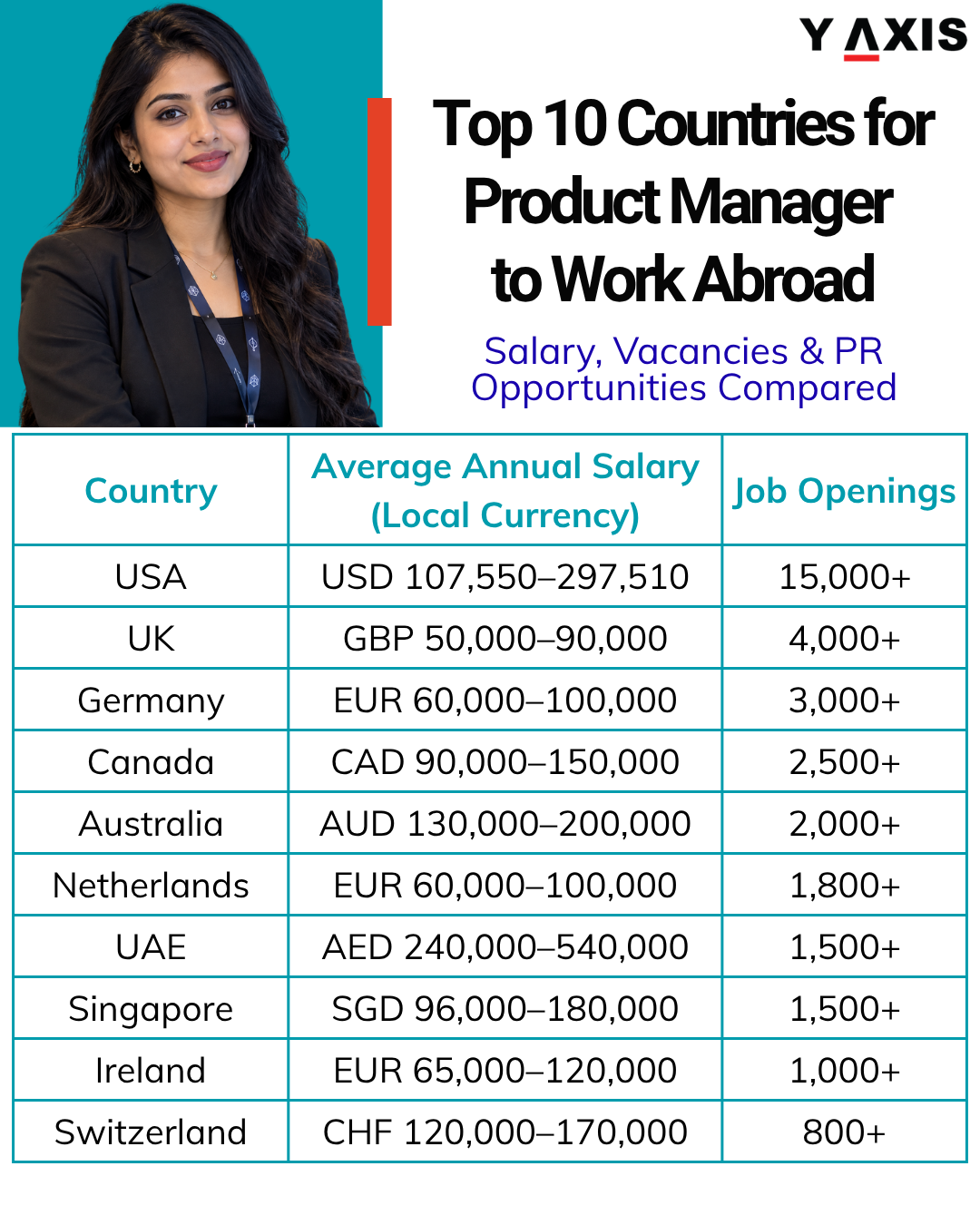
Top 10 Countries to Work Abroad as a Product Manager