


Posted on August 24 2026
Canada Updates TFWP Rules to Give Small Employers More Hiring Flexibility. Check Your Eligibility!

By , Editor & Director
Updated August 24 2026
Highlights: Canada to Expand Hiring Options for Low-Wage Foreign Worker
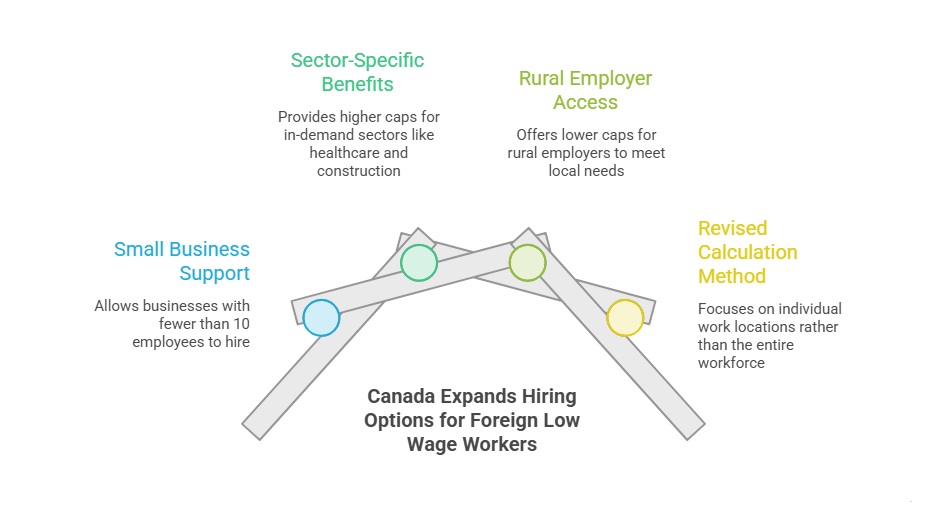
- Canada has revised its Temporary Foreign Worker Program allowing some small work locations to hire up to two low-wage temporary foreign workers.
- Canadian employers with fewer than 10 employees can now hire one low-wage worker, or two in select in-demand sectors.
- The revised calculation applies to different work locations in Canada rather than an employer's entire workforce.
- Foreign health care, construction and food production employers can benefit from the higher 20% low-wage worker cap.
- Rural employers in Canada may also access a 15% low-wage workforce cap under provincial measures introduced in March 2026.
*Want to apply for Canada work visa? Let Y-Axis assist you with the process.
Canada to Strenthen Low-Wage Temporary Foreign Worker Hiring Options in 2026
Canada has officially updated its federal Temporary Foreign Worker Program rules to make it easier for certain small work locations to hire low-wage foreign workers. Under the changes introduced by Employment and Social Development Canada on August 18, 2026 employers with fewer than 10 employees at a particular work location can hire up to one low-wage temporary foreign worker.
Canadian employers operating in in-demand sectors such as health care, construction and food production can hire up to two low-wage temporary foreign workers under the revised calculation.
The major policy updates under Canada’s TFWP initiative are as follows:
|
Rule |
Details |
|
Small work locations |
Employers with fewer than 10 employees at a work location can hire up to 1 low-wage TFW |
|
In-demand sectors |
Health care, construction and food production employers can hire up to 2 |
|
Standard cap |
Generally 10% for most employers |
|
Higher sector cap |
20% for certain in-demand sectors |
|
Rural cap |
Provinces can raise the cap to 15% for eligible rural employers |
|
Low-wage definition |
Pay below 120% of the regional median wage |
|
LMIA |
Generally required for TFWP hiring |
|
Ontario example |
Low-wage threshold is $36.92 per hour |
|
2026 TFWP target |
60,000 foreign workers |
|
2026 IMP target |
170,000 foreign workers |
Note: Employers using the low-wage stream must continue to meet other TFWP requirements. These include covering workers' transportation to and from Canada, providing suitable housing costing less than 30% of pre-tax income and arranging private health insurance where provincial or territorial coverage is unavailable.
Also, read...
How the Revised TFWP Initiative will benefit Indian Workers in Canada?
The revised TFWP rules in Canada could create additional opportunities for eligible Indian workers seeking temporary employment in the country in sectors facing labour shortages. However, foreign workers still require employer support and must meet the applicable work permit and TFWP requirements, while employers generally need a positive or neutral LMIA.
The benefits of updated TFWP policies in Canada for Indian workers are as follows:
- More opportunities with small Canadian employers.
- Up to two low-wage TFW positions may be available at eligible small work locations in health care, construction and food production.
- Increased potential employment opportunities in Canada's in-demand sectors.
- Rural employers may have access to a higher 15% workforce cap in eligible provinces.
- Workers hired through the low-wage stream continue to receive protections relating to transportation, housing and health insurance.
- Jobs meeting the applicable wage threshold can be considered under the high-wage stream, which is not subject to the low-wage workforce cap.
- Canada's 2026 immigration plan includes admission targets of 60,000 TFWP workers and 170,000 workers through the International Mobility Program.
*Are you looking for step-by-step assistance with Canada immigration? Contact Y-Axis, the world's No. 1 overseas immigration consultancy.
For recent Canadian immigration updates, check out the Y-Axis Canada Immigration News Page.
FAQs
What has Canada changed in its Temporary Foreign Worker Program?
Canada has revised its Temporary Foreign Worker Program (TFWP) rules to allow certain small work locations to hire more low-wage temporary foreign workers. Employers with fewer than 10 employees at a particular work location can now hire up to one low-wage worker. Employers in selected in-demand sectors, including health care, construction, and food production, may hire up to two workers under the revised calculation.
How many low-wage foreign workers can small Canadian employers hire?
Under the revised calculation, an employer with fewer than 10 employees at a particular work location can hire up to one low-wage temporary foreign worker. Employers operating in eligible in-demand sectors can hire up to two workers. The change applies when the standard workforce cap would otherwise allow the employer to hire fewer than the permitted number of workers.
Which sectors can hire up to two low-wage foreign workers?
Employers in three identified in-demand sectors can hire up to two low-wage temporary foreign workers at eligible small work locations. These sectors are:
- Health Care
- Construction
- Food Production
The higher allowance is linked to the existing 20% low-wage workforce cap for these sectors, compared with the standard 10% limit applicable to many other employers.
What is considered a low-wage job under Canada's TFWP?
A position is considered low-wage when its pay falls below 120% of the applicable regional median wage listed on Canada's federal Job Bank. The exact threshold varies by location. For example, the low-wage threshold cited for Ontario is $36.92 per hour. Jobs that meet or exceed the relevant threshold can generally fall under the high-wage stream instead.
Do Canadian employers need an LMIA to hire low-wage foreign workers?
Employers generally need a positive or neutral Labour Market Impact Assessment (LMIA) to hire or retain foreign workers through the Temporary Foreign Worker Program. The LMIA is intended to demonstrate that qualified Canadian citizens or permanent residents are not available for the position.
However, not every Canadian work permit requires an LMIA because many permits are issued through the International Mobility Program (IMP).
Can Indian workers benefit from the revised Canadian TFWP rules?
Yes, eligible Indian workers could potentially benefit if Canadian employers create additional positions under the revised workforce calculations. The changes may be particularly relevant to workers seeking opportunities in:
- Health Care
- Construction
- Food Production
- Eligible Rural Locations
However, the rule change does not automatically provide Indians with work permits. Workers still need an eligible job and must meet applicable immigration and work permit requirements.
What requirements must employers meet when hiring low-wage TFWs?
Employers hiring through Canada's low-wage TFWP stream must continue meeting several worker-protection requirements, including:
- Paying transportation costs to and from Canada
- Providing access to suitable housing costing less than 30% of the worker's pre-tax income
- Purchasing private health insurance when provincial or territorial coverage is unavailable
- Meeting all applicable LMIA and TFWP requirements
What is the rural workforce cap for low-wage foreign workers?
Since March 13, 2026, provinces have been allowed to increase the low-wage workforce cap to 15% for eligible employers in rural areas. This provides additional flexibility for rural businesses facing labour shortages.
The measure is separate from the revised small-work-location calculation and depends on the applicable provincial rules and whether the employer and location qualify for the rural provision.
Are low-wage foreign workers currently restricted in some Canadian cities?
Yes. Canada continues to maintain a moratorium on LMIA applications for low-wage jobs in urban areas where the unemployment rate is above 6%. This restriction has been in place since September 2024.
Therefore, the revised small-employer calculation does not mean every Canadian employer can hire low-wage foreign workers. Location, sector, workforce size, and applicable LMIA restrictions still need to be considered.
How many temporary foreign workers will Canada admit in 2026?
Under Canada's 2026 immigration levels plan, the federal government expects to admit:
- 60,000 foreign workers through the Temporary Foreign Worker Program (TFWP)
- 170,000 foreign workers through the International Mobility Program (IMP)
The International Mobility Program generally does not require an LMIA. These figures reflect Canada's broader approach to managing temporary migration while responding to labour market needs.
Tags:
Canada work visa
work in Canada
Temporary Foreign Worker Program in Canada
Canada permanent residence
Canada immigration news
migrate to Canada
Canada low-wage worker cap,Rural and Urban Employment policies in Canada
Canada work permit
Share
Options for you by Y-Axis

Get it on your mobile

Get News alerts

Contact Y-Axis
Latest Article
Related Post
Trending Article

Posted On October 01 2026
Canada invites 1.9 Lakh+ Candidates in 9 months in 2026. You Can Be The Next One. Apply Now!