

Posted on July 23 2026
Canada Plans to Provide 454,000 PRs annually and Opens New Opportunities for Aspiring Immigrants. Apply Now!

By , Editor
Updated October 01 2026
Highlights: Canada Reveals 908,000 Planned PR Admissions for 2026 and 2027
- Canada announces greater transparency on PR admissions and opens new opportunities for aspiring Immigrants on July 21, 2026.
- Canada has set an annual target of 380,000 PR admissions for both 2026 and 2027 under the levels plan.
- Up to 115,000 protected persons and 33,000 in-Canada workers could receive PR through the two one-time initiatives over 2026 and 2027.
- Canada’s total planned PR admissions for 2026–2027 amount to 908,000, averaging 454,000 admissions annually.
- Canada had already admitted 128,000 PRs by May 2026, with one-time initiatives accounting for 14.4% of the total PR approvals.
*Want to check your eligibility for Canada PR? Avail Y-Axis Immigration Points Calculator to assess your profile.
Canada Reveals New Details on 2026 and 2027 PR Admissions With More Opportunities for Eligible Applicants
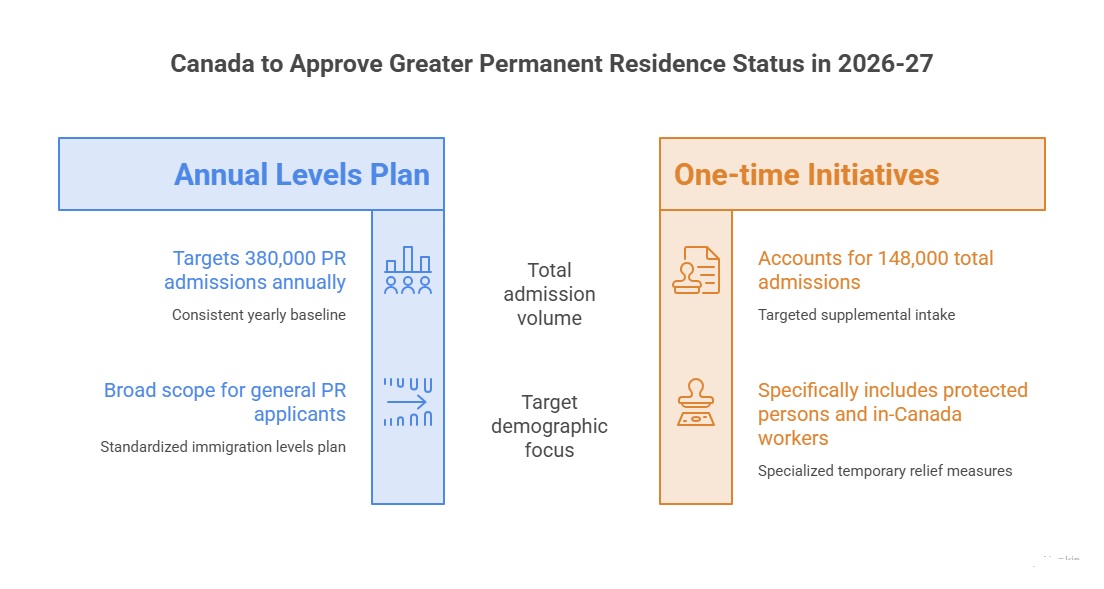
Canada’s latest update provides greater clarity on its permanent residence admission targets for 2026 and 2027. While the levels plan sets the annual PR admission target at 380,000, this figure does not include admissions through two one-time initiatives for protected persons and in-Canada workers.
Together, the government plans up to 908,000 PR admissions over 2026 and 2027, averaging 454,000 admissions annually. By May 2026, Canada had already admitted 128,000 PRs, with one-time initiatives accounting for approximately 14.4% of the total.
The table below highlights the estimated Canada permanent residence (PR) approval across the upcoming 2 years:
|
Category |
2026 |
2027 |
Total for 2026–2027 |
|
Levels plan PR admissions |
3,80,000 |
3,80,000 |
7,60,000 |
|
Protected persons through one-time initiative |
Up to 46,000 |
Up to 69,000 |
Up to 115,000 |
|
In-Canada workers through one-time initiative |
Up to 20,000 |
Up to 13,000 |
Up to 33,000 |
|
Total planned PR admissions |
Up to 446,000 |
Up to 462,000 |
Up to 908,000 |
|
PRs admitted by May 2026 |
1,28,000 |
— |
— |
Also, read...
Ontario Introduces New Scoring System for Three Canada PR Pathways. Check Your Eligibility!
How to apply for Canada permanent residence from India?
Canada PR applicants from India must first identify the immigration pathway that best matches their profile. To apply for permanent residence in Canada you need to complete the required eligibility, documentation, and application steps.
The steps to apply for Canada PR for Indians are as follows:
Step 1: Check your eligibility by reviewing your age, education, work experience, language proficiency, funds, and other requirements to determine which Canada PR pathway may be suitable for you.
Step 2: Select the most suitable immigration program, such as Express Entry, Provincial Nominee Programs(PNPs), or other economic immigration pathways, based on your profile.
Step 3: Complete an approved English or French language test (IELTS, OET, etc) and obtain the required test results for your chosen immigration program.
Step 4: Obtain an Educational Credential Assessment (ECA) to verify that your foreign education is equivalent to Canadian standards.
Step 5: Create an online profile for the relevant immigration pathway and provide accurate information about your education, work experience, language skills, and other qualifications.
Step 6: Upon receiving an invitation to apply (ITAs), submit your complete permanent residence application along with the required documents and fees.
Step 7: Complete medical examinations, police clearance requirements(PCC), biometrics, requested by the Canadian immigration authorities.
Step 8: Once your PR application is approved, settle in Canada with a permanent residence status.
*Are you looking for step-by-step assistance with Canada immigration? Contact Y-Axis, the world's No. 1 overseas immigration consultancy.
For recent Canadian immigration updates, check out the Y-Axis Canada Immigration News Page.
FAQs
What is Canada’s annual PR admission target for 2026 and 2027?
Canada has set an annual target of 380,000 permanent residence admissions for both 2026 and 2027 under its levels plan. However, these figures do not include admissions through two one-time initiatives for protected persons and in-Canada workers. When these additional admissions are included, Canada’s total planned PR admissions for 2026 and 2027 could reach up to 908,000.
How many PR admissions does Canada plan for 2026 and 2027 combined?
Canada plans to admit 380,000 permanent residents annually under the levels plan for both 2026 and 2027. In addition, up to 115,000 protected persons and 33,000 in-Canada workers could receive PR through two one-time initiatives. This brings the total planned PR admissions for 2026 and 2027 to up to 908,000, averaging 454,000 admissions annually.
What are Canada’s one-time PR initiatives?
Canada’s one-time initiatives provide additional permanent residence admissions for protected persons and certain in-Canada workers. These admissions are separate from the annual PR targets outlined in the levels plan. The government has planned up to 115,000 admissions for protected persons and 33,000 admissions for in-Canada workers over 2026 and 2027, increasing the overall number of planned PR admissions during this period.
How many PRs had Canada admitted by May 2026?
Canada had admitted 128,000 permanent residents by May 2026, according to the government’s latest data. PR admissions through the one-time initiatives accounted for approximately 14.4% of the total admissions during this period. The government’s new webpage provides a monthly breakdown of admissions under the levels plan and the two one-time initiatives for greater transparency.
How many protected persons could receive PR through the initiative?
Canada could grant permanent residence to up to 115,000 protected persons through the one-time initiative over 2026 and 2027. By May 2026, 9,300 protected persons had already received PR, representing 20% of the annual target of 46,000 admissions. These admissions are separate from the annual levels plan target of 380,000 PR admissions.
How many in-Canada workers could receive Canadian PR?
Up to 33,000 in-Canada workers could receive permanent residence through the one-time initiative over 2026 and 2027. By May 2026, 9,100 in-Canada workers had received PR, representing 46% of the annual target of 20,000 admissions. These admissions are not included in the 380,000 annual PR admission target under the levels plan.
What is the total number of planned PR admissions for 2026 and 2027?
Canada’s planned PR admissions for 2026 and 2027 total up to 908,000. This includes 760,000 admissions under the levels plan, along with up to 115,000 protected persons and 33,000 in-Canada workers admitted through two one-time initiatives. The combined figure averages approximately 454,000 permanent residence admissions per year during the two-year period.
Can in-Canada workers apply for Canadian permanent residence?
Eligible in-Canada workers may qualify for Canadian permanent residence through various immigration pathways, depending on their work experience, occupation, language ability, education, and other factors. Canada has also included additional PR admissions for in-Canada workers under a one-time initiative for 2026 and 2027. Applicants should assess their eligibility for the available PR pathways.
What is the Parents and Grandparents Program PR update?
Canada closed the door to new Parents and Grandparents Program (PGP) PR sponsorship applications on July 15, 2026, with 50,900 applications already in inventory. Under the levels plan, PR admissions through the Parents and Grandparents Program are set at 15,000 annually for 2026, 2027, and 2028. Applicants should monitor future government announcements for any new intake updates.
How can I apply for Canadian permanent residence?
To apply for Canadian permanent residence, first identify an immigration pathway that matches your profile and check its eligibility requirements. You may need to complete a language test, obtain an Educational Credential Assessment (ECA), create an immigration profile, and submit a PR application if invited. The required steps and documents vary depending on the immigration program you choose.
Tags:
Canada Permanent Residence
Canad PR
Canada immigration news
migrate to Canada
Canada immigration
international professionals in Canada
Express Entry
Provincial Nomination Program
Canada PNP
Educational Credential Assessment
Share
Options for you by Y-Axis

Get it on your mobile

Get News alerts

Contact Y-Axis
Latest Article
Related Post
Trending Article

Posted On October 15 2026
India-Switzerland Mobility Pact Opens New Work, Study and Travel Opportunities for Indians. Check Your Eligibility!