


Posted on April 02 2026
Canada Introduces Eight Major Immigration Changes from April 1, Impacting PR Applicants and Newcomers. Check Your Eligibility Now!

By , Editor
Updated April 02 2026
Highlights: Canada Announces Eight Major Immigration Changes for PR Applicants in 2026
- Canada has announced eight changes in its immigration policies for new PR applicants.
- The latest Canadian permanent residency rules are set to affect new PR applications effective from April 1.
- Under the updated policies, the Canada PR and citizenship fees are revised along with minimum income requirements for the super visa programs.
- The Canadian provinces and territories (PTs) will now have greater authority over PR selection based on the applicant’s intent to settle and establish economic ties.
- Foreign nationals can now also obtain work permits in rural areas through the Temporary Foreign Worker Program.
*Want to apply for a Canada PR? Let Y-Axis guide you with the process.
Top 8 Canada Permanent Residence (PR) changes in 2026
Canada recently introduced several measures affecting PR pathways and application statuses in April 2026. The federal government in Canada has announced eight major changes to immigration policies that will directly affect PR applications this year.
The newly updated policies for Canada PR application in 2026 are as follows:
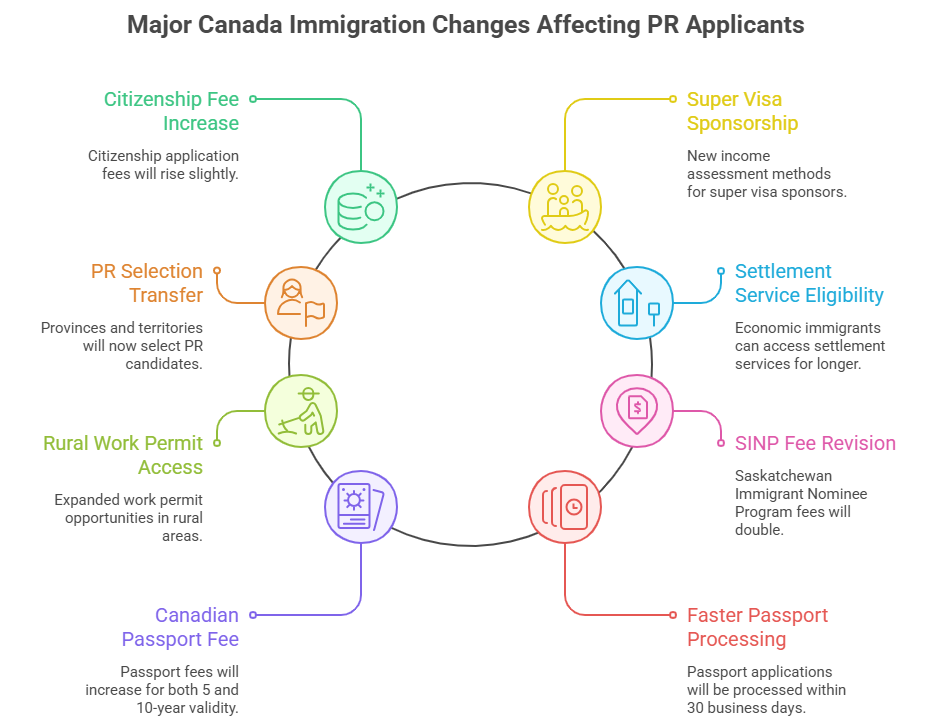
- Updated Citizenship and Canada PR application fee: The right-of-citizenship fee will increase by $3.25, from $119.75 to $123, and is revised annually.
- New income requirements for Canada super visa sponsorship: Sponsors (Canada PR holders) of super visa for parents/grandparents can meet the minimum income requirements through two new ways (extended income assessment and co-signer supplementing the host's income).
- PR selection authorities transferred to PTs: The federal government transferred PR selection authorities to the provinces and territories, enabling them to assess candidates independently.
- Changes to settlement service eligibility: Economic immigrants can access federally funded settlement services for up to six years after obtaining permanent resident status.
- Access to work permits in rural areas expands: Foreign nationals seeking jobs under the low-wage stream of the Temporary Foreign Worker Program (TFWP).
- Revised Saskatchewan Immigrant Nominee Program (SINP) fee: Applicants under Saskatchewan's worker immigration streams will have to pay an application fee of $500, up from $250.
- Revised Canadian passport fee: Increase in the fee for Canadian passports from $160 to $163.50 for 10-year validity, and from $120 to $122.50 for 5-year validity.
- Faster processing of Canadian passports: Canada has set a rule that passport applications will be processed within 30 business days or delivered free of charge.
Also, read...
Canada Introduces New PNP Rule: Provinces Get Full Authority Over PR Selection
How will the new Immigration Rules in Canada affect Foreign Nationals?
The latest PR rule changes occurring between March 31 and April 1, 2026, will affect foreign nationals in the following ways:
- Faster visa and passport processing will streamline immigration pathways.
- Revised settlement eligibility for up to 6 years will help newcomers use settlement services more effectively.
- Securing a provincial nomination certificate will carry greater weight in the PR selection process.
- A work permit through the Temporary Foreign Worker Program will encourage the hiring of more temporary foreign workers in rural areas.
- Alternate pathways to meet income requirements for sponsoring a Super Visa for parents/grandparents.
- The updated fee structure will provide better clarity of cost expectations.
- Travel flexibility through a 30-business-day passport processing guarantee.
*Are you looking for step-by-step assistance with Canada immigration? Contact Y-Axis, the world's No. 1 overseas immigration consultancy.
For recent Canadian immigration updates, check out the Y-Axis Canada Immigration News Page.
FAQs
What are the new immigration changes introduced by Canada from April 1, 2026?
Canada introduced eight immigration changes effective April 1, 2026, including updated citizenship fees, faster passport processing timelines, revised settlement service eligibility, and changes to administrative costs. These updates aim to improve efficiency, transparency, and service delivery for foreign nationals planning to immigrate, work, or settle in Canada.
Who will be affected by the April 1, 2026 immigration changes in Canada?
The new changes primarily affect foreign nationals, permanent residents, and individuals applying for Canadian citizenship or immigration services. Newcomers, economic immigrants, and future citizens may experience updated processing timelines, revised fees, and modified access to settlement services under Canada’s latest immigration policy adjustments.
Will immigration application fees increase under the new rules?
Yes, certain immigration and citizenship-related fees have been updated effective April 1, 2026. Applicants planning to apply for permanent residence or citizenship should review the revised fee structure before submitting applications. These updates aim to align service costs and improve processing efficiency across Canada’s immigration system.
What is the new passport processing rule introduced by Canada?
Canada introduced a 30-business-day passport processing guarantee starting April 1, 2026. If passport applications are not processed within this timeframe, eligible applicants may receive a refund of passport processing fees. This change aims to improve service efficiency and reduce waiting times for new Canadian citizens.
How long can new permanent residents access settlement services?
Under the new rules, economic immigrants can access federally funded settlement services for up to six years after obtaining permanent residence. This defined timeline encourages newcomers to use language training, employment assistance, and integration programs early in their settlement journey.
Will these changes impact new PR applicants?
Yes, new permanent residence applicants may experience updated processing timelines, fee structures, and service access policies. While some changes involve revised costs, they also introduce improved service standards and more structured immigration processes for individuals planning to settle in Canada.
Are these immigration changes beneficial for foreign nationals?
Yes, many of the changes focus on improving processing efficiency, faster service delivery, and clearer timelines. Foreign nationals may benefit from better planning opportunities, improved transparency, and enhanced immigration services designed to support smoother transitions to living and working in Canada.
Do the new rules affect Canadian citizenship applicants?
Yes, individuals applying for Canadian citizenship may see updated fees and improved processing commitments. Additionally, new citizens will benefit from faster passport processing guarantees, which provide greater convenience and improved travel flexibility after receiving Canadian citizenship.
Why did Canada introduce these immigration changes?
Canada introduced these changes to modernize immigration services, improve efficiency, and better manage growing immigration demand. The updates also aim to enhance transparency, reduce delays, and provide a more structured immigration system for foreign nationals moving to Canada.
When did the new Canadian immigration rules come into effect?
The new immigration changes came into effect on April 1, 2026. Applicants planning to immigrate, apply for citizenship, or access settlement services after this date should review the updated rules to understand how these changes may impact their immigration plans.
Tags:
Canada immigration
migrate to Canada
work in Canada
Canada work permit
Canada work visa
Canada right of citizen fee
Provincial Nomination Program
Canada PR
Canada super visa
Canada immigration news
Share
Options for you by Y-Axis

Get it on your mobile

Get News alerts

Contact Y-Axis
Latest Article
Related Post
Trending Article
Posted On April 02 2026
Canada Introduces Eight Major Immigration Changes from April 1, Impacting PR Applicants and Newcomers. Check Your Eligibility Now!