


Posted on February 20 2026
Canada's Express Entry Adds 3 New Occupations for PR Visa. Check Your Eligibility Now!

By , Editor
Updated February 21 2026
Highlights: Canada Adds Three New Express Entry Categories for 2026
- Canada has updated its Express Entry System for 2026 by prioritizing new occupational categories and attracting foreign skilled workers to labor-shortage sectors.
- The professions prioritised under the revised Express Entry policies include researchers, healthcare specialists, aviation experts, and select military recruits.
- Targeted immigration streams for the Express Entry program now include highly skilled foreign military professionals, doctors, nurses, and pilots.
- The country has decided to increase its defense expenditure to 5% of GDP by 2035 to strengthen military security and expand workforce capacity.
- Total defense and research investment in Canada will rise by 85%, with up to 125,000 new defense-related jobs in the coming years.
*Want to check your eligibility for Canada? Try the FREE Y-Axis Canada CRS points calculator to get an instant score!
Canada’s Latest Reforms for the Express Entry System in 2026 Target Defence, Healthcare, and Aviation Talent
Canada has announced new Express Entry categories for 2026, prioritizing specific fields such as defense, healthcare, and aviation to meet workforce demand. The recent policies reflect the country’s strategy to align immigration selection with labour market demands while balancing Canada PR admissions at sustainable levels.
The revised Express Entry program mainly focuses on categories such as research, healthcare, aviation, and defence, outlining Canada’s intention to strengthen its defence sector. The country plans to increase its defense spending to 5% of GDP and research and development investment by 85%, by 2035. The updated policies also aim to create 125,000 new defence-related jobs over the next decade.
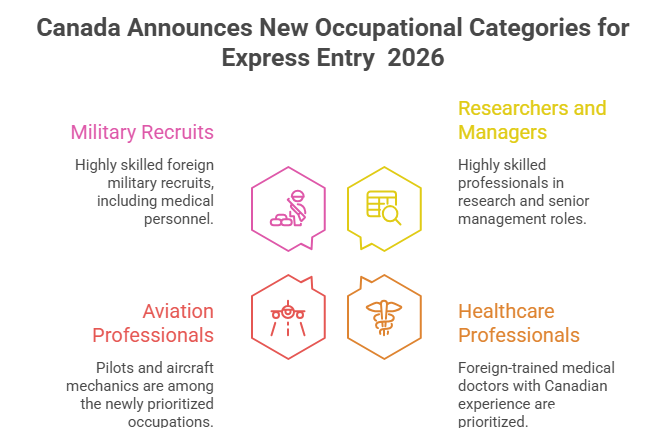
Occupations prioritised under Express Entry 2026:
- Researchers and senior managers
- Healthcare professionals, including foreign-trained medical doctors with Canadian experience
- Aviation professionals such as pilots and aircraft mechanics
- Highly skilled foreign military recruits, including military doctors, nurses, and pilots.
*Want to apply for Express Entry? Let Y-Axis guide you with the process.
List of New Occupations Added to the Express Entry System in 2026
Canada has announced new occupation-based categories for the Express Entry System in 2026. These additions reflect the country’s intention to prioritize professionals who can better support Canada’s economy and boost the workforce in critical sectors. The categories mainly include leadership roles, academic research, transport expertise, and specialized military talent.
According to recent policies, candidates must have at least 1 year of Canadian work experience within the last 3 years to be eligible to apply for the listed occupations under the category-based selection. The new categories will operate in parallel with existing priority streams, which are healthcare, French-language proficiency, and skilled trades.
The table below highlights the newly introduced categories in the Express Entry System for 2026:
| Category | Occupations | NOC Code |
|---|---|---|
| Senior Management | Senior managers in construction, transportation, production and utilities | NOC 00015 |
| Senior Management | Senior managers in trade, broadcasting and other services | NOC 00014 |
| Senior Management | Senior managers in health, education, social and community services | NOC 00013 |
| Senior Management | Senior managers in financial, communications and business services | NOC 00012 |
| Research | University professors and lecturers | NOC 41200 |
| Research | Post-secondary teaching and research assistants | NOC 41201 |
| Military | Commissioned officers of the Canadian Armed Forces | NOC 40042 |
| Military | Specialized members of the Canadian Armed Forces | NOC 42102 |
| Military | Operations members of the Canadian Armed Forces | NOC 43204 |
| Transport and Aviation | Air pilots, flight engineers and flying instructors | NOC 72600 |
| Transport and Aviation | Aircraft mechanics and inspectors | NOC 72404 |
| Transport and Aviation | Automotive service technicians, truck and bus mechanics | NOC 72410 |
| Transport and Aviation | Aircraft instrument, electrical and avionics mechanics and technicians | NOC 22313 |
Also, read…
Canada launched New Express Entry Stream for Healthcare Doctors. Apply Now!
How will the Latest Express Entry Changes Affect Indian Applicants in 2026
Recent updates to the Express Entry System highlight Canada’s focus on skill-based immigration. While the total number of permanent residents in Canada is monitored to minimise pressure on housing and public services, the country continues to invite qualified immigrants to help stabilise the workforce. This is likely to create greater opportunity and urgency among Indian applicants for Canada PR. If your profession falls under the new categories or existing priority streams, this could significantly improve your chances of selection through category-based draws.
Things to keep in mind while applying:
- You must have at least 1 year of Canadian work experience in a qualifying profession in the last 3 years.
- You still need to qualify under programs like the Federal Skilled Worker Program, Canadian Experience Class, or Federal Skilled Trades Program.
- A high CRS score is integral for competitive category-based draws.
- Key sectors include Healthcare, French-language proficiency, skilled trades, with newly introduced leadership, research, defence, and aviation roles.
- Keep your IELTS scores, ECA, and other documents up to date to meet the eligibility criteria for the draws.
*Are you looking for step-by-step assistance for Canada immigration? Contact Y-Axis, the world’s No. 1 overseas immigration consultancy, for end-to-end support!
For recent immigration updates on Canada, check out Y-Axis Canada Immigration News page!
FAQs
What changes has Canada announced to the Express Entry system in 2026?
Canada has introduced new priority categories under the Express Entry system to attract skilled professionals in critical sectors such as research, healthcare, aviation, and defence. The updates also include certain highly skilled foreign military recruits, including doctors, nurses, and pilots joining the Canadian Armed Forces. These changes aim to better align immigration selection with Canada’s labour market needs while managing overall permanent resident admissions. The government has clarified that existing categories, such as healthcare, skilled trades, and French-language proficiency, will continue alongside the newly introduced targeted streams.
Why is Canada adding military and defence-related roles to Express Entry?
Canada’s decision to include military and defence-related roles under Express Entry aligns with its broader national strategy to strengthen defence capabilities and reduce reliance on external partners. By attracting highly skilled foreign military professionals, including medical personnel and aviation specialists, Canada aims to enhance its workforce readiness in critical sectors. The move supports long-term plans to increase defence research, investment, and job creation. These changes reflect Canada’s focus on building a self-reliant, skilled workforce that can contribute to national security, innovation, and essential public services from the first day of arrival.
Which occupations are included in the new Express Entry priority categories?
The newly introduced Express Entry categories include researchers, senior managers, aviation professionals such as pilots and aircraft mechanics, and foreign-trained medical doctors with Canadian work experience. In addition, highly skilled foreign military recruits, including military doctors, nurses, and pilots, are now part of the targeted selection. These occupations have been identified as critical to Canada’s economic growth and public service needs. By prioritizing these roles, the government aims to address labour shortages in essential industries while ensuring that newcomers possess the skills required to integrate quickly into the Canadian workforce.
Will Canada continue regular Express Entry draws after these changes?
Yes, Canada will continue conducting invitation rounds under existing Express Entry categories. Candidates with French-language proficiency, healthcare experience, and skilled trades backgrounds will still be considered in category-based and general draws. The newly introduced streams will operate alongside these existing categories rather than replacing them. This ensures that skilled workers across various sectors continue to have opportunities to receive Invitations to Apply for permanent residency. The government’s objective is to balance targeted recruitment in priority sectors with broader economic immigration goals while maintaining a structured and transparent selection process.
How do these changes impact overall Canada PR targets?
The government has indicated that the new Express Entry categories are part of a broader plan to restore immigration levels to more sustainable numbers. While Canada continues to welcome skilled professionals, it is also adjusting permanent resident targets to ease pressures on housing and social infrastructure. The focus is now on selecting candidates who can immediately contribute to critical sectors rather than increasing overall intake numbers. This means immigration remains a key pillar of economic growth, but with a stronger emphasis on workforce alignment, sector-specific needs, and long-term sustainability.
Are healthcare professionals still a priority under Express Entry?
Yes, healthcare professionals remain a key priority under Canada’s Express Entry system. In fact, the 2026 updates reinforce the importance of medical and health-related roles, including foreign-trained doctors with Canadian experience and military medical personnel. Canada continues to face labour shortages in healthcare across several provinces, making this sector vital for category-based draws. Candidates with relevant qualifications, work experience, and language proficiency may benefit from targeted selection rounds. Healthcare remains one of the most consistent and in-demand fields under Canada’s economic immigration strategy.
What does this mean for foreign workers planning to apply through Express Entry?
Foreign workers should carefully assess whether their occupation falls under the newly introduced priority categories or existing targeted streams. Those with experience in research, aviation, healthcare, or defence-related fields may see improved opportunities in category-based draws. However, meeting eligibility criteria under programs such as the Federal Skilled Worker Program, Canadian Experience Class, or Federal Skilled Trades Program remains essential. Applicants must still maintain competitive Comprehensive Ranking System scores and valid documentation. The changes highlight the importance of aligning one’s professional profile with Canada’s evolving labour market priorities.
How does Canada select candidates under category-based Express Entry draws?
Under category-based selection, Canada invites candidates who meet specific criteria linked to identified priority occupations or language abilities. Eligible candidates must first qualify under one of the federal economic programs managed by Express Entry and enter the candidate pool. The government then conducts targeted draws focusing on selected sectors, inviting those with relevant experience and competitive Comprehensive Ranking System scores. This approach allows Canada to address labour shortages more efficiently while maintaining transparency in the selection process. Category-based draws operate alongside general and program-specific invitation rounds.
Does this update affect French-language or skilled trades candidates?
The recent update does not remove or reduce opportunities for French-language candidates or skilled trades professionals. These categories continue to be part of Canada’s targeted Express Entry draws. French-speaking candidates remain especially important in supporting Canada’s Francophone immigration goals outside Quebec. Similarly, skilled trades workers continue to address workforce gaps in construction, manufacturing, and related industries. The addition of new categories simply expands the focus to include research, aviation, healthcare, and defence sectors, ensuring that immigration supports a broad range of economic priorities.
How can eligible candidates prepare for the new Express Entry categories?
Eligible candidates should begin by confirming their occupation classification and ensuring it aligns with Canada’s National Occupational Classification system. Gathering updated work experience letters, educational credentials, language test results, and other required documents is essential before creating an Express Entry profile. Those in priority sectors such as healthcare, research, aviation, or defence should highlight relevant Canadian or international experience. Maintaining a strong Comprehensive Ranking System score remains important. Staying informed about category-based draw announcements and policy updates will help candidates strategically plan their Canada PR application process.
Tags:
Canada immigration news
Canada immigration
Migrate to Canada
Canada visas
Canada draws
Canada Express Entry draws
Express entry program
latest express entry draws
Canada PR
Canada PR visa
New Express Entry categories
Share
Options for you by Y-Axis

Get it on your mobile

Get News alerts

Contact Y-Axis
Latest Article
Related Post
Trending Article

Posted On April 02 2026
Canada Introduces Eight Major Immigration Changes from April 1, Impacting PR Applicants and Newcomers. Check Your Eligibility Now!